GMS PhD Student Wins Boston University Life Sciences Case Competition, Discovering New Career Paths
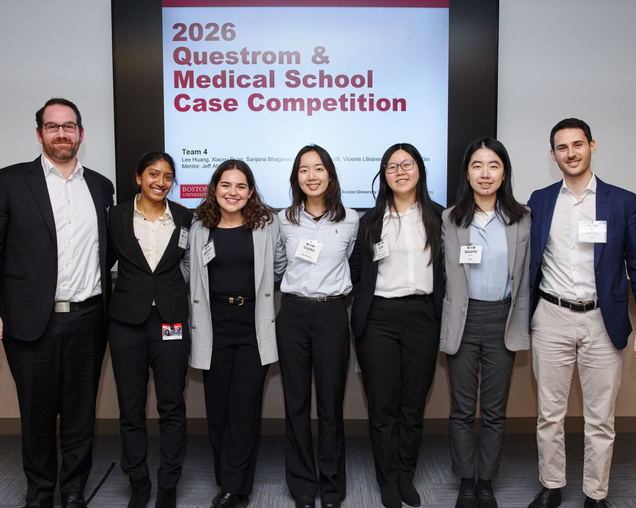
Sanjana Bhagavatula, a third-year PhD student in the Department of Genetics and Genomics, did not expect that participating in a business school case competition would change how she thinks about her future.
After participating in (and winning) the third annual Boston University Healthcare Case Competition in February, however, she discovered that her skills as a scientist extend far beyond the lab.
Hosted by the BU Questrom School of Business, the Chobanian & Avedisian School of Medicine and the College of Engineering, the competition brings interdisciplinary teams together to answer challenging questions bridging life sciences and market strategy. This year’s client was health-tech company Philips.
“I hadn’t heard about this competition until a few weeks before it happened,” Bhagavatula said. “I got an email from [GMS Director of Professional Development Bénédicte Gnangnon, PhD]. I thought, ‘sure; let me just try it out.’”
Bhagavatula, who recently passed her qualifying exam, is completing her PhD research in Dr. Stefano Monti’s computational biology lab, where she analyzes transcriptome profiling data to study aging and cancer.
She saw the competition as an opportunity to explore life sciences consulting as a potential career path, especially having attended several meetings through the BU Consulting Club.
Over two intensive weeks, Bhagavatula’s six-person team worked on a case proposing a plan to boost Philip’s leadership in the cardiac ultrasound market and make diagnostic care more accessible. The team was mentored by Jeff Abraham, Partner at Health Advances.
Preparation for the case competition was rigorous, involving significant research and analysis of public earnings statements from Philips and competitor companies. The team spent upwards of 20 hours preparing their presentation, which they delivered to judges on the 4th floor of the Medical Campus Instructional Building.
Her team won, but the impact of the experience on Bhagavatula extended far beyond the victory. It allowed her to reflect on the transferable hard and soft skills she has that could serve her in multiple fields. Her competition mentor even repeatedly told her team that they were just as qualified as first-year associates arriving to their company from college.
“I think we think of ourselves as very siloed in what we do,” Bhagavatula said. “I’m a scientist, so it feels like, ‘Oh, well, you can’t look into the business stuff. That’s not meant for you.’ But that was so far from the truth.”
Bhagavatula’s key takeaway is that your career does not have to follow one path.
“[I gained] just general confidence that you don’t have to go into exactly the same thing you studied,” she said. “Learning is continuous, and it can be in different directions.”
For other graduate students considering trying something outside their field, Bhagavatula has simple advice: “Just apply. Even if you think it’s not for you, even if you update your resume for the first time in years… try it. You might surprise yourself.”
** Bhagavatula and her participation in Boston University Life Sciences Case Competition highlight how BU is embracing convergent interdisciplinary collaboration and research across the University in response to the recent BU Task Force on Convergence (see The Brink March 13)