Early-Career Faculty Resources
The Associate Dean of Research ad interim, hosted a series of listening sessions with early-career faculty to promote open dialogue and strengthen collaboration across BU’s research community. These sessions were designed to familiarize participants with the wide range of research resources available at the BU Medical Campus.
Together, these resources outline how to find key funding opportunities and support mechanisms available to early-career faculty navigating today’s evolving research funding landscape by connecting them with institutional expertise and support, including:
BU Federal Relations
BU Federal Relations helps early-career faculty understand the federal landscape, identify funding opportunities, and build visibility for your work in Washington, DC.
What We Do
Advocacy
Advocate for BU’s priorities as the federal government considers policies that affect research universities, higher education, and innovation.
Funding Insights & Support
Help BU faculty and researchers navigate the federal funding landscape and stay ahead of emerging opportunities. Resources include:
- One-on-one consultations
- Early-career funding roadmaps
- Proposal library
- Federal agency primers
- Campus workshops
- Beltway BUzz newsletter
Profile-Raising & Engagement
Share BU’s expertise with policymakers and increase the university’s visibility at the national level. Resources include:
- Advocacy guides
- Capitol Hill events
- One-on-one meetings with policymakers
Stay Informed
Keep up to date as new regulations, proposed budget cuts, and executive orders emerge. Learn more:
Start a Conversation
Interested in funding support, policy engagement, or advocacy opportunities? We’re here to help.
Jennifer Grodsky, Vice President for Federal Relations
grodsky@bu.edu | (202) 393-7272
Jessica Wong, Director for Federal Relations
wongjk@bu.edu | (202) 393-7272 | Office Hour Available
BACK TO TOP↑
Foundation Relations
Foundation Relations supports faculty and researchers in identifying, cultivating, and securing funding from private foundations. Because foundations are highly individualistic and mission-driven, successful proposals require a tailored and strategic approach.
Understanding Foundation Funders
Foundation funders typically:
- Have distinctive missions and grant-making priorities.
- Seek to play a unique role in advancing a project or researcher’s career.
- Favor innovative and sometimes higher-risk ideas.
- Are led by passionate individuals who may not be technical experts.
- Announce opportunities through Requests for Proposals (RFPs).
Funding Norms
- Awards typically range from $100,000–$500,000 over one–four years. Awards over $1M are less common.
- Typical F&A/IDC rates: 0–20%.
- BU accepts a foundation’s published F&A rate.
Applications typically involve two stages:
- Letter of Intent (LOI) or Concept Paper: Two-three pages to introduce the project and PI. The goal is to briefly communicate what need or gap the project addresses, how you will carry it out, and how your work advances the foundation’s mission.
- Full Proposal: Detailed overview of the project aims, plan and methods, budget, and outcomes. Review may involve foundation staff, advisory boards, lay reviewers, or trustees.
How We Support You
Find: Identify foundation funders and grant programs aligned with your research.
- Assess funding needs across schools, departments, and individual researchers.
- Search databases and bulletins for foundation opportunities of $100,000 or more.
- Share opportunities through department chairs and direct outreach.
- Maintain tables of funding opportunities by discipline.
Cultivate: Help you build relationships and position your work.
- Provide guidance on outreach to foundation staff.
- Support in understanding funder priorities and culture.
- Connect you to colleagues with experience working with specific foundations.
- Identify of potential internal or external advocates.
Solicit: Assist you in preparing competitive applications.
- Coordinate with Proposal Development.
- Collect of institutional information and required documents.
- Provide example of successful proposals through BU’s Successful Proposal Library.
- Edit proposals for clarity, accessibility, and alignment with guidelines.
- Identify critical readers to provide feedback on your proposal.
Foundation Relation Resources
- Early Career Roadmaps: In partnership with Federal Relations, we create a detailed list of early career funding opportunities open to you over the next 10 years. The list is tailored to your research and goals and indicates which years you will be eligible to apply for each opportunity. To request an Early Career Roadmap, please complete this form, and a member of our team will follow up to schedule a meeting.Meet the Funder Events: Foundation Relations invites foundation program officers to discuss their funding priorities and upcoming opportunities. These events give you the chance to connect directly with foundation representatives and awarded BU faculty, ask questions about grant programs, and learn about the grant application process.
- Successful Proposal Library: A curated repository of proposals with more than 100 successful letters of intent (LOIs), proposals, and related application materials. You can browse the contents to find insight on how to structure and format your proposal, what level of detail to provide, and how to speak to foundation priorities.
- Red Team Reviews: In partnership with the Office of Research, the FR team organizes structured internal reviews for high-value ($500,000+) and prestigious proposals. We identify two expert reviewers (e.g. past awardees, field experts) who will provide written feedback and attend a 1-hour meeting with you and FR to discuss actionable steps to improve your proposal.
How to Get Started
Contact Senior Director of Foundation Relations David Gillerman at dgillerm@bu.edu or Assistant Director Foundation Relations Sophie Reilly at sreilly3@bu.edu to discuss your research interests, funding goals, and timeline. Starting the conversation early helps strengthen proposals and improve funding outcomes.
For more information about the services and resources available, visit the Foundation Relations website.
BACK TO TOP↑
Proposal Development Office
The
Proposal Development Office (PDO) was established to provide technical and skilled administrative support to principal investigators developing grant and contract proposals for external funding.
Supporting Your Research from Concept to Submission
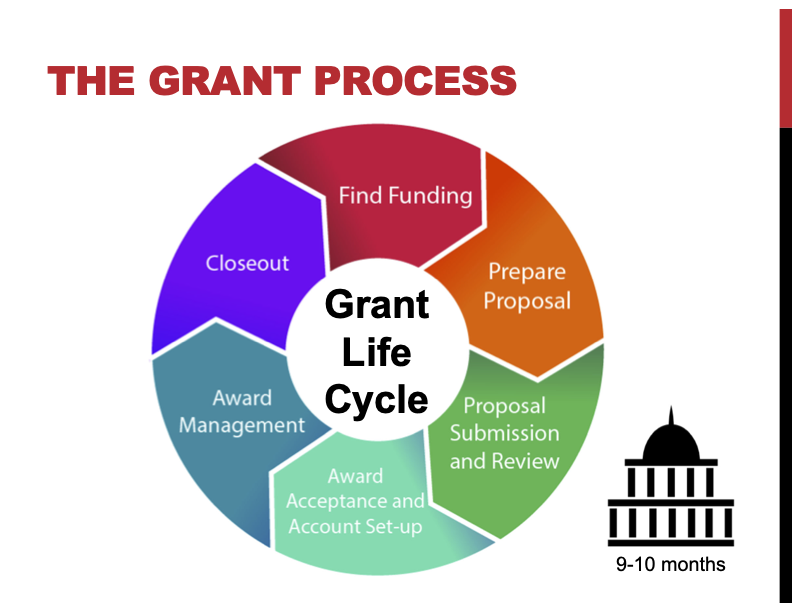
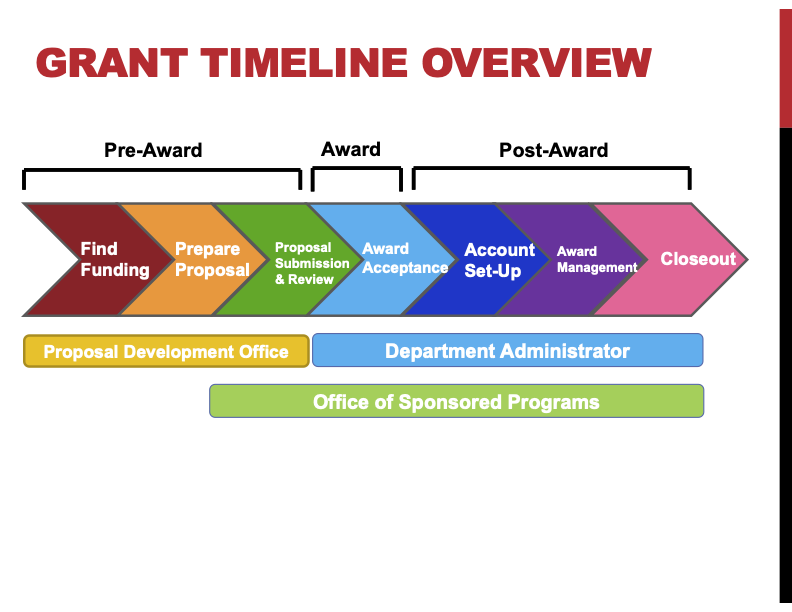
Identify Funding Opportunity
PDO can help you with:
- Funding fit & eligibility assessment.
- Budget development.
- Institutional approvals.
- Identifying collaborators and subcontracts.
- Representation during pre-award (OSP / Sponsor).
- Navigation of grant application systems.
Budget Development
PDO will manage full budget development, including:
- Personnel
- Supplies
- Animals
- Travel
- Other Direct Costs
- Direct Costs
- Modified Total Direct Costs (MTDC)
Grant Components
Scientific Components
- Abstract
- Narrative
- Research Strategy
- Specific Aims
- References
- Introduction (re-submission)
- Biosketch
- Candidate Information
- Goals (K&F grants)
Administrative Components
- Budget, Justification, Facilities & Resources, Equipment, Authentication of Key Biological and/or Chemichal Resources, Cover Letter and/or PHS assignment Request Form.
- Consortium Agreements, Vertebrate Animals and/or Human subjects, Resource/Data Sharing Plan, Letter of Support, Multiple PI Plan, Select Agent Research, Current/Pending Support (K Grants), Letters of Reference (F Grants).
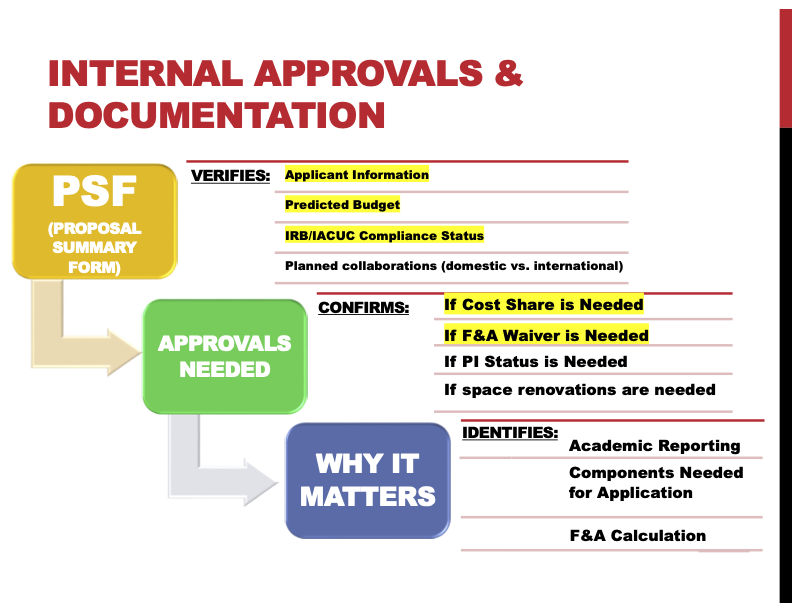
Final Submission Timeline
Notify your Academic Department of intent to submit one month prior to the deadline.
OSP Deadlines (Business Days Before Sponsor Deadline)
| 10 days |
PSF, budget, justification, biosketches (PI & collaborators) |
9/23 |
| 5 days |
All final administrative components |
9/30 |
| 3 days |
Final proposal due |
10/2 |
Tips, Tricks & Helpful Links
1. It’s a Team Effort
- PI: Scientific writing
- PDO: Grant writing, budget development, administrative support
- OSP: Final review and submission
2. Plan Ahead
- Subcontracts, mentors, consultants, collaborators, or multi-PI proposals require additional paperwork
- Ensure your department is aware of the submission
3. Discuss with Colleagues
- Department (Chief/Chair) approval is required before OSP submission.
Especially important for:
- Cost sharing.
- Additional research space, etc.
- Your colleagues are your best resources
4. Helpful Links
PDO Website
OSP Website
NIH CSR Videos
Contact
Julia Huntsman, PDO Director
jhunts@bu.edu |
BACK TO TOP↑
Alumni Medical Library
See our resources for self-guided research, or contact a librarian for assistance.
Research Self-Help
Librarian Assistance
BACK TO TOP↑