Researchers Develop Two-Step Approach to More Accurately Detect Tau in Uncertain Alzheimer’s Diseases Prognosis
Photo by Shubham Dhage on Unsplash.
Alzheimer's disease
Researchers Develop Two-Step Approach to More Accurately Detect Tau in Uncertain Alzheimer’s Diseases Prognosis
“Better testing should help patients and families get reliable information sooner and make more informed decisions about treatment, research participation and planning for the future.”
Blood-based biomarkers (BBMs) are revolutionary blood tests that can detect Alzheimer’s disease (AD) brain changes earlier, cheaper and more easily than traditional methods such as Aβ-PET scans which are expensive and have limited accessibility. However, blood tests do not always give a clear yes-or-no answer. One of the most promising blood markers, called p-Tau217, can leave a substantial number of people with an uncertain diagnosis. Patients within this “gray zone” may need an expensive brain scan or other testing to determine whether amyloid, a key feature of Alzheimer’s disease, is present.
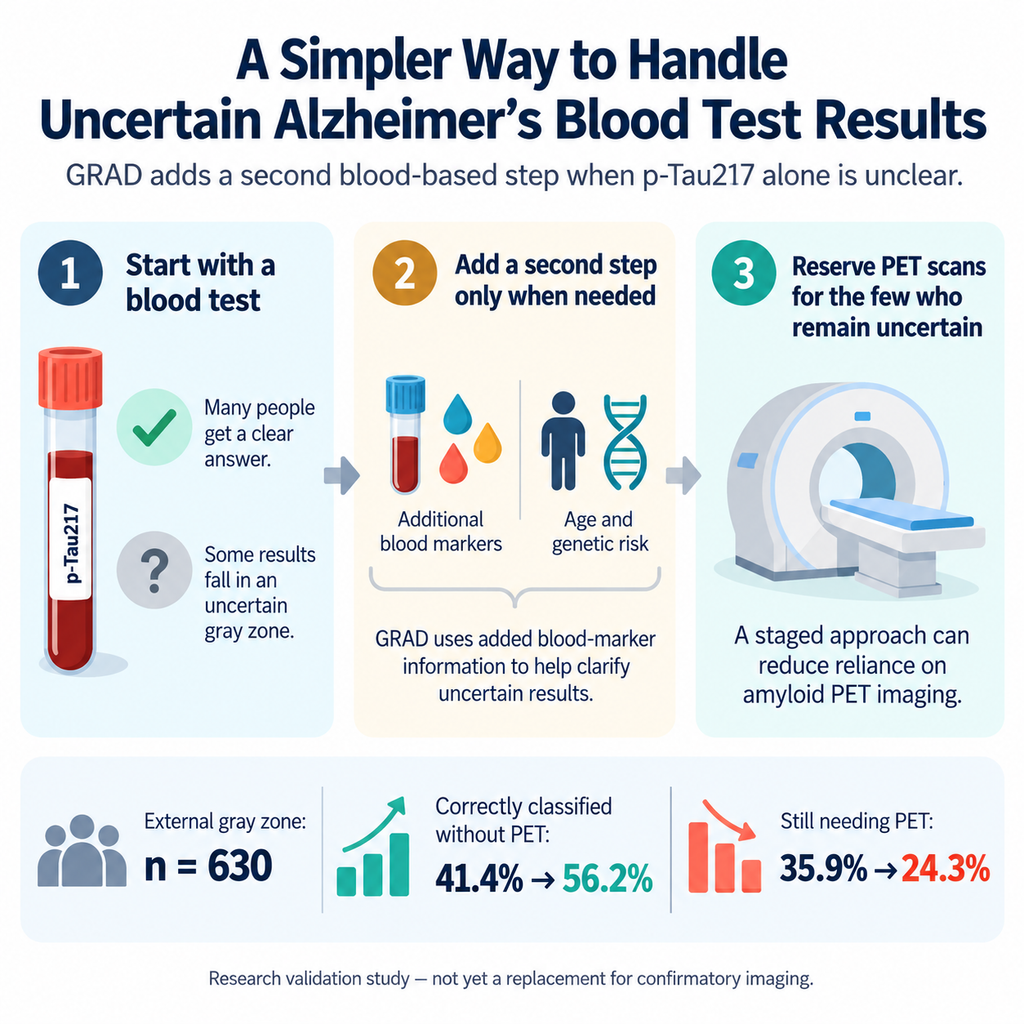
To address this problem, researchers at Boston University Chobanian & Avedisian School of Medicine and the University of Connecticut have developed and tested a two-step approach called Gatekeeper‐Reflex model for AD (GRAD)—a step-by-step blood-testing strategy that could resolve many of these uncertain results. While promising, the researchers caution that GRAD is not ready to replace confirmatory imaging and still needs to be tested prospectively before use in routine clinical care.
“GRAD does not try to replace a good Alzheimer’s blood test. Instead, it focuses additional testing specifically on the people for whom the first blood test does not give a clear answer. This creates a practical “test first, investigate further only when needed” approach that more closely resembles how clinicians make decisions in the real world,” explains first author Harthik Parankusham, a student in the department of physiology and neurobiology at the University of Connecticut.
The researchers developed GRAD using data from 145 people with memory or thinking problems who participated in the Alzheimer’s Disease Neuroimaging Initiative. All participants had blood biomarker measurements and an amyloid PET brain scan, which they used as the reference for determining whether amyloid was present. GRAD first looked only at p-Tau217. When that blood test gave a clear result, no additional testing was needed. When the result fell into the uncertain gray zone, the model considered additional blood biomarkers along with factors such as age and genetic risk.
They then tested the same approach in an independent group of 1,644 cognitively unimpaired participants from the A4/LEARN studies. Importantly, this allowed the researchers to test whether the approach still worked in a much larger and clinically different group of people. Among the 630 participants whose p-Tau217 results fell into the gray zone, GRAD improved the ability to identify amyloid and reduced the proportion who would still need PET imaging.
“A more efficient blood-first testing strategy could eventually help clinicians identify which patients need confirmatory testing as part of that evaluation. Additionally, the approach may also be useful for Alzheimer’s prevention and treatment trials, where researchers often need to identify people with brain amyloid from very large groups of potential participants.
Brandon Frank, PhD
 Brandon Frank, PhD
According to the researchers, new disease-modifying treatments require clinicians to determine whether Alzheimer’s-related amyloid is present before treatment is considered. “A more efficient blood-first testing strategy could eventually help clinicians identify which patients need confirmatory testing as part of that evaluation. Additionally, the approach may also be useful for Alzheimer’s prevention and treatment trials, where researchers often need to identify people with brain amyloid from very large groups of potential participants,” adds Brandon Frank, PhD, assistant professor of neurology at BU and clinical neuropsychologist at the VA Boston Healthcare System.
The researchers hope that a blood-first approach can make accurate Alzheimer’s testing easier to reach, so that fewer people need expensive scans or invasive procedures simply to get a clear answer.
Other institutions who participated in this research included: the University of California Irvine; Mass General Brigham; Harvard Medical School and Yale School of Medicine. These findings appear online in the Annals of Clinical and Translational Neurology.