New Child & Adolescent Counseling Program Responds to Pediatric Mental Health Care Crisis
Former U.S. Surgeon General Vivek Murthy, MD, MBA, laid out the crisis in child and adolescent mental health in a 2021 health advisory. “Mental health challenges are the leading cause of disability and poor life outcomes in young people,” he said, “affecting up to 1 in 5 U.S. children ages 3 to 17 with a reported mental, emotional, developmental, or behavioral disorder.”
Only half of adolescents receive the mental health support they need, and one recent survey found that more than 85% of primary care practices, one of the settings where these issues are most frequently encountered, experience significant barriers to accessing adolescent mental health advice and services.
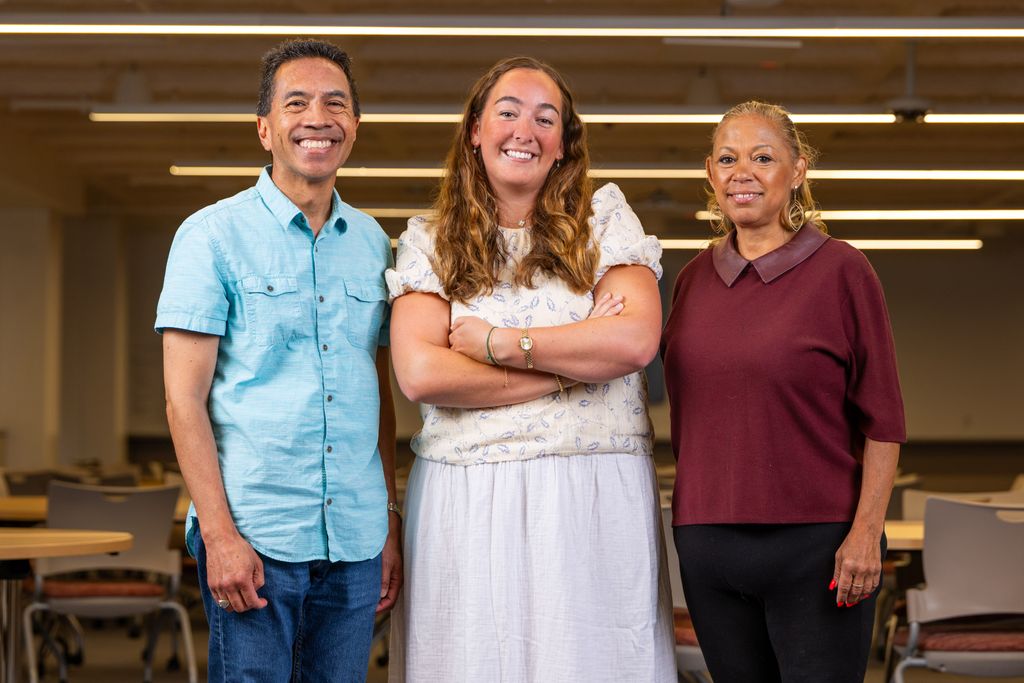 Carryl Navalta, PhD, a clinical associate professor of psychiatry and director of the new Child & Adolescent Integrated Behavioral Health Care Concentration; Alana Nicker, second year mental health counseling & behavioral medicine student; Rachel Levy-Bell, PsyD, a clinical psychologist at BMC and director of the master’s program in Mental Health Counseling & Behavioral Medicine,
“At Boston Medical Center (BMC), we can have a waitlist of approximately 100 children and adolescents needing to be seen…These are the kids who can fall through the cracks,” said Rachel Levy-Bell, PsyD, a clinical psychologist at BMC and director of the master’s program in Mental Health Counseling & Behavioral Medicine at the Chobanian & Avedisian School of Medicine.
Boosting the Number of Pediatric Mental Health Counselors
To bolster the numbers of students entering the field, the counseling & behavioral medicine program, in collaboration with BMC’s TEAM UP Scaling and Sustainability Center, launched a new Child & Adolescent Integrated Behavioral Health Care Concentration this fall. Carryl Navalta, PhD, a clinical associate professor of psychiatry and director of the new program believes it is the nation’s first and only master’s-level specialty track providing comprehensive behavioral health education, clinical training and competency-based preparation for work in pediatric integrated care settings.
Although the most prevalent outpatient model for mental health counseling remains one-on-one therapy, the integrated care model in which the counselor is part of a primary care team has been gaining traction. It’s a model that advocates say expands access and provides preventive care in crucial formative childhood and adolescent years, while improving job satisfaction and lowering burnout rates for providers.
“TEAM UP has developed a model to provide the infrastructure, and the training to make that model work effectively…Our students are being placed on a team of medical providers in a traditional medical setting where they’re learning how to provide behavioral health care in the context of primary care,” said Navalta. Up to 10 of the 40-48 students admitted each year will participate in the concentration.
How Integrated Mental Health Care Works
In the integrated care approach, child and adolescent mental health concerns can be flagged by family members, the child’s school or routine mental health screening at the pediatrician’s office. The primary care provider can then bring in an on-site mental health counselor.
“The parent is hearing this from someone they trust because they’ve been going to that pediatrician’s office, or that pediatrics department at the local community health center for years,” explained Navalta. Because the mental health counselor is located in-house, the child gets seen during the same appointment.
“The minute you let someone walk out that door and ask them to make follow-up phone calls to find mental health support elsewhere, you lose them,” said Sonia Erlich, MA’14, MFA, TEAM UP’s director of workforce development and training. “Many people are not going to take that step because it’s not convenient, because they don’t get a callback, or because a provider doesn’t take their insurance.”
For the past two years, Navalta has collaborated with Erlich and TEAM UP, supported by a federal Health Resources and Services Administration (HRSA) grant. The new agreement codifies that relationship, and builds on the experience of TEAM UP, which began developing a pediatric integrated behavioral health model with Massachusetts-based federally qualified community health centers in 2015 and has since expanded to 14 pediatric practices in Massachusetts and beyond.
“In terms of prevention, access to care and destigmatizing mental health conditions, integrated models can make a big difference,” said Emily Feinberg, ScD, MSc, MSN, senior director of TEAM UP and an adjunct professor of pediatrics at the Chobanian & Avedisian School of Medicine and professor at Brown University School of Public Health.
The TEAM UP Story
Feinberg was one of the founders of TEAM UP, whose mission originated with a request from the Richard and Susan Smith Family Foundation to find a way to bring child and adolescent mental health care to settings that are positioned to help close the access gap. TEAM UP works with practices that serve historically marginalized populations and communities whose mental health is affected by structural and social determinants of health and are less likely to receive mental health services. They use the state-mandated physical exam for children entering school systems, which are also repeated annually, to screen for and address mental health issues. A community health worker on the team plays a vital role, gaining trust with their knowledge of the language and culture of the community.
Levy-Bell has noticed a significant shift in recent years with more incoming students interested in working with children and adolescents. Unfortunately, students can experience significant financial burden due to tuition and Boston’s high cost of living.
“Without financial support, this can force them to choose between completing the concentration and meeting their financial obligations, or to forgo community-based practice for higher-paying private sector positions,” said Navalta.
Financial considerations are a big part of most students’ future plans, said second-year mental health counseling student, Alana Nicker, who is enrolled in the new program.
To help offset that, the Inspirational Futures Foundation, a private grant-making foundation supporting programs that serve children, teens, young adults and families, recently awarded the new mental health concentration a $50,000 grant that provides $10,000 stipends each to four students, with the remaining $10,000 for suicide prevention training to cover educational and training fees.
Navalta is hoping that the Inspirational Futures Foundation grant, the new concentration and the integrated team approach will result in more students entering and remaining in the field. But high caseloads, the complexity of treating young people, the toll of dealing with trauma associated with many of these cases, limited resources and administrative duties contribute to the field’s elevated burnout rate. Working with a team in integrated care helps counter the isolation and administrative burden.
“You can really get caught up in going from patient to patient,” said Nicker. “The (integrated behavioral health care approach) helps you to stay curious, to stay learning.”
The ability to consult with a team can help counter the siloing effect experienced in private practice, Navalta said.
“It’s nice to be able to collaborate with people and learn from them. It’s like a community,” Nicker said.