How an Armenian-American Partnership Is Changing the Way Armenia Teaches Medicine
Master’s of Science in Health Professions Education graduates, attendings and residents teaching at the bedside while BU faculty observe.
Armenia
How an Armenian-American Partnership Is Changing the Way Armenia Teaches Medicine
A program designed by Boston University and HENAR Foundation is turning a single cohort of physician-educators into a nationwide shift toward competency-based medical education, and the ripple is only beginning.
At a teaching hospital in Yerevan this autumn, a clinical scene that looked entirely routine carried something new. A resident presented a case and reasoned through it aloud with faculty; the group moved together to the bedside to examine the patient; and then, instead of dispersing, they paused to talk — not only about the diagnosis, but about how the case had been taught. What set the moment apart was not the medicine, but the method. The session had been designed, led, and critiqued by Armenian physicians who, a year earlier, had set out to master something their own training had never formally offered them: how to teach medicine at the bedside.Those physicians are the first graduates of the Master’s of Science in Health Professions Education (MSHPE) program, a partnership between Boston University Chobanian & Avedisian School of Medicine and HENAR Foundation. Delivered through the Boston University – Armenia Medical Partnership (BU-AMP), the program has recently entered a new, practice-based phase, and representatives of Boston University and HENAR traveled to Armenia to see the results firsthand, at the bedside, where they matter most.
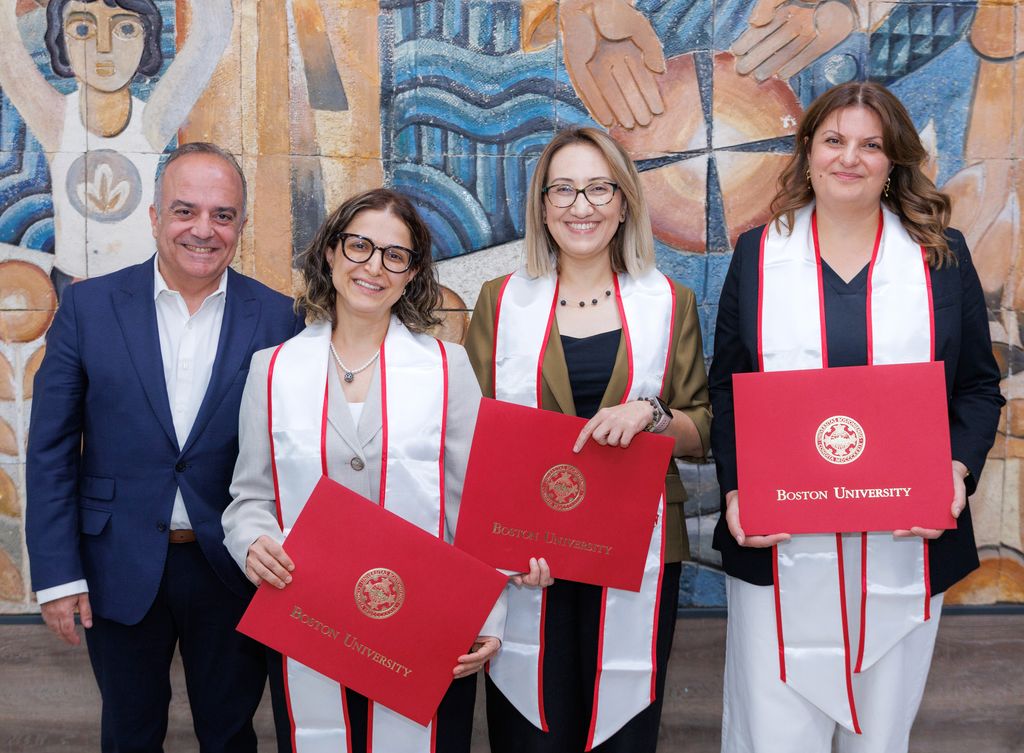 Director of the National Institute of Health/Armenia Alexander Bazarchyane with MSHPE graduates from ANIH (l to r): Alexander Bazarchyan, Hrachuhi Ghazaryan, Lilit Marutyan, Zaruhi Tavadyan.
The delegation visited several hospitals that serve as clinical bases for the academic departments of Yerevan State Medical University (YSMU) and the National Institute of Health/Armenia (ANIH); Muratsan University Hospital Complex, the Mikaelyan Institute of Surgery, Wigmore Women’s and Children’s Hospital, and Erebuni Medical Center. In each, they watched physician-educators from the program’s first cohort lead clinical teaching sessions alongside faculty they themselves had helped train, proof that the learning had already moved out of the classroom and into daily practice.
A change in how a country teaches, not a one-time intervention
The significance of the MSHPE program lies less in any single visit than in what it is quietly rewiring. For generations, medical training in Armenia, as in much of the world, rewarded the transfer of knowledge: what a physician learned in the classroom. This program is helping shift that model toward competency-based medical education, which asks a harder question: what a physician can actually do at the bedside, and how well they can teach the next generation to do it.
One of the most important impacts of this initiative is that it contributes to a shift in the way we think about teaching. It is not simply about transferring knowledge, but about developing competencies, promoting active learning, strengthening assessment and creating a supportive educational environment,
Jeffrey Markuns, MD, EdM
“One of the most important impacts of this initiative is that it contributes to a shift in the way we think about teaching. It is not simply about transferring knowledge, but about developing competencies, promoting active learning, strengthening assessment and creating a supportive educational environment,” said Jeffrey Markuns, MD, EdM, executive director of the Boston University Global Health Collaborative and founding director of the MSHPE program at the school.
That shift is designed to spread. Rather than importing foreign experts to deliver care and then depart, the program invests in Armenian physician-educators who become, in effect, multipliers. The first cohort — six physicians selected in partnership with YSMU and ANIH — completed graduate-level training this year at Boston University through a blend of online and in-person study, including a six-week intensive summer session in Boston. But even as they studied, they taught: through local faculty development and “Training of Trainers” sessions every two weeks over the past year, those six passed their new expertise to 171 fellow physician-educators across Armenia’s academic and clinical institutions.
Six became 171 in a single year. Each of those 171 now shapes the residents in their own departments, and those residents will one day care for patients in every region of the country. It is this compounding, from a handful of educators to departments, curricula, and ultimately the national standard, that turns a grant-funded program into lasting, systemic change.
“The power of this program is that it is designed to multiply. Every physician-educator we train becomes a teacher of teachers, and each of them reaches the next. We are not filling a gap, we are helping reshape the system that will train every future physician in this country,” said Yelena Abovyan, executive director of HENAR Foundation.
Recognition at the Highest Levels
The program’s first year closed with graduation ceremonies at ANIH and YSMU in September, attended by representatives of the Ministry of Health, the Ministry of Education, ANIH, YSMU, HENAR, and Boston University. The presence of both ministries was itself a measure of how far the work has traveled from pilot to policy: the institutions that govern Armenian healthcare and education are watching, and increasingly investing.
“Reforming medical education is a national undertaking, not an institutional one. What gives us confidence is seeing the Ministries of Health and Education, our academic institutions, and our clinical partners aligned behind a shared goal, because a system built together is a system that lasts.”said Arman Voskerchyan, co-founder of HENAR Foundation.
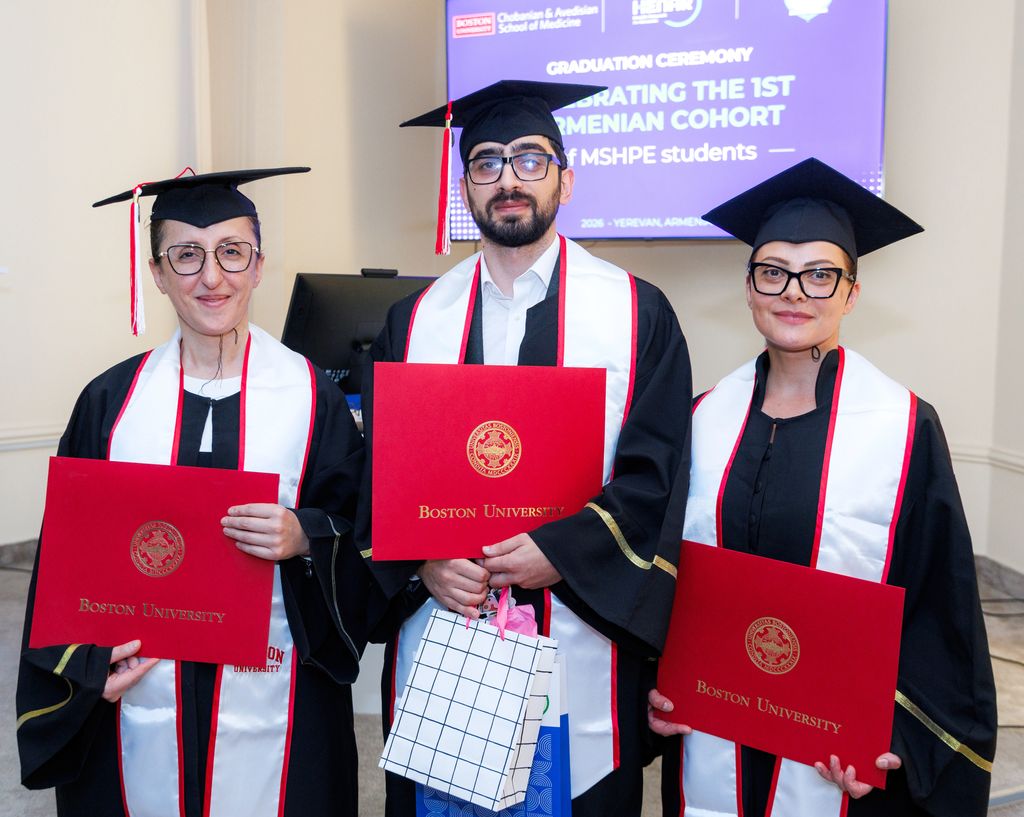 MSHPE graduates from Yerevan State Medical University (l-r) Hripsime Apresyan, Suren Brutyan, Alvard Hovhannisyan.
The Ripple Widens
The program has already begun its second year. A new cohort of ten physician-educators has been selected to pursue MSHPE studies at Boston University, and, like those before them, they will carry what they learn back to their colleagues, departments, and institutions, widening the circle with every cycle.
We are embedding international best practices into the structure of Armenian postgraduate medical education, so that progress continues whether or not we are in the room.
Aram Kaligian, MD
“We are embedding international best practices into the structure of Armenian postgraduate medical education, so that progress continues whether or not we are in the room. That is the difference between humanitarian assistance and a strategic partnership,” said Aram Kaligian, MD, clinical associate professor at Boston University Chobanian & Avedisian School of Medicine.
For the Armenian-American community that has helped make this work possible, the program is a reminder of what the diaspora’s partnership with Armenia can achieve when it is built to last — not a single act of generosity, but an investment that keeps multiplying long after the visit ends.
The MSHPE program is jointly implemented by Boston University Chobanian & Avedisian School of Medicine and HENAR Foundation, with the support of Afeyan Initiatives for Armenia (AIFA) and the Armenian American Medical Association of Greater Boston (AAMA). By preparing a new generation of physician-educators and faculty leaders, the program is helping introduce and expand competency-based medical education in Armenia, contributing to broader efforts to strengthen medical education, faculty development, and healthcare quality throughout the country.