Skip to Main Content
Boston University Chobanian & Avedisian School of Medicine
Search

  • Admissions
  • Education
  • Research
  • Giving
  • Emergency
Search
  • Current Students
  • Faculty
  • Staff
  • Alumni
  • Parents
  • Donors
  • About
    • Frontline Medicine
    • By The Numbers
    • Organizational Chart
    • BUMC HR Resources
    • History
    • Clinical Affiliations
    • Basic & Clinical Sciences
    • Faculty Directory
    • Alumni Medical Library
  • Education
    • PhD Education
    • MD Education
    • Master’s Degree Education
    • Dual Degree Programs & Certificates
    • Center for Continuing Education
  • Admissions
    • Why Chobanian & Avedisian School of Medicine?
    • Apply for MD Program
    • Apply for PhD Program
    • Apply for Master’s Program
  • Student Affairs
    • MD Student Affairs
    • GMS Student Affairs Resources
  • Giving
    • Why Give?
    • Who Gives?
    • What Can I Give?
    • Where Can I Give?
    • What Can I Attend?
    • How Can I Give?
    • Contact the Advancement Office
    • Parents Community
    • Donor Resources
  • Research
    • Academic Research Collaboration Message Board
    • Cores, Facilities & Services
    • Find Funding
    • Centers & Institutes
    • Human Subject Research
    • Resources
    • Research Job Openings
  • Offices & Services
    • Office of the Dean
    • Faculty Affairs Office
    • MD Program Offices
    • Master’s & PhD Program Offices
    • Alumni Office
    • Advancement Office
    • Louis W. Sullivan Center
    • Communications Office
    • Events Office
  • News & Events
    • News Archive
    • Calendar

Frontline Medicine & Science

  • AlumniAnnual Alumni Awards Luncheon Honors Physicians, Researchers and Educators
  • Awards & HonorsLisa Shen, MD, Named Distinguished Faculty of the Month for October
  • Awards & HonorsIna Hoti Named Distinguished Staff of the Month for October
View News & Events

Magazine

Cover of the Summer/Fall 2026 issue of Boston University medicineSummer/Fall 2026Boston University Medicine

Genetic Variations May Hinder Protective Benefits of Vitamin D on Diabetes

yellow vitamin d medicine against yellow background

Photo by Michele Blackwell on Unsplash

Commentary

Genetic Variations May Hinder Protective Benefits of Vitamin D on Diabetes

April 24, 2026
Twitter Facebook

The Center for Disease Control estimates nearly 50% of the U.S. population has either prediabetes (38%) or type 2 diabetes (T2D). Vitamin D deficiency is common in individuals with T2D with a prevalence of more than 80%. Past studies have reported pre-diabetic adults on 4000 IUs vitamin D3/d (median of 2.5 years) received no benefit in reducing progression to type 2 diabetes (T2D) compared to placebo. While other studies have shown participants receiving vitamin D who maintained certain levels of serum 25-hydroxyvitamin D [25(OH)D], resulted in approximately 52% and 71% risk reductions.

In the latest issue of JAMA Network Open, Dawson-Hughes et al., examined four common vitamin D receptor (VDR) polymorphisms (common genetic variations in DNA sequences) and observed that subjects with the vitamin D receptor (VDR) ApaI AA alleles, received no benefit from vitamin D treatment. However, subjects with ApaI AC and CC genotypes showed a 19% decreased risk of progressing to T2D. Polymorphisms are associated with chronic disorders including autoimmune diseases, diabetes, heart disease, deadly cancers and Alzheimer’s disease. Polymorphisms also disrupt drug responses by alterations in enzyme function, drug transport and receptors.
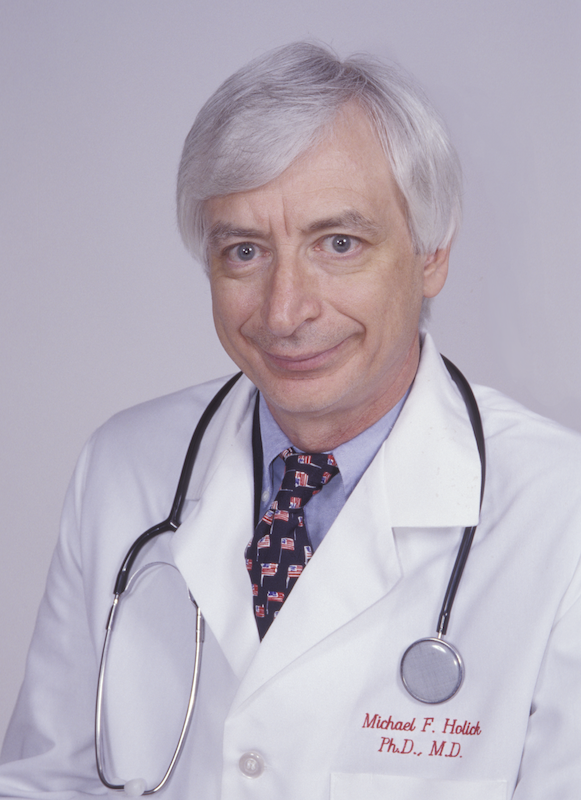
Head and shoulders image of Dr. Holick wearing whitecoat and stethoscope
Michael Holick, MD, PhD

“It is of no surprise that polymorphisms in the vitamin D receptors would be associated with alterations in vitamin D’s associated health benefits,” says Michael F. Holick, PhD, MD, professor of medicine, pharmacology, physiology & biophysics and molecular medicine at Boston University Chobanian & Avedisian School of Medicine in an accompanying commentary in the journal.

Holick points out that this observation is only one small piece of the complex puzzle related to genomics and the risk for developing type 2 diabetes. “The active form of vitamin D, 1,25-dihydroxyvitamin D [1,25(OH)2D] interacting with VDR is responsible for vitamin D’s effect on improving glucose metabolism and reducing risk for T2D. It provides further insight into individual differences in response to vitamin D supplementation and helps explain the disparity of conclusions regarding studies that have evaluated the impact of supplementation with vitamin D on serum concentrations of 25(OH)D and clinical outcomes including T2D,” he explains.

According to Holick, the enormity of the disease burden of diabetes worldwide and the confirmation that vitamin D supplementation of 4000 IUs/d markedly reduces risk of developing it, should be a wake-up call. “While it is unrealistic to determine everyone’s VDR polymorphisms and other polymorphisms that have been related to T2D, these findings should be the impetus for health organizations to develop strategies to improve vitamin D status for children and adults with food fortification programs, implementation of supplementation and sensible sun exposure recommendations for those who are at risk.”

Explore Related Topics:

  • Commentary
  • research
  • Share this story

Share

Genetic Variations May Hinder Protective Benefits of Vitamin D on Diabetes

72 East Concord St.
Boston, MA 02118
Contact & Directions
Boston University Chobanian & Avedisian School of Medicine
  • Instagram
  • LinkedIn
  • Facebook
  • X

We are Frontline Medicine & Science.

Every day, we learn, conduct research, care, teach, discover, and pioneer in places not everyone goes: the classrooms at the frontline of medicine & science.

  • Medical Campus
  • Search
  • Directory
  • Contact
Boston University
  • © 2026 Trustees of Boston University
  • Privacy Statement
  • Accessibility
  • DMCA
© 2026 Boston University. All rights reserved. www.bu.edu
Boston University Masterplate