Massachusetts Medical Schools Launch Statewide Faculty Development Initiative in Serious Illness Communication
Photo by Stephen Andrews on Unsplash.
Faculty Development
Massachusetts Medical Schools Launch Statewide Faculty Development Initiative in Serious Illness Communication
Faculty from all four Massachusetts medical schools convene for collaborative training with VitalTalk.
Faculty from all four Massachusetts medical schools came together on September 25 for an intensive faculty development workshop focused on strengthening how future physicians learn to communicate with patients and families facing serious illness.
The workshop brought together faculty scholars from Boston University Chobanian & Avedisian School of Medicine, Harvard Medical School, Tufts University School of Medicine and UMass Chan Medical School as part of the Massachusetts Medical Schools Collaborative’s ongoing work to advance serious illness communication and education across the Commonwealth.
The faculty scholars represent a broad range of clinical disciplines and care settings, including internal medicine and primary care, pediatrics, emergency medicine, surgery, neurology, cardiology, endocrinology, nephrology, oncology and bone marrow transplantation, and pulmonary and critical care, as well as nursing. This breadth reflects the importance of serious illness communication across specialties and throughout a patient’s care.
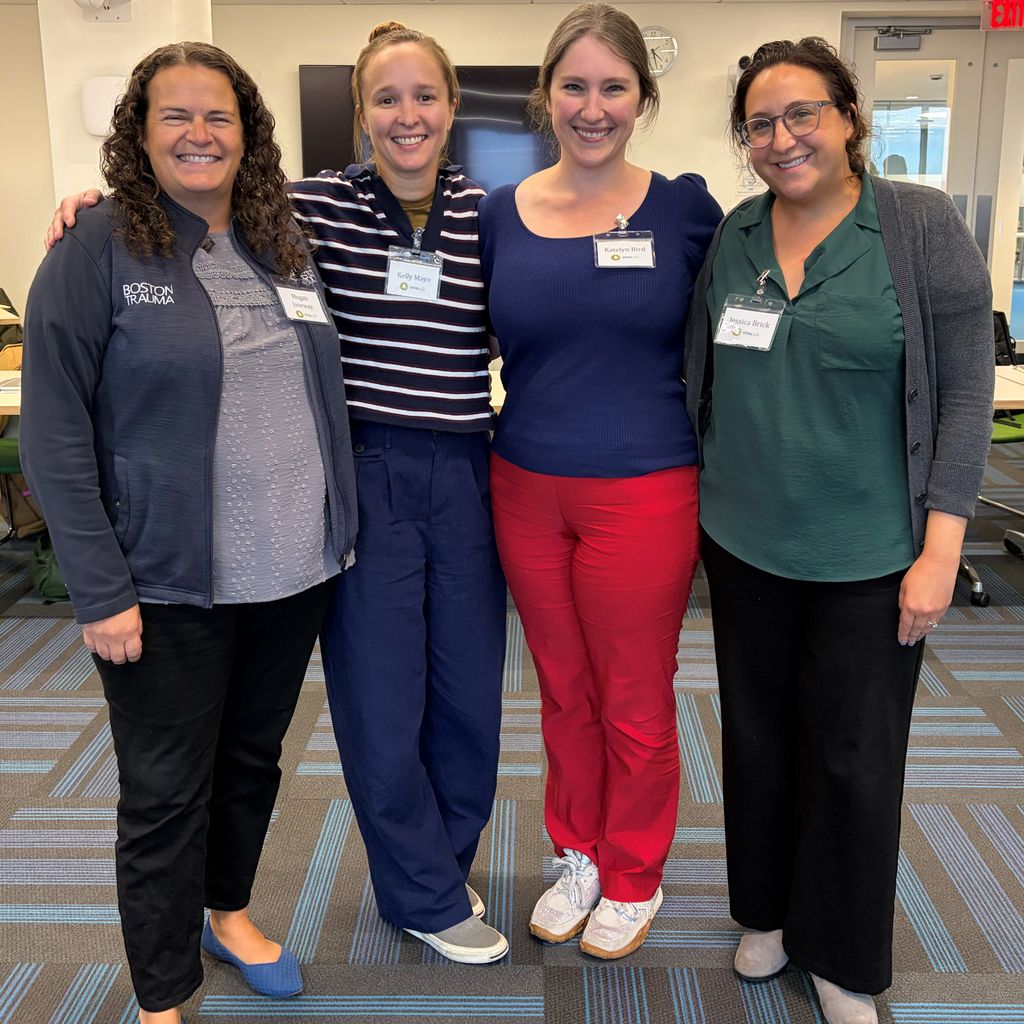 (L to r) Megan janeway, MD, Kelly May, MD, Katelyn Bird, MD, MS, Jessica Brick, MD.
Led in partnership with VitalTalk, a national leader in evidence-based communication training, the program is designed not only to strengthen participating faculty members’ own communication skills, but also to prepare them to teach and coach medical students during real clinical encounters.
Serious illness conversations can involve some of the most complex and consequential moments in medicine: sharing difficult news, responding to emotion and uncertainty, understanding what matters most to patients, discussing goals of care, and helping patients and families make informed decisions about treatment. Yet opportunities for medical students to observe, practice, and receive feedback on these skills can vary considerably depending on where and with whom they train.
“We designed our program to address this gap by developing a cross-institutional community of clinician-educators,” said Jennifer Reidy, MD, chief of palliative care and professor at UMass Chan Medical School. “These faculty were selected because they are great communicators, teachers and role models; with this training, they’ll be able to coach students at the bedside and in clinics during difficult, emotional encounters with patients and families.”
The initiative builds on several years of collaboration among Massachusetts’ medical schools to strengthen education in serious illness communication. Previous work by the Collaborative found that medical students viewed serious illness communication as essential to high-quality medical practice regardless of specialty and identified a need for more consistent, integrated opportunities to develop these skills throughout medical school.
By working together across institutions, the Collaborative aims to develop approaches that can be incorporated into medical education throughout Massachusetts while creating opportunities for schools to learn from one another.
The Faculty Development Program is led by Jennifer Reidy, MD, MS, FAAHPM, chair of the Massachusetts Medical Schools Collaborative and UMass Chan Medical School lead, in partnership with faculty leads at each of the participating schools: Megan Young, MD, and Leah Taffel, MD, Boston University Chobanian & Avedisian School of Medicine; Kirsten Engel, MD, Dorothy Tolchin, MD, EdM, and Irene Yeh, MD, MPH, FAAHPM, Harvard Medical School; and Tamara Vesel, MD, Tufts University School of Medicine.
About the Massachusetts Medical Schools Collaborative
The Massachusetts Medical Schools Collaborative brings together Boston University Chobanian & Avedisian School of Medicine, Harvard Medical School, Tufts University School of Medicine, and UMass Chan Medical School to advance serious illness communication and palliative care education for medical students. Initially funded and convened by the Massachusetts Coalition for Serious Illness Care, the Collaborative works across institutions to identify shared competencies, understand students’ educational experiences, strengthen curricula, develop faculty, and expand opportunities for students to learn and practice communication skills in clinical care.