Annual Alumni Awards Luncheon Honors Physicians, Researchers and Educators
Celebrating the 2026 Alumni Award winners, (l to r) Humanitarian Awardee Tamara Fitzgerald, MD’04, PhD’04, Distinguished Alumni Awardee Omid Farokhzad, MD’99, MA’94, MBA, Advocacy, Equity & Social Justice in Medicine Alumni Awardee Mardia Stone, MD’79, MPH, Emerging Leaders Alumni Awardee Michael Sherman, MD’15, MA’11, GMS Distinguished Alumni Awardee Tara Moore, PhD’00.
Alumni
Annual Alumni Awards Luncheon Honors Physicians, Researchers and Educators
Kimberly Dodd, MD’02, MS’10, named new Alumni Advisory Council president.
This year’s annual Alumni Awards Ceremony and Luncheon held September 18 in Hiebert Lounge, honored five alumni who improved healthcare access in low-income countries, reimagined critical and emergency care, invented technologies to fight diseases and advanced medical science.
“We chose amazing people,” said Alumni Advisory Council Awards Committee Chair Heidi Abdelhady, MD’98.
For the past 25 years, Mardia Stone, MD’79, MPH, the inaugural recipient of the Advocacy, Equity & Social Justice in Medicine Award, has focused primarily on global health. A sense of duty and love for her native country, prompted her return to Liberia in 2005.
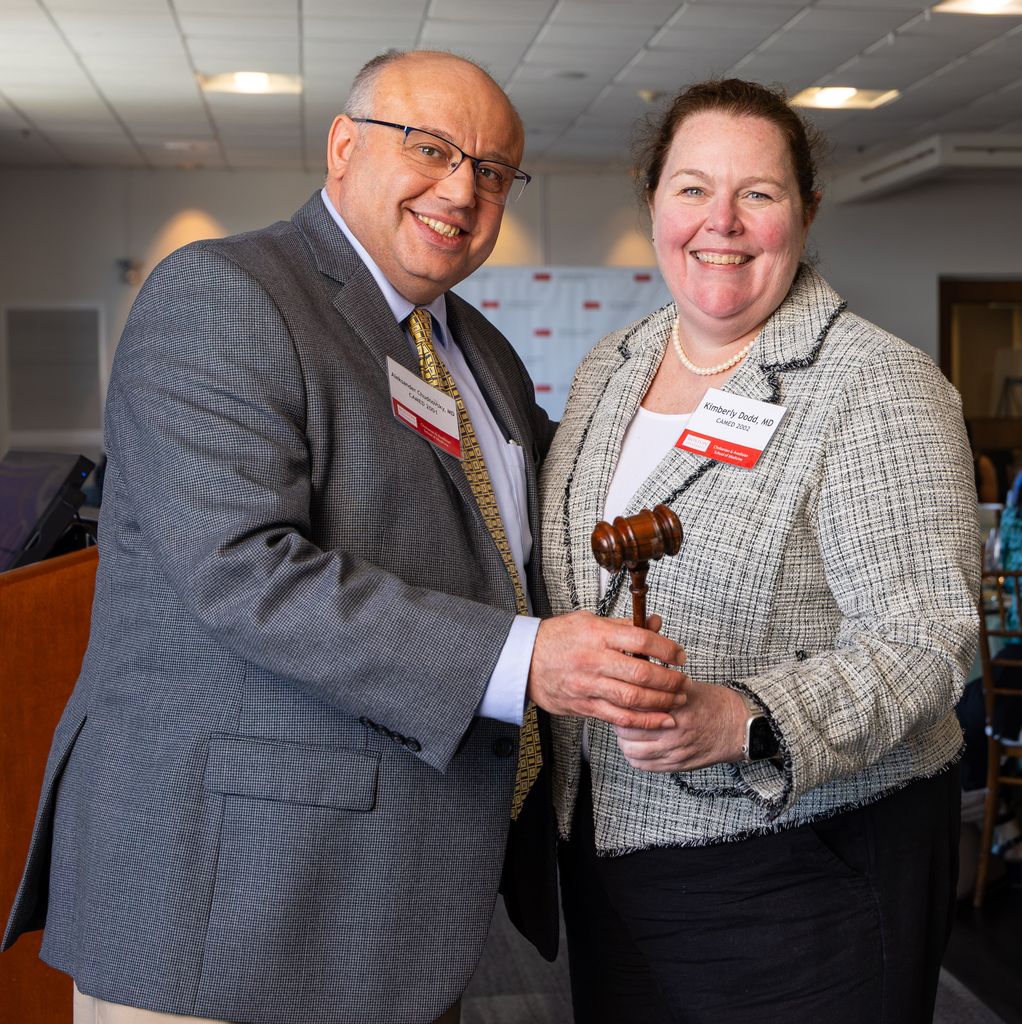 Passing the gavel from Alumni Association President Sasha Chudnovsky, MD’01, to his successor Kimberly Dodd, MD’02, MS’10.
Stone worked for seven years in Liberia, in the wake of a brutal civil war, during the administration of the country’s first female president Ellen Johnson Sirfeaf. She chaired the transition team on health and social welfare, building the foundation for its healthcare system. Stone returned to the U.S. in 2013, but was called back the next year by Tolbert Nyenswah, LLB, MPH, DrPH, who was leading the country’s response to Ebola. At the time, not much was known about the disease except that it was nearly always fatal. Even as doctors and other healthcare providers were dying alongside their patients, or fleeing the country in terror, Stone remained, working for three years as a World Health Organization Ebola Response Team consultant and coordinator, and co-authoring a book, “Collapse and Resiliency, the Inside Story of Liberia’s Unprecedented Ebola Response”, with Nyenswah.
“She worked shoulder-to-shoulder with government leaders and community members to coordinate response efforts that saved lives,” said Associate Dean of Alumni Affairs Heather Miselis, MD’00’04, MPH/MA’00. Stone established residency training programs to address the shortage of specialists in the country and helped found Liberia’s first national public health institute.
“My journey has not been a straight and narrow path,” said Stone. “I’ve seen a lot. I’ve done a lot. I’ve met a lot of people. But standing here at this institution is one of the most joyful moments of my life, because this is where it started.”
Michael Sherman, MD’15, MA’11, assistant professor of emergency medicine and critical care medicine, received the Emerging Leader’s Award. Sherman is an attending physician at Boston Medical Center whose work is focused on “those first critical hours when every decision, every action, every second matters,” said Miselis. “He dedicates himself to caring for the sickest patients, but also to reimagining the systems of care that he works with.”
Sherman’s research examines resuscitation practices, invasive monitoring and national trends in emergency critical care delivery. Miselis lauded Sherman for his innovative, interactive teaching style.
“As emergency critical care physicians, we’re rarely the doctors anyone wants to see,” said Sherman. “But we have the privilege of being there when patients need us most. We bring critical care to patients wherever they are: in the emergency department, the ICU, the operating room or even in the elevator.”
When she was a fourth-year medical student, Humanitarian Award recipient Tamara Fitzgerald, MD’04, PhD’04, chose a travel elective doing general surgery in Cameroon. Following her residency, she traveled to Uganda where she worked with that country’s only pediatric surgeon and helped establish a fellowship that has since trained a dozen pediatric surgeons.
Working with a diverse team that included everyone from surgeons to entrepreneurs from the U.S. and Uganda, Fitzgerald spearheaded the development of low-cost medical devices for low-income countries.
“One of the reasons that I loved it here (at BU) was because I felt like this institution always had a heart for people who can’t access healthcare,” said Fitzgerald. “Whether that was ministering to homeless people in Boston or globally, or helping people who, for whatever reason, can’t access care.”
Distinguished Alumni Award recipient Omid Farokhzad, MD’99, MA’94, MBA, is the author of more than 200 papers and an inventor with more than 200 patents.
“His discoveries have demonstrated the power of using nanoparticles to deliver targeted therapies, to detect diseases earlier and to personalize medicine in ways I never thought possible,” said Miselis. Farokhzad’s discoveries have launched six biotechnology companies and he has endowed chairs, established scholarships for young scientists and trained and mentored more than 120 post-doctoral fellows.
“What I’ve learned is that careers are rarely built according to a master plan,” he said. “Mine has been built through curiosity, hard work, good fortune, but most importantly through people. Every accomplishment is the work of many hands and minds: mentors who took a chance on me; colleagues who challenged me; students and fellows whose ideas made the science better; collaborators who brought perspectives I didn’t have; and teams who were willing to pursue difficult problems when success was far from certain.”
Matt Layne, PhD’97, associate dean of graduate medical sciences, ad interim, praised the research, collaborative approach and teaching skills of Tara Moore, PhD’00, professor of anatomy & neurobiology, associate dean of research, ad interim, and recipient of the Graduate Medical Sciences Distinguished Alumni Award.
“Her work has made numerous contributions to understanding brain aging, cortical injury and neuroplasticity,” said Layne. “All of this work has been extremely impactful for our understanding of human disease and biology.”
In 2016, Moore was recognized for her teaching abilities with the GMS Educator of the Year award. She served for five years as chair of Boston University’s Institutional Animal Care and Use Committee and is now vice chair.
“I did what you’re not supposed to do; I stayed in the same lab for my entire career,” said Moore. “But it’s been very rewarding. One of the factors that kept me at BU is the community here. There is a strong focus on mentoring, collaboration and support. It’s an amazing environment in which to be a researcher.”
The annual luncheon also marks the transition to a new Alumni Advisory Council president, with Sasha Chudnovsky, MD’01, handing the gavel to his successor Kimberly Dodd, MD’02, MS’10.