Two New Visual Arts Programs Help Boston Medical Center Residents and Fellows Hone Skills as Clinicians
One evening last fall, medical residents from Boston Medical Center (BMC) found themselves on the Charles River Campus in the College of Fine Arts’ quiet, spacious Faye G., Jo, and James Stone Gallery, viewing art ranging from sculpture to contemporary and abstract paintings done by BU art students.
The residents were there as part of the VITAL (Visual Thinking & Art in Learning Medicine) program, a new educational initiative designed to immerse BMC residents and fellows in the language and skills of the arts that translate to the medical field. By using art as the vehicle, early-career physicians can delve into the gray areas of medicine—like observation, interpretation, empathy, and ambiguity.
Using humanities and the arts to educate the next generation of doctors has gained in popularity, and BU is no exception. VITAL is one of two recently launched programs at BMC—the other is the MANET Project (Museum Art in Neurology Education Training). Both programs create learning experiences that cannot be gained from medical textbooks and hospital shifts.
VITAL began in 2025 and is overseen by Deepthi Gunasekaran, MD, a nephrologist and assistant professor of medicine and Gopala Krishna Yadavalli, MD, an infectious disease expert and clinical associate professor of medicine in collaboration with Lissa Cramer, director of BU Art Galleries. Together, they create interactive, hands-on learning experiences that help foster visual thinking strategies that get young doctors to explore questions like, “What do you see? What do you see that makes you say that?” Yadavalli says. “There’s no right or wrong here. But it is important to understand why we’re thinking the way we’re thinking.”
Led by Pria Anand, MD, an assistant professor of neurology at the medical school and director of the Adult Neurology Residency program at BMC, the MANET Project is a unique collaboration between BMC and curators at the Harvard Art Museums. Started in 2024 by Tatiana Greige, MD, then BMC chief resident, now a neurohospitalist at MaineHealth Maine Medical Center, the collaboration is the first of its kind, art-based neurology program in the country. After just one semester, the 17 residents in the initial cohort were shown to have dramatically improved their observational skills. The findings, led by Anand, Greige, and other BU colleagues, were published in Neurology Education. The program is now a regular part of neurology training, of which Anand is particularly proud.
“To be a good neurologist, you have to be interested in someone else’s subjective experience to understand the depth of someone’s symptoms, and how those symptoms are affecting their life,” Anand says. “Neurology forces you to contend with how you perceive the world, and there’s a long tradition of using art as a way to understand someone else’s experience of neurologic illness.” For example, art or drawing can be a way to understand a person’s visual distortion from a migraine or to communicate with someone who has lost their speech from a stroke, or other symptoms that can be difficult or impossible to articulate.
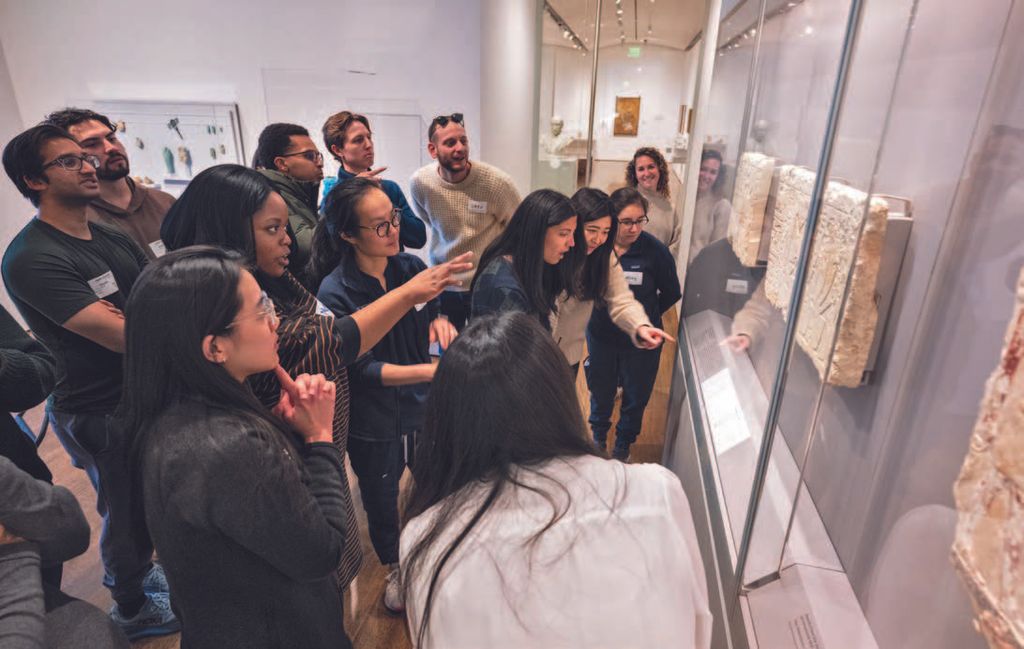 BMC medical residents view an ancient tomb relief during a recent visit to the Harvard Art Museums. They discussed the importance of interpreting history and understanding individual stories like the one depicted in the damaged relief.
During a recent trip to the Harvard Art Museums, a group of 30 residents was brought to three different works, guided by Jen Thum, Harvard Art Museums’ associate director of academic engagement and campus partnerships and research curator. They stopped in front of a large painting titled Four Stops, by Nina Chanel Abney, an American artist known for works that combine aspects of representation and abstraction. They had 15 minutes to absorb the scene and discuss what they were seeing—people sitting in a subway car, colors dripping and blending, a floating blue face in the shape of a balloon.
They then moved on to a gallery filled with art from ancient Egypt. There, Thum explained the story of a 4,000-year-old tomb relief on display—how it tells the story of the person and family it is memorializing, yet was sawed into pieces when it was taken from the tomb and is now missing information. The group discussed how in the hospital, doctors are often given only pieces of a person’s story and must do their best to understand the full picture. Last, they viewed some of the museum’s photography collection, including Dorothea Lange’s iconic Depression-era black and white photo, Migrant Mother, Nipomo, California.
“This is an incredible program for Boston Medical Center, especially as a safety-net hospital,” Anand says. “We care for a diverse group of patients, and I think to serve that community in a way that provides the best possible care, being empathetic, and being able to see perspectives different than your own is really important.”