Symposium Showcases Variety, Depth of GMS Student & Postdoctoral Research
Now in her fourth year as an MD/PhD student, Texas native Brittny Garcia thought she’d made her peace with New England winters. Despite the snowstorms and bitter cold, which sometimes made her long for warmer places, she didn’t second-guess her decision to choose Boston University’s combined program—four years toward a medical degree sandwiching four years of PhD research.
“I really fell in love with the mission of the Medical Campus, the research being done here, and the mentors,” said Garcia, one of six students and postdoctoral researchers selected as Research Talk Awards winners at the second Annual Graduate Medical Sciences Research Symposium held April 9 in Hiebert Lounge. An estimated 200 students, faculty, and staff in attendance heard presentations by the Research Talk Awards winners and viewed nearly 100 poster displays showcasing the wide range of work being done by postdoctoral fellows and MD/PhD, PhD, and MS students.
The symposium helps students become better communicators and gives faculty the opportunity to learn about the research and methods at various labs on the Medical and Charles River Campuses, VA Boston Healthcare, and Boston Medical Center.
“This event gives you an idea of the breadth and depth of the research on the Medical Campus and the strength of the programs in general,” said Thomas Clarke, PhD, an assistant professor of pathology & laboratory medicine and one of the volunteer judges of the poster presentations.
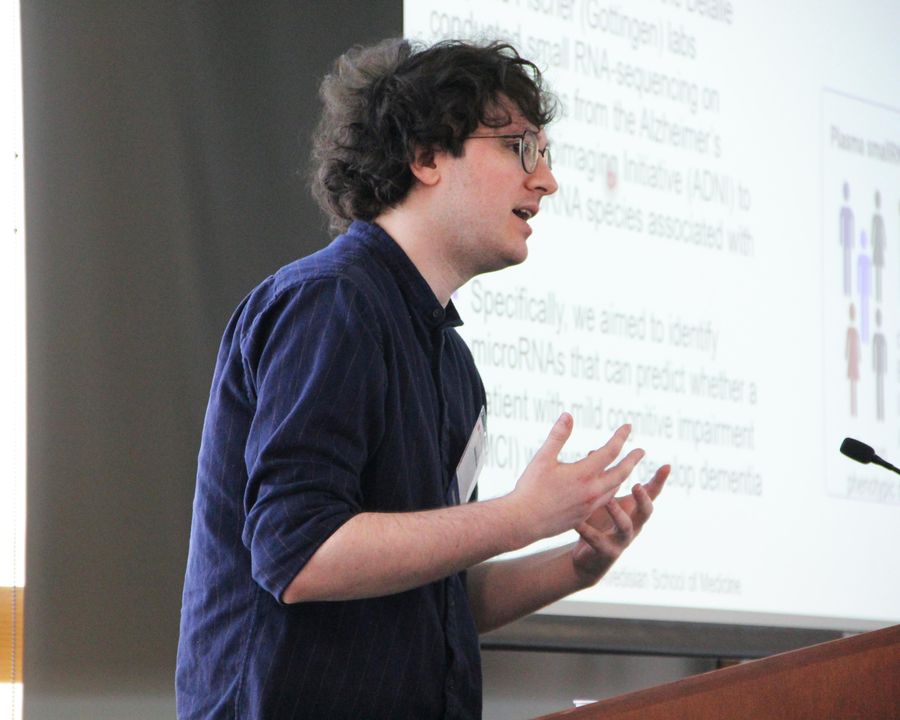 Research Talk Awards winner and fourth-year PhD student Andre Krunic.
“You can see techniques that you’re maybe thinking about incorporating into your research that other labs are already doing, and it can spur collaborations.”
Fourth-year biomolecular pharmacology PhD student Andre Krunic honed his Research Talk Awards presentation at department seminars and the Society for Neuroscience annual meeting last year. His research exploring the use of microRNAs for early diagnosis and treatment of Alzheimer’s disease was published recently in the journal Alzheimer’s & Dementia.
Students spend the first year of a PhD program in the classroom, rotating into various labs to find a good match for their research interests. Though he was interested in neuroscience, Krunic was undecided at first as to which research specialty he would choose.
The reputation of the Alzheimer’s Disease Research Center and BU’s affiliation with the famed Framingham Heart Study (FHS), the longest-running longitudinal study in the US, attracted Krunic to the school.
“When I first came here, I wasn’t set on Alzheimer’s disease. However, when I joined the lab and learned about the novel approaches we were researching to prevent it, such as using microRNAs, I started to become really invested in the field,” said Krunic. “BU is really an excellent place to do Alzheimer’s and dementia research.”
The FHS also was a big draw for Bahar Bakhshi, MS. Originally from Iran, Bakhshi is a third-year PhD candidate in molecular & translational medicine. Her research investigates how to better utilize data from continuous glucose monitoring to predict diabetes and cardiovascular disease risk.
“I’m really interested in diet and other lifestyle interventions. I’m hoping to build a career that leverages these different tools to come up with better ways of self-monitoring for individuals who are at risk for chronic diseases like diabetes and cardiovascular disease,” said Bakhshi.
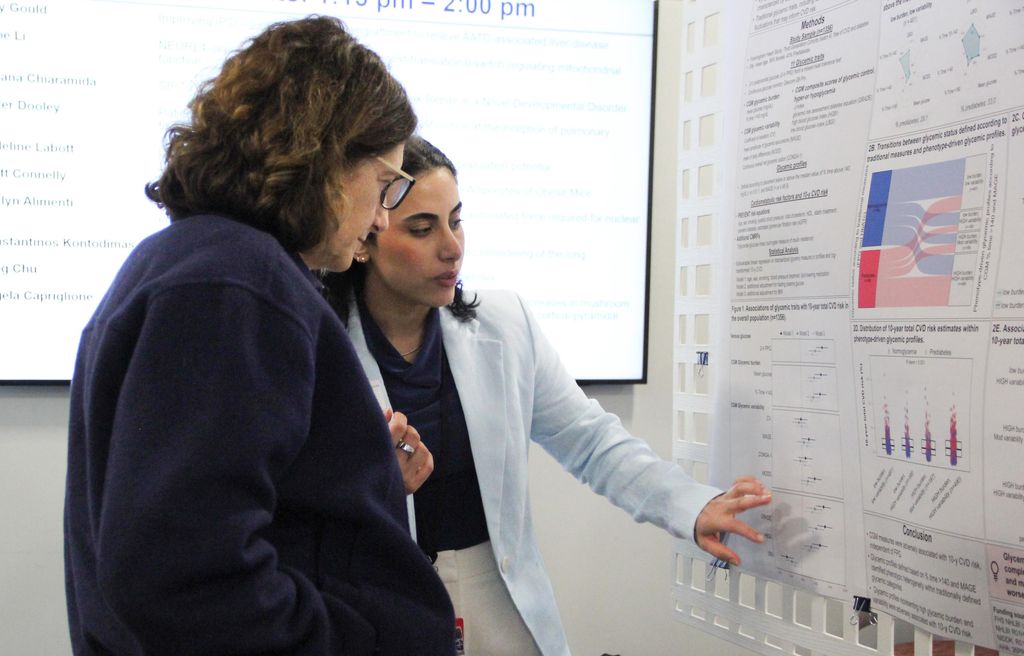 Third-year PhD student Bahar Bakhshi, MS, right, explains her research on continuous glucose monitoring.