Mentorship Program Helps Junior Faculty Climb the Academic Ladder
Assistant Professor Marisol Lopez, PhD, MS (left), being mentored by Professor Judith Linden, MD.
Faculty
Mentorship Program Helps Junior Faculty Climb the Academic Ladder
Assistant professors paired with senior faculty mentors who understand the path to promotion
Marisol Lopez, PhD, MS, came to Boston University four years ago as an assistant professor of physiology. In the decade prior to her hiring, she’d worked her way up the academic ladder from public school teacher to teaching physiology to graduate, dental, and medical students after earning both her master’s and doctoral degrees.
Never one to rest on her laurels, Lopez now is working on the next rung—a promotion to associate professor. It’s the biggest step of her career thus far, requiring her to have a national reputation in her field, backed by letters written by fellow experts attesting to her standing.
“Getting to the associate professor level is going to be hard. It takes a lot of effort and dedication,” said Lopez. Arriving at BU from a faculty position at a small Wisconsin college, she had to learn the language of academic promotion at a large, research-oriented institution.
“I was not familiar with, for example, the ‘arm’s-length letter’ [an impartial evaluation from an external expert with no close personal or professional ties],” she said. “I needed to increase my involvement with professional societies to be able to develop those relationships.”
As a participant in the Propelling Rise of Faculty (PRoF) program, Lopez gained a partner in that effort when she was paired with mentor Judith Linden, MD, professor of emergency medicine, executive vice chair in the department of emergency medicine, and a teacher at the school for 32 years.
 Elaine Lee, PhD, director of the Grants Strategy Office.
Initiated in 2022 by Dean Ad Interim and Associate Dean of Faculty Affairs Hee-Young Park, PhD, the program pairs an early career faculty member, with five or fewer years as an assistant professor, with a faculty mentor who supports their professional development, research grant applications, and efforts to become associate professor. The program focuses on publications and scholarly projects, establishing collaborations at the University and around the country, gaining sponsorship from senior faculty, and managing work-life balance.
“Dean Park had noticed that clinicians and clinician educators weren’t getting promoted as frequently. To design PRoF, we looked at what they needed to know, and how could we amplify their record so we could get those promotions to go through,” said Elaine Lee, PhD, director of the Grants Strategy Office and clinical associate professor of medical sciences & education.
The academic ladder progresses from assistant professor to associate professor and, finally, to full professor. In its first three years, PRoF had 93 participants, expanding exponentially from its initial 2022 cohort of six participants. Of those, 24 received grant funding and seven attained the rank of associate professor, typically a four-to-five-year process.
David Greer, MD, professor and chair of neurology and a PRoF mentor, said publishing impactful research at a national level is fundamental to promotion. Receiving federally funded grants and presenting at national conferences are also connected to national recognition.
“The most important thing for the University is that the [arm’s-length] letter writers from outside peer institutions speak to your national reputation. Importantly, they need to say not only that you meet the criteria for promotion at BU, but you meet criteria for promotion at their institution,” said Greer. “That tells BU that you have a national reputation, because you would meet the bar for promotion at any place you could go.”
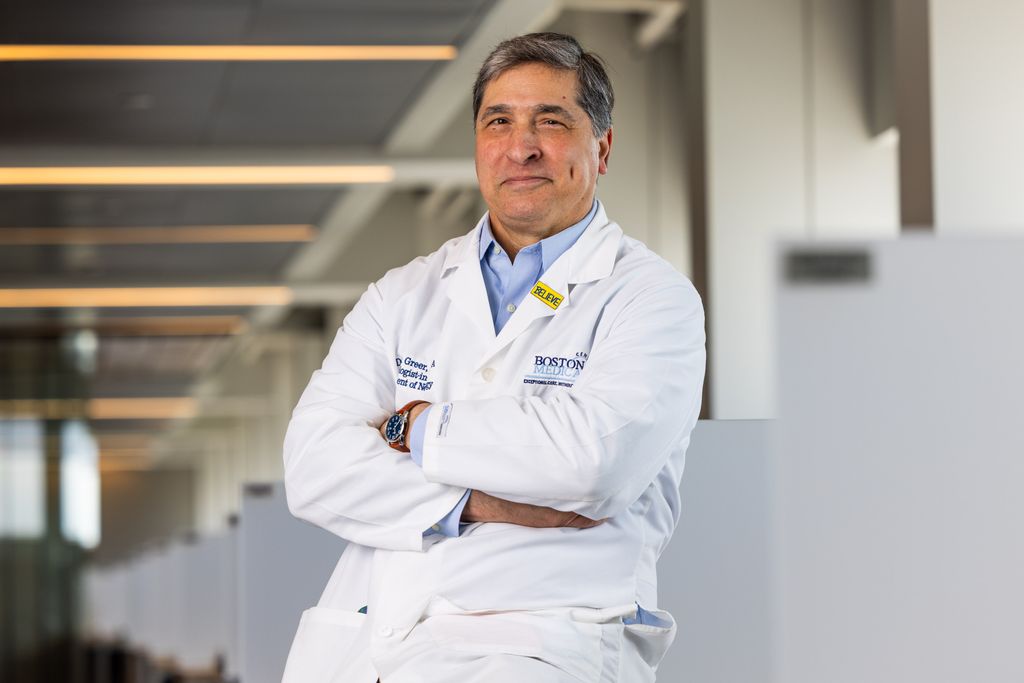 David Greer, MD
“It’s a really tough road, and it’s good to have someone who understands the process,” said Lopez.
But why climb that ladder?
“As you increase your academic status, it enhances your professional satisfaction and career longevity, also opening up additional leadership opportunities,” said Linden. Still it can be difficult to balance the daily demands of teaching, research, and clinical work with the extracurricular effort required for promotion.
Dean Park had noticed that clinicians and clinician educators weren’t getting promoted as frequently. To design PRoF, we looked at what they needed to know, and how could we amplify their record so we could get those promotions to go through.
“One of the things that I’ve done [with Lopez] is talk about how she can leverage what she needs to do for the medical school, for her curriculum development and students, by collaborating with national partners who are doing similar work,” said Linden. “Specifically, I’ve encouraged her to utilize national societies to form working groups to publish collaborative research, guidelines, etcetera. I’ve encouraged her to pursue leadership opportunities within these societies.”
One of PRoF’s requirements is that the mentor must be from a different department than the mentee.
Greer enjoys this approach to mentoring and advising participants on how to advocate to their chairs.
“I’m somebody totally removed from your department who can give you unbiased advice. As a department chair, being able to give that perspective, I think, is particularly valuable,” he said. “Your chair may not even know that you’re doing X, Y, or Z. You should let them know, and maybe they can give you the resources to be able to develop in that area. Those are the reasons that I really love the program.”