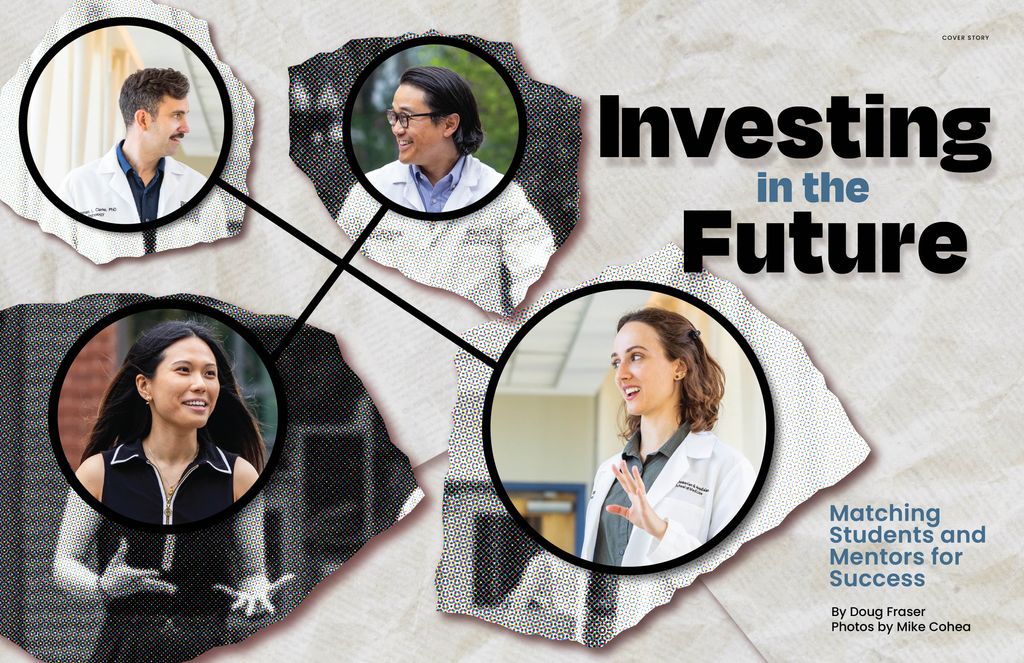
WHEN SHE ENROLLED AT THE CHOBANIAN & AVEDISIAN SCHOOL OF MEDICINE, third-year medical student Isabelle Joy wanted to continue working in research as she had as a BU undergrad. Her interest in molecular biology matched nicely with the Clarke Laboratory’s focus on the mechanisms of DNA repair—and the mentoring style of Thomas Clarke, PhD, assistant professor of pathology & laboratory medicine, sealed the deal.
“If you invest the time teaching, training, mentoring, and creating a supportive environment, people are more likely to stay in your lab, and that longevity is really important because they can learn techniques, learn the research, and really understand the projects they’re working on,” said Clarke.
From the outside, the process of scientific research and discovery might appear to be a solitary endeavor, but while the research lab often bears a single person’s name, teamwork is the engine driving the research—and an important part of that support structure is the mentor/mentee relationship.
“I think investing the time to mentor and train people moves the science along quicker,” Clarke said.
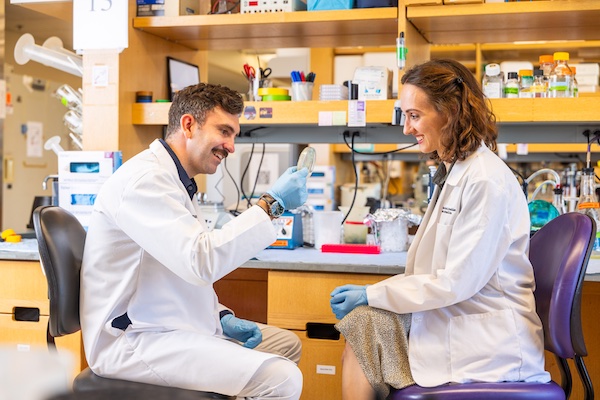 Mentor Thomas Clarke, PhD, assistant professor of pathology & laboratory medicine, in his lab with mentee Isabelle Joy, a third-year medical student.
There are many different mentoring styles, and Matthew Layne, PhD, assistant dean of research and director of the Medical Student Research program, describes the process of pairing students with labs and mentors as “matchmaking.”
Mentors need to recruit students who will pair well with them and other team members working in wet labs or in public health, translational medicine and data sciences, while students seek a relationship that is a good fit with their work style and will give them the tools they need for career success—particularly critical for PhD students who spend most of their time doing hands-on research and relatively little time in the classroom.
“When students come in the first year, they are often undifferentiated. They don’t know which lab or program they’re going to go into,” said Christopher Gabel, PhD, associate professor of pharmacology, physiology & biophysics, and director of the Program in Biomedical Sciences (PiBS). The average PhD student takes five and a half years to complete a degree; in the first year, they are in the PiBS, taking courses and doing three seven-week rotations in labs they select.
In the second year, students choose a specialty, a lab, and take a few more courses plus a qualifying exam.
“For the rest of their time, the focus is on research,” said Gabel. “In the matching process, we emphasize that students make sure that the mentor/mentee relationship is ideal, because how well that relationship works is where the rubber meets the road. Students do the best when that’s a really good match.”
“I think investing the time to mentor and train people moves the science along quicker.”
All students engaged in research—including medical, graduate, and PhD students—need mentors to direct their research, secure funding that pays them for their work, and show them how a professional lab works. Many mentors also provide career advice and sponsorship.
“There’s so much more involved in flourishing and staying in research than the knowledge base. There’s also a lot of practical knowledge, and part of your toolbox in being a mentor is career building,” said Natalia Morone, MD, MS, associate professor of medicine.
Deeply involved in mentorship at the school, Morone runs “Mentoring the Mentors,” an annual case-based seminar for faculty.
“I do think that the assumption that you can mentor just because you’ve been mentored is a fallacy,” said Morone. “I think the reason the program is so well received by the people who go through it is that it’s very helpful to talk through cases with other people to see how they would handle it.”
 Plastic and reconstructive surgeon Daniel Roh, MD, PhD, discusses research and career goals with third-year medical student Kylie Tang.
Third-year medical student Kylie Tang worked in a lab throughout her BU undergraduate years and decided to continue doing research as a medical student in the lab of plastic and reconstructive surgeon Daniel Roh, MD, PhD.
Her first undergraduate lab experience involved developing research skills and building strong relationships. As a medical student, Tang appreciated Roh’s approach, which considered the interests and needs of the mentee. She recalled a time in the lab when Roh, who knew she wanted to become a surgeon, took the time to show her how to suture.
“I had never had a spontaneous moment when a mentor remembered what I was interested in and then took it upon himself to further my interests,” she said. Roh encouraged her to present to residents at Boston Medical Center, and critiqued her presentations at the 2025 Evans Days poster competition—where she took third place in the basic science category—and at the 2026 Medical Student Research Symposium, where she won a Serchuck Poster Award.
Roh’s work ethic and enthusiasm for science and research impressed her. “I think, in his mind, research is not work; it’s something he enjoys, and I really want to have that enjoyment in my future too,” she said.
Both Joy and Tang participate in the medical school’s Learn, Experience, Advocate, Discover and Serve research track. Joy was supported by the Karin Grunebaum Cancer Research Foundation for the Medical Student Summer Research Program and placed first in the Basic Science category of the 2025 Evans Days poster contest. Clarke envisions Joy having her own lab eventually.
“There’s a certain amount of idealism when you mentor; it feels very satisfying to see people succeed, whether in publications or when they get grants and start getting recognition and leadership positions. It’s very, very satisfying,” said Morone.
 Medical student Kylie Tang (right) with mentor Daniel Roh, MD, PhD, assistant professor of surgery.