Graduates Step into Their Futures at Annual Convocation Ceremonies
Advised of the importance of trust, class members urged to make the world a better place
Events
Graduates Step into Their Futures at Annual Convocation Ceremonies
Advised of the importance of trust, class members urged to make the world a better place
Families and friends marked the passage of hundreds of Chobanian & Avedisian School of Medicine graduates into the worlds of medicine and science in two separate ceremonies held May 14 at BU’s Track & Tennis Center.
In his address at the afternoon MD/PhD convocation, invited speaker Atul Gawande, MD, MPH, renowned surgeon, professor, and former assistant administrator for global health at USAID, spoke of the fundamental trust that must exist between patient and doctor.
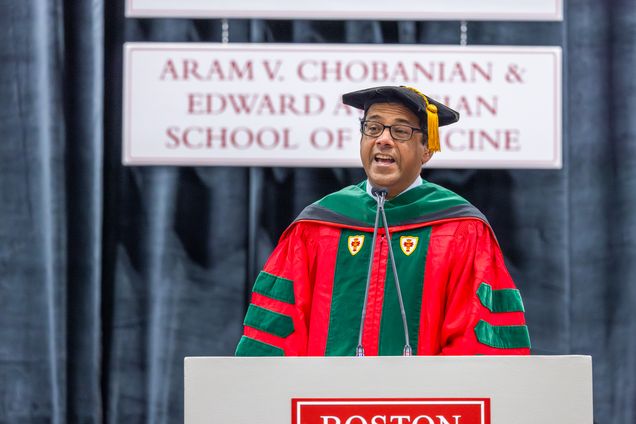 Invited MD and PhD Convocation speaker Atul Gawande, MD, MPH, surgeon, professor, former assistant administrator for global health at USAID, documentary film producer and writer.
Trust, Gawande advised, is won with competence, integrity, and benevolence.
“In this tricky moment in history, it can seem that the virtues of competence, integrity, and benevolence are not valued. But people are hungrier for them now than ever before. They will remain the keys to your success,” he said. “If you consistently demonstrate over time, not only that you can and will do what you say, but also that you truly mean well by people…that you understand where they’re coming from and genuinely put their priorities first, then they will come to believe in you.”
That ceremony awarded 161 degrees, including 132 MDs, 22 PhDs, five MD/PhDs, and one each MD/MBA and MD/MPH.
Jenna Libera was the first of two student speakers. Chosen by her classmates to address the convocation, Libera received her PhD in pharmacology and works at pharmaceutical giant Eli Lilly. She spoke about the rewards and lessons of a life devoted to discovery.
“As we celebrate the completion of our journey at Boston University, may we remember to embrace the spirit of discovery in the future seasons of our life, in our career ambitions and personal endeavors, continuing to marvel at the wonders that are yet to be discovered around us and within us.”
Selected by medical students as their speaker, Amos Mwaura discussed the constantly evolving field of medicine and the hope inherent in scientific discoveries, the need to find common ground with patients, and the necessity of finding a work-life balance.
 Amos Mwaura, MD’26, receives congratulations from
his classmates after delivering the MD student speaker
address.
“Why should I worry when, time and time again, my peers have demonstrated that we are capable of being outstanding physicians, that we are driven to provide exceptional care…and most importantly, that we are ready to improve the health of our communities one patient at a time?” said Mwaura.
C. James McKnight, PhD, associate dean of graduate medical sciences (GMS), told master’s degree students at their morning convocation to continue making a difference.
“Your hard work here has prepared you, and we are confident that you have the will, the courage, and the tools that are necessary to make a difference in all of our futures,” said McKnight.
There were 42 MA, 334 MS, and eight combined degrees awarded at the morning ceremony.
“The world is undergoing profound and rapid change with the impacts of artificial intelligence, a constantly shifting political and policy arena, and changes to federal research funding,” said Hee-Young Park, PhD, dean ad interim. She urged GMS graduates to continue what they’d done during their graduate education. “You remained focused. You stayed determined. You continued your pursuit of knowledge with purpose,” she said. “This is exactly how you will make the world better.”
 GMS student speaker Farihah Chowdhury, MS’26
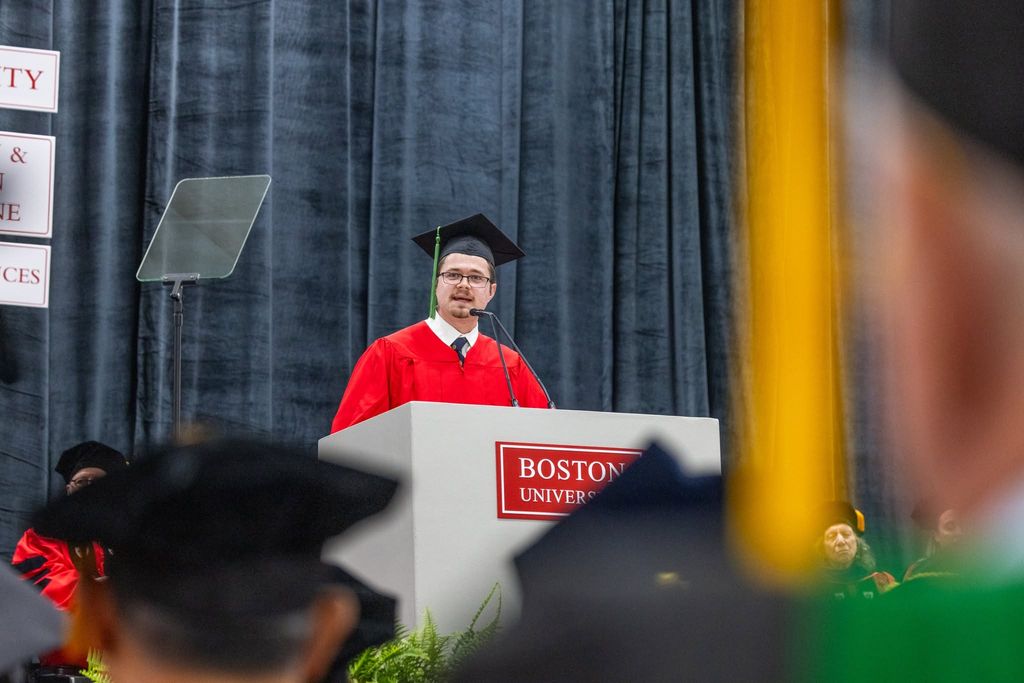 GMS student speaker Samuel Camilli, MS’26.
Farihah Chowdhury was the first of three students chosen by their peers to speak at the GMS convocation. The child of immigrants from Bangladesh, Chowdhury cited her parents’ determination to build a better life in the US for their family, instilling in her a profound sense of duty to serve others. She also spoke of the 18 months she spent volunteering in the hematology and oncology unit at Boston Medical Center learning valuable life lessons.
“My time volunteering at the hospital has helped me realize the importance of the smallest acts of kindness and what it feels like to play an essential part in someone’s larger medical journey,” said Chowdhury, who received an MS in medical sciences.
 Yerke Suleimenova (holding her child) receives her diploma from Hee-Young Park, PhD, dean ad interim.
Headed to the University of Massachusetts Chan Medical School with an MS in pathology laboratory science, Samuel Camilli chose to reflect on what he’d learned from failure, not success. The Sarasota, Florida, native said he was disappointed when he couldn’t meet the rigorous demands of working a hospital night shift while attending graduate school. He also internalized the rejection he invariably received when
applying to medical schools.
But Camilli discovered three things that carried him forward: being fully present, being deliberative in how he spent his time, and observing and learning from the unexpected.
“Take time to look over your shoulder at the road behind you. See the victories and the failures, the highs and the lows,” he told classmates. “Use that information in the present to adjust; not to panic…but to make a thoughtful next step.”
The transition from small-town Virginia to Boston and BU’s physician assistant program was initially daunting for convocation speaker Paige Conner, who found Bostonians were reserved, made only brief eye contact, and favored quick conversation. But that changed when she met her friendly and supportive classmates and found that kindness takes many forms.
“Sometimes it’s quiet. Sometimes it’s just someone showing up,” said Conner, who is returning to Virginia to begin practicing as a physician assistant. “Even in the most ordinary moments we have the ability to impact someone in ways we may never fully realize.”
Conner also observed that healthcare professionals tend to meet patients on what may be the worst day of that patient’s life.
“What they’ll remember won’t always be the diagnosis or the treatment,” she said. They’ll remember how we made them feel. As we move forward, don’t underestimate the impact of how you show up—for your patients, your colleagues, each other, and yourself.”

Osaretin Aimufua receives congratulations from her hooder and sister Esosa Aimufua. 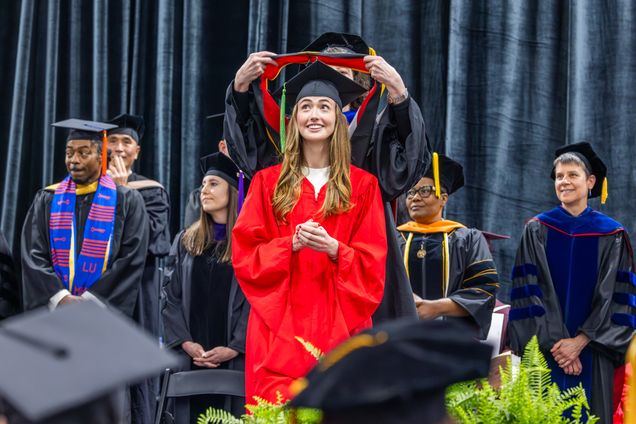
Ainsleigh Scott, a 2026 MAMS graduate, is hooded by program director and Associate Professor of Medicine Gwynneth Offner, PhD.