Four BU Medical Students Help Make Drinking Water Safer in African Nation
Boston University medical students Diego López, MD’28, Michalina Jadick, CAS’22, MD’28, Jazmine Johnson, MD’28, (second, third, and fourth from left), and Brent Leung, MD’24,’28 (second from right) traveled to Malawi for a month as part of BU’s Global Health Summer Scholarship program. Photo courtesy of Brent Leung.
Four BU Medical Students Help Make Drinking Water Safer in African Nation
The group traveled to Malawi as part of BU’s Global Health Summer Scholarship program
In the summer of 2025, four Boston University medical students, Michalina Jadick, CAS’22, MD’28, Jazmine Johnson, MD’28, Brent Leung, MD’24,’28, and Diego López, MD’28, spent a month in Malawi, a landlocked country in southeastern Africa, working to improve water chlorination practices in rural communities.
But that’s not the work they had originally planned to do.
The Global Health Summer Scholarship program provides funding for Chobanian & Avedisian School of Medicine students to travel abroad and undertake a research, language immersion, or a community health project in the summer between their first and second years of study. Through the program, these students were set to partner with the nonprofits Bridges to Malawi and K2 TASO to help distribute Artemisia annua, more commonly known as mugwort or wormwood, in low-resource communities. When it’s ingested as tea, the plant serves as a natural antimalarial treatment.
A few weeks before the students were set to depart, the nonprofits decided to redirect their focus to water treatment rather than antimalarial efforts. That meant the students had to come up with a new project proposal— and fast.
A Quick Pivot
The students received word of the change in May. Their flights were booked for early June.
“In the span of maybe two weeks, all four of us banded together to iron out the details of a new project to resubmit to BU and the National Health Science Research Committee in Kasungu, Malawi, so we would have permission to [do our work there],” Jadick says.
The decision to focus their efforts on drinking water made sense.
Drinking water in Kasungu’s villages often comes from wells, rivers, or ponds, and can contain waterborne illnesses, especially during the country’s rainy season. Adding just a teaspoon of chlorine solution to 20 liters of water renders the water drinkable for 24 hours.
Bridges to Malawi, a US-based organization, and K2 TASO, its Malawian counterpart, work with the local government to distribute buckets of chlorine stock solution to 24 designated health centers across Kasungu. From there, either a representative from a village will pick up the solution and bring it back to the community, or a local health official will pick it up and deliver it to the villages in their district.
The distributions occur roughly twice a month—primarily during rainy season—and are usually accompanied by education sessions on how to use the solution. But because water treatment happens at the household level, results vary widely. That’s where the students came in.
Surveying Residents
They interviewed government officials and nonprofit staff to figure out how the chlorine solution was prepared, distributed, and explained, went along on distribution trips, and helped lead education sessions.
From there, the students created a qualitative survey about chlorination practices for Kasungu residents, then used the survey to conduct interviews with 100 residents, with the help of an interpreter from K2 TASO. (The students credit the nonprofit and its director, Peter Minjale, as integral to their The survey’s aim was to establish where breakdowns in the process occurred.
“The goal of our project was to help ensure that folks are able to get chlorine throughout the year, and not just during the rainy season, when [incidents of waterborne] diarrheal illnesses are higher,” Johnson says. “Seeing some of these seemingly small challenges to keeping water clean was really enlightening for both us and the organizations we worked with.”
As the students learned, almost everyone believed in the efficacy of chlorine; the issues were in administration. When treating water with chlorine, you have to stir vigorously, then wait 30 minutes for the chemical to take effect, but not everyone waited the whole 30 minutes—or even knew it was necessary. Some also added too much chlorine, which can be dangerous over time, or didn’t follow anticontamination practices, like keeping water covered after it was treated. The biggest issue by far, however, was that not everyone knew when and where to find the chlorine.
The students presented the survey they created, plus their initial findings, to K2 TASO, community health officials, the District Health Research Committee of Kasungu, and Rudolf Zinkanda Banda, the District Environmental Health Officer. They also presented it to the National Health Sciences Research Committee of Malawi, a national body that oversees all research operations across Malawi.
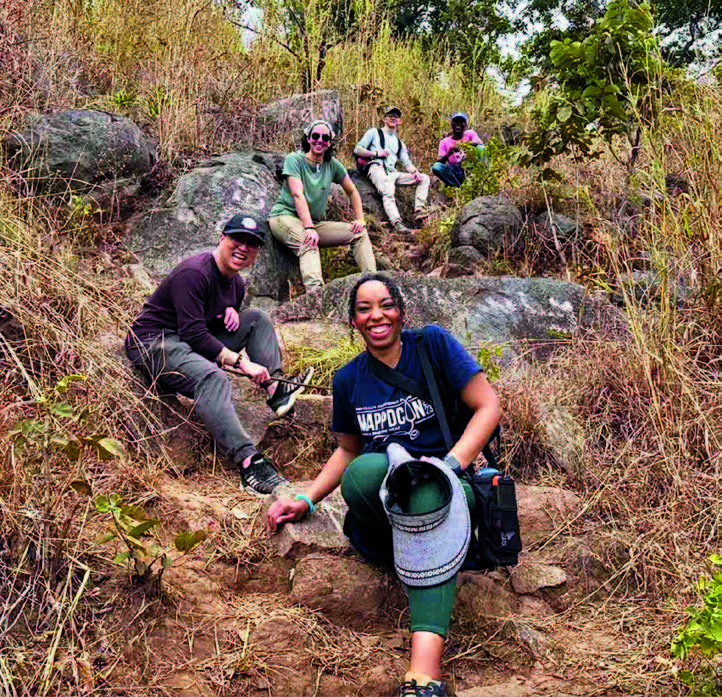 “The goal of our project was to help ensure that folks could get chlorine throughout the year, and not just
during the rainy season, when [incidents of waterborne] diarrheal illnesses are higher,” says Jazmine
Johnson (front), pictured with her trip mates.
Next steps
Going forward, K2 TASO can use the survey to conduct regular interviews and identify pain points; the data also adds legitimacy to the nonprofit’s efforts. “One of the things we talked about in various meetings was the utility of having formal research done,” Jadick says. “Now, when these organizations go to the government and say, ‘We need more chlorine to give to people,’ they actually have evidence to support why they need it.”
When not busy working on the project, all four students spent time in clinical spaces; K2 TASO conducts regular mobile health clinics in rural communities and director Minjale also works as a physician. As rising second-year medical students, the four couldn’t act as full providers, López says. But they could administer malaria tests, listen to patients’ hearts and lungs, take down medical history, and guide patients through physical exam maneuvers.
“Seeing how medicine is practiced in a low-resource setting was incredibly eye-opening,” Diego López, MD’28, says. “Providers can’t just order a gazillion laboratory tests, or imaging, like we do here. Observing the ways they’ve learned to manage complicated chronic conditions, for example, was incredibly impactful.”
He and his fellow students plan to return to Malawi to continue the work they started this summer. And all say they see themselves going into global health in the future.
“Seeing the beauty and resilience of people who’ve adapted to make the best out of difficult circumstances illuminated something in a way that I can’t really put into words,” López says. “I just know that it’s something I want to keep participating in and learning from.”