BMC Chief Residents Learn How to Care for Older Adults
Hollis Day, MD, MS, MHPE, BMC chief of geriatrics, giving a talk to chief residents on geriatric care.
Faculty
BMC Chief Residents Learn How to Care for Older Adults
21st year of groundbreaking program duplicated nationally
In her talk welcoming Boston Medical Center (BMC) chief residents, program directors, and faculty mentors to the 21st annual Chief Resident Immersion Training (CRIT) in the Care of Older Adults, co-director Lisa Caruso, MD, MPH, laid out the crisis in US geriatric care with 62 million people over the age of 65 on Medicare, and only 7,300 certified geriatricians.
“Even if you consider only the neediest, those who have comorbidities, disabilities, the sickest of that group, there still are not enough geriatricians to take care of them,” said Caruso, on the first of the three-day training session held May 29–31 at Ocean Edge Resort in Brewster, Massachusetts. Although the number of people in the US over 65 increased by 60% from 2000 to 2022, the number of board-certified geriatricians declined by 28%, according to American Medical Association analysis.
“We’re seeing those challenges now. I think that’s only going to get worse,” said CRIT faculty member Hollis Day, MD, MS, MHPE, BMC chief of geriatrics since 2015.
“My goal has always been to teach people from other disciplines how to take better care of older adults,” said Day.
Geriatricians typically treat patients over the age of 65 who have multiple chronic medical conditions.
“We are able to handle the complexity of care, and we are specialists in transitions of care; whether it’s outpatient to inpatient, or inpatient to a rehab stay, helping people stay in place and live longer in the community through home care, or ultimately, whether they need to be in long-term care facilities, smoothing those transitions so that things don’t fall through the cracks and people end up in the hospital again,” said Day.
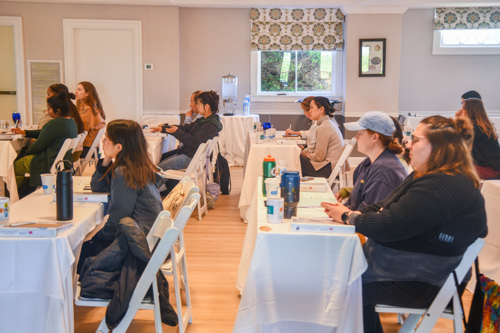 Chief residents combined lectures with skills training and group discussions during immersion training.
The Chief Resident Immersion Training in the Care of Older Adults program began in 2005 as an innovative way to address the geriatrician shortage by having experts educate chief residents. Caruso, who has been with the program since its inception, said they focused on chief residents because of their role teaching residents and medical students.
Modeled after BU and BMC’s CRIT in Addiction Medicine that marked its 25th anniversary this spring, the geriatrics conference taps into the teaching and administrative roles of chief residents through lectures, skills training, and group discussions to inform them about the principles of caring for older adults as well as strengthening leadership, teaching skills, and collaboration across disciplines. Funded by BMC’s Office of Graduate Medical Education, the CRIT geriatric program originated at BU/BMC and has since gone national with 34 hospitals adopting similar immersion training programs.
The core principles of geriatric care include matching treatment to patient’s desired health outcomes and care preferences; prescribing medications that are not riskier than necessary and don’t interfere with other treatment goals; putting an emphasis on helping patients move safely every day; and identifying, preventing, and managing dementia, depression, and delirium. It’s a holistic approach that geriatricians say helps make their jobs feel satisfying.
“Medicine in general is very algorithmic: someone has a problem, you do something to make it better,” said CRIT faculty Nicole Mushero, MD, PhD, assistant professor of medicine at the Chobanian & Avedisian School of Medicine, and a BMC geriatrician. But older adults are more at risk for bad outcomes, adverse effects of medications and treatments, and there is a heightened need to consider each patient on an individual basis.
“Maybe they don’t want the surgery. Maybe they don’t want this procedure. Maybe they don’t want this medication. We need to understand what is right for their goals and health outcomes,” said Mushero. “I always say, ‘I love not doing things.’ That’s one of my favorite things about geriatrics.”
“This conference helped reinforce best practices for approaching geriatric patients—it’s not a one-size-fits-all approach,” agreed Eric Beltrami, MD, a dermatology chief resident. As chief resident, he is responsible for 15 residents in that specialty, and Beltrami said he appreciated both the leadership and practical skills components of the training.
BMC is considered a leader in geriatric care. Named one of the top programs in the country by U.S. News & World Report for the last two years, it has the nation’s oldest home-based geriatric primary care program.
Integral to CRIT training are modules where groups of chief residents, led by faculty, follow the case study of a fictional patient from admission to discharge.
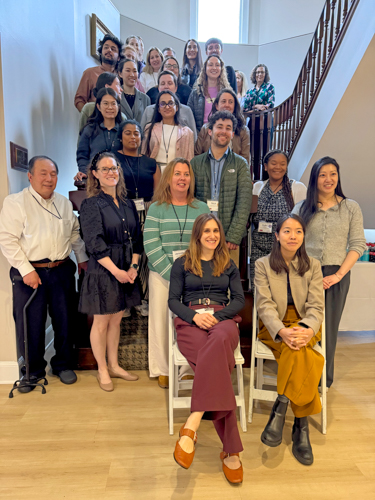 Nineteen chief residents from seven medical specialties attended this year’s CRIT.
“We see a lot of geriatric patients, in both the outpatient and inpatient settings, but there’s often not that much time to talk in depth about their issues and the different ways that you may want to treat them that you wouldn’t think about with younger patients,” said family medicine chief resident Anna Rahrick, MD.
Concentrating on one fictional patient through the stages of hospitalization gives chief residents the time to consider options and alternatives that they normally don’t have the opportunity to explore, said Caruso.
“They don’t have 16 patients that they’re trying to manage. They just have one over a two-day span,” said Caruso. “They can take their time to consult their peers and expert geriatricians to consider the best ways to manage this complicated fictional patient.”
There were seven medical specialties represented at this year’s CRIT, with 19 chief residents and three program director/faculty mentors. In the case study modules, the chief residents heard patient progress analyzed from many more viewpoints than they would in a real patient conference. Specialists discussed post-surgery delirium, continued pain, medications, and discharge options that might otherwise be handled by a case manager or passed on to another physician.
“It gives depth to their specialty that they typically don’t have the time to appreciate,” said Caruso. And it cultivates teamwork.
“I think probably the most useful thing, long term, is realizing what my resources are. Who can I call? Who can I ask for help? What resources and policies does the hospital have that I can draw on,” said OB/GYN chief resident Navya Kumar, MD.
CRIT faculty praised program directors who oversee chief residents in each specialty and encouraged them to attend the immersion training.
“The program directors have been invested. They have adopted different action plans and quality projects and taken the curriculum back to their own programs and promoted it,” said Caruso. They send their chief residents to CRIT each year to fill education gaps in their residency programs and to help prepare them to teach residents.
Monica Hogan, NP, is a certified gerontological nurse practitioner in BMC’s home-based geriatric primary care program. She has been a CRIT faculty member for 18 years and has seen a heightened awareness by health professionals of the special needs of the geriatric community. She said CRIT training has had an impact.
“I definitely see there are many more providers who are geriatric friendly…thinking of what matters most to the patient and the goals of care,” she said. “You see it reflected in the way residents are trained. I feel we have some really strong advocates in the medical specialties.”