Armenian Healthcare Summit Spotlights Boston University/HENAR Programs
The World Health Organization and the nonprofit Health Network for Armenia (HENAR) Foundation convened a Healthcare Policy Summit in January 2026 in the capital city of Yerevan.
Participants in the summit included representatives from the Boston University-Armenia Medical Partnership (BU-AMP), a multidisciplinary program coordinating collaboration between the Chobanian & Avedisian School of Medicine and health policy and healthcare entities in Armenia; the Armenian ministries of health and education; Yerevan State Medical University; the Armenian National Institute of Health; the Asian Development Bank; and many Yerevan hospitals focused on linking Armenia’s universal healthcare and primary healthcare reform agendas to health workforce development by upgrading postgraduate medical education.
Founded in 2021, the HENAR Foundation is working to deliver better value, better care, and better health for current and future generations of Armenians. Cofounder Arman Voskerchyan opened the summit, pointing out the importance of identifying key gaps and bottlenecks related to healthcare standards, training environments, licensing, accreditation, faculty capacity, and healthcare workforce distribution.
The initial phase of the country’s universal healthcare plan rolled out in January. Armenian First Deputy Minister of Health Lena Nanushyan told the summit the government now provides many healthcare services free of charge for the disabled, children under 18, the poor, and those over 65, but still cannot afford to pay for key services including most lab draws, x-rays and advanced imaging, and all but very basic medications. Nanushyan explained that plans for the next several years are to gradually extend the range of services to these groups and then slowly expand coverage to all Armenians.
“The Armenian government has been continuously working to address gaps in healthcare…and we have learned that you cannot tackle large problems in isolation; activities are interconnected, requiring a systems change,” said Nanushyan. “We want to ensure physicians graduate with strong, practical skills, so they can effectively address patients’ needs and deliver high-quality care.”
A key priority is competency-based medical residency programs.
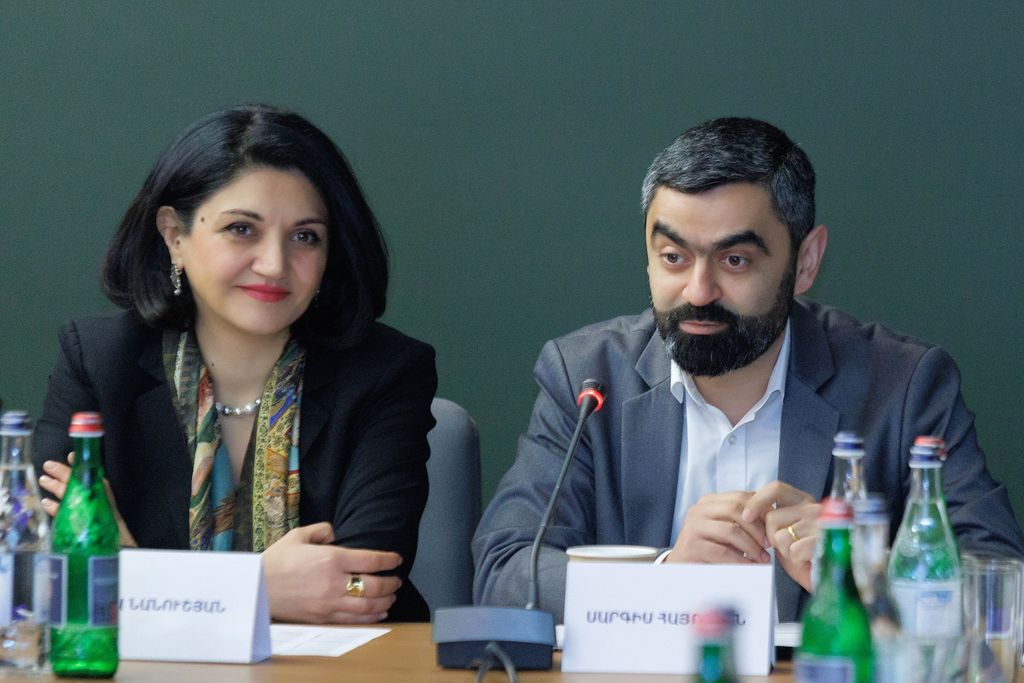 First Deputy Minister of Health Lena Nanushyan (left) and Deputy Minister of Education Sargis Hayotsyan (right)
Sargis Hayotsyan, Armenia’s deputy minister of education and chairman of the country’s Higher Education and Science Committee, said his ministry’s main goal at the summit was “to better understand how residency education is perceived within the policymaker community and among our international partners, and to present the regulatory provisions outlined in the Law on Higher Education and Science.”
Jeff Markuns, MD, associate professor of medicine and executive director of the BU family medicine department’s Global Health Collaborative, outlined a phased strategy for healthcare personnel capacity building by first developing a core group of educational “champions” made up of postdoctoral faculty and healthcare leaders, then helping them design and oversee new competency-based curricula while strengthening faculty through targeted development programs. Markuns stressed the importance of having measurable goals and evaluations, strong accreditation systems, and mechanisms to sustain skills over time.
Henry Louis, MD, HENAR’s director of the master’s degree in health professions education program in Armenia, noted the program’s success in training faculty to introduce and apply the principles and practices of a competency-based medical education across residency disciplines as diverse as pediatric infectious diseases, family medicine, and orthopedic surgery. Recently, Boston University, working with HENAR, BU-AMP, and the Armenian-American Medical Association of Greater Boston, launched two new programs. A Rural Family Medicine Fellowship initiated in 2024 provides additional training to new doctors working in rural areas, and a master’s degree program started in 2025 trains healthcare leaders and medical school faculty on effective medical education.
The HENAR Foundation also recently announced expansion of their Community Health Worker Program in the southernmost province of Armenia. What started with three villages in 2024 now includes four additional villages, thanks to funding from the John and Hasmik Mgrdichian Foundation. A full-day’s journey from Yerevan, the villages sit close to the borders with Azerbaijan and Iran. Community health workers are community members trained to provide health services and bridge gaps between communities and formal healthcare systems. They directly represent the communities in which they work, providing basic medical and psycho-social services.
“Community health worker programs are so important to delivering quality healthcare in underserved areas,” said Aram Kaligian, MD, director of the BU-AMP.