Doctoring
Doctoring 1 is a year-long course in the first year where students learn foundational doctoring skills. The primary purpose of Doctoring 1 is to advance students’ skills in the ten doctoring domains (see below). Through the multiple components of the course, students will learn and practice medical interviewing, physical examination skills and clinical reasoning. They will explore relational competence in both direct patient care and in the small group role plays. Students will learn how to gather data during a medical encounter, including a structured approach to chronological history taking for the history of present illness and details of the additional components (ex. past medical history, past surgical history, family history, social history, allergies, medications, review of systems). Students will learn and practice physical examination techniques in small groups and in clinical encounters. These skills culminate in a systematic approach to the head-to-toe physical examination at the end of the second module.
As the course progresses and students enter their systems based PISCEs modules, students will build off their foundational physical exam skills to learn more advanced skills and physical diagnosis in the system they are learning about in their PISCEs course and this will continue into Doctoring 2. Students will develop the skills of communicating the components of the medical encounter in standard oral and written format. Additionally, oral presentation skills of research topics will be taught and evaluated in small groups. As the course progresses, clinical reasoning aka “how doctors think” will be utilized in evaluating symptom presentations. In all aspects of the course, health equity and disparities will be a lens students will use to reflect on their own backgrounds, on the lived experiences of their patients, and on their role as developing clinicians.
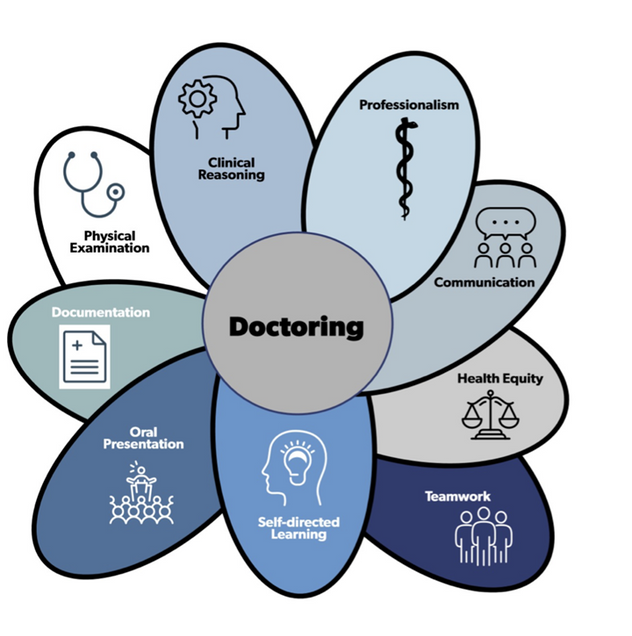
Doctoring 2 is a year-long course in the second year in which students build off their experience in Doctoring 1 enhancing their skills in the 10 doctoring domains. The course is structured in case-based small groups with a faculty member that allow practice of advanced communication and physical examination skills, as well as clinical reasoning skills. Some of the sessions will include actors or standardized patients to enhance the authenticity of the experiences. There will be a focus on hypothesis-driven data collection (i.e., asking history questions and performing physical examination maneuvers that increase or decrease the likelihood of the diseases on the differential diagnosis) and clinical reasoning. Students will refine and expand their case presentation and note-writing skills and be introduced to the electronic medical record. Cases will promote integration of foundational and social science topics and provide an opportunity for self-directed learning. Students will have a variety of additional simulation sessions and actor/standardized patient interviews to further their skills. They will continue their clinical placements with a longitudinal preceptor in the fall and will participate in hospital-based clinical encounters with 4th year medical student and faculty preceptors during the winter/spring to further advance their clinical skills in preparation for their clinical clerkships. Students will continue to work on their teamwork skills and competence in building a therapeutic alliance with patients and will reflect on topics surrounding professionalism, ethics, and professional identify formation.
Contact Information
Doctoring 1
Doctoring 2