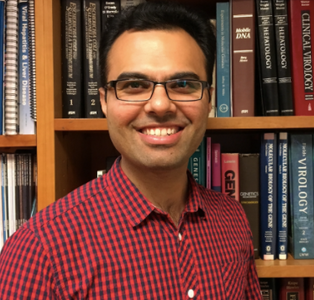
Mohsan Saeed
Associate Professor
Associate Professor
Biochemistry & Cell Biology
Virology, Immunology & Microbiology
See BU Profile for additional information
Our laboratory investigates the fascinating molecular strategies that positive-strand RNA viruses employ to overcome host defenses and establish productive infections. At the heart of this research is a fundamental question: How do viruses use their limited repertoire of proteins to manipulate the complex cellular machinery of their hosts?
A major challenge in defining the functions of viral proteins during infection is the availability of experimental systems that faithfully recapitulate infection while allowing precise genetic manipulation of the viral genome. Two essential pillars of our research are therefore the development of highly permissive, physiologically relevant infection models and robust reverse genetics platforms that enable us to engineer recombinant viruses carrying targeted loss-of-function mutations.
Armed with these experimental systems, we integrate molecular virology, biochemistry, proteomics, and large-scale genetic screens to uncover biologically meaningful virus–host interactions, identify viral virulence factors that subvert host defenses, and reveal viral and host vulnerabilities that can be exploited for therapeutic intervention.
Research Interests
1. Our flagship focus: Defining the viral degradome
We employ N-terminomics, a powerful mass spectrometry-based proteomics approach, to identify host proteins cleaved during viral infection. We then investigate how cleavage of these proteins drives innate immune evasion and cellular remodeling.
2. Mapping the viral interactome
We establish platforms to profile how viral proteins interact within infected cells. By genetically fusing affinity tags to viral proteins and performing temporal interactomics, we identify functional interacting partners and characterize their roles in infection.
3. Probing viral replication mechanisms
We investigate how viral proteins orchestrate core replicative processes—from viral RNA translation to replication organelle biogenesis to virion assembly— using high-resolution confocal microscopy, fluorescent in situ hybridization, and transmission electron microscopy.
4. Developing platforms for clinically relevant viral isolates
Many medically important viruses lack tractable cell culture systems and reverse genetics tools. We build these essential platforms to enable rigorous laboratory investigation of clinical isolates without introducing adaptive changes from prolonged culture.
Selected Publications
- Caobi A, Su CM, Beusch CM, Kenney D, Darling TL, Feng S, Semaan M, Wacquiez A, Sanders NL, Tully ES, Chen DY, Evdokimova M, Ding Z, Caobi A, Jones D, Alysandratos KD, Mizgerd JP, Kirchdoerfer RN, Kotton DN, Douam F, Crossland NA, Boon ACM, Gordong DE, Baker SC, Saeed M. SARS-CoV-2 nsp15 enhances viral virulence by subverting host antiviral defenses. 2025. Proc Natl Acad Sci U S A.
- Datta S, Chen DY, Tavares AH, Reyes-Robles T, Ryu KA, Khan N, Bechtel TJ, Bertoch JM, White CH, Hazuda DJ, Vora KA, Hett EC, Fadeyi OO*, Oslund RC*, Emili A*, Saeed M*. High resolution photocatalytic mapping of SARS-CoV-2 spike interactions on the cell surface. 2023. Cell Chemical Biology. *Co-corresponding authors
- Chen DY, Chin CV, Kenney D, Tavares AH, Khan N, Conway HL, Liu G, Choudhary MC, Gertje HP, O’Connell AK, Adams S, Kotton DN, Herrmann A, Ensser A, Connor JH, Bosmann M, Li JZ, Gack MU, Baker SC, Kirchdoerfer RN, Kataria Y, Crossland NA, Douam F, Saeed M. Spike and nsp6 are key determinants of SARS-CoV-2 Omicron BA.1 attenuation. 2023. Nature.
- Weingarten-Gabbay S*, Klaeger S*, Sarkizova S, Pearlman LR, Chen DY, Bauer MR, Taylor HB, Conway HL, Tomkins-Tinch CH, Finkel Y, Nachshon A, Gentili M, Rivera KD, Keskin DB, Rice CM, Clauser KR, Hacohen N, Carr SA, Abelin JG, Saeed M*, Sabeti PC. Profiling SARS-CoV-2 HLA-I peptidome reveals T cell epitopes from out-of-frame ORFs. 2021. Cell. *Co-corresponding authors
- Saeed M*, Kapell S, Hertz NT, Wu X, Bell K, Ashbrook AW, Mark MT, Zebroski HA, Neal ML, Flodström-Tullberg M, MacDonald MR, Aitchison JD, Molina H, Rice CM*. Defining the proteolytic landscape during enterovirus infection. 2020. PLoS Pathogens. *Co-corresponding authors
- Saeed M, Andreo U, Chung HY, Espiritu C, Branch AD, Silva JM, Rice CM. SEC14L2 enables pan-genotype HCV replication in cell culture. 2015. Nature.