Framingham Heart Study Brain Aging Program to Host Clinical Neuropathology Case Conference
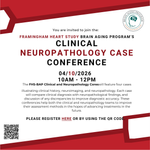
The Framingham Heart Study Brain Aging Program will host its upcoming Clinical Neuropathology Case Conference on April 10, 2026, from 10:00 AM to 12:00 PM.
This interactive session, organize
d by the program’s Clinical and Neuropathology Cores, will feature four compelling cases highlighting clinical history, neuroimaging, and neuropathological findings. Each case will explore the alignment—and at times discrepancy—between clinical diagnoses and neuropathological outcomes, fostering discussion aimed at improving diagnostic accuracy.
These conferences play a vital role in strengthening collaboration between clinical and neuropathology teams, ultimately contributing to more precise assessment methods and advancing future treatments in brain aging and neurodegenerative disease.
The event will be held virtually. Registration is required.
https://bu-hipaa.zoom.us/webinar/register/WN_6WHzlVaCRTKns67a9Sv-EQ#/registration
APOE genotype-specific methylation patterns are linked to Alzheimer disease pathology and estrogen response
Abstract
The joint effects of APOE genotype and DNA methylation on Alzheimer disease (AD) risk is relatively unknown. We conducted genome-wide methylation analyses using 2,021 samples in blood (91 AD cases, 329 mild cognitive impairment, 1,391 controls) and 697 samples in brain (417 AD cases, 280 controls). We identified differentially methylated levels in AD compared to controls in an APOE genotype-specific manner at 25 cytosine-phosphate-guanine (CpG) sites in brain and 36 CpG sites in blood. Additionally, we identified seven CpG sites in the APOE region containing TOMM40, APOE, and APOC1 genes with P < 5 × 10⁻⁸ between APOE ε4 carriers and non-carriers in brain or blood. In brain, the most significant CpG site hypomethylated in ε4 carriers compared to non-carriers was from the TOMM40 in the total sample, while most of the evidence was derived from AD cases. However, the CpG site was not significantly modulating expression of these three genes in brain. Three CpG sites from the APOE were hypermethylated in APOE ε4 carriers in brain or blood compared in ε4 non-carriers and nominally significant with APOE expression in brain. Three CpG sites from the APOC1 were hypermethylated in blood, which one of the 3 CpG sites significantly lowered APOC1 expression in blood using all subjects or ε4 non-carriers. Co-methylation network analysis in blood and brain detected eight methylation networks associated with AD and APOE ε4 status. Five of the eight networks included genes containing network CpGs that were significantly enriched for estradiol perturbation, where four of the five networks were enriched for the estrogen response pathway. Our findings provide further evidence of the role of APOE genotype on methylation levels associated with AD, especially linked to estrogen response pathway.
DREAMER: a computational framework to evaluate readiness of datasets for machine learning
Abstract
Background: Machine learning (ML) has emerged as the predominant computational paradigm for analyzing large-scale datasets across diverse domains. The assessment of dataset quality stands as a pivotal precursor to the successful deployment of ML models. In this study, we introduce DREAMER (Data REAdiness for MachinE learning Research), an algorithmic framework leveraging supervised and unsupervised machine learning techniques to autonomously evaluate the suitability of tabular datasets for ML model development. DREAMER is openly accessible as a tool on GitHub and Docker, facilitating its adoption and further refinement within the research community..
Results: The proposed model in this study was applied to three distinct tabular datasets, resulting in notable enhancements in their quality with respect to readiness for ML tasks, as assessed through established data quality metrics. Our findings demonstrate the efficacy of the framework in substantially augmenting the original dataset quality, achieved through the elimination of extraneous features and rows. This refinement yielded improved accuracy across both supervised and unsupervised learning methodologies.
Conclusion: Our software presents an automated framework for data readiness, aimed at enhancing the integrity of raw datasets to facilitate robust utilization within ML pipelines. Through our proposed framework, we streamline the original dataset, resulting in enhanced accuracy and efficiency within the associated ML algorithms.
Asian Cohort for Alzheimer’s Disease (ACAD) pilot study on genetic and non-genetic risk factors for Alzheimer’s disease among Asian Americans and Canadian
Abstract
Introduction: Clinical research in Alzheimer's disease (AD) lacks cohort diversity despite being a global health crisis. The Asian Cohort for Alzheimer's Disease (ACAD) was formed to address underrepresentation of Asians in research, and limited understanding of how genetics and non-genetic/lifestyle factors impact this multi-ethnic population.
Methods: The ACAD started fully recruiting in October 2021 with one central coordination site, eight recruitment sites, and two analysis sites. We developed a comprehensive study protocol for outreach and recruitment, an extensive data collection packet, and a centralized data management system, in English, Chinese, Korean, and Vietnamese.
Results: ACAD has recruited 606 participants with an additional 900 expressing interest in enrollment since program inception.
Discussion: ACAD's traction indicates the feasibility of recruiting Asians for clinical research to enhance understanding of AD risk factors. ACAD will recruit > 5000 participants to identify genetic and non-genetic/lifestyle AD risk factors, establish blood biomarker levels for AD diagnosis, and facilitate clinical trial readiness.
Highlights: The Asian Cohort for Alzheimer's Disease (ACAD) promotes awareness of under-investment in clinical research for Asians. We are recruiting Asian Americans and Canadians for novel insights into Alzheimer's disease. We describe culturally appropriate recruitment strategies and data collection protocol. ACAD addresses challenges of recruitment from heterogeneous Asian subcommunities. We aim to implement a successful recruitment program that enrolls across three Asian subcommunities.
Relative Contributions of Mixed Pathologies to Cognitive and Functional Symptoms in Brain Donors Exposed to Repetitive Head Impacts
Abstract
Objective: Exposure to repetitive head impacts (RHI) is associated with later-life cognitive symptoms and neuropathologies, including chronic traumatic encephalopathy (CTE). Cognitive decline in community cohorts is often due to multiple pathologies; however, the frequency and contributions of these pathologies to cognitive impairment in people exposed to RHI are unknown. Here, we examined the relative contributions of 13 neuropathologies to cognitive symptoms and dementia in RHI-exposed brain donors.
Methods: Neuropathologists examined brain tissue from 571 RHI-exposed donors and assessed for the presence of 13 neuropathologies, including CTE, Alzheimer disease (AD), Lewy body disease (LBD), and transactive response DNA-binding protein 43 (TDP-43) inclusions. Cognitive status was assessed by presence of dementia, Functional Activities Questionnaire, and Cognitive Difficulties Scale. Spearman rho was calculated to assess intercorrelation of pathologies. Additionally, frequencies of pathological co-occurrence were compared to a simulated distribution assuming no intercorrelation. Logistic and linear regressions tested associations between neuropathologies and dementia status and cognitive scale scores.
Results: The sample age range was 18-97 years (median = 65.0, interquartile range = 46.0-76.0). Of the donors, 77.2% had at least one moderate-severe neurodegenerative or cerebrovascular pathology. Stage III-IV CTE was the most common neurodegenerative disease (43.1%), followed by TDP-43 pathology, AD, and hippocampal sclerosis. Neuropathologies were intercorrelated, and there were fewer unique combinations than expected if pathologies were independent (p < 0.001). The greatest contributors to dementia were AD, neocortical LBD, hippocampal sclerosis, cerebral amyloid angiopathy, and CTE.
Interpretation: In this sample of RHI-exposed brain donors with wide-ranging ages, multiple neuropathologies were common and correlated. Mixed neuropathologies, including CTE, underlie cognitive impairment in contact sport athletes. ANN NEUROL 2024;95:314-324.
Blood-derived mitochondrial DNA copy number is associated with Alzheimer disease, Alzheimer-related biomarkers and serum metabolites
Abstract
Background: Blood-derived mitochondrial DNA copy number (mtDNA-CN) is a proxy measurement of mitochondrial function in the peripheral and central systems. Abnormal mtDNA-CN not only indicates impaired mtDNA replication and transcription machinery but also dysregulated biological processes such as energy and lipid metabolism. However, the relationship between mtDNA-CN and Alzheimer disease (AD) is unclear.
Methods: We performed two-sample Mendelian randomization (MR) using publicly available summary statistics from GWAS for mtDNA-CN and AD to investigate the causal relationship between mtDNA-CN and AD. We estimated mtDNA-CN using whole-genome sequence data from blood and brain samples of 13,799 individuals from the Alzheimer's Disease Sequencing Project. Linear and Cox proportional hazards models adjusting for age, sex, and study phase were used to assess the association of mtDNA-CN with AD. The association of AD biomarkers and serum metabolites with mtDNA-CN in blood was evaluated in Alzheimer's Disease Neuroimaging Initiative using linear regression. We conducted a causal mediation analysis to test the natural indirect effects of mtDNA-CN change on AD risk through the significantly associated biomarkers and metabolites.
Results: MR analysis suggested a causal relationship between decreased blood-derived mtDNA-CN and increased risk of AD (OR = 0.68; P = 0.013). Survival analysis showed that decreased mtDNA-CN was significantly associated with higher risk of conversion from mild cognitive impairment to AD (HR = 0.80; P = 0.002). We also identified significant associations of mtDNA-CN with brain FDG-PET (β = 0.103; P = 0.022), amyloid-PET (β = 0.117; P = 0.034), CSF amyloid-β (Aβ) 42/40 (β=-0.124; P = 0.017), CSF t-Tau (β = 0.128; P = 0.015), p-Tau (β = 0.140; P = 0.008), and plasma NFL (β=-0.124; P = 0.004) in females. Several lipid species, amino acids, biogenic amines in serum were also significantly associated with mtDNA-CN. Causal mediation analyses showed that about a third of the effect of mtDNA-CN on AD risk was mediated by plasma NFL (P = 0.009), and this effect was more significant in females (P < 0.005).
Conclusions: Our study indicates that mtDNA-CN measured in blood is predictive of AD and is associated with AD biomarkers including plasma NFL particularly in females. Further, we illustrate that decreased mtDNA-CN possibly increases AD risk through dysregulation of mitochondrial lipid metabolism and inflammation.
AI-based differential diagnosis of dementia etiologies on multimodal data
Abstract
Differential diagnosis of dementia remains a challenge in neurology due to symptom overlap across etiologies, yet it is crucial for formulating early, personalized management strategies. Here, we present an artificial intelligence (AI) model that harnesses a broad array of data, including demographics, individual and family medical history, medication use, neuropsychological assessments, functional evaluations and multimodal neuroimaging, to identify the etiologies contributing to dementia in individuals. The study, drawing on 51,269 participants across 9 independent, geographically diverse datasets, facilitated the identification of 10 distinct dementia etiologies. It aligns diagnoses with similar management strategies, ensuring robust predictions even with incomplete data. Our model achieved a microaveraged area under the receiver operating characteristic curve (AUROC) of 0.94 in classifying individuals with normal cognition, mild cognitive impairment and dementia. Also, the microaveraged AUROC was 0.96 in differentiating the dementia etiologies. Our model demonstrated proficiency in addressing mixed dementia cases, with a mean AUROC of 0.78 for two co-occurring pathologies. In a randomly selected subset of 100 cases, the AUROC of neurologist assessments augmented by our AI model exceeded neurologist-only evaluations by 26.25%. Furthermore, our model predictions aligned with biomarker evidence and its associations with different proteinopathies were substantiated through postmortem findings. Our framework has the potential to be integrated as a screening tool for dementia in clinical settings and drug trials. Further prospective studies are needed to confirm its ability to improve patient care.
Cognitive resilience to Alzheimer’s disease characterized by cell-type abundance
Abstract
Introduction: The molecular basis of cognitive resilience (CR) among pathologically confirmed Alzheimer's disease (AD) cases is not well understood.
Methods: Abundance of 13 cell types and neuronal subtypes in brain bulk RNA-seq data from the anterior caudate, dorsolateral prefrontal cortex (DLPFC), and posterior cingulate cortex (PCC) obtained from 434 AD cases, 318 cognitively resilient AD cases, and 188 controls in the Religious Orders Study and Rush Memory and Aging Project was estimated by deconvolution.
Results: PVALB+ neuron abundance was negatively associated with cognitive status and tau pathology in the DLPFC and PCC (Padj < 0.001) and the most reduced neuronal subtype in AD cases compared to controls in DLPFC (Padj = 8.4 × 10⁻⁷) and PCC (Padj = 0.0015). We identified genome-wide significant association of neuron abundance with TMEM106B single nucleotide polymorphism rs13237518 in PCC (p = 6.08 × 10⁻¹²). rs13237518 was also associated with amyloid beta (p = 0.0085) and tangles (p = 0.0073).
Discussion: High abundance of PVALB+ neurons may be a marker of CR. TMEM106B variants may influence CR independent of AD pathology.
Highlights: Neuron retention and a lack of astrocytosis are highly predictive of Alzheimer's disease (AD) resilience. PVALB+ GABAergic and RORB+ glutamatergic neurons are associated with cognitive status. A TMEM106B single nucleotide polymorphism is related to lower AD risk, higher neuron count, and increased AD pathology.
Whole-genome sequencing study in Koreans identifies novel loci for Alzheimer’s disease
Abstract
Introduction: The genetic basis of Alzheimer's disease (AD) in Koreans is poorly understood.
Methods: We performed an AD genome-wide association study using whole-genome sequence data from 3540 Koreans (1583 AD cases, 1957 controls) and single-nucleotide polymorphism array data from 2978 Japanese (1336 AD cases, 1642 controls). Significant findings were evaluated by pathway enrichment and differential gene expression analysis in brain tissue from controls and AD cases with and without dementia prior to death.
Results: We identified genome-wide significant associations with APOE in the total sample and ROCK2 (rs76484417, p = 2.71×10⁻⁸) among APOE ε4 non-carriers. A study-wide significant association was found with aggregated rare variants in MICALL1 (MICAL like 1) (p = 9.04×10⁻⁷). Several novel AD-associated genes, including ROCK2 and MICALL1, were differentially expressed in AD cases compared to controls (p < 3.33×10⁻³). ROCK2 was also differentially expressed between AD cases with and without dementia (p = 1.34×10⁻⁴).
Discussion: Our results provide insight into genetic mechanisms leading to AD and cognitive resilience in East Asians.
Highlights: Novel genome-wide significant associations for AD identified with ROCK2 and MICALL1. ROCK2 and MICALL1 are differentially expressed between AD cases and controls in the brain. This is the largest whole-genome-sequence study of AD in an East Asian population.
The Relationship between Framingham Stroke Risk Profile on Incident Dementia and Alzheimer’s Disease: A 40-Year Follow-Up Study Highlighting Female Vulnerability
Abstract
Objective:Sex differences in the association between cardiovascular risk factors and the incident all-cause dementia and the subtype Alzheimer's disease (AD) risk are unclear.
Methods:Framingham Heart Study (FHS) participants (n = 4,171, 54% women, aged 55 to 69 years) were included at baseline and followed up to 40 years. The Framingham Stroke Risk Profile (FSRP) was dichotomized into 2 levels (cutoff: 75th percentile of the FSRP z-scores). Cause-specific hazard models, with death as a competing event, and restricted mean survival time (RMST) model were used to analyze the association between FSRP levels and incident all-cause dementia and AD. Interactions between FSRP and sex were estimated, followed by a sex-stratified analysis to examine the sex modification effect.
Results:High FSRP was significantly associated with all-cause dementia (hazard ratio [HR] = 1.25, robust 95% confidence interval [CI] = 1.21 to 1.29, p < 0.001) and AD (HR = 1.58, robust 95% CI = 1.57 to 1.59, p < 0.001) in cause-specific hazard models. High FSRP was significantly associated with incident dementia (HR = 2.81, robust 95% CI = 2.75 to 2.87, p < 0.001) and AD (HR = 2.96, robust 95% CI = 2.36 to 3.71, p < 0.001) in women, but not in men. Results were consistent in the RMST models. Current diabetes and high systolic blood pressure as FSRP components were significantly associated with dementia and AD in women but not in men.
Interpretation:High FSRP in mid- to early late life is a critical risk factor for all-cause dementia and AD, particularly in women. Sex-specific interventions and further research to elucidate underlying mechanisms are warranted. ANN NEUROL 2024;96:1124-1134.
Comparison of Commonly Measured Plasma and Cerebrospinal Fluid Proteins and Their Significance for the Characterization of Cognitive Impairment Status
Abstract
Background: Although cerebrospinal fluid (CSF) amyloid-β42 peptide (Aβ42) and phosphorylated tau (p-tau) and blood p-tau are valuable for differential diagnosis of Alzheimer's disease (AD) from cognitively normal (CN) there is a lack of validated biomarkers for mild cognitive impairment (MCI).
Objective: This study sought to determine how plasma and CSF protein markers compared in the characterization of MCI and AD status.
Methods: This cohort study included Alzheimer's Disease Neuroimaging Initiative (ADNI) participants who had baseline levels of 75 proteins measured commonly in plasma and CSF (257 total, 46 CN, 143 MCI, and 68 AD). Logistic regression, least absolute shrinkage and selection operator (LASSO) and Random Forest (RF) methods were used to identify the protein candidates for the disease classification.
Results: We observed that six plasma proteins panel (APOE, AMBP, C3, IL16, IGFBP2, APOD) outperformed the seven CSF proteins panel (VEGFA, HGF, PRL, FABP3, FGF4, CD40, RETN) as well as AD markers (CSF p-tau and Aβ42) to distinguish the MCI from AD [area under the curve (AUC) = 0.75 (plasma proteins), AUC = 0.60 (CSF proteins) and AUC = 0.56 (CSF p-tau and Aβ42)]. Also, these six plasma proteins performed better than the CSF proteins and were in line with CSF p-tau and Aβ42 in differentiating CN versus MCI subjects [AUC = 0.89 (plasma proteins), AUC = 0.85 (CSF proteins) and AUC = 0.89 (CSF p-tau and Aβ42)]. These results were adjusted for age, sex, education, and APOEϵ4 genotype.
Conclusions: This study suggests that the combination of 6 plasma proteins can serve as an effective marker for differentiating MCI from AD and CN.