Framingham Heart Study Brain Aging Program to Host Clinical Neuropathology Case Conference
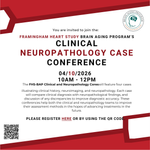
The Framingham Heart Study Brain Aging Program will host its upcoming Clinical Neuropathology Case Conference on April 10, 2026, from 10:00 AM to 12:00 PM.
This interactive session, organize
d by the program’s Clinical and Neuropathology Cores, will feature four compelling cases highlighting clinical history, neuroimaging, and neuropathological findings. Each case will explore the alignment—and at times discrepancy—between clinical diagnoses and neuropathological outcomes, fostering discussion aimed at improving diagnostic accuracy.
These conferences play a vital role in strengthening collaboration between clinical and neuropathology teams, ultimately contributing to more precise assessment methods and advancing future treatments in brain aging and neurodegenerative disease.
The event will be held virtually. Registration is required.
https://bu-hipaa.zoom.us/webinar/register/WN_6WHzlVaCRTKns67a9Sv-EQ#/registration
“It Will Make CTE a Treatable Disease”: The Race for a Diagnosis in Life
When you’re not feeling yourself, you hope your doctor can provide some answers. Maybe they can tell you what’s wrong, why it’s happening, and what can be done about it. Or, if they can’t zero in on a diagnosis, perhaps tests—blood work, scans, samples—can help fill in the gaps.
But what if a diagnosis never comes? What if you remain a medical mystery? For those worried that they might have chronic traumatic encephalopathy (CTE), a neurodegenerative disease caused by repeated hits to the head, a definitive resolution may remain out of reach.
CTE has become synonymous with collision-heavy sports like football and linked to a jumble of symptoms—memory loss, confusion, aggression, poor impulse control, slow movement, and more—but there is currently no way of diagnosing it in life. The only way to confirm if someone had the progressive disease is to examine their brain after death. That’s not much consolation if you suspect you or a loved one is suffering with it today.
In an age when brain scans can help identify Alzheimer’s disease, blood tests can spot cancer, and a clinical interview is all it takes to assess many psychiatric disorders, why does identifying CTE in the living remain so elusive?
| Read More: |
4th Annual FHS-BAP Virtual Symposium on “Inflammation, Immunity, and Alzheimer’s Disease: From Mechanisms to Potential Therapeutics”
May 10, 2024
Sponsored by BU Alzheimer's Disease Center, BU Evans Center for Interdisciplinary Biomedical Research, American Heart Association, and the Framingham Heart Study Brain Aging Program.
‘A living hell inside of my head’: For first time, more advanced stage of CTE diagnosed in teen football player
November 20, 2023
(CNN) In July 2019, just months after graduating from high school, 18-year-old Wyatt Bramwell took his own life. About a year later, researchers at Boston University diagnosed him with stage 2 chronic traumatic encephalopathy, known as CTE, caused by playing tackle football for several years.
Wyatt’s mother suspects that he knew what he was doing when he died.
“He shot himself in the heart, not the head,” Christie Bramwell said. It was her son’s dying wish to donate his brain to CTE research, and the only way to diagnose the disease is through an autopsy of the brain.
In Wyatt’s brain, researchers discovered the first case of stage 2 CTE to be diagnosed in a high school football player, according to Dr. Ann McKee, director of the Boston University CTE Center, who diagnosed Wyatt.
The Kansas City, Missouri, teen had the worst brain trauma ever seen in someone so young, according to the Concussion Legacy Foundation.
“This is an example of a person with fairly advanced damage to his brain, given that he only played amateur football and his highest level was high school,” McKee said.
Wyatt’s condition was caused by playing tackle football for about 10 years, including four years in high school, McKee says. Bramwell says he started playing flag football at 5 years old and advanced to tackle in the third grade.
Bramwell says she knew what CTE was but thought it was only found in older professional football players. She never imagined the disease would alter her life forever.
“I thought the worst thing that would ever happen to my kid maybe was a bad tackle. Something broken, something bleeding. That wasn’t the case.”
Dr. Rhoda Au Receives Prestigious Melvin R. Goodes Prize for Excellence in Alzheimer’s Drug Development
September 20, 2023
The Alzheimer's Drug Discovery Foundation's Goodes Prize supports researchers transforming the field by translating the biology of aging into new therapeutics and diagnostic tools
NEW YORK, Sept. 20, 2023 /PRNewswire/ -- The Alzheimer's Drug Discovery Foundation (ADDF) has presented Rhoda Au, PhD, MBA, Professor of Anatomy and Neurobiology at the Boston University Chobanian and Avedisian School of Medicine, with the 2023 Melvin R. Goodes Prize for Excellence in Alzheimer's Drug Development for her pioneering work with digital biomarkers. The annual award honors prominent scientists who are recognized for their work transforming the Alzheimer's clinical trial space and was presented at the Ninth Annual Melvin R. Goodes Prize Luncheon.
"Dr. Au's research is a critical part of this pivotal moment in Alzheimer's research," says Howard Fillit, MD, Co-Founder and Chief Science Officer at the ADDF. "Now that we are beginning to see drugs emerge on the market, it is more important than ever to have corresponding biomarkers that can help us identify which patients will benefit from the right drugs at the right time."
Dr. Au's groundbreaking work, supported through the ADDF's Diagnostics Accelerator, leverages technology from smartphones and tablets to collect data on Alzheimer's-related characteristics, which can help to detect Alzheimer's 20 to 30 years before symptoms present, paving the way for early diagnosis and intervention. Her work is part of the Diagnostics Accelerator's larger strategy to fast-track the development of accessible and non-invasive tools to revolutionize Alzheimer's diagnosis and treatment. Dr. Au is the first researcher with work focused on diagnostic technologies to receive the Goodes Prize.
The data collected by Dr. Au and her team is used to create digital profiles that can differentiate between people with stable cognition, cognitive decline, and dementia. Digital biomarkers like those being developed by Dr. Au will make it easier and more accessible to monitor for warning signs of dementia, enabling patients to be monitored in their own homes rather than having to commute to a physician's office. These biomarkers combine cutting-edge technologies with the latest insights into the biology of aging.
The Goodes Prize, named for Melvin R. Goodes, a distinguished leader in the pharmaceutical industry, is awarded each year to an innovative researcher who has made a significant and lasting impact in the Alzheimer's field. The prize includes $150,000 to further the awardee's research.
"Dr. Au and all connected with the ADDF sustain our hope that Alzheimer's may be more than treatable. It may also be preventable—and dare we dream—curable," says Nancy Goodes. "With the innovative science we have heard about from Dr. Au and our past winners today, it is easy to imagine that the next big breakthrough comes right here, through the ADDF and the Goodes Prize."
"It is an incredible honor to accept this award and be inducted into a group of past recipients that includes some of the greatest minds in the Alzheimer's field," says Dr. Au. "I am grateful for the generosity of the Goodes family and for this endorsement from the ADDF of the promise of our work. We believe digital biomarkers can revolutionize the way we diagnose this disease and improve clinical trials to get effective drugs to the patients who need them as quickly as possible."
Notable guests in attendance included Joel Ehrenkranz, Bonnie Pfeifer Evans, Nancy Goodes, Leonard A. Lauder, Jo Carole and Ronald S. Lauder, Marsha and Henry Laufer, Hilary and Wilbur Ross, Randal Sandler, Sharon Sager, and Alice Shure.
"My brother and I founded the ADDF because we saw the urgent need for effective treatments for Alzheimer's, which touches families all across the globe," says Ronald S. Lauder, Co-Founder and Co-Chairman of the ADDF. "This is why it is so meaningful to be here to celebrate an award that honors the world's top Alzheimer's researchers, who along with the leadership of the ADDF are changing the course of this disease."
The event featured a thought-provoking discussion on how the biology of aging is leading to promising therapies in the drug pipeline with Dr. Howard Fillit and current and previous Goodes Prize recipients: Roberta Diaz Brinton, PhD, Inaugural Director of the Center for Innovation in Brain Science at the University of Arizona and member of the ADDF's Board of Governors; Daniel Martin Watterson, PhD, John G. Searle Professor of Molecular Biology and Biochemistry and Professor of Pharmacology at the Northwestern University Feinberg School of Medicine; Jerri M. Rook, PhD, Research Associate Professor in the Department of Pharmacology at Vanderbilt University in the Vanderbilt Center for Neuroscience Drug Discovery; Miranda E. Orr, PhD, Assistant Professor of Gerontology and Geriatric Medicine at the Wake Forest University School of Medicine; and Rhoda Au, PhD, MBA, Professor of Anatomy and Neurobiology at the Boston University Chobanian and Avedisian School of Medicine.
ABOUT THE ALZHEIMER'S DRUG DISCOVERY FOUNDATION (ADDF)
Founded in 1998 by Leonard A. and Ronald S. Lauder, the Alzheimer's Drug Discovery Foundation is dedicated to rapidly accelerating the discovery of drugs to prevent, treat and cure Alzheimer's disease. The ADDF is the only public charity solely focused on funding the development of drugs for Alzheimer's, employing a venture philanthropy model to support research in academia and the biotech industry. The ADDF's leadership and contributions to the field have played a pivotal role in bringing the first Alzheimer's PET scan (Amyvid®) and blood test (PrecivityAD®) to market, as well as fueling the current robust and diverse drug pipeline. Through the generosity of its donors, the ADDF has awarded more than $270 million to fund over 730 Alzheimer's drug discovery programs, biomarker programs and clinical trials in 19 countries. To learn more, please visit: http://www.alzdiscovery.org/.
Dr. Richard Sherva | BU Precision Med in AD ARC Lecture Series
November 8, 2023
Dr. Richard Sherva presented," Genetic factors modulating both susceptibility to chronic viral infections and their effect on AD risk".
Dr. Sherva is an associate professor in the Department of Medicine in the Biomedical Genetics section at Boston University.
Dr. Benjamin Woolozin | BU Precision Med in AD ARC Lecture Series
September 13, 2023
Dr. Benjamin Woolozin presented, "RNA Methylation: A New Biomarker in AD".
Dr. Wolozin is a professor of pharmacology and neurology as well as a member of the Center for Systems Neuroscience and the Neurophotonics Center at Boston University in Massachusetts.
Dr. Gyungah Jun | BU Precision Med in AD ARC Lecture Series
October 11, 2023
Dr. Jun presented, "Our Contribution to APOE Research for Alzheimer’s Disease: Past, Current, and Future"
Dr. Jun is a globally renowned Alzheimer’s disease (AD) geneticist and an expert in analysis of “big data”. She is an associate professor in the Department of Medicine in the Biomedical Genetics section at Boston University.
3rd Annual FHS-BAP Virtual Symposium on Biomarkers and Translational Approaches to Alzheimer’s Disease and Related Disorders
April 11, 2023
Sponsored by BU Alzheimer's Disease Center, BU Evans Center for Interdisciplinary Biomedical Research, American Heart Association, and the Framingham Heart Study Brain Aging Program.
Identification of circRNAs linked to Alzheimer’s disease and related dementias
Puri S*, Hu J*, Sun Z, Lin M, Stern TD, Farrer LA, Wolozin B†, Zhang X†. Identification of circRNAs Linked to Alzheimer’s Disease and Related Dementias. Alzheimers Dement. 2023. Online ahead of print. (* equal contribution)
Examination of potentially modifiable dementia risk factors across the adult life course: The Framingham Heart Study
Devine S, Au R, Liu C. Examination of potentially modifiable dementia risk factors across the adult life course: The Framingham Heart Study. Alzheimers Dement. 2023. Online ahead of print.