Framingham Heart Study Brain Aging Program to Host Clinical Neuropathology Case Conference
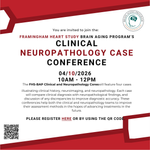
The Framingham Heart Study Brain Aging Program will host its upcoming Clinical Neuropathology Case Conference on April 10, 2026, from 10:00 AM to 12:00 PM.
This interactive session, organize
d by the program’s Clinical and Neuropathology Cores, will feature four compelling cases highlighting clinical history, neuroimaging, and neuropathological findings. Each case will explore the alignment—and at times discrepancy—between clinical diagnoses and neuropathological outcomes, fostering discussion aimed at improving diagnostic accuracy.
These conferences play a vital role in strengthening collaboration between clinical and neuropathology teams, ultimately contributing to more precise assessment methods and advancing future treatments in brain aging and neurodegenerative disease.
The event will be held virtually. Registration is required.
https://bu-hipaa.zoom.us/webinar/register/WN_6WHzlVaCRTKns67a9Sv-EQ#/registration
FHS-BAP Director Dr. Lindsay Farrer Named William Fairfield Warren Distinguished Professor

The Framingham Heart Study Brain Aging Program (FHS-BAP) is pleased to announce that its Director, Dr. Lindsay Farrer, has been named a William Fairfield Warren Distinguished Professor, Boston University's highest distinction for senior faculty.
Dr. Farrer is among five BU faculty members recognized for their outstanding contributions to research, scholarship, teaching, and service. His extensive research in the genetics of Alzheimer's disease and other complex disorders has helped identify genetic risk factors across diverse populations and advance our understanding of disease risk.
This prestigious appointment recognizes Dr. Farrer's longstanding contributions to scientific discovery, interdisciplinary collaboration, leadership, and mentorship.
Read the full announcement in BU Today.
Researchers Develop Improved Measure of Genetic Risk for Alzheimer’s Disease
August 27, 2026
Boston University researchers, including Framingham Heart Study Brain Aging Program investigator Lindsay A. Farrer, PhD, have developed and validated a new multi-ancestry polygenic risk score (PRS) for Alzheimer’s disease that improves risk prediction across diverse ancestral populations.
The study, published in Nature Genetics, used genetic data from diverse populations to create a more broadly applicable measure of genetic susceptibility to Alzheimer’s disease. The new PRS was more predictive of an Alzheimer’s diagnosis than previous scores developed using primarily individuals of European ancestry.
Researchers also examined the relationship between the new PRS and Alzheimer’s-related clinical, cognitive, imaging, biomarker, and neuropathological measures using data from several studies, including the Framingham Heart Study. Higher genetic risk was associated with poorer cognitive performance, reduced hippocampal volume, Alzheimer’s-related biomarkers, and steeper cognitive decline among individuals with very high risk scores.
The findings demonstrate the importance of including diverse populations in genetic research and may help improve long-term Alzheimer’s disease risk prediction, clinical trial recruitment, and future personalized prevention strategies.
Read the full story from Boston University Chobanian & Avedisian School of Medicine
FHS-BAP Receives $31.5 Million NIA Funding Renewal
The Framingham Heart Study Brain Aging Program (FHS-BAP) has received a $31.5 million, five-year funding renewal from the National Institute on Aging (NIA) to continue and expand research on brain aging, Alzheimer’s disease, and related dementias.
The renewal builds on decades of longitudinal data from the Framingham Heart Study, allowing researchers to investigate how cognitive impairment and dementia develop over time and to identify factors that may contribute to risk, resilience, and opportunities for earlier detection and prevention.
Advancing Brain Aging and Alzheimer’s Research
During the next five years, FHS-BAP will expand research across several areas, including vascular and inflammatory contributors to Alzheimer’s disease, genetic risk and resilience, and biomarkers that may help identify brain changes before symptoms become apparent.
The renewed program will also place increased emphasis on making curated FHS brain-aging data more accessible and usable for researchers and on supporting mentorship opportunities for early-career investigators.
Leadership for the Next Phase
The renewed program is led by Lindsay Farrer, PhD; Rhoda Au, PhD; Donald Lloyd-Jones, MD, ScM; and Jesse Mez, MD, MS.
The addition of Lloyd-Jones, Director of the Framingham Heart Study, and Mez, co-leader of the FHS-BAP Clinical Core, strengthens the connection between the Brain Aging Program and the broader Framingham Heart Study as FHS-BAP enters its next five-year funding cycle.
Media Coverage
Boston University’s The Brink recently featured the FHS-BAP funding renewal and spoke with program investigators about the research, resources, and priorities shaping the program’s next phase.
Research on Tap: The Framingham Heart Study — Three Generations, 78 Years of Data, and More to Discover
We are proud to be featured in Boston University's Research on Tap series, spotlighting the enduring legacy and ongoing impact of the Framingham Heart Study.
This landmark longitudinal study — now spanning 78 years, three generations, more than 15,000 participants, and over 2 million biosamples — has fundamentally reshaped our understanding of cardiovascular disease and continues to drive groundbreaking discoveries across a wide range of health conditions, including cognitive decline, dementia, osteoporosis, cancer, kidney and lung health, and more.
Join us for a special panel event:
Thursday, April 9 | 4–6 PM Kilachand Center Colloquium Room (Room 101), 610 Commonwealth Avenue, Boston, MA 02215
The event will bring together leading researchers to explore how decades of rigorous, population-based science have evolved into a collaborative network of studies — and to discuss new opportunities for interdisciplinary partnership.
Featured panelists include: Donald Lloyd-Jones, Rhoda Au, Lindsay Farrer, Jessica Fetterman, Douglas Kiel, Daniel Levy, Jesse Mez, Joanne Murabito, Matthew Nayor, George O'Connor, Nicole Spartano, Vanessa Xanthakis, and more.
For accessibility accommodations (ASL interpreters, CART), please contact research@bu.edu.
Health Economics Mini-Symposium on AD/ADRD Research

Boston University, in collaboration with the National Bureau of Economic Research Coordinating Center on the Economics of Alzheimer’s Disease and Alzheimer’s Disease–Related Dementias (AD/ADRD), will host a Health Economics of AD/ADRD Mini-Symposium on Thursday, April 23, 2026, from 1:00–2:30 PM (ET).
This virtual session, titled “What Am I Missing in ADRD Research that Should Matter to My Research in Health Economics?”, will examine how findings from ADRD research can inform health economics approaches to prevention, treatment, and care.
Speakers include Nilufer Ertekin-Taner, Sid O'Bryant, and Eric Reiman, followed by a panel discussion.
The event is sponsored by the Framingham Heart Study Brain Aging Program, the Boston University Evans Center for Interdisciplinary Biomedical Research, and the Boston University Alzheimer’s Disease Research Center.
Participation is free, but registration is required.
Register here: https://bostonu.zoom.us/webinar/register/WN_6j9D4CXfSbiLS8mWvZ5odQ
For questions, please contact Maria Dudek at medudek@bu.edu
Register Now: 6th Annual FHS Brain Aging Program Symposium
The Boston University Framingham Heart Study Brain Aging Program is pleased to announce its 6th Annual Symposium, taking place virtually on Wednesday, April 29, 2026, from 12:00–4:00 PM (EST).
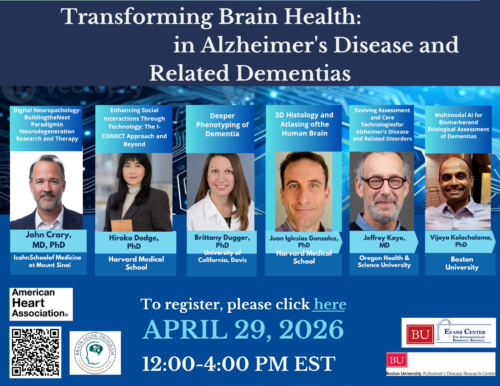
This year’s theme, “Transforming Brain Health: Digital Approaches in Alzheimer’s Disease and Related Dementias,” will spotlight cutting-edge research at the intersection of technology and brain health. The symposium will feature six internationally renowned speakers presenting innovative work aimed at advancing understanding and care in Alzheimer’s disease and related dementias.
This event offers a valuable opportunity for researchers, clinicians, and trainees to engage with emerging digital approaches shaping the future of brain aging and neurodegenerative disease research.
Participation is free, but registration is required.
For questions about the event, please contact Maria Dudek at
Framingham Heart Study Brain Aging Program to Host Clinical Neuropathology Case Conference
The Framingham Heart Study Brain Aging Program will host its upcoming Clinical Neuropathology Case Conference on April 10, 2026, from 10:00 AM to 12:00 PM.
This interactive session, organized by the program’s Clinical and Neuropathology Cores, will feature four compelling cases highlighting clinical history, neuroimaging, and neuropathological findings. Each case will explore the alignment—and at times discrepancy—between clinical diagnoses and neuropathological outcomes, fostering discussion aimed at improving diagnostic accuracy.
These conferences play a vital role in strengthening collaboration between clinical and neuropathology teams, ultimately contributing to more precise assessment methods and advancing future treatments in brain aging and neurodegenerative disease.
The event will be held virtually. Registration is required.
How the Framingham Heart Study Has Revolutionized Healthcare — 10 Groundbreaking Moments
The Framingham Heart Study, led by Boston University, has been reshaping how the world understands heart disease, brain aging, and human health for over 78 years — and a major new feature in BU's The Brink highlights just how profound that impact has been.
The article spotlights 10 of the study's most groundbreaking contributions to medicine, drawn from a deep dive in the Journal of the American College of Cardiology. At the center of it all: the discovery that cholesterol, blood pressure, diabetes, smoking, diet, and sedentary lifestyle are the core risk factors for cardiovascular disease — insights that have saved millions of lives around the world.
A Study That Keeps Evolving
Now spanning more than 15,000 participants across three generations, the Framingham Heart Study continues to break new ground. In January 2025, Dr. Donald Lloyd-Jones — a past president of the American Heart Association and chief of preventive medicine at BU's Chobanian & Avedisian School of Medicine — became the study's sixth principal investigator.
AI Meets Brain Aging
One of the study's most exciting recent frontiers is the intersection of artificial intelligence and cognitive health. Dr. Rhoda Au, Professor of Anatomy and Neurobiology at BU, has been collecting and analyzing digital voice recordings of older Framingham participants — uncovering subtle speech patterns that may signal cognitive impairments likely to progress to dementia. In collaboration with researchers at the BU Rafik B. Hariri Institute for Computing and Computational Science & Engineering, Dr. Au helped develop an AI program with the potential to predict a patient's likelihood of developing Alzheimer's disease years before symptoms appear.
Read the Full Story: 10 Ways the Framingham Heart Study Has Revolutionized Healthcare – BU The Brink
Dr. Rhoda Au Co-Authors Landmark Study on AI and Multi-Modal Digital Biomarkers for Alzheimer’s Detection
Our own Dr. Rhoda Au is at the forefront of a major shift in how Alzheimer's disease may one day be detected — earlier, more accurately, and right from a smartphone.
A study published in the Journal of Prevention of Alzheimer's Disease (Volume 13, January 2026), co-authored by Dr. Au, examines how digital technologies are opening new doors for detecting Alzheimer's disease and related dementias (ADRD) far earlier than traditional methods allow.
Beyond Traditional Testing
For decades, diagnosing Alzheimer's has relied on in-person, paper-based neuropsychological assessments — valuable tools, but ones with clear limitations in scale, sensitivity, and early detection. The new research demonstrates how AI-powered analysis of digital voice recordings and ocular (eye) scans can capture cognitive and behavioral changes with far greater precision, offering a scalable path to earlier intervention.
The Power of Multiple Signals
One of the study's key insights is the growing importance of combining multiple types of data. While speech analysis alone has shown strong early promise, the research points to a rapidly emerging frontier: multi-modal sensors embedded in everyday smartphones and internet-connected devices that can collect a rich picture of brain health over time — no clinic visit required.
Dr. Au and her co-authors highlight AI-analyzed speech as a particularly promising avenue, building on years of Framingham Heart Study voice recording data, where subtle changes in language patterns have been linked to future cognitive decline.
Why This Matters
Early detection is everything in Alzheimer's care. The ability to identify at-risk individuals before significant symptoms emerge — using tools as accessible as a phone — could transform how the disease is managed and ultimately prevented.
This work is part of Dr. Au's broader mission through the Framingham Heart Study Brain Aging Program (FHS-BAP) to pioneer a new era of precision brain health.
Read the study in the Journal of Prevention of Alzheimer's Disease
Digital neuropsychological measures by defense automated neurocognitive assessment: reference values and clinical correlates
Abstract
Introduction: Although the growth of digital tools for cognitive health assessment, there's a lack of known reference values and clinical implications for these digital methods. This study aims to establish reference values for digital neuropsychological measures obtained through the smartphone-based cognitive assessment application, Defense Automated Neurocognitive Assessment (DANA), and to identify clinical risk factors associated with these measures.
Methods: The sample included 932 cognitively intact participants from the Framingham Heart Study, who completed at least one DANA task. Participants were stratified into subgroups based on sex and three age groups. Reference values were established for digital cognitive assessments within each age group, divided by sex, at the 2.5th, 25th, 50th, 75th, and 97.5th percentile thresholds. To validate these values, 57 cognitively intact participants from Boston University Alzheimer's Disease Research Center were included. Associations between 19 clinical risk factors and these digital neuropsychological measures were examined by a backward elimination strategy.
Results: Age- and sex-specific reference values were generated for three DANA tasks. Participants below 60 had median response times for the Go-No-Go task of 796 ms (men) and 823 ms (women), with age-related increases in both sexes. Validation cohort results mostly aligned with these references. Different tasks showed unique clinical correlations. For instance, response time in the Code Substitution task correlated positively with total cholesterol and diabetes, but negatively with high-density lipoprotein and low-density lipoprotein cholesterol levels, and triglycerides.
Discussion: This study established and validated reference values for digital neuropsychological measures of DANA in cognitively intact white participants, potentially improving their use in future clinical studies and practice.