Student Updates
New Method for Evaluating Cancer Risk of Chemicals is Quick, Precise, Inexpensive
Researchers from Boston University Schools of Medicine and Public Health have developed and evaluated a fast, accurate and cost-effective approach to assessing the carcinogenicity of chemicals—that is, whether exposure to a chemical increases a person’s long-term cancer risk. As a result, they have generated one of the largest toxicogenomics datasets to date, and have made the data and results publicly accessible through a web portal at carcinogenome.org.
Despite significant investments into cancer research over the last decades, approximately 1.7 million new cancer cases and 600,000 cancers deaths were estimated in the U.S. in 2017 alone. Of these, 90-95 percent were not attributable to known heritable genetic factors, making environmental exposures a major suspect in these cases.
The researchers exposed human cell lines to hundreds of individual chemicals known to be carcinogens and non-carcinogens. They then generated gene expression profiles from the exposed cell lines, and the profiles (signatures) were input to a machine learning algorithm, (a computer model), that was trained to distinguish between carcinogens and non-carcinogens. The accuracy of the model was then evaluated by testing its capability of correctly ‘guessing’ the carcinogenicity of known chemicals.
According to the researchers, of the tens of thousands of chemicals in commercial use, only a small number (less than two percent) have been thoroughly tested for their potential carcinogenicity, in part due to the extremely costly and time-consuming nature of the current chemical screening process. “The method we developed, once further optimized and validated, would provide for a fast and cost-effective approach to the prioritization of chemicals for further (more expensive/extensive) testing. Additionally, our approach could be easily extended to evaluate adverse effects of exposure other than carcinogenicity such as endocrine disruption, metabolic disruption, etc.,” explained corresponding author Stefano Monti, PhD, associate professor of medicine at BUSM.
Although more work needs to be done before this approach can be applied in regulatory and clinical settings, the researchers hope this study will stimulate others to take on the challenge and to join the effort to develop more cost-effective approaches to chemical screening and the consequent elimination of hazardous substances from the environment.
The study involved collaborators at the National Toxicology Program/The National Institute of Environmental Health Sciences and at the Broad Institute of Massachusetts Institute of Technology MIT and Harvard.
These findings appear online in the journal Environmental Health Perspectives.
Funding for this study was supported in part by the Find the Cause Breast Cancer Foundation; the Evans Center for Interdisciplinary Biomedical Research ARC on “Genomics Models of Environmental Chemical Carcinogenicity” at Boston University; the Superfund Research Program at Boston University (P42 ES007381-21); and a LINCS/NIEHS Admin Supplement (P42 ES007381-19S2).
GSDM Celebrates “Topping Off” of Addition, Renovation Construction Project
Wet weather couldn’t dampen spirits as the Henry M. Goldman School of Dental Medicine community gathered on Friday, March 29, 2019, to celebrate the “topping off” of the School’s Addition and Renovation Construction Project.
Huddled under umbrellas and clad in rain ponchos, a crowd of about 100 watched as a crane hoisted a large steel beam—painted white, covered in signatures, and adorned with an evergreen tree and an American flag—into the air and placed it onto the existing steel skeleton. Walking on the beam, two ironworkers from Ironworkers Local 7 secured the beam in place as the audience below cheered.
“Today’s ceremony is an opportunity to celebrate the truly remarkable work that has been completed to date,” said Dean Jeffrey W. Hutter. “It is also a moment to recognize and acknowledge the crew of workers who are on site every day – and in particular, the workers from Ironworkers Local 7, who have done an absolutely incredible job at erecting the steel skeleton for the additions to our building.”
A “Topping Off” ceremony celebrates the placement of a structure’s uppermost steel beam and dates back 1,000 years to ancient Scandinavia, when Viking chieftains would hoist an evergreen tree atop a newly finished building to celebrate its completion and appease the tree-dwelling spirits displaced during construction. In present day, ironworkers have carried on the tradition, as iron and steel have replaced timber as primary building materials for most buildings.
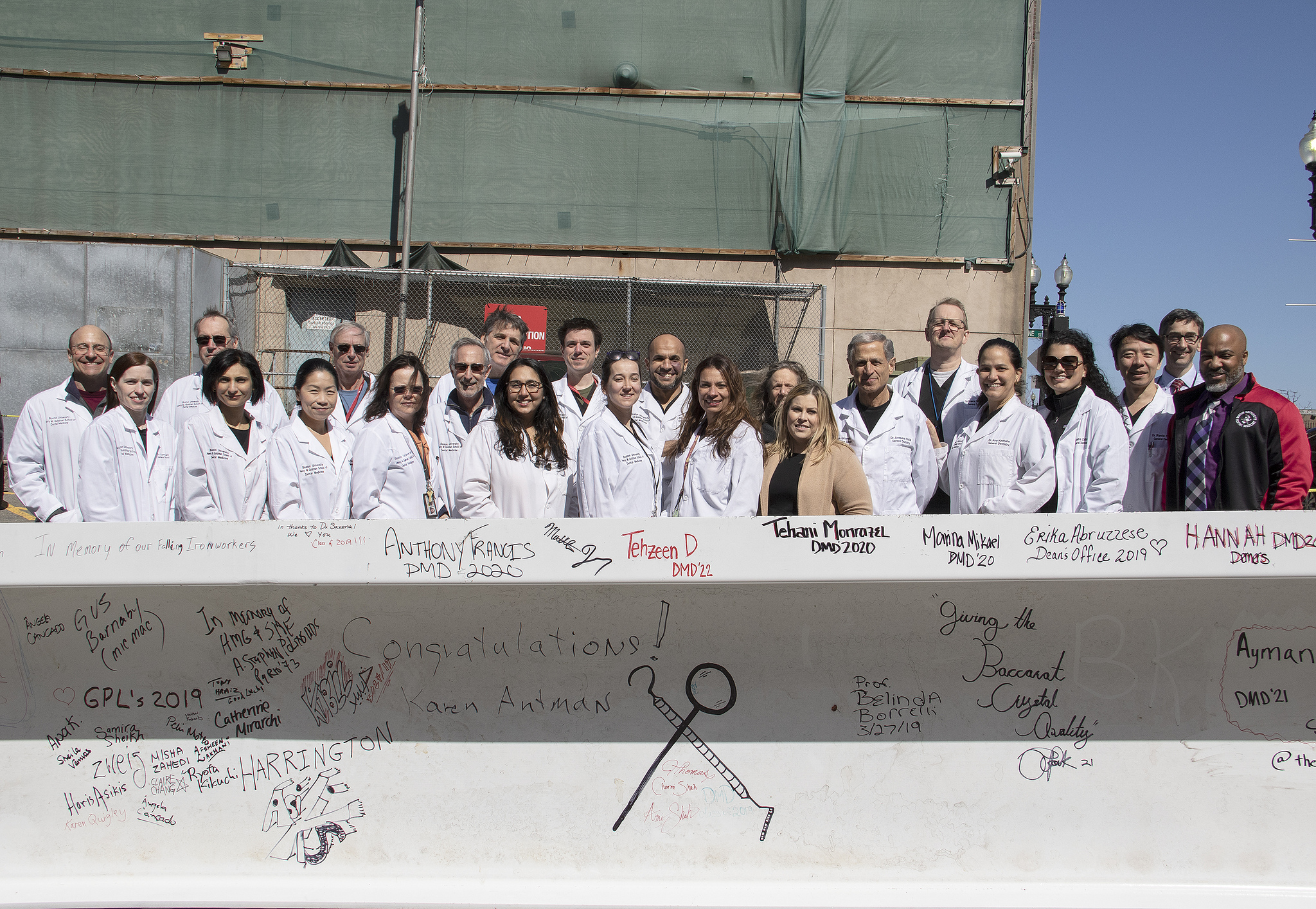 In the days leading up to the ceremony, members of the GSDM community—faculty, staff, students, residents, fellows, alumni, and others from Boston University, the City of Boston, SmithGroup, Compass Project Management, and Shawmut Design and Construction, who have all played an important role in the construction—were invited to sign the beam so that, according to Dean Hutter, “a small piece of each [of you] will be carried into the future of the new building.”
Kevin Honan, Massachusetts state representative of the Seventeenth Suffolk County District, consisting of Allston and Brighton, and newly appointed chair of the Commonwealth of Massachusetts Oral Health Caucus, attended the Topping Off ceremony and also had an opportunity to sign the beam before it was placed onto the structure.
The ceremony began with opening remarks from Dean Hutter. The audience then heard from Gary Nicksa, Boston University senior vice president for operations; David Johnson, SmithGroup vice president and higher education design strategist; Christy Murphy, senior project manager with Compass Project Management, Kevin Sullivan, vice president New England institutional for Shawmut Design & Construction. Jeremy Long, corporate safety director for Prime Steel Erecting, who spoke from his heart as to the skill and dedication of his fellow ironworkers, rounded out the speeches.
“We’ve created something incredible right here,” said Mr. Long. “I couldn’t be more proud to be here today, and to top off this project with each and every one of you.”
After the ceremony, the crowd moved inside the Henry M. Goldman School of Dental Medicine through the new Patient & Visitor Entrance into the new Patient Treatment Centers’ Waiting Area, which had been converted into a reception space complete with high-top tables and a buffet spread of light refreshments.
The ceremony took place a mere 51 weeks after the project’s groundbreaking ceremony. Since then, the school has unveiled a new Patient Treatment Centers’ Waiting Area and Patient & Visitor entrance on Albany Street as well as several new office suites on the first floor and a state-of-the-art central sterilization room in the basement.
When construction is completed, GSDM’s updated building will have 48,000 additional square feet and a new, contemporary façade. The building will house new administrative, instructional, and clinical spaces, as well as a 140-seat auditorium, a 100-chair technologically advanced Predoctoral Patient Treatment Center, a 117-station Simulation Learning Center, and space for collaboration and multifunctional learning. The building construction and renovation project is slated to be complete in February 2021.
For photos of the ceremony, please visit the Flickr album.
POV: We Need a Health New Deal Now
Inequality and climate change are threats to our physical well-being

In recent weeks, talk of a Green New Deal has entered the political debate, with the aim of overhauling the country’s transportation system, providing universal healthcare, creating a federal jobs guarantee, investing in infrastructure, and other goals reminiscent of the original New Deal.
Today, the United States is in the midst of a crisis larger than the Great Depression, larger even than climate change. It is a crisis of health. The United States spends more on health than any other country in the world, yet our health is consistently mediocre compared to our peer countries.
Epidemics—obesity, opioids, gun violence—kill thousands each year. US life expectancy declined between 2016 and 2017 from 78.7 to 78.6 years. The decrease may seem insignificant until we consider that this is the third consecutive year life expectancy dropped in this country, a multiyear decline not seen since the 1918 flu pandemic, which killed an estimated 675,000 Americans.
The challenges provoking the New Deal and Green New Deal are subsets of the health crisis. The wealthiest 1 percent of Americans can expect to live 10 to 15 years longer than the poorest 1 percent; climate change is a key health challenge of our time: from the hazard of natural disasters to the amplification of infectious threats to the mental health toll of living in the age of a rapidly warming Earth.
We need a Health New Deal. While its particulars would be open to debate, I suggest that its basic structure should be organized around the following three priorities:
Plan all public policies with health in mind. This was the idea behind the American Public Health Association’s 2013 publication Health in All Policies: A Guide for State and Local Governments. A Health in All Policies approach challenges lawmakers to view all legislation through the lens of health. They can do this through the use of Health Impact Assessments—systems of analysis that determine the health effects of a given policy or program—and by consulting professionals in the fields of medicine and public health. We have already begun to see a Health in All Policies approach start to take hold at the state level.
In the current legislative session, 29 bills have been introduced in 11 states addressing policy from a health perspective. They include a New York bill to build a task force to find evidence-based solutions that reduce kids’ exposure to adverse childhood experiences, a Hawaii bill that would create a working group to help with updates to the Hawaii Department of Health’s statutory power and duties, so they will be in line with a more comprehensive approach to health, and a West Virginia bill establishing a Minority Health Advisory Team and authorizing a Community Health Equity Initiative demonstration program. A Health New Deal would help carry this movement forward at the national level.
Incentivize health promotion in all sectors. Each day, decision makers in politics, business, and other sectors make choices that shape the air we breathe, the food we eat, the neighborhoods we live in, the schools we attend, and other factors core to our health. Sometimes these choices make us healthier, sometimes they do not.
The difference is often a matter of incentives. There are many examples of how incentives can produce healthier outcomes, in both the public and private sector. In recent years, for example, the mortgage funder Fannie Mae instituted its Healthy Housing Rewards Initiative, which provides discounts to borrowers willing to incorporate health-promoting features, such as exercise facilities or green spaces, into their property design.
Incentives at the federal level also shape health. For example, tax credits for the use of solar energy or for the construction of rental housing for economically disadvantaged households, while not necessarily offered with health in mind, nevertheless have a powerful effect on the conditions that make us sick or keep us well. Likewise, government subsidies for the corn, soybeans, and livestock that are processed into cheap, high-fat foods may have been created for economic reasons, but by incentivizing the production of foods that contribute to the obesity epidemic, they have significant consequences for health. A Health New Deal would look for new ways of incentivizing health in both the public and private sector.
Change the national health conversation. Abraham Lincoln once said, “[I]n this country, public sentiment is everything. With it, nothing can fail; against it, nothing can succeed.” Sustaining a politics of health—not a politics of healthcare, a politics of health—will take a shift in public sentiment around what we talk about when we talk about health.
We cannot limit the conversation to doctors and medicine alone and call it a discussion about health. This would be like limiting the climate change debate to technocratic chatter about carbon emissions, while ignoring the complex social, economic, environmental, and political forces that created this challenge over many years.
A Health New Deal would shine a light on what we should be talking about when we talk about health and help shift the Overton window towards bold, transformative solutions. We know this is possible because the Green New Deal is already doing it in the realm of climate change, opening the conversation up to a debate about inequality, social and economic justice, infrastructure, workers’ rights, and more. The creation of a Health New Deal could inspire a similar shift in the health conversation, focusing the national debate on the foundations of health.
The original New Deal promulgated by President Franklin D. Roosevelt was more than an economic recovery package. It was an attempt to leverage a unique historical moment into an enduring public good. In meeting crisis with ambition, it changed this country at the structural level. We are living in unique times once again.
The political upheavals of recent years have pulled back the curtain on a range of inequities that have taken root and now threaten our health. Racism, opioids, economic inequality, food insecurity, and yes, climate change—these are not problems we can afford to nibble around the edges of. We need a Health New Deal to tackle these core issues, change the health conversation, and create policies that truly safeguard health.
“POV” is an opinion page featured on BU Today that provides timely commentaries from students, faculty, and staff on a variety of issues: on-campus, local, state, national, or international. Anyone interested in submitting a piece, which should be about 700 words long, should contact Rich Barlow at barlowr@bu.edu.BU Today reserves the right to reject or edit submissions. The views expressed are solely those of the author and are not intended to represent the views of Boston University.
Sandro Galea, Robert A. Knox Professor and dean of the School of Public Health, can be reached at sgalea@bu.edu. His latest book, Well: What We Need to Talk about When We Talk about Health, will be published in May 2019. A version of this commentary originally appeared March 4, 2019 in Fortune.
Parking and Transportation Services for Patriot’s Day, April 15
Patriot's Day is celebrated on Monday, April 15.
Shuttle: No daytime service.
MBTA: Commuter rail trains will operate on a regular weekday schedule. Buses will operate a weekday schedule. Some routes will be detoured at certain times during Marathon Monday to prevent disruption to the race or other Patriots’ Day events.
Parking: All parking facilities will be open. Regular parking parameters and employees should park in their assigned garages.
If you have any questions regarding this holiday schedule, please call the TranSComm at 617-358-3506 or the Parking Office at 617-358-7592.
BUSM Student’s Bernese Mountain Dog Captivates, Comforts BMC Patients
Otis’ charm proves irresistible to students as well
When Cara Guenther started medical school, she yearned to spend more time visiting with patients. But the demanding curriculum often made that difficult.
That changed after Ms. Guenther, a third year student at the School of Medicine, got a Bernese mountain dog named Otis. She’d always wanted a Bernese mountain dog, a breed known for being affectionate and good with people. She soon realized that Otis’ loving, calm demeanor made him an ideal candidate to be a therapy dog. So Guenther and Otis enrolled in a training program run by Dog B.O.N.E.S., a local nonprofit that pairs therapy dogs with youth, elderly, and disabled people. Needless to say, Otis passed with flying colors.
“Bernese mountain dogs are certainly known for being affectionate and needy, so I think they are a good fit for this,” Ms. Guenther says.
Once certified, Otis and Ms. Guenther joined Boston Medical Center’s Healing Pups program. Over the past 18 months, Otis, who weighs in at about 110 pounds, has become something of a star on the pediatrics ward. He and Guenther also see any patient elsewhere in the hospital asking for a visit from a four-legged friend. And it’s not just patients who have become fans.
While he’s at BMC, Ms. Guenther makes a point of having Otis visit with MED students, who love to stop for a quick cuddle and photo op.
“Patients smile, they laugh, sometimes they want him to climb up on the bed with them,” says Ms. Guenther, “which I don’t let him do.” She says the whole experience has been rewarding for her—and for Otis. “He loves the attention,” she says. As for her: “I don’t think I’ve ever done anything that has had such an immediate impact on boosting a person’s spirits. It’s rare to be able to make an impact so easily and see the effects of what you’re doing so visibly, so it’s really heartwarming.”
Poor Oral Health May Increase the Risk of Pancreatic Cancer Among African American Women
In the U.S., studies show that African Americans are more likely to get pancreatic cancer (PC) than Caucasians. Poor oral health, specifically adult tooth loss and periodontal disease prevalence, has a similar pattern. Using data from the Black Women’s Health Study, researchers from the Slone Epidemiology Center at BU found that compared to African American women who showed no signs of poor oral health, those who reported adult tooth loss had a substantially increased risk of PC. This association become even stronger for those who had lost at least five teeth.
According to the researchers, these observations may be related to oral bacteria and the inflammation caused by certain bacteria. In previous studies among different populations the presence of circulating antibodies to selected oral periodontal pathogens was associated with increased risk of PC.
“Oral health is a modifiable factor. Apart from avoiding cigarette smoking, there is little an individual can do to reduce risk of PC. Improving access to low cost, high quality dental care for all Americans may decrease racial disparities in this cancer,” said Julie Palmer, ScD, associate director of BU’s Slone Epidemiology Center and a professor of epidemiology at BUSPH.
These findings appear online in the journal Cancer Epidemiology, Biomarkers & Prevention.
This work was supported in part by the National Institutes of Health grants NCI U01CA187508 (J.R. Palmer, H. Gerlovin, D.S. Michaud), NCI R01CA098663 (J.R. Palmer, Y.C. Cozier) and NCI U01CA164974 (J.R. Palmer, H. Gerlovin, Y.C. Cozier).
Medical Campus Student Lounge Now Open
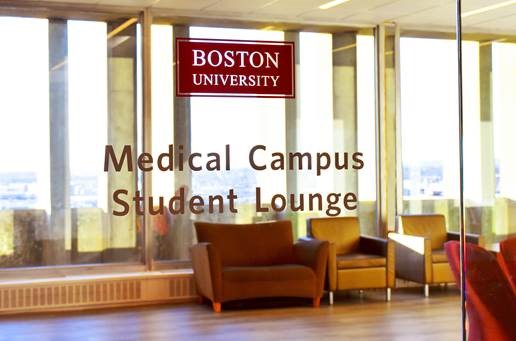
The L14 Medical Campus Student Lounge, complete with a kitchen, soft seating, a handicapped accessible bathroom and lots of natural light, is now open to enrich student study and relaxation spaces on campus.
Many thanks to John Barton and the facilities staff for the rapid completion of this investment in large group assembly and community space.
Watch the video walkthrough or check out the Facebook album to see more of the space.
Now Open! New L13 Study Space in the Alumni Medical Library

The renovation of the 13th floor of the Alumni Medical Library is complete! Students representing each of the schools on the Medical Campus cut the ribbon for the Learning Resource Center. They were flanked by, from left, BUSPH Associate Dean for Education Lisa Sullivan, PhD, BUMC Provost and BUSM Dean Karen Antman, GSDM Associate Dean of Students Joseph Calabrese, DMD, BUSM Associate Dean for Medical Education Priya Garg, MD.
“We’ve been looking forward to having this much-needed new study space for our students. We thank the Miselis family for their generous gift that contributed to renovating this outstanding space,” said Dr. Antman.
“I can’t wait to see this beautiful space filled with students. It was designed to provide a variety of different options so students can find the best one to suit their study style and needs,” said Angela Jackson, MD, Associate Dean for Student Affairs. “I especially like the cozy, cocoon chairs for quiet, individual study – and napping.”
Check out all of the options for individual and small group study -- including carrels, individual study pods, group study rooms and spaces for one-on-one tutoring. Pressed for time? Watch the video walkthrough or see more on Facebook.
President’s Day Parking and Transportation Information
President's Day is Monday, Feb. 18.
Shuttles: No shuttles will be operating; this includes the HealthNet shuttle.
MBTA: The following schedule and services will be in effect:
- Commuter rail trains will operate on a Saturday schedule.
- The ferry will run on a weekday schedule.
- The subway and buses will operate on a Saturday schedule EXCEPT the Crosstown buses, which will NOT operate on the holiday.
For additional information on routes and schedules, please call the MBTA Customer Service Center at 617-222-3200 or visit www.mbta.com.
Parking: All parking facilities will be open. Drivers with 610 Garage access may park in the 710 Garage or the DOB Garage on the holiday. Those who do not have garage access may park in the 710 Garage or the DOB Garage for a flat rate fee of $8.
If you have any questions regarding this holiday schedule, please call the TranSComm Office at 617-358-3506 or the Parking Office at 617-358-7592.
Fun, Friendly Dodgeball Competition at Fuller Gym Kickoff
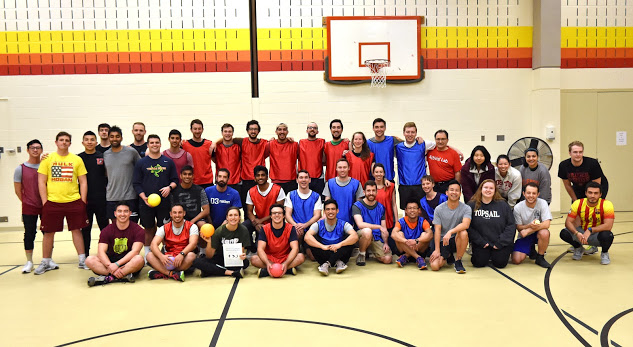
Nearly 70 students participated in dodgeball game as a kickoff event for the Fuller Gym, held on Feb. 4. Access to the Fuller Gym basketball court and recreational area has been granted to the BUMC community as part of a campuswide pilot program.
Teams from the Schools of Medicine, Public Health, Henry M. Goldman School of Dental Medicine (GSDM) and Graduate Medical Sciences showed up ready to play. GSDM took first-place honors. After the mini-tournament, the first Bootcamp and yoga classes offered by BU’s FitRec launched.
Be on the lookout for a March Madness tournament, other competitions and class offerings. View photos from the event. For more information, visit the Fuller Gym website.