Student Updates
Medical Campus Volunteers Brave Polar Vortex to Help Boston’s Homeless
Mayor to participants: “Every person you meet out there is loved by somebody”
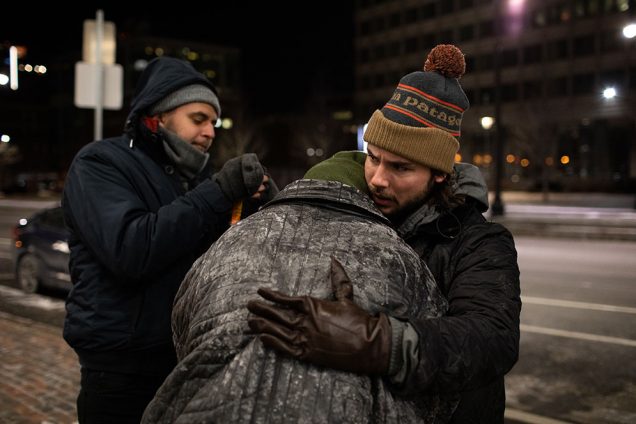
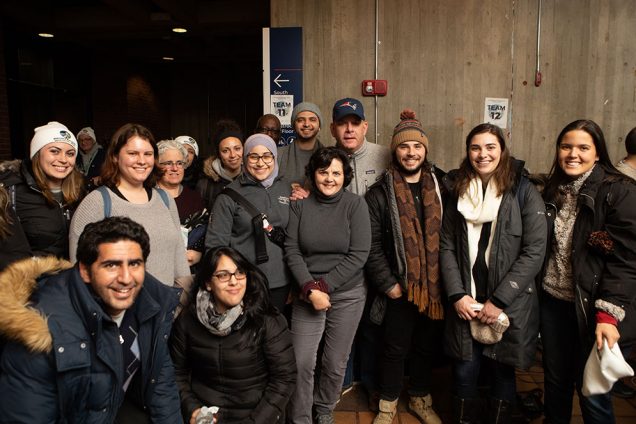
At 10:30 pm January 30, it was dark on the streets of Boston, and bitterly cold. Mayor Martin Walsh had just kicked off the 39th annual Boston homeless census, telling more than 300 volunteers at City Hall that their work was important—that they would be gathering valuable data in the fight to get people off the streets for good. He gave a shout-out to public safety officials, first responders—and even to a group of BU students, who had been joining the census for a number of years. This year, with Harold Cox, a School of Public Health associate professor of community health sciences and an associate dean, leading the way, the Medical Campus had dispatched some 15 volunteers.
The Northeast was locked in a polar vortex, and Walsh warned everybody about the dangerous wind chills. Anyone sleeping outside risked death.
“When you’re out there tonight, remember that every person you encounter has a story,” Walsh told the volunteers, who would fan out in 45 teams across the city, combing subway platforms, parks, building doorways, and alleys to count homeless people, and offer them shelter. “Remember that every person out there is loved by somebody.”
And it’s a lot of people. In 2018, the number of people across Massachusetts who experienced homelessness at some point was 20,068, according to a report from the Department of Housing and Urban Development. That marked the highest level since 2013. The report also said homelessness jumped 38 percent in the last decade despite aggressive steps to reduce the count. One especially alarming figure was that the number of people ages 18 to 24, without children, who experienced homelessness rose 11 percent.
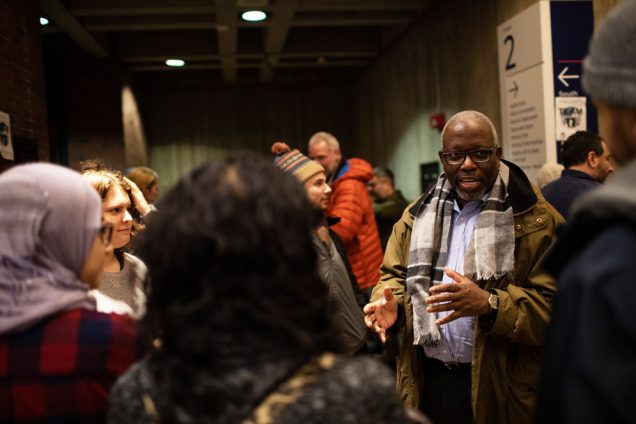
The count begins
Now, just minutes after their group left City Hall, heading toward TD Garden (their coverage area stretched from just beyond City Hall Plaza to North Station), one SPH student, Mackenzie Bullard, along with three classmates and Wendy Heiger-Bernays, an SPH clinical professor of environmental health, was approached by a man weaving his way down a frozen Cambridge Street, his thin leather jacket open to the subzero wind chill. His gloveless fingers clutched the stub of a cigarette.
“Do you guys have a light?” asked the man, who appeared to be intoxicated.
“I’m Mackenzie,” said Bullard, who has worked closely with the homeless through SPH’s Activist Lab. Unfortunately, he told the man, none of them had a light. “We’re with the homeless census,” Bullard said, introducing the group. “It’s really cold out there tonight. Do you need a place to stay?”
The ferocious winds made it hard to hear—or talk.
“Got a light?” the man repeated.
Bullard offered again to help him get inside.
“Got a light?” the man asked.
Back and forth it went. The homeless man—he said his name was Bobby—headed into the street, dodging a couple of cars. Concerned for his safety, Bullard and SPH student Rafik Wahbi, an Egyptian immigrant who has been volunteering with the homeless since he was 14, followed close behind. All the students had received training from SPH in how to safely connect with homeless people on the street. Earlier, in a meeting at City Hall, their team leader, Katie King (College of Arts & Sciences’06, School of Public Health’13), deputy director of Boston’s Intergovernmental Relations office, had reminded them to respect each person’s dignity and not force anyone inside.
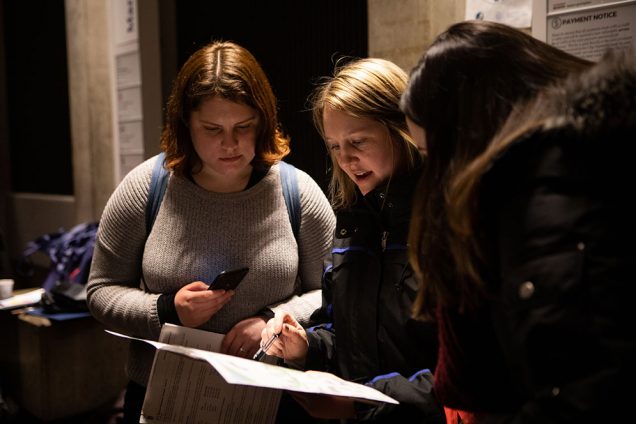
Out of the dark and cold, two more homeless souls appeared on the sidewalk near Bobby, a man and a woman, both of them ill-clad for the weather and looking exhausted and miserable. They immediately accepted the group’s offer of shelter. Heiger-Bernays called Jake Sullivan, BU’s vice president for government and community affairs, who has been volunteering with the homeless census for 17 years, to ask him to dispatch an outreach van. Along with the volunteers on foot, a fleet of vans was crisscrossing the city, responding to requests to take people to shelters. (The numbers from the census are still being processed.)
While the three of them stood in the cold, Bobby asked the woman if she had a light. Her boyfriend angrily told Bobby to back off, threatening to hurt him. Bobby threatened him back.
Remembering something they’d learned in their bystander intervention training—change the subject, if necessary—Wahbi and Bullard made Bobby an offer: if they bought him cigarettes and a lighter, would he go to a shelter? Yes, he would. Buying cigarettes for a homeless man may not have been ideal, but as Wahbi said later, this was a case of “harm reduction.”
“In this world when you don’t have anything, you still have your dignity and you’re going to fight to keep that dignity,” Wahbi said. “At the end of the day he seemed like a kind man who was just looking for a lighter and a smoke.”
Wahbi, who grew up in California after his family left Egypt and is experiencing his first Boston winter, stayed with Bobby while Bullard went off to buy cigarettes.
Heiger-Bernays and the two other students in their group, Andrea Dettorre and Mansi Varma, brought the couple to a bench inside a nearby bus shelter that offered minimal protection from the wind.
The man said he was a military veteran who had done three tours in Iraq and Afghanistan and had PTSD. “Don’t worry about me,” he said. “I’ve been through a lot. I know how to handle myself. Take care of my girl.”
His girlfriend, who wore a flimsy jacket and carried a small cream-colored suitcase, barely spoke, except to thank Heiger-Bernays and the students. Her lips were turning blue. Varma and Dettorre pressed their packets of hand warmers on her. They covered her hands with theirs. Dettorre hadn’t had much experience with homeless people before volunteering for the census, and she had felt nervous at the beginning. But now she felt calm, and focused on helping the two stay warm until the van arrived.
Huddled together on the bench, the couple recited the Lord’s Prayer. Squatting on the ground in front of them, Dettorre joined in.
“Our Father, who art in heaven, hallowed be your name. Your kingdom come, your will be done, on earth as it is in heaven…”
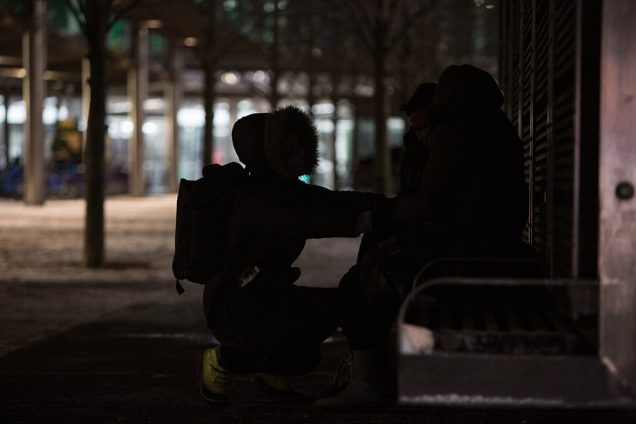
Salvation arrives
Another group of volunteers came along carrying bags of blankets and clothing. They gave hats and gloves to the couple, who thanked them profusely.
Heiger-Bernays checked in with Sullivan. It was a hectic night on the streets of Boston, but the van was on its way. She worried aloud about the couple and Bobby—but also about Varma, who was shivering under her layers of clothing. Like Wahbi, Varma had grown up in California and had never experienced cold like this before. Hearing the forecast that morning, she had fleetingly considered dropping out. “I thought: am I willing to be inconvenienced?” she had said earlier in the evening. “Do I love the homeless? The answer is, yes, I love the homeless.” She has even befriended a number of homeless people she’s met on the streets of Boston.
Across the street, meanwhile, where Wahbi was waiting with Bobby—and keeping him from falling down—Bullard arrived with cigarettes and a lighter. Bullard and Wahbi lit a cigarette for Bobby and helped him slip on a pair of Wahbi’s gloves.
“I love you guys,” Bobby said. “Thank you for helping me.”
The two classmates answered together: “We love you, too, Bobby.”
Finally, after what seemed like an eternity on the frigid streets, but was actually only about 15 minutes, a van from the Pine Street Inn pulled up to the corner where Bullard and Wahbi were waiting with Bobby. Bobby got into the van. So did the couple, with help from Heiger-Bernays, Dettorre, and Varma. Wahbi warned the driver there was tension between the two homeless men.
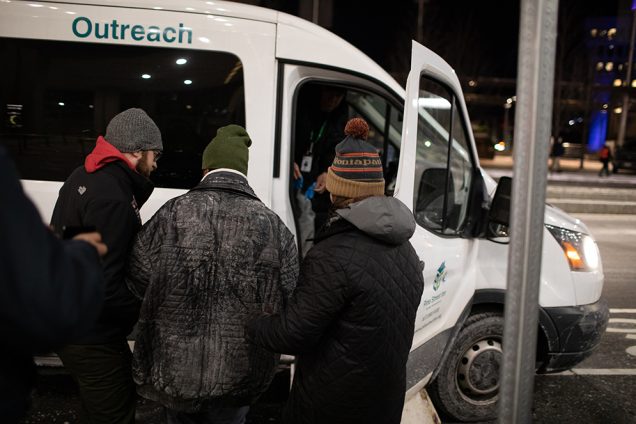
The van pulled away into the night. Splitting into two groups, Heiger-Bernays and the students continued on their way toward TD Garden, looking for more people with nowhere to spend the night. They were mindful of what Jim Greene, the city’s point person on homelessness, had told them at City Hall earlier: “Think about where you’d go to get warm if you were outside tonight.” Walking through a dark parking lot, Bullard headed toward a giant dumpster. That’s where he would go, he said. The dumpster turned out to be chained shut.
Inside the North Station MBTA station, the group from SPH introduced themselves to two young men seated on the floor above the escalator on worn dirty blankets. “I can’t go to a shelter,” one of the men, who wore a Red Sox cap, told Bullard. “They make me too anxious.” Bullard said he understood.
At 11:45 pm, Heiger-Bernays thanked the students for what they’d done and for the compassion and respect they had showed Bobby, the couple, and the two young men on the floor at North Station and wished them a safe trip home. They all headed home on the subway.
Dettorre said the next day that throughout the night she had been thinking about what Walsh had said to the group: Every person you meet has a story. Every person you meet is loved by somebody. One night of volunteering was just one night, she said, but she was committed to doing more than a night of volunteering to make sure that everybody on the streets felt loved.
This BU Today story was written by
BUMC Program Successfully Prepares Minority Students for Dental School
Boston University’s Oral Health Sciences (OHS) master’s program is a successful credential-enhancing program for dental school applicants, while also serving as a pipeline to increase the number of qualified applicants from underrepresented minority (URM) groups.
There are a variety of academic enrichment programs for medical school applicants however, development of pre-dental enrichment programs has lagged behind. In 2005, Goldman School of Dental Medicine (GSDM), in collaboration with the School of Medicine’s (BUSM) Graduate Medical Sciences, introduced the OHS pipeline program to enhance the academic preparedness of students from URM groups for dental school admission.
In order to evaluate the OHS program’s success, acceptance to dental school and performance at GSDM in the first and second years among URM students was measured from 2005-15 and compared to non-URM OHS graduates and non-OHS dental students. A total of 55 URM students completed the OHS program during this period, with 49 successfully matriculating to a dental school in the U.S. and 33 attending GSDM.
The researchers also found the average OHS GPA was higher for those URM students accepted to dental school than for those who did not gain admission (3.36 vs. 2.94). Evaluation of the academic performance of URM OHS students in the first year and second year at GSDM showed that these students performed as well as the non-OHS and non-URM OHS students.
“These results demonstrate that the OHS master’s program has been successful in its mission of increasing the number of qualified applicants from groups historically underrepresented in the dental profession. It is one of our strongest master’s program helping to fulfill our mission of promoting diversity, equity and inclusion,” said corresponding author Theresa A. Davies, PhD, director of the Oral Health Sciences program at BUSM.
“The collaboration between OHS and GSDM prepares its graduates to practice as expanded healthcare providers, integrating the concepts of dentistry, medicine and public health. The academic foundation established by OHS Masters’ Program positions our students for personal and professional success,” added co-author Larry Dunham, DMD, director of Diversity at GSDM.
Although pipeline programs have positively impacted the number of URM enrollees in dental school, a low number of URM dental students and practitioners still exists. “Attempts to diversify faculty along with effective recruitment and retention strategies for URM students must continue.”
These finding appear online in the Journal of Dental Education.
BUMC Access to Fuller Gym

Fuller Gym | 85 E. Newton St., Basement (Located in the Solomon Carter Fuller Mental Health Building)
Hours: 4-9 p.m. ONLY (Mondays, Wednesdays, Thursday, Fridays, Saturdays and Sundays);
Valid BU ID required to gain access
Access to the Fuller Gym basketball court and recreational area has been granted to the BUMC community, as part of a campuswide pilot program. All BUMC students, staff and faculty now have access to the space from 4-9 p.m., six days a week (gym is closed on Tuesdays). The court can be used for pick-up basketball, volleyball, soccer and other group sports. During this pilot, access will be restricted to the gym floor only. Access to the weight room, cardio equipment and the pool is not available. There is a swipe card accessible closet for equipment storage.
FITNESS CLASSES AT FULLER GYM
Starting Sunday, Feb. 3, FitRec will begin offering four instructor-led classes each week: Yoga, Bootcamp, HIIT and Zumba.
To participate in these classes, you must purchase a Med Campus FitPass ($50 per semester) through BU FitRec at bu.edu/fitrec/medcampusfitpass. The FitPass is separate from the FitRec membership you already receive as a full-time student.
USAGE
- All users must complete a Waiver Form (see website) prior to using Fuller Gym.
- Fuller Gym is open to all BUMC students, staff and faculty from 4-9 p.m. only, in the days listed above
- To see calendar of classes and available open gym time, please go to the calendar on the Fuller Gym webpage.
- Users of this gym are responsible for keeping the gym area clean and for putting away all equipment after use in the swipe card access closet. Failure to do so may result in gym access being revoked.
- On Thursdays from 4-6 p.m., the gym has been designated for open volleyball to allow for time to set-up and clean-up the equipment.
- Users are not allowed to book specific events, unless it is for campuswide events AND has been approved by your respective Student Affairs offices. Specific contacts for each school are available on the Fuller Gym webpage.
Kick-off Dodgeball Event
Monday, Feb. 4 | 4-6 p.m.
Celebrating the Legacy of Martin Luther King, Jr.
The Medical Campus community gathered in Hiebert Lounge on Thursday, Jan. 24, to commemorate the legacy of Dr. Martin Luther King, Jr. This year the annual event featured a conversation with Crystal Ann Williams, Associate Provost for Diversity & Inclusion.
Rafael Ortega, MD, Associate Dean for Diversity & Inclusion, welcomed more than 100 attendees. Dr. Ortega, who moved to Fayetteville, NC, from the Dominican Republic to learn English for a year at a predominantly white school while he was a teenager, began the event by talking about how Dr. King had impacted his own experience. “Only years later, did I fully grasp the significance of our greatest civil rights leader and how his teachings shaped my thinking.”
He then recognized Marcelle Willock, MD, former Professor and Chair of Boston University School of Medicine’s (BUSM) Department of Anesthesiology, who recently was appointed Professor Emerita. She was presented a certificate by Dr. Ortega and Hee-Young Park, PhD, Associate Dean for Faculty Affairs and Chair of Medical Sciences & Education at BUSM. Dr. Willock told the audience, “I want the students and junior faculty to realize the tradition, the legacy, what you can accomplish and to never forget your roots and those who helped you.”

Holding back tears, Associate Provost Williams began her speech acknowledging Dr. Willock, who is the first African-American to achieve Professor Emerita status at Boston University. “I’m going to see if I can get through this without resorting to tears because it’s so moving that you’re here.”
As BU’s inaugural Associate Provost for Diversity & Inclusion, Ms. Williams provides leadership for initiatives that promote diversity, access and inclusion across the university. She is an award-winning poet, author of four books and recipient of several artistic fellowships, grants and commissions.
Ms. Williams reflected on the anguish and fear she witnessed following the election of President Donald J. Trump while serving as Associate Vice President for Strategic Initiatives, Professor of English and Senior Advisor to the President at Bates College. She also talked about a trip to a series of civil rights monuments and memorials she took with BU alumni. “I was struck by how many black women, in particular, have been erased from the national narrative as being seminal to the efficacy of the movement.” Ms. Williams compared the activism of black women during the Civil Rights Movement to the activism carried out by African-American women in 2016 and 2018 and how their actions were instrumental to political change.
She also discussed how the Civil Rights Movement was led by strategists and legal analysts who were relentless, and she expressed concern over the limited awareness of the movement’s full history. “We are undereducated about the civil rights movement in this country and I fear … it serves injustice.”
Ms. Williams concluded by challenging each member of the audience to learn something they didn’t know this year and reminded them that there is still more work to do concerning civil rights. “Remember that King said, ‘If I cannot do great things, I can do small things in a great way.’"
The event was sponsored by the BUSM Diversity & Inclusion Office, Goldman School of Dental Medicine Diversity Office, BU School of Public Health and BMC Minority Recruitment Program.
Thirteen Faculty Promoted to Professor
The following faculty have been promoted to the rank of Professor:
 |
Christopher Andry, MED, Pathology & Laboratory Medicine and Family Medicine, is well recognized in the field of biospecimen science. In a team-based setting at BU and BMC, he has established evidence-based protocols and standards to ensure curation and distribution of high-quality, well-annotated biospecimens. Dr. Andry has served as the PI on more than $2 million in grants and contracts to set standards for the science of biospecimen collection. A mentor for many medical and graduate students, he directs the Master of Science in Pathology Laboratory Sciences program and serves as course director, lecturer and laboratory instructor in medical, dental and graduate courses. Dr. Andry has raised the profile of BU in biobanking and provides the expertise for obtaining usable tissue samples for medical campus research faculty. He has chaired the BU Laboratory Safety committee for 12 years and directs the Cancer Tissue Archive for Precision Medicine, BU-BMC Cancer Center. . |
 |
Lawreen H. Connors, MED, Pathology & Laboratory Medicine, focuses her basic science research on uncovering the protein and genetic determinants that underlie the formation of amyloid. The early stages of her career featured structural studies of amyloid-causing transthyretin (TTR) mutants, mainly those causing cardiac dysfunction. More recently, her studies have been focused on wild-type TTR amyloidosis, an age-related disease now recognized as an under-appreciated cause of heart failure in the elderly. She has received continuous support from the NIH and foundation grants, as well as industry-sponsored research agreements. In 2009, she played a major role in establishment of the Amyloid Pathology Diagnostic Testing Laboratory in the Amyloidosis Center, a CAP-accredited and CLIA-certified facility that offers histologic and molecular testing for amyloid. Dr. Connors teaches GMS classes on systemic amyloidosis, and has mentored more than 20 master, doctoral, and postdoctoral students. She has served on multiple local, national and international committees, and is Director of the Amyloidosis Center Gerry Laboratory and co-Director of the Amyloid Pathology Diagnostic Testing Laboratory. . |
 |
Shoumita Dasgupta, MED, Medicine/Biomedical Genetics, is a scientist educator whose scholarly work is focused on integrating genetic and genomic science in medical and graduate education. She has made significant contributions to the reform of medical school education in genetics, introducing curricula using team-based teaching and flipped classroom learning, with an additional focus on education in diversity and ethics. She has constructed and published several innovative teaching activities that integrate cultural, ethical and genetic/genomic concepts. Through her leadership in the Medical Course Directors of the Association of Professors of Human and Medical Genetics, she has played a major role in the revision of the Medical School Core Curriculum in Genetics that provides the foundation for genetics courses taught at most medical schools in the country. Several curricula have also been shared in multiple countries (one in 19 countries; another in eight). Several articles (including one in Trends in Genetics and another in Genetics in Medicine) are featured in the CDC’s Public Health Genomics Knowledge Database. A paper on training future physicians in the era of genomic medicine has been used as the basis for curriculum development in England’s Genomic Education Programme. Dr. Dasgupta also was selected to lead NIH genomic medicine education initiatives on emerging genomic technologies and their responsible, inclusive implementation for trainees and providers. . |
 |
Karen E. Lasser, MED, General Internal Medicine, a primary care-physician researcher, has dedicated her career to improving health conditions in vulnerable populations, spanning primary care practice-based research; interventions to promote preventive services in vulnerable populations; outpatient medication safety; and interventions related to addiction (e.g. tobacco use disorder, opioid management). She is the first-author of a highly influential JAMA Internal Medicine publication investigating how patient navigation and financial incentives promote smoking cessation among primary care patients served at an urban safety-net hospital. Dr. Lasser has been continuously funded from NIH, non-federal foundations, and intramural programs with A total of more than $5.2 million in direct costs since her promotion to Associate Professor in 2009. She also has served as a research mentor to more than 35 trainees (medical students, residents, master’s students and fellows) and junior faculty. The majority of her mentees have been women and/or underrepresented minorities. Dr. Lasser has received numerous awards, and been appointed to national and international committees, and has served on AHRQ, NIH and PCORI study sections. . |
 |
Stephanie Lee, MED, Medicine/Endocrinology, Diabetes & Nutrition, is recognized for her NIH funded work in clinical thyroid disease, specifically improving differentiation of malignant v. benign thyroid nodules. Dr. Lee is PI on two externally funded grants using ultrasound for diagnosis of thyroid nodules and developing a multi-institution thyroid cancer registry. In 2015 she received the ATA Woman of the Year award and has served on the ATA guidelines committee for managing patients with thyroid nodules and on the faculty of the Thyroid World Congress. She directed two of the largest ultrasound courses for endocrinologists associated with the 2018 annual meetings of The Endocrine Society and the American Thyroid Association (ATA). She developed a two-year didactic curriculum, part of the core curriculum for the Endocrine Fellowship and developed and directs a monthly multidisciplinary Endocrine-Pathology-Surgery Clinical Conference on thyroid cytology and pathology. In 2017, she created an 80-hour curriculum required for the certification of Endocrinologists for the human administration of radioactive iodine. In 2018, she was selected as an Evans Clinician, a lifelong designation awarded to Department of Medicine faculty that recognizes outstanding clinicians who possess the skills, attributes and professionalism that define excellence. . |
 |
Ching-Ti Liu, SPH, Biostatistics, is an expert in statistical genetics and its applications, specifically on obesity, type 2 diabetes and musculoskeletal disorders. He serves as a biostatistician and statistical geneticist on several large research consortia and co-leads the African American Genetics of Glucose and Insulin Consortium (AAGILE) and the Anthropometric and Adiposity working group in the Cohorts for Heart and Aging Research in Genomic Epidemiology (CHARGE) Consortium. He has published more than 100 peer-reviewed journal articles, the majority in high-impact journals (e.g. Nature, Nature Genetics, Genome Biology, American Journal of Human Genetics) and has averaged 13 papers per year since his last promotion. Dr. Liu has maintained a rich portfolio of externally funded research, the vast majority from the NIH. An exemplary teacher and mentor, Dr. Liu has developed three new courses and has been the recipient of the School’s Excellence in Teaching Award twice. . |
 |
Mark Miller, MED, Psychiatry, is a Clinical Psychologist in the Behavioral Sciences Division of the National Center for PTSD at VA Boston Healthcare System. He is an internationally recognized expert in the genetics, neurobiology, and assessment of PTSD. As a Principal Investigator, he has been continuously funded by the National Institute of Mental Health and/or the US Department of Veterans Affairs for almost 20 years. He has published more than 100 peer-reviewed papers on the topic of PTSD and related conditions and this body of work has been cited approximately 6,000 times. Dr. Miller is currently an Associate Editor for the American Psychological Association’s flagship publication, the Journal of Abnormal Psychology, and he previously served in the same capacity for two other leading journals in the field of traumatic stress. He is a frequent grant reviewer for the NIH and other US and international funding agencies and he has served as a research mentor to numerous pre- and post-doctoral trainees in Boston University training programs. . |
 |
Joanne Murabito, MED, General Internal Medicine, is an outstanding clinician-scientist trained in epidemiology with specific interests in aging, cardiovascular disease and genetic epidemiology. Her research using the Framingham Heart Study (FHS) database focuses on the epidemiology and genetics of longevity, healthy aging and reproductive aging (menopause). She is investigating the use of mobile health technologies to study overall and cardiovascular health. Dr. Murabito has a history of current and prior NIH funding, and is the author of 173 original peer-reviewed articles, with some first-author publications reflecting her emphasis on team science with leadership of large consortia, and others with more restricted author teams. She has published in Nature Genetics, Circulation and JAMA. . |
 |
Timothy Naimi, MED, General Internal Medicine, is a CDC-trained epidemiologist with a focus on adult binge drinking, youth drinking and the health effects of ‘moderate’ alcohol consumption. He has been the PI on three NIH-funded R01 projects to develop better measures of state alcohol policy environments and to study their relationships with excessive alcohol use and related outcomes, including fatal motor vehicle crashes and alcohol-related homicides and suicides. Dr. Naimi has 106 peer-reviewed papers with seven published in the last five years (11 as first author and 10 as last author). . |
 |
Elizabeth Pearce, MED, Medicine/Endocrinology, Diabetes & Nutrition, is a renowned clinical investigator, endocrinologist and epidemiologist who has made significant contributions in iodine nutrition, thyroid disease in pregnancy, environmental thyroid disrupters and the association of thyroid function with cardiovascular risk. Her internationally cited publications have changed recommendations in the US for iodine supplementation and iodine use in pregnancy. Among her 87 articles, 22 include a mentee as first author. President of the American Thyroid Association (ATA), Dr. Pearce is the recipient of the prestigious Van Meter Award and she recently co-chaired the ATA’s Thyroid in Pregnancy Guidelines Task Force. She has been part of the leadership of the Iodine Global Network, a nongovernmental agency devoted to the elimination of iodine deficiency disorders, since 2007. . |
 |
Emily Rothman, SPH, Community Health Sciences, is an expert in violence prevention research in the areas of dating abuse and sexual violence, human trafficking and community violence. Her scholarship on relationship violence has been ahead of its time, long before the #metoo movement. Dr. Rothman has been continuously funded since 2004 and has been PI of K01 and R03 grants from the NIH, three large-scale grants from the National Institute of Justice, a Department of Justice grant, multiple grants from the US Centers for Disease Control, and a Robert Wood Johnson Foundation leadership grant. She has more than 85 peer-reviewed publications, 40 as first author, many of which have appeared in high-impact journals including the New England Journal of Medicine, American Journal of Public Health, JAMA and Pediatrics. She has earned three teaching awards from SPH, in addition to the Linda Saltzman New Investigator Award from Futures Without Violence and the CDC Foundation, and the Early Career Prevention Network Award from the Society for Prevention Research. She has facilitated psychoeducational groups and individual counseling interventions for perpetrators of partner and sexual violence since 1997. . |
 |
Jillian C. Shipherd, MED, Psychiatry, is a leader in the field of PTSD and LGBT health. She has directed the national LGBT Health Program for the VA since 2012. Her national fellowship program on LGBT Heath has been adopted at VA sites across the country, including Boston. She worked at the national level to develop a VA policy on care for transgender veterans and a policy for veterans who identify as lesbian, gay or bisexual. She has served on 39 national committees, (with leadership roles in 10), and on nine editorial boards. The recipient of the American Psychological Association’s Award for Distinguished Contribution to Education and Training, and the Health Professionals Advancing LGBT Equality (GLMA) 2018 Achievement Award, she has published more than 100 peer-reviewed papers and has served as a PI on six awards with funding exceeding $2M and in non-PI roles on 12 awards . |
 |
Weiming Xia, MED, Pharmacology & Experimental Therapeutics, is an expert in Alzheimer’s disease (AD) and related neurodegenerative disorders. His post-doctoral research linking presenilin and gamma secretase and the associated seminal paper published in Nature in 1999 directly led to a specific therapeutic target for AD. His current research is focused on identifying therapeutic targets for AD, and developing biomarkers for AD diagnostics and therapeutics. He is the PI on VA Merit and Pilot Awards and a foundation grant from the Cure Alzheimer’s Fund. He is also site PI on an R01 and serves as a co-investigator on two additional R01s and other grants. Dr. Xia has 95 peer-reviewed journal articles as well as 13 invited peer-reviewed critical reviews, 12 book chapters, and one book, which have appeared in high-impact journals (e.g., Nature, PNAS, Cell) and leading specialty journals in AD and neuroscience. |
BU-BMC Cancer Center Announces Co-Directors
Julie Palmer, ScD, Matthew Kulke, MD, and Gerald Denis, PhD, have been appointed Co-Directors of the BU-BMC Cancer Center, effective Feb. 1, 2019.
 |
Dr. Palmer also is Associate Director of Boston University’s Slone Epidemiology Center, Professor of Epidemiology at BU School of Public Health and Associate Director for Population Sciences at the BU-BMC Cancer Center. |
 |
Dr. Kulke also is Zoltan Kohn Professor of Medicine at BUSM, Chief of the Section of Hematology/Oncology in the Department of Medicine at BUSM-BMC and Medical Director of the Clinical Cancer Center at BMC. He previously served as Deputy Director of the BU-BMC Cancer Center. |
 |
Dr. Denis also is Associate Professor of Pharmacology and Medicine (Hematology and Oncology). |
Together, these leaders will bring together their respective expertise in population sciences, clinical and basic research to foster interdisciplinary research and build robust bridges for collaboration among engineers, chemists, biologists and computer scientists, to deepen the University’s community of investigators who focus on cancer. Dr. Denis also will direct the Center’s administrative activities.
Jan. 21 Parking and Transportation Information
The Martin Luther King, Jr. holiday will be celebrated on Monday, Jan. 21. Below is parking and commuting information for that day.
Parking:
All parking facilities will be open. Employees with 610 Garage access may park in the 710 Garage or DOB garages. Those without parking garage access may park in the 710 Garage for $8 on the holiday.
Shuttles:
No shuttles will be operating including the BU Shuttle Bus and the HealthNet Shuttle.
MBTA Services:
All buses and trains will operate on a Saturday schedule except the CT1 and the CT3 which are NOT operating. Commuter rail will operate on its regular schedule. For additional MBTA information visit www.mbta.com or call customer service at 617-222-3200.
Any questions? Call TranSComm at 617-358-3506 or the Parking office at 617-358-7592.
1/17 Crosstown Early Morning Electrical Shutdown
Beginning Thursday morning, Jan. 17, at 12:01 a.m., electrical power will be shut off throughout the entire Crosstown Building (801 Mass. Ave) and will be off through 6 a.m. This work is necessary to replace the 600 amp breaker.
What’s impacted
• Whole building electrical power, BU’s 4th Floor Data Center, Air Handling Units, Boilers, Condenser Water Loops
What does this mean
• All lights and power outlets will be down.
• Electrified doors will default to fail-safe or fail-secure.
How to prepare
• Power down IT equipment or other equipment Wednesday night, Jan. 16, prior to the electrical shutdown.
Keep in mind
• The shutdown of the air handling units, boilers, condenser water loops, etc., that provide heating and cooling to spaces should not be noticed since this will occur during overnight hours when the building is not occupied; these units are typically not running when the building is unoccupied and only power up when the temperature drops or reaches a certain level.
Questions
Call Control at 617-638-4144.
BMC Neurology Patients Collaborate with BU Students to Display the Healing Power of Music
What do you get when you combine students from the Boston University College of Fine Arts, talented BMC neurology patients, and a few instruments? A concert to remember.
For the last seven years, Boston University’s Arts|Lab program, which aims to help people reimagine art in society, has sponsored a production that features a unique musical collaboration between CFA students and BMC patients. The concert, befittingly called “When Patients Heal You,” offers those living with a variety of neurological disorders the opportunity to present themselves in a different light – as artists.
This year, patient performances ranged from gospel to classical music and were dedicated to the BMC neurology team as well as patient friends and family that were in attendance.
“What makes this concert so magical is that it displays the universality of music, with patients and students representing a variety of cultures and still being able to communicate through song,” said Moisès Fernández Via, MD, director of the Arts|Lab. “We only give patients and students one day to rehearse and create something beautiful. This challenges everyone to trust their individual talent, each other, and their instrument.”
Patients showcased their skills on the saxophone, bass and electric guitar. Some also played and sang their own composed music with the support of CFA musicians, including violinists, pianists, and singers.
The newest patient to join the production this year called the event, “life-changing” as it helped reconnect him with the instrument he fell in love with as a young boy – the saxophone. “I got the chance to improv with a CFA afro-jazz percussionist, and it was one of the best moments I’ve had in a long time,” said the patient.
Celebrate the Legacy of Martin Luther King, Jr.

Thursday, Jan. 24
Noon-1 p.m.
Instructional Building, Hiebert Lounge
All members of the BU Medical Campus are invited to a special presentation commemorating the legacy of Rev. Martin Luther King, Jr.
Conversation with Crystal Ann Williams, Associate Provost for Diversity & Inclusion
 Crystal Ann Williams is Boston University’s inaugural Associate Provost for Diversity & Inclusion. She provides leadership for initiatives that promote diversity, access, and inclusion across the University.
Since her arrival, she has energized our efforts to diversify the faculty, students and staff with renewed enthusiasm, and has been working closely with leaders on the Medical Campus to achieve our goals of diversity and inclusion.
Professor Williams joined BU in October 2017 from Bates College, where she served as Associate Vice President for Strategic Initiatives, Professor of English and as a senior advisor to the President.
She is an award-winning poet, the author of four books, and the recipient of several artistic fellowships, grants, and commissions. She is consistently recognized as a thought leader on diversity in the arts and has helped to lead and convene programs at the state and local levels involving arts, civic, and philanthropic leaders. She holds a BA from New York University and an MFA from Cornell University.
This event is brought to you by the BUSM Diversity & Inclusion Office, Goldman School of Dental Medicine Diversity Office, BU School of Public Health and BMC Minority Recruitment Program. Refreshments will be provided.