Student Updates
$9 Million Grant Fuels Sickle Cell Study: BU team uses iPS stem cells to probe treatments, cures

BU researchers have developed a way to test treatments for sickle cell disease—a genetic disorder of the red blood cells—by working with stem cells grown from a small vial of patients’ blood. “It’s a clinical trial in a test tube,” says molecular biologist George J. Murphy, a School of Medicine assistant professor of medicine and a codirector of BU’s Center for Regenerative Medicine (CReM).
The BU team recently received a five-year, $9 million grant from the National Heart, Lung, and Blood Institute of the National Institutes of Health to grow the versatile cells—called induced pluripotent stem, or iPS, cells—as well as generate a living library of genetic variations of sickle cell disease. Known as disease modeling, it is one of the ways the scientists at CReM are working in collaboration with clinicians to tackle hereditary and incurable conditions.
Growing iPS cells enables researchers to study a range of subtle genetic factors and mutations and test treatments on human tissue. Reflecting the cutting edge of the rapidly evolving field of regenerative medicine, the versatile iPS cells, which CReM researchers had previously derived from small samples of their own skin, resemble embryonic stem cells. Like embryonic cells, under optimal conditions they can be made to differentiate into any type of cell found in the body, and might replace embryonic cells completely once researchers eliminate risks associated with them. Murphy says that the iPS cells represent a crucial step toward the eventual use of regenerative medicine to customize cells with a donor’s own DNA, using the donor’s own cells, and replace diseased tissue or organs with healthy ones.
The recent grant supports the University’s multidisciplinary approach, involving a repertory of molecular biologists, hematologists, and genetics experts, to scale up drug studies in iPS lines, whose production is extremely labor-intensive. (In Murphy’s lab, researchers must tend the delicate cell cultures seven days a week.) “The grant brings together two of the most dynamic entities” on the Medical Campus, says Murphy, referring to BU’s Center of Excellence in Sickle Cell Disease in addition to CReM.

The diagram above illustrates the process of creating induced pluripotent stem cells from patients' blood samples. These identical stem cells can then be used for gene therapy or for disease modeling and drug testing. Diagram courtesy of George Murphy.
When all goes well, it takes a month in the lab for sickle cell donors’ blood cells to be redifferentiated, through a complex process involving a “vector”—in this case a virus—followed by cultivation and selection of cell colonies returned to an embryonic-like state. Like embryonic cells, the cultures can develop into any type of human cells. Their progress can be tracked visually under the microscope and in more refined and complex ways, explains Murphy, a former Fulbright scholar and an advisor for NASA’s SLS 2 Life Sciences Space Shuttle mission. The result—a renewable supply of stem cells with the donors’ genetics—makes the cells immortal. Murphy and Martin Steinberg, a MED professor of medicine, pediatrics, pathology, and laboratory medicine and director of the Center of Excellence in Sickle Cell Disease, say that the NHLBI grant will see the iPS research to the next level, making it possible to maintain and predict the health and purity of cell cultures. It will be many years before the results of this research translate into human trials, which would be preceded by studies on animals.
About 80,000 Americans live with sickle cell disease, which can result in a range of potential complications, including severe pain, fatigue, infections, and impaired development. The disease is most often diagnosed in the United States at birth, although doctors can test for it in utero with amniocentesis. The condition can lead to stroke, even in very young children. Abnormalities in hemoglobin, the oxygen-carrying protein responsible for blood’s red color, give the short-lived sickle cells their characteristic rod-like shape and make them stiffen and stick to each other, blocking blood vessels and arteries. The genetic trait for the disease, found in people of African, Mediterranean, Middle Eastern, East Indian, Caribbean, and South and Central American descent, affects one in 12 African Americans, according to the Centers for Disease Control. (The iPS study is being done in collaboration with scientists in Saudi Arabia, which has a population at high risk for sickle cell disease.) Healthy people can carry the trait; the disease results when a baby inherits the gene from both parents. In the United States, testing newborns for sickle cell disease is now mandated by law, according to the U.S. Department of Health and Human Services.
Sickle cell can be a cruel disease. Patients experience “sudden attacks of severe pain, pneumonia-like infections, stroke, liver disease, and problems walking,” says Steinberg. One of the world’s foremost experts on sickle cell genetics, he has worked with sickle cell patients in treatment, diagnosis, and research for most of his career.

Several treatments are available that prolong the lives of sickle cell patients. The fairly inexpensive anti-tumor drug hydroxyurea, which reduces mortality by as much as 40 percent, must be taken daily and indefinitely to be effective, Steinberg notes. It appears to stimulate production of fetal hemoglobin, a type usually found only in newborns, which helps prevent the sickling of red blood cells. Most recently, the disease has been reversed through bone marrow transplants, but the procedure is extremely risky and requires an identical sibling donor, he says. Still in the experimental phase is a procedure to transplant patients with their own marrow, after it has been genetically “corrected” through the recombinant techniques commonly known as gene therapy.
With the help of the new funding, the iPS procedure will replace human subjects in the testing of more effective treatments and potential cures for sickle cell disease. The elegance, and promise, of the procedure is that “you can make as many cells as you want,” says Murphy, explaining that the growth factors and cell cultures used in the CReM lab are the result of years of trial and error. Although the iPS cells offer the promise of a versatile, inexhaustible alternative, until the process of deriving them is perfected, the researchers use embryonic stem cells as controls.
With the researchers’ efforts focused on the disease modeling phase, iPS cells hold “enormous promise,” says Murphy, but also one that must be approached cautiously. “We have to be prepared for the fact that anything could turn out wrong,” he says.
This BU Today story was written by Susan Seligson. She can be reached at sueselig@bu.edu.
Free Infectious Diseases Symposium, Oct. 1, Register Now!
The Annual Infectious Diseases Symposium, “Inflammation in Disease Pathogenesis” will be held Saturday, Oct. 1. This symposium brings together researchers from regional institutions with an interest in inflammation and disease. Four outstanding speakers will present their work with sufficient time for discussion and informal interactions among participants. The goal is to facilitate collaborations within the Greater Boston area and to pursue new lines of investigation. Registration is complimentary to meeting attendees.
The speakers represent a broad spectrum of researchers interested in inflammation, both pathogen-specific and sterile inflammation. Dr. Caroline A. Genco, Research Director, Section of Infectious Diseases, Department of Medicine, and Professor, Department of Microbiology, Boston University School of Medicine, will provide introductory remarks.
Invited speakers include: Ulrich von Andrian, MD, PhD, Harvard Medical School; Kathryn Moore, PhD, New York University; Dan Portnoy, PhD, University of California Berkeley; Paul Kubes, PhD, University of Calgary, Canada. Dr. von Andrian works in the field of immunology, focusing on blood cell and immune cell migration as well as T cell differentiation; Dr. Moore's research consists of the role of the innate immune system in sterile inflammatory conditions and host defense; Dr. Portnoy is focused on microbial pathogenesis and host defense against infection; Dr. Kubes works on molecular mechanisms in response to infection and sterile inflammation. The first Infectious Disease symposium focuses on inflammation and disease pathogenesis.
The Annual Infectious Diseases Symposium is co-sponsored by the Section of Infectious Diseases, Department of Medicine, Boston Medical Center, and the Boston University School of Medicine. Complimentary registration and additional information can be found at https://www.bumc.bu.edu/id/events/.
Myron Nevins PERIO 67 Presents Schoolman Lecture
Myron Nevins PERIO 67 presented a lecture titled, “A Paradigm Shift from Autogenous Bone to Tissue Engineering,” on September 13. The lecture was attended by residents and faculty of the Department of Periodontology & Oral Biology, as well as GSDM alums and other faculty members.
The lecture was part of the Department’s endowed annual lectureship, which allows them to invite prominent speakers to present new and innovative materials related to periodontology or implantology to the residents, faculty, and alumni.
“This year we were honored to have a prominent speaker and former GSDM faculty member, Dr. Myron Nevins to deliver this important lecture,” said Professor and Director of the Advanced Specialty Education Program in Periodontics Dr. Serge Dibart.
Dr. Nevins is an Associate Professor of Periodontology at the Harvard School of Dental Medicine, Clinical Professor of Periodontology at the Temple University School of Dentistry, Adjunct Professor of Periodontics at the University of North Carolina, and is a Consultant to the Naval Postgraduate Dental School, Walter Reed National Military Medical Center, Bethesda MD. He has served as the President of the American Academy of Periodontology, is a Diplomate and served as Director and Chair of the American Board of Periodontology. He has been the Editor of the International Journal of Periodontics & Restorative Dentistry since 1981 and published periodontal and implant textbooks. Dr. Nevins is a recipient of the Master Clinician Award and the Gold Medal Award from the American Academy of Periodontology. Dr. Nevins also works in private practice with fellow GSDM alums Gary Reiser PERIO 70 and Roger Wise PERIO 73 at Perico, P.C. Dr. Gerald M. Kramer, former Professor and Chair of the GSDM Department of Periodontology founded Perico, P.C. in 1966.
Following the lecture, Dean Jeffrey W. Hutter hosted a reception at which time faculty and residents could have a one-on-one discussion with Dr. Nevins.
Dean Hutter said, “It is an honor to have Dr. Nevins return to GSDM to address our residents and faculty and I thank him for taking time out of his busy schedule to visit us. I am confident that I speak for the entire department when I say that we look forward to him returning on a regular basis so that he may play an important role in the education of our residents.“
Visiting Professor Mary Jane England Touts Integrated Care at BUSPH Public Health Forum
Shoes and bras. Those were the two tangibles that Mary Jane England recalled about her time spent treating patients in state psychiatric institutions – long before she would go on to chair an Institute of Medicine committee charged with exploring ways that mental health and substance-use care could be improved. The men's shoes: Ordered in bulk in the same size for all patients, causing podiatry problems. The bras: Also ordered in one-size-fits-all, adding to women's aches and pains.
"The mentally ill die earlier – not from mental illness, but from medical problems," England, a psychiatrist, said at a BUSPH forum Wednesday focused on ways to integrate mental health and substance abuse treatment into the healthcare system. "When mental health is [adequately] treated, the incidence and costs of medical care are lower."
England, a visiting professor in the Department of Health Policy & Management, spoke of the need to integrate mental health care and physical care. She cited statistics showing that 80 percent of people with behavioral health disorders visit a primary care practice at least once a year, and that 50 percent of all behavioral health disorders are treated in primary care settings.
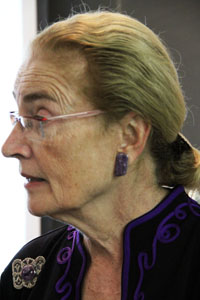
"We need to find a way to get primary care practitioners comfortable in providing behavioral health care," she said. "We need a 'whole person' orientation in primary care. . . . The reality is that people with mental health problems are being seen in primary care. They're just not getting good care."
In addition to her new role at BUSPH, England is chairing a steering committee of a Colorado project called Advancing Care Together [ACT], a four-year effort that is bringing together experts in primary care, substance abuse and mental health to pilot and evaluate integrated-care approaches. She said she is proud of that effort, which followed from her IOM committee work.
"We do all this good [research] work and it goes on the shelf," she said. "The translational issues are enormous." The ACT project aims to evaluate whether integrated care delivery works – to improve health outcomes and save money, among other things – and if so, which delivery models work best.
"It is so hard to change behavior," she said of the health care field, in which she has worked in myriad capacities since she trained as a psychiatrist on the BU medical campus. "We continue to work in our silos.
"We're going to be really looking at climate change – how to get providers to change their behaviors" at the 11 Colorado sites participating in the ACT project, which she hopes will help to shape national care models.
England, who served as president of Regis College for 10 years and previously headed the Massachusetts Department of Social Services, said she was grateful for the chance to re-enter the health policy field at BUSPH, at the invitation of Dean Bob Meenan. Among her projects will be a review of mental health services for students on the medical campus, which is scheduled for completion by December.
England said recent advances in understanding "the science of the brain" in treating depression, addiction and other behavioral health disorders were exciting. Now, she said, the challenge is to make the same kind of gains in healthcare delivery systems.
"We need patient outcome data" that shows that integrated care works, she said. "That's what we hope to achieve."
Submitted by Lisa Chedekel
Foul Water and Fiery Serpent, Film Screening & Panel Discussion, Sept. 29
Boston University’s Center for Global Health and Development, and the Department of International Health are co-sponsoring the screening “Foul Water and Fiery Serpent” a new documentary following community health workers in Ghana and Sudan through the eradication of the disabling Guinea worm parasite.
The film features former President Jimmy Carter and The Carter Center and is narrated by Golden Globe winner Sigourney Weaver.
- Thursday, September 29
- 12:30-2:30 p.m.
- Keefer Auditorium, Evans Building, BUMC
- http://www.foulwaterfieryserpent.com
Guinea worm is the first parasitic disease eradicated without a vaccine or drug. The program, led by Dr. Donald Hopkins, represents a public health intervention based on behavior change, education and innovation. The screening will be followed by a panel discussion with:
Dr. Donald Hopkins
Dr. Hopkins directs all of the health programs of The Carter Center. He first joined the Center in 1987 as the senior consultant for the health programs where he led the Center's efforts to eradicate Guinea worm disease and river blindness worldwide. Dr. Hopkins's professional experience includes serving as deputy director (1984-1987) and acting director (1985) of the Centers for Disease Control and Prevention. He was an assistant professor of tropical public health at Harvard School of Public Health, and he directed the Smallpox Eradication/Measles Control Program in Sierra Leone, West Africa.
Gary Strieker
Gary Strieker is executive director and senior producer for Cielo Productions, Inc., a non-profit company producing news reports on global public health issues for U.S. and international broadcasters. Until January 2004, Strieker was CNN's global environmental correspondent, based in Atlanta. On an assignment unique in television journalism, Strieker traveled the globe reporting on the planet's environmental health. Airing regularly on CNN and CNNI, his reports focused mainly on endangered species and threatened habitats, especially in developing nations facing critical choices between exploitation and conservation of natural resources. Before becoming a journalist, he was a resident vice president of Citibank in the Africa regional office in Nairobi. Before that, he spent five years as an international legal adviser to the government of Swaziland. He first came to Africa as a volunteer lawyer with the U.S. Peace Corps.
Paul Chen
Paul Chen is the Regional Director, c.s. North America for Vestergaard Frandsen, a leading innovator of emergency response and disease-control textiles.
Doug Tuttle
Doug Tuttle is the recently returned Guinea worm TA (technical assistant a.k.a. field worker)
BUSM Lecture Honors Victim of 9/11 Tragedy
BUSM will present the 10th annual Sue Kim Hanson Lecture in Immunology at noon, Friday, Sept.16, in the School of Medicine’s Keefer Auditorium. The annual lecture honors Sue Kim Hanson, MA, and PhD ’02, a former researcher in BUSM’s Pulmonary Center. Hanson, her husband and their daughter were passengers on one of the airplanes that struck the World Trade Center on Sept. 11, 2001.
This year’s lecturer is Brigitta Stockinger, PhD, Head of the Division of Molecular Immunology at the National Institute for Medical Research (London). Stockinger is also a member of the European Molecular Biology Organization and a Fellow of the Academy of Medical Sciences.
The lecture, “Regulation of interleukin-17 mediated immune responses: from controlled inflammation to autoimmunity,” will focus on interleukin-17, which is necessary to coordinate the inflammatory immune response required to defend the body against infectious agents, particularly fungal and other specific bacterial infections (such as pneumonia, streptococcus and pertussis). The absence or malfunction of interleukin-17 in patients could cause immune pathology and even initiate autoimmune diseases in which the body reacts against its own components (multiple sclerosis for example). The finely tuned reactions of a functioning immune system fight environmental pollutants and regulate the body’s inflammatory responses.
Stockinger has devoted her research career to understanding T cell regulation and memory (with an emphasis on Th17 cells that produce interleukin-17), which when coupled with external environmental factors can affect the immune system. Stockinger emphasizes the importance of the adaptability and functional flexibility of T lymphocytes (which secrete interleukin-17) as they have the ability to safeguard the body by fighting infection or attack the body, causing immune pathology or disease.
Sue Kim Hanson moved to Boston and earned a master’s degree in medical sciences from BUSM in 1992. After graduation she joined the school’s Pulmonary Center and then entered BUSM’s doctoral program in the Immunology Training Program through the department of pathology and laboratory medicine.
Her dissertation project was an investigation of the role of interleukin-16 in immunity and targeted deletion of the interleukin-16 gene in mice. Her degree was awarded posthumously by unanimous vote by the dissertation committee.
“Sue was on her way to a promising career in molecular biology,” said David Center, MD, Gordon and Ruth Snider professor of pulmonary medicine and associate provost for translational research. “While her life was taken at an early age, her legacy lives on through this annual lecture. We are proud to remember and honor her and her family each year.”
New Translational Medicine Collaboration Opportunity
The Clinical and Translational Science Institute (CTSI) and the Office of Technology Development (OTD) invite you to learn about a new translational medicine collaboration opportunity with BU and other leading institutions, sponsored by Pfizer Centers for Therapeutic Innovation.
A Town Hall meeting with Pfizer representatives will be held on Wednesday Sept. 28, 11 a.m.-12 p.m., Hiebert Lounge.
Learn about:
- Opportunities to advance research programs from the lab to the clinic
- Support from Pfizer technologies, libraries, financial resources and a local lab in Boston
- Focus on protein therapeutics, with a mission to drive innovative drug candidates through a successful proof-of-mechanism in humans
The deadline for the first round of proposals is Oct. 14.
For more information about the program go to http://www.bu.edu/otd/awards/opportunities/pfizer-centers-for-therapeutic-innovation/ Contact April Effort with any questions.
From Pests to Poisons: Basic Science, Epidemiology, and the Policy of Pesticides, Gijs van Seventer Doctoral Seminar Series Kicks Off
Pesticide science has been given the important task of providing human society the food, fiber and public health that it requires in an environmental sound, sustainable and affordable manner. One of the main challenges that we face in obtaining these goals is pesticide resistance.
Join J. Marshall Clark, PhD, Professor and Director, Massachusetts Pesticide Analysis Laboratory, Department of Veterinary & Animal Sciences, University of Massachusetts, Amherst, as he reviews the major classes of insecticide currently used to control insect vectors of human disease, such as human lice, their modes of action and the means by which insect pest become resistant to these control agents. Using genomic and other molecular approaches, certain enzymes that detoxify insecticides can be identified proactively and used in resistance monitoring. His seminar is titled "Action and Resistance Mechanisms of Insecticides Used to Control Human Lice."
The seminar will be held on Friday, Sept. 16, 12-1 p.m. in the BUSM Instructional Building, room L210.
Attend the Annual Research Retreat Day Sponsored by Evans Center for Interdisciplinary Biomedical Research, Sept. 20
 Researchers from both the Medical and Charles River campuses are invited to the Annual Research Day sponsored by the Evans Center for Interdisciplinary Biomedical Research on Sept. 20. There will be presentations of innovative research and discussion topics such as the promotion of inter- and multi- disciplinary research at BU, new tools and approaches to aid research, research in media, time management and a special presentation for trainees “Science Beyond Academia”.

There are also opportunities for faculty and trainees network during lunch and to participate in moderated round table discussions.
This event will be held at at Museum of Science Boston, Science Park, d’Arbeloff Suite. You must RSVP to attend the Research Retreat as space is limited. To view the complete agenda and to register please visit https://www.bumc.bu.edu/evanscenteribr/ . Contact Robin MacDonald with questions.
Ample signage will be posted to facilitate your finding the function room. Upon arrival you will be signed in, on-site parking, provided on a first-come basis, will be validated (please remember to bring your ticket in with you), and you will receive a hand stamp for same-day admission to the museum.
USSDA Students Stand Up for Veterans at Operation Stand Down
The 2011 Massachusetts Operation Stand Down was held on August 26 and 27, at the IBEW 103 in Dorchester. GSDM, under the leadership of CHP Oral Health Promotion Director Kathy Lituri, has volunteered at this event for several years running, but this year they collaborated with Dr. Al Filzer and Healthcare for the Homeless to provide the best services possible to the homeless veterans in attendance. The group screened 143 veterans over the course of the two-day event and provided denture cleaning and referrals for oral health issues when needed.
All dental students were welcome and encouraged to participate, however students of GSDM’s Uniformed Services Student Dental Association (USSDA) really turned out in force for the event. USSDA is a fairly new student group whose goals are to promote awareness of dentistry in the Armed Forces and the Public Health Service, provide support and assistance to fellow dental students in the Uniformed Services, and to uphold their commitment to service through community outreach in local areas of need.
USSDA leader John Greiner DMD 13, said “I emailed all of our members to attend Operation Stand Down, and got a great response. This event was so important to us because we were able to directly help military veterans. Without these selfless individual's service to our country we wouldn't have people to serve as dentists. Being in the military, as an officer, has provided me and others in our organization with a deeper respect and thankfulness for the people who serve currently, and who have served in the past.”
Dean Jeffrey W. Hutter added, “As a retired Captain of the United States Navy Dental Corps, with 21 years of service, I think it is very important to support local veterans in their time of need. Operation Stand Down is an excellent way for our students to reach out to these veterans and I am extremely proud of their efforts at this year’s event.
In addition to the services that GSDM provided veterans also received a variety of other goods and services at the event including: food, shelter, clothing, and other health screenings.
Greiner added, “This was the least we could do for these individuals who have invested so much time and energy into the country we love.”
USSDA will begin welcoming new members as well as holding officer elections in mid to late September. This will mark the second full year that USSDA has been active at GSDM and their goal is to grow and increase their presence. For more information contact Greiner at jgreiner@bu.edu.
Photos are available on facebook and flickr.