Student Updates
Recent Immigrants Benefit from GSDM Outreach Effort
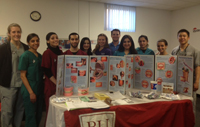
In early April recent immigrants to the Boston area benefited from a community outreach effort led by the Boston University chapter of the American Student Dental Association (ASDA) and the Global & Population Health office at Boston University Henry M. Goldman School of Dental Medicine (GSDM).
The Notre Dame Educational Center (NDEC) Dental Health Fair offered health promotion, education, age appropriate activities, and referrals to NDEC students. Volunteers gave oral health screenings to 26 attendees of the fair. The event was organized by ASDA Community Outreach Co-Chairs Ingy Alhelawe DMD 15 and Neelam Shah DMD 14, in collaboration with Oral Health Promotion Director Kathy Lituri. GSDM volunteers have held this event biannually for several years.
Founded in 1860, NDEC is a comprehensive adult educational center, which offers many resources for immigrants. Among the programs offered by NDEC are English Speakers of Other Languages (ESOL) classes, a high school diploma program, and a literacy program. They also offer support services, such as career counseling, immigration counseling, tutoring services, and education counseling.
“It was a great event with many participants from NDEC and ASDA volunteers,” said Shah.
The GSDM volunteers were: Ingy Alhelawe DMD 15, Sana Banday AS 15, Yousef Behbehani DMD 16, Rubbiya Charania DMD 16, Justine Karanian DMD 15, Shireen Khan AS 15, Michael Lee DMD 15, Linda Linsinbigler DMD 15, Kathy Lituri, Monica Schmidt DMD 17, Neelam Shah DMD 14, and Jake Ward (pre-dental).
Dean Jeffrey W. Hutter said, “Thank you to Kathy Lituri and all the volunteers that worked to make the School’s outreach at the Notre Dame Educational Center an enduring success.” He continued, “It is through efforts like this that the Henry M. Goldman School of Dental Medicine succeeds in its mission of excellence in community service.”
Submitted by GSDM Communications
Addressing the Physician Shortage: Recommendations for Medical Education Reform
Since it started more than 30 years ago, funding the graduate medical education (GME) system has not evolved even as there has been a revolution in GME. The United States contributes almost $10 billion a year from Medicare into funding the GME system. However this system fails to provide the workforce needed for the 21st century and lacks the necessary transparency and accountability.
With an aging population and millions of people newly registered for health insurance because of the Affordable Care Act, there is a pressing need to increase the number of primary care physicians. In the United States, it is estimated that only 20.9 percent of residents graduating from GME programs will practice primary care.
Recommendations recently published in the Journal of General Internal Medicine prepared by the Health Policy Education Subcommittee of the Society of General Internal Medicine (SGIM) outline how to reform the GME system to support the development of a physician workforce that can provide high quality, high value, population-based, and patient-centered health care, aligned with the dynamic needs of America’s healthcare delivery system.

Angela Jackson, MD, associate dean for student affairs at Boston University School of Medicine and a physician in general internal medicine at Boston Medical Center, is the article’s first author and is Co-Chair of the SGIM’s Health Policy Committee.
“SGIM hopes its policy and paper will invigorate the debate on GME funding, moving beyond discussions limited to funding levels to discussions on GME program accountability for public fund use and how to shape a GME system that will provide the nation with the physician workforce that we need,” said the authors.
The recommendations address workforce analysis, funding mechanisms, transparency, competency-based curriculum accountability, distributions of physician specialties and educational innovation, and call for:
1. Fully funding the National Health Care Workforce Commission
2. Having all payers for care contribute toward GME
3. Rebasing direct and indirect medical education payments to reflect 21st century costs
4. Requiring transparency in spending GME funds
5. Using GME funding exclusively for trainee education and related costs
6. Requiring training programs demonstrate their graduates are competent to practice 21st century medicine
7. Developing incentives for training programs to align the practice patterns of their graduates with regional and national workforce needs
8. Funding to develop GME innovations designed to impact the physician workforce positively.
BUSM Graduates Welcomed to Medical and Scientific Community
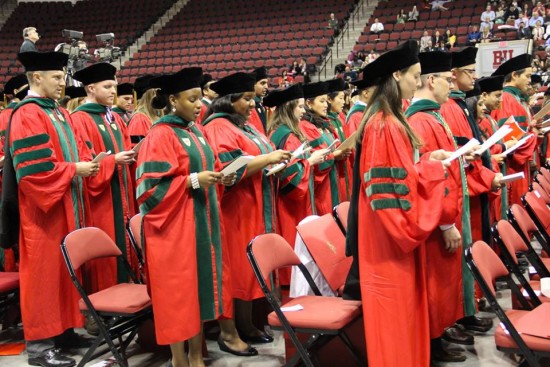
On Saturday, May 17, members of the BUSM Class of 2014 gathered to celebrate their graduation from medical school. Congratulations, Grads! View the pics on Facebook
The 167th Boston University School of Medicine commencement opened with an academic procession of 300 members of the faculty lining up on either side of the Class of 2014 to welcome them into the community of scientists and physicians. The ceremony, held at the Agganis arena on May 17, was a celebration of achievement and commitment to medical research and caring for patients.
“We gather together today to publically recognize and celebrate the credentials that these degree candidates have earned, a major life transition,” said Dean Karen Antman, MD. “I speak for the faculty in saying that it has been a great privilege to work with you. You are smart and committed, resilient and adaptive.”
The degrees earned by the Class of 2014 included 52 PhDs, 157 MDs, 12 MD-PhDs, 10 MD-MPHs, and six graduates who received an MSc.
“It has been said that ‘life is what happens when you are otherwise making plans,’” said U.S. Assistant Secretary of Defense for Health Affairs Jonathan Woodson, MD, who delivered the commencement address. “I have found this to be true time and again, and it expresses the need in life to expect the unexpected. Each of you should be prepared to negotiate around obstacles even as you keep your eye on the prize or the long range goals you have set for yourself. It is important to understand that deviations are the friction points in life when we learn the most about ourselves and we grow.
Woodson asked the parents of the graduates to stand to be recognized for their support and dedication that helped make their children’s accomplishments possible.
Speaking for her fellow doctoral students, Ariana Harris, PhD, noted, “To solve the mysteries of the world, we need each and everyone one of us to contribute. In a little while we will received our academic hoods and you will hear the titles of our individual projects, getting a sense of how different they are. This is what makes the scientific community amazing. There is so much to learn and so many of us are eager to figure it out. I am confident that whatever careers we pursue as individuals, our thirst for knowledge will continue. We use our scientific training every day. We search for logic, reason and evidence that support our thoughts and beliefs.”
Referring to the white coats he and his classmates received upon entering BUSM, Brian Curry, MD, speaking on behalf of the medical students, said, “We received these as a symbol of our induction to a calling. We didn’t realize it at the time, they also symbolized the granting of a very special kind of power. One that, just like our white coats themselves, we have spent the better part of four years clumsily trying to grow into and will likely continue to do for the rest of our careers. My message to you, BUSM class of 2014, is simply this: Earn this power. Earn it, but recognize we will never own it. We only can ever be responsible stewards of this power our patients have entrusted to us. Though today marks the retiring of these short white coats, we should never allow ourselves to get fat and happy with the notion that we have somehow grown into them. We must earn it anew every day, with every patient, always.”
Celebrating Success! GMS Commencement Images on BUSM Facebook
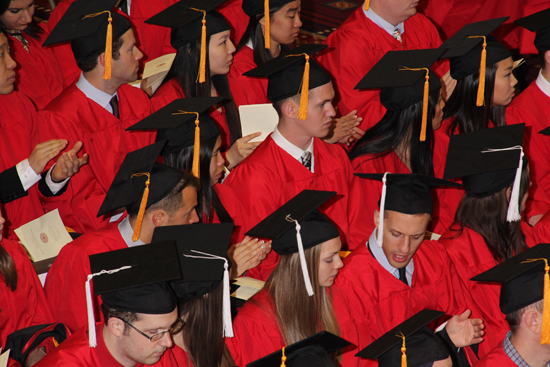 On Friday, May 16, the BUSM GMS Class of 2014 gathered in Metcalf Hall to celebrate commencement. See them on BUSM Facebook!
Celebrating Success! Division of Graduate Medical Sciences 2014 Commencement
“Your degree empowers you not just as scientists, researchers, clinicians, and health professionals but as critical thinkers, problem solvers and advocates,” said Associate Provost for the Division of Graduate Medical Sciences (GMS) Linda Hyman, PhD, to the 180 master’s degree graduates of 19 of the division’s programs. “This is a great day and we, your parents, friends, colleagues, teachers and mentors are here to celebrate you – your success, hard work, accomplishments, and your efforts to get to where you are today. I hope you leave BU with the knowledge that you have done well, and that you have the confidence to use your talents widely.”
The commencement ceremony, held on May 16 in Metcalf Hall of the George Sherman Union, featured three student speakers. “It has been an honor to be a part of this community of healing these past two years,” Jonathan Waldo, earning a master’s degree in Mental Health Counseling and Behavioral Medicine, told his fellow GMS graduates. “In reflecting on the nature of our field, I’ve recognized that when we invest our time in the lives of others we often gain insight into our own lives, our struggles, our hopes and our strengths. Our horizon beckons, and we are prepared.”
Brian Fry, receiving his Master of Arts in Medical Sciences degree, noted that, “As we move forward with the degrees we have earned today, we’re going to be a part of a rapidly changing landscape of health care, health policy and health sciences research. Many of the people and organizations that will desperately need to change will also be the most resistant to that change. It will be up to us to inspire action and lead by example. It is my hope that we welcome change and personal growth by chasing future, better versions of ourselves. We owe it to our future patients, clients and colleagues to never settle for anything but our very best.”
One of seven graduates of the GMS Bioimaging program and an accepted GMS doctoral student for the fall of 2014, Lauren Zajac reflected on her belief that art and science are the same, noting that in the Bioimaging program students work with images. “We behave as critics, curators, and artists. Interpreting a medical or biological image requires a set of skills similar to those required to interpret a work of art. Both artistic and biological images are representations, carry information and are the products of human experimentation. The process of creating art is a science, and the scientific pursuit of a question is truly an art. The two are intertwined and inseparable,” she said. “Great artists develop methods to produce the works we see in a gallery or museum. In a similar way, great scientists, through trial and error, develop methods to produce work that beautifully demonstrates a particular idea or model.”
Cancer’s Potential On-Off Switch
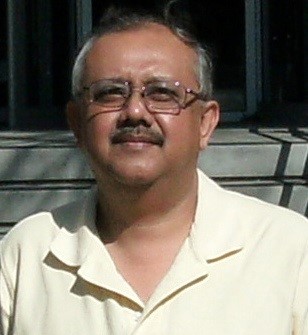
A team of Boston University School of Medicine (BUSM) researchers have proposed that an “on and off” epigenetic switch could be a common mechanism behind the development of different types of cancer. Epigenetics is the phenomena whereby genetically identical cells express their genes differently, resulting in different physical traits.Researchers from the Boston University Cancer Center recently published two articles about this in Anticancer Research and Epigenomics.
The current paradigm states that cancer develops from environmental and genetic changes to cancer progenitor cells. These changes are the result of mutations, exposure to toxic substances or hormonal imbalances.
Cancer progression is extremely complex, however. It also is well known that new mutations and the activation of more cancer causing genes occur throughout the development and progression of cancer.
“If we believe that everything in nature occurs in an organized fashion, then it is logical to assume that cancer development cannot be as disorganized as it may seem,” said Sibaji Sarkar, PhD, instructor of medicine at BUSM and the articles corresponding author. “There should be a general mechanism that initiates cancer progression from predisposed progenitor cells, which likely involves epigenetic changes.”
The existence of this epigenetic switch is indirectly supported by the fact that tumors develop through different stages. When cells rapidly grow during cancer progression, they become stuck in their current stage of development and their cell characteristics do not change. This is the reason that there are so many types of leukemia—the characteristics that a leukemia cell possesses when it begins to rapidly grow and expand are the characteristics that it will keep until the rapid growth stops.
“If we believe that all of the irreversible changes, mutations and effects of carcinogens make cells rapidly grow, then the mechanism that allows cells to stop growing and assume new changes in character must be of great importance,” added Sarkar. “The study of cancer progression is key to understanding how cancer cells continue to differentiate.”During cancer progression, there are different stages of rapid growth and differentiation. The control that allows for this switch between growth and differentiation can only be achieved through reversible mechanisms, such as epigenetic changes.
Sarkar and colleagues have previously proposed that epigenetic changes are involved in cancer progenitor cell formation and cancer progression. They also believe that epigenetic changes have the ability to control rapid growth and change of characteristics (different grades/types of tumors).
Sarkar compares the stages of cancer growth to a rocket orbiting in space – that is, that an object within an orbit continues to circle a given path, until it is given a signal (or additional fuel) to propel itself into a further orbit. This comparison can be made for cancer progenitor cells and epigenetics. A specific cell continues to grow at a certain stage until it is given a signal – in this case, an epigenetic switch – that propels it to differentiate into a new orbit, or further differentiated cell.
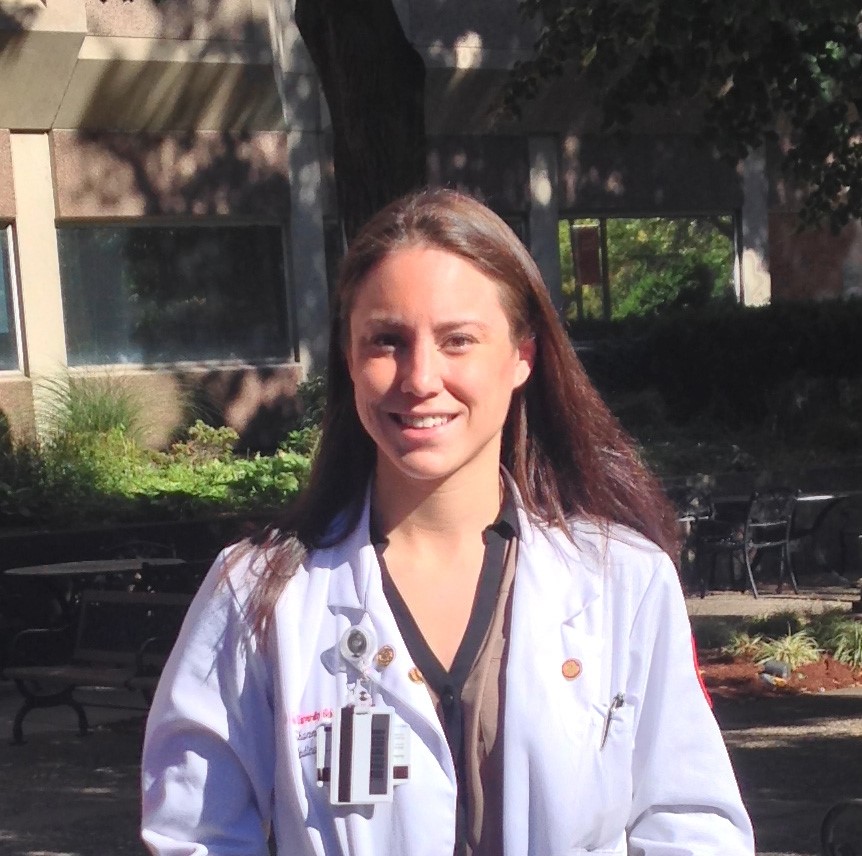
“While the specific details of the epigenetic code that regulates these changes has not been discovered, the fact that we have a possible explanation for the reversible and ever-changing characteristics for cancer progenitor cells is very exciting,” said Sarkar. “Future epigenetics findings hold the key to develop drugs which could possibly kill cancer progenitor cells to reduce cancer relapse and drug-resistant cancer cells.”
Shannon Byler, who served as the first author for both articles, is a student at Boston University. Other BU student co-authors of the Anticancer Research article are Sarah Goldgar, Sarah Heerboth, Meghan Leary, Genevieve Housman and Kimberly Moulton.
Register for the John McCahan Medical Campus Education Day
Boston University's Schools of Medicine, Public Health, Dental Medicine and the Division of Graduate Medical Sciences are proudly sponsoring the John McCahan Medical Campus Education Day on Thursday, May 22, 8:30 a.m.-3:30 p.m. in the BUSM Instructional Building, Hiebert Lounge 14th Floor.
“Education Day is a fantastic opportunity to meet and network with innovative educators from across the entire medical campus,” explains BUSM Gross Anatomy Course Director Ann Zumwalt, PhD, who also serves as chairman of the event planning committee. ”The event showcases creative educational initiatives and is consistently inspiring and invigorating for BUMC educators.”
The purpose of the event is to showcase and enhance educational innovations, scholarship and research across the Boston University Medical Campus. All faculty, students, residents, fellows and staff of BUMC are invited to attend.
Register online: https://www.bumc.bu.edu/jmedday/ Registration by May 22 is required for workshops and lunch.
Program Highlights
Keynote Lecture: (8:45 a.m.)
The Art and Science of Giving Feedback
Carole Pfeiffer, PhD
University of Connecticut Health Center
Dr. Pfeiffer is a Professor of Medicine and a sociologist who has worked in medical education for three decades. She is the Director of the Clinical Skills Assessment Program at the University of Connecticut School of Medicine and was a founding member of the Association of Standardized Patient Educators. She has a particular interest in communication skills in the clinical encounter.
Poster Session: Posters focus on themes of educational innovations, research and technology. Oral presentations and awards will be given for outstanding student, fellow/resident and faculty abstracts
Luncheon: Pre-registered attendees will be provided lunch. Register
Faculty Workshops: Pre-Registration required. Participants will learn about educational strategies, innovations, research and scholarship by attending the interactive workshops. See workshop details and registration online.
Contact: For more information, contact Liza Young, 638-4799 or lizamil@bu.edu
John McCahan Medical Campus Education Day
- Thursday, May 22
- 8:30 a.m.-3:30 p.m.
- BUSM Instructional Building, Hiebert Lounge 14th Floor.
Ribbon Cuttings Mark Official Openings for Two New GSDM Department of Restorative Sciences & Biomaterials Labs
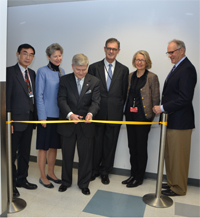
Two ribbon cutting ceremonies marked the official opening of two new laboratory spaces for the Department of Restorative Sciences & Biomaterials at Boston University Henry M. Goldman School of Dental Medicine (GSDM) in March. One of the new labs is located on the Second Floor of the Evans Biomedical Research Center at 650 Albany St. (X-2) and the other is on the Fifth Floor of the Housman Medical Research Center at 780 Harrison Ave. (R-5).
The Department of Restorative Sciences & Biomaterials at GSDM is at the forefront of evaluating and developing materials for computerized fabrication of restorations. The faculty has developed new concepts and techniques for analyzing the interaction between biomaterials and cells at the molecular and genetic levels. The department is strategically positioned to create, analyze and test novel synthetic materials for tissue replacement and prosthetic therapy.
The ceremonies began at the X-2 laboratory space, where Dean Jeffrey W. Hutter led a ribbon cutting with Dr. Karen Antman, Provost of Boston University Medical Campus (BUMC) and Dean of the Boston University School of Medicine (BUSM); Dr. Ronald Corley, Associate Provost for Research at BUMC and Professor and Chair of Microbiology at BUSM; Dr. Dan Nathanson, Professor and Chair of the Department of Restorative Sciences & Biomaterials; Dr. Maria Kukuruzinska, Associate Dean for Research and Professor in the Department of Molecular & Cell Biology; and Dr. Lee Chou, Professor of Biomaterials in the Department of Restorative Sciences & Biomaterials.
The guests and dignitaries then walked over to R-5, where Dean Hutter led a second ribbon cutting with Provost Antman; Associate Provost Corley; Dr. Kukuruzinska; Dr. Nathanson; and Dr. Russell Giordano, Associate Professor in the Department of Restorative Sciences & Biomaterials and Director of Biomaterials. Prior to cutting the ribbon, Dean Hutter, Dr. Nathanson, and Provost Antman each briefly addressed the attendees.
Dean Hutter said, “Our Department of Restorative Sciences & Biomaterials proudly conducts basic science and applied research; trains pre- and post-doctoral students and residents in research methodology and biomaterials; and educates dental students with respect to novel materials and procedures that may improve patient care.” He continued, “I know that these new research laboratories will only add to the quality of our research and the education we are able to provide our students and residents.”
Photos are available on Facebook and Flickr.
Submitted by GSDM Communications.
BUSM’s Wolozin Receives Alzheimer’s Association Zenith Fellows Award
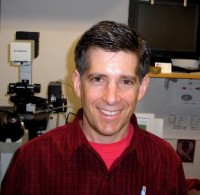
Benjamin Wolozin, MD, PhD, professor of pharmacology and neurology, was awarded the Alzheimer’s Association Zenith Fellows Award, a $450,000 grant dispersed over three years. Initiated in 1991, the award provides support for cutting edge basic science or biomedical research that addresses fundamental problems related to early detection, etiology pathogenesis, treatment and/or prevention of Alzheimer’s disease (AD).
The Wolozin Lab won the award with its proposal “It Takes TIA to Tangle: The Role of RNA Binding Proteins in AD.” The lab already has discovered a RNA binding protein that induces tau misfolding, one of the essential steps that leads to cognitive loss in AD. This award will allow the Wolozin Lab to experimentally induce the misfolding, investigate the factors that regulate the misfolding and in the future, potentially design therapeutics to prevent the misfolding.
"Dr. Wolozin's investigation represents the exciting and promising research that is very much needed if we are to eventually find effective treatments for Alzheimer's. For the more than five million Americans with Alzheimer's, we are pleased to be a partner in that work," said Jim Wessler, president/CEO Alzheimer's Association, MA/NH Chapter.
May 13 Fifth Annual Lynne Stevens Memorial Lecture
"Trauma Informed Services: Implications for Healthcare Providers and Systems"
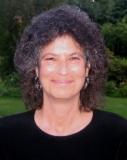
Carole Warshaw, MD
Director, National Center on Domestic Violence, Trauma and Mental Health
Executive Director, Domestic Violence Mental Health Policy Initiative
Tuesday, May 13
Noon-1 p.m.
BUSM Instructional Building, L-110
This annual memorial lecture is in honor of Lynne Stevens, LICSW, BCD (1946-2009), the director of the Responding to Violence Against Women Program and an Assistant Professor in the Department of Family Medicine. She was a clinician, activist and researcher who worked locally, nationally, and internationally, specializing in evaluation of the quality of care offered to women who were victims of violence.
Attendees are cordially invited for lunch at 11:45 a.m. and a Q & A discussion from 1-2 p.m. with Dr. Warshaw following the lecture.
State Medicaid Cuts Mean More Emergency Department Visits, Higher Costs for Safety-Net Hospital
According to a study released April 17 in the American Journal of Public Health, dental-related Emergency Department (ED) visits increased up to 14 percent following Massachusetts Medicaid cuts.
Findings are based on data from Boston Medical Center, an urban safety-net hospital in Boston’s South End.
In this retrospective study of existing data, researchers looked at dental-related ED visits and costs for three years before and two years after Massachusetts Health Care Reform, which reduced Medicaid coverage for adult dental care in July 2010. The study looked at adults 21 and older and ED use from July 1, 2007 to June 30, 2012.
“Dental-related ED visits increased two percent the first year and 14 percent the second year after Medicaid cuts,” said Dr. Judith Jones, one of the study’s authors and Director of the Center for Clinical Research at Boston University Henry M. Goldman School of Dental Medicine. “Percentage increases were highest among older adults, minorities, and persons receiving charity care, Medicaid, and Medicare.”
Related costs of care rose significantly, too. The average cost per patient per visit increased seven percent in 2010–2011 and 27 percent in 2011–2012.
The study found that most people using the ED for dental care reported caries (cavities) and soft tissue issues, conditions that are best treated in the dentist’s office.
In short, “Use of EDs for dental care points to an inappropriate use of resources and lack of continuity of dental care,” according to Jones.
“The findings highlight the need for primary dental care among the poor, racial/ethnic minorities, and adults of all ages, especially older adults.”
The idea for the study came from Dr. Pushkar Mehra, chair of the Department of Oral & Maxillofacial Surgery, who noted that, “after MassHealth Dental for adults was reduced, the residents in the BU/BMC Oral & Maxillofacial Surgery program were spending more time in the ED seeing patients with dental needs.”
Dean Jeffrey W. Hutter added, “I am proud of the leading role the Boston University Henry M. Goldman School of Dental Medicine is taking in identifying and addressing access to care issues in the state of Massachusetts through our research, in our Patient Treatment Centers, and at our Dental Health Center locations.”
Massachusetts Health Care Reform cut Medicaid spending on adult dental care by nearly 50 percent—from $139.4 million/year from July 1, 2007 to June 30, 2010, to $67.2 million/year from July 1, 2010 to June 30, 2012. In 2012, Medicaid partially restored dental care coverage for adults in Massachusetts. The study authors recommend further research to determine whether ED visits declined as a result.
Additional authors include Drs. Martha Neely, Lillelenny Santana Gutierrez, and Sharron Rich, MPH.
Submitted by GSDM Communications.