Student Updates
Dec. 25-Jan. 1 Parking and Transportation Information
Parking
All parking facilities will be open Dec. 25-Jan. 1. All valid 610 Garage access will be programmed to work in the 710 Albany St. and DOB garages on Monday, Dec. 25 and Monday, Jan. 1 ONLY. Those who are not enrolled in the monthly parking program may park in 710 and DOB garages for $7 on Monday, Dec. 25 and Monday, Jan. 1 ONLY.
Shuttles
The Boston University Shuttle (BUS) will not operate Dec. 25-Jan. 1. Friday, Dec. 22 is the last day of Weekday Service before Holidays and Intersession (including Comm. Ave. Loop) and the last day of Late Night Service before Holidays and Intersession.
Service will resume on Tuesday, Jan. 2 at 7 a.m. at a reduced weekday service (20 minute peak and 30 minute off-peak) 7 a.m.-midnight (NO Comm. Ave. Loop). This will continue through Wednesday, Jan. 17. Refer to the BUS website for more information.
The Inner Campus Shuttle, Evening Shuttle, patient shuttles and VA Shuttle will not be operating Monday, Dec. 25 and Monday, Jan. 1.
MBTA
Visit the MBTA website for more details.
- Sunday, Dec. 24 and Monday Dec. 25: Buses, subway and commuter rail will operate on a Sunday schedule. CT1 and CT3 will not operate.
- Sunday, Dec. 31: Buses, subway, and commuter rail will operate on a Sunday schedule. CT1 and CT3 will not operate.
- Additional Service
- All Commuter Rail lines will operate with additional outbound service after 11 p.m.
- All Subway lines will operate on rush-hour schedules from 3 p.m.-1 a.m.
- Fares will not be collected after 8 p.m.
- Bicycles are prohibited on all inbound Commuter Rail trains between 10 a.m.-6 p.m. and outbound trains after 4 p.m.
- Additional Service
- Monday, Jan. 1: Buses, subway, and commuter rail will operate on a Sunday schedule. CT1 and CT3 will not operate.
If you have any questions regarding this holiday schedule, please call the Office of Transportation Services at 638-7473 or the Parking Office at 638-4915.8-7473 or the Parking Office at 638-4915.
15-Minute Screen Lock for BUMC Computers Starting Friday, Jan. 5, 2018

Boston University is going to use Microsoft Group Policy to configure a 15-minute screen lock on Medical Campus computers. This change will not be implemented for classroom computers because they are not used to access, process, or store non-public data.
Why implement screen lock?
The BU Data Protection Standards require all computers handling non-public data (Internal, Confidential, and Restricted Use data) to lock the screen when not in use for a few minutes. Since the maximum amount is 15 minutes, we are setting the configuration to 15 minutes.
BU Policy, designed to comply with state and federal law, requires screen lock because disk encryption is only effective when the computer is powered off or when the screen is locked.
What else does BU Policy require?
There are several requirements, but these are the basics for desktops, laptops, and phones:
- Operating System and applications that are supported and regularly updated
- Anti-malware installed and set to auto update and scan
- Disk encryption (only required for Restricted Use data)
- Auto screen lock
Any personal devices used to access non-public data must have these safeguards as well. Do what you can with our guidance, then ask for help.
Will screen lock stop my research?
No, screen lock does not affect ongoing computer processes, such as performing statistical analysis. Likewise, if staff must walk away from an ongoing conference call or training, the conference call or training video will not stop. Staff will need to re-enter their password when 15 minutes have elapsed.
This change may initially cause inconvenience, but it is necessary to safeguard data in the event that a computer is inappropriately accessed or stolen from the Medical Campus.
If you have any concerns, please contact Medical Campus Information Security Officer David Corbett.
CTSI to Test New Approach to Health Care Delivery
Investigators at Boston University Clinical and Translational Science Institute (BU-CTSI) and colleagues have been awarded a five-year, $8.6 million grant from the National Institutes of Health (NIH) National Center for Advancing Translational Sciences (NCATS) to develop, test, and disseminate a replicable, high-quality coordination of care approach for vulnerable populations experiencing disparities.
Called TRIP (Translating Research Into Practice), it will focus on African American women with breast cancer and the disparities they face in in time-to-treatment, quality of treatment and delayed follow up to abnormal tests.

In addition to BU-CTSI, investigators include Tufts CTSI, Brigham and Women’s Hospital and Harvard Catalyst (the Harvard Clinical and Translational Science Center), and University of Massachusetts Center for Clinical and Translational Science (CCTS).

“This is an important approach to implementing clinical care. Models that work in one institution with selected patient populations must be tested at other institutions to ensure that best practices can be transferred. This program will begin to tell us how to approach diagnosis of breast cancer in women from many different socio-economic and ethnic backgrounds, said David Center, MD, Director of the BU-CTSI. “This is a perfect use of the NCATS Cooperative CTSA Innovation Award network, which funds unique ideas from individual CTSIs that propose to use the resources of multiple CTSA institutions.”
In partnership with the Boston Breast Cancer Equity Coalition, a diverse group of local community stakeholders whose mission is to achieve equity for all women with breast cancer, TRIP researchers found that three evidence-based strategies known to reduce delays in care have failed to make it into practice as a result of persistent patient and health system barriers:
- A navigator for every vulnerable patient to solve problems and provide support and guidance through the complex health care system;
- A regional registry to help providers and navigators track their patients; and
- Resources to help navigators identify social determinants of health (e.g., food and housing insecurity).
TRIP will integrate these strategies into a cohesive package across six hospitals, with the goal of assisting 1,100 women seeking breast cancer care over the next five years. A key aspect of the project is to test the effectiveness of the combined approach.If successful, TRIP can be adapted to the treatment of any disease in other communities impacted by health disparities.
TRIP will be led by principal investigators Tracy Battaglia, MD, MPH of BU-CTSI; Karen Freund, MD, MPH of Tufts CTSI; Jennifer Haas, MD, MPH of Brigham and Women’s Hospital and Harvard Catalyst; and Stephenie Lemon, PhD of UMass CCTS. The six participating clinical sites are Boston Medical Center, Brigham & Women’s Faulkner Hospital, Beth Israel Deaconess Medical Center, Dana-Farber Cancer Institute, Massachusetts General Hospital, and Tufts Medical Center. Boston Breast Cancer Equity Coalition, Boston Patient Navigator Network, the University of Chicago, and the Institute for Translational Medicine will build a coalition of stakeholders and provide community engagement support.
“The rapid rate of scientific discovery far outpaces the ability of our health care system to integrate evidence into every day practice, especially in cancer care for low income, racial ethnic minority patients who remain less likely to receive timely, quality treatment,” said Battaglia, who also is a BMC internal medicine physician. ”Sustainable solutions require collaboration among all community stakeholders, including patients, providers, public health practitioners, health systems and scientific investigators. Community engaged research conducted in real life settings is necessary to ensure scientific discoveries reach all populations.”
TRIP is in its start-up phase, consisting of stakeholder interviews, implementation planning, and development of the registry and screening tools. Then the academic, clinical and community partners will have four years to implement and test TRIP across the six participating hospitals.
Once completed, this community engaged program will demonstrate the feasibility of community-academic partnerships to provide innovations in information-sharing and systems implementation that will translate into reductions in health disparities for vulnerable patients facing any disease.
“This innovative model of care links multiple clinical systems and community resources to meet the many needs of women with breast cancer in Boston,” said Lemon, professor of medicine in the Division of Preventive and Behavioral Medicine at University of Massachusetts Medical School and co-director of community engagement at the UMass CCTS. “However, people with different conditions and in different locations experience similar struggles. If we find this model to be effective, it has potential to transform collaborative care delivery for other disease conditions and in places across the country. We have the goal of scaling up the care delivery model once we have completed the initial project in Boston. We have engaged partners from Chicago to be the first to work with us to identify ways to spread our model.”
TRIP is supported by the National Center For Advancing Translational Sciences of the National Institutes of Health under Award Number U01TR002070, and by the NIH Office of Behavioral and Social Sciences Research The content of this release is solely the responsibility of the authors and does not necessarily represent the official views of the NIH.
NEIDL BSL-4 Lab Gets Green Light
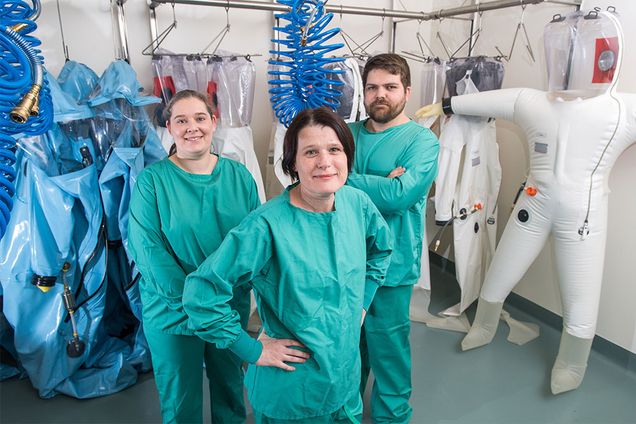
After years of scrutiny by regulatory agencies and city, state, and federal officials, Boston University’s National Emerging Infectious Diseases Laboratories (NEIDL) has received final approval from the Boston Public Health Commission (BPHC) to conduct research at Biosafety Level 4 (BSL-4).
“We’re extraordinarily pleased,” says NEIDL Director Ronald B. Corley, a School of Medicine professor of microbiology. The BSL-4 lab, on BU’s Medical Campus in the South End, was built according to the most stringent safety specifications set by the US government for infectious disease research. Corley says the BPHC permission is “the last hurdle for our scientists being able to work with approved BSL-4 pathogens—specifically, Ebola and Marburg.” Ebola and Marburg are both rare but life-threatening viruses that have become global public health threats. There is no available FDA-approved vaccine or therapy for Ebola, which killed and sickened tens of thousands of people in West Africa in a 2014–2016 outbreak, or for Marburg. Ebola cases traveled to the United States and Europe during the 2014 outbreak.
“As we have seen over the past several years, we are all vulnerable to potentially devastating infectious diseases that may have originated halfway across the globe,” says Gloria Waters, BU vice president and associate provost for research. “With the opening of the NEIDL’s BSL-4 lab, BU is poised to establish itself as a national leader in fighting microbial systems and infectious diseases. The work that will be carried out here will bring benefit and relief in the form of vaccines, treatments, and cures to people in Boston, the United States, and around the world.”
The NEIDL, where multidisciplinary teams of microbiologists, virologists, engineers, and other scientists have been doing research at BSL-2 for five years and at BSL-3 since January 2014, is part of a national network of secure facilities that study emerging infectious diseases and develop diagnostic tests, treatments, and vaccines to promote public health. There are 11 BSL-4 labs across North America—10 in the United States and one in Winnipeg, Canada. The NEIDL BSL-4 lab is one of only two labs sited within universities in the United States—the other one is at Galveston National Laboratory, at the University of Texas Medical Branch—and Corley says the NEIDL lab is the only one “in the middle of a very research-intensive university like BU” and in “a mecca for biomedical research like the Boston area.”
One important benefit of the location, says Corley, is that NEIDL researchers can draw on the expertise of multidisciplinary teams of scientists—engineers, chemists, biologists who work on regenerative medicine—across BU, and at other institutions in Boston.
Last December, after more than three years of review, BSL-4 research at the NEIDL was approved by the Centers for Disease Control and Prevention (CDC). All BSL-4 research conducted at the NEIDL must also be approved on a case-by-case basis by BU’s Institutional Biosafety Committee, which was created under National Institutes of Health guidelines to review research involving biohazardous materials.
Waters says that while the NEIDL has received the permit to conduct BSL-4 research, approval and review of the work in the BSL-4 lab will be ongoing. “Every project is scrutinized and continuously monitored by multiple local and federal agencies,” she says. “The details of all of our research proposals are available to the public. I take our commitment to safety and transparency extremely seriously, as does every one of my colleagues and staff and faculty members.”
Corley says his team—scientists, administrators, security personnel, environmental and health and safety officials, community relations representatives—has emphasized transparency concerning research at the NEIDL. “We’re not going to do anything in secret,” he says. “We’re going to tell people what we are doing.” Corley says he and others have offered close to 200 tours of the 192,000-square-foot, 7-story facility, with 2,400 participants—public officials, the media, members of the community—and that doesn’t include the many visiting scientists from other institutions. Corley says the NEIDL’s Community Liaison Committee, which facilitates communication between the NEIDL and the community and comprises residents from the South End, Roxbury, Dorchester, East Boston, and Cambridge, has recently been expanded to 17 people.
As we have seen over the past several years, we are all vulnerable to potentially devastating infectious diseases that may have originated halfway across the globe. With the opening of the NEIDL’s BSL-4 lab, BU is poised to establish itself as a national leader in fighting microbial systems and infectious diseases.”—Gloria Waters
NEIDL microbiologist Elke Mühlberger, who came to BU nine years ago from the BSL-4 lab at Germany’s Philipps University of Marburg, is one of the world’s leading researchers on Ebola and Marburg viruses—the latter named for the city where it was identified. Now that the BPHC has granted approval, Mühlberger, a MED associate professor of microbiology, can take the necessary steps to begin work on the BSL-4 lab’s first approved project in collaboration with BU’s Center for Regenerative Medicine stem cell biologist and tissue engineer Gustavo Mostoslavsky, a MED associate professor of medicine and microbiology. “We still don’t understand why Ebola virus is so lethal for humans,” Mühlberger says. “This project is about establishing novel infection platforms that mimic the pathology of these viruses in humans. Understanding how these viruses devastate particular organs will help us to come up with treatment options.”
“To my knowledge, no one has done this before,” says Corley. “It brings us closer to really understanding why these pathogens are so deadly.” And understanding the pathogens brings Mühlberger and the NEIDL team of multidisciplinary scientists closer to finding ways to prevent and treat the viruses.
Currently, there are two experienced BSL-4 researchers at the NEIDL working with Mühlberger on her project: research scientist Adam Hume and senior research scientist Judith Olejnik. “We have worked hard to get the BSL-4 lab up and running,” Mühlberger says. “However, now that all approvals have been obtained, the real work begins and we are excited to take it on.”
Mühlberger says the BSL-4 team has already come up with a list of the most important experiments to perform once the lab is operational. Because of the required BSL-4 safety precautions, which have all been described by NEIDL scientists and security officials at public hearings, it will probably take another one to two months to begin the actual hands-on BSL-4 work. Mühlberger now has to obtain the Ebola and Marburg viruses from other CDC-approved BSL-4 labs—a process that must follow rigorous inspection, safety, security, and transportation rules.
Corley says the NEIDL’s BSL-4 lab is one of the most carefully designed and constructed buildings of its kind in the world. It has its own filtration, decontamination, and waste disposal systems and special engineering features that prevent microorganisms from being released into the environment. Researchers wear protective, air-supplied, full-body suits and undergo extensive training in handling hazardous infectious agents.
The work being done throughout the NEIDL is closely interconnected. Although special training and approvals are required for all Level 4 work—where Mühlberger, Hume, Olejnik, and other scientists in pressurized space suits will study the deadliest pathogens—the work done at other levels supports those efforts. “Developing the technology to learn a pathogen’s genetic makeup and how it invades the body’s immune system is a step-by-step process,” says Mühlberger. “Technologies established at BSL-2 can be applied to higher containment levels up to and including BSL-4.”
“All the parts of the jigsaw fit together,” says NEIDL virologist Paul Duprex, a MED professor of microbiology, who studies measles and mumps viruses. “That’s one of the strengths of this building—scientists can work at BSL-2, -3, and -4.”
Duprex has been doing preparatory work for a project on the Nipah virus, which he says will go forward at the NEIDL BSL-4 lab after the necessary approval and permitting process.
NEIDL researcher John Connor, a MED associate professor of microbiology, has been collaborating with BU engineers and other scientists to develop tools for early detection of emerging infectious diseases. “I’ll be so happy to have this building finally fulfill the function for which it was built,” he says. His research on a diagnostic for Ebola, Marburg, and Lassa fever, which are all BSL-4 viruses, has meant working with scientists at other BSL-4 facilities in the United States, such as the Galveston National Laboratory or the US Army Medical Research Institute for Infectious Diseases at Fort Detrick, in Maryland.
“I came here in 2007 with the idea of being able to work with people at higher levels of containment in order to be able to make an impact as quickly as possible,” Connor says. “So it’s great to finally be looking at the possibility of really doing that.
“I’m thrilled.”
This BU Today story was written by Sara Rimer.
2018 Healing Pups Calendars Available Now

Support the Healing Pups program by purchasing a 2018 calendar!
This unique program brings comfort and smiles to our students during exam time, as well as patients and families dealing with illness and trauma. A perfect gift or stocking stuffer for the dog lover in your life!
Celebrate the Legacy of Martin Luther King, Jr.

SAVE THE DATE
Thursday, Jan. 18 | Noon-1 p.m.
Instructional Building, Hiebert Lounge
All members of the BU Medical Campus are invited to a special presentation commemorating the legacy of Rev. Martin Luther King, Jr.
Invocation by Rev. Julian Armand Cook
Assistant Director, Howard Thurman Center
Conversation with Jonathan Woodson, MD
Director, Institute for Health System Innovation and Policy
Jonathan Woodson, MD
 Jonathan Woodson, MD, leads the University-wide Institute for Health System Innovation and Policy. He serves as Larz Anderson Professor in Management and Professor of the Practice at the Questrom School of Business, and holds joint appointments as Professor of Surgery at the School of Medicine and Professor of Health Law, Policy and Management at the School of Public Health.
Dr. Woodson holds the rank of brigadier general in the US Army Reserves and served from 2010 to 2016 as assistant secretary of defense for health affairs in the US Department of Defense. There, he was the principal advisor to the Secretary of Defense for all health and force health protection issues while ensuring the effective execution of the Department's medical mission.
Prior to his time in the Department of Defense, Dr. Woodson served as professor of surgery and associate dean for students, diversity, and multicultural affairs at the School of Medicine, and was a senior attending vascular surgeon at Boston Medical Center.
This event is brought to you by the BUSM Office of Diversity and Multicultural Affairs, Goldman School of Dental Medicine Office of Diversity, BU School of Public Health, and BMC Minority Recruitment Program. Refreshments will be provided.
Matthew Kulke, MD, Joins BUMC
Appointed Chief of the Section of Hematology/Oncology, Zoltan Kohn Professor of Medicine, Deputy Director of the BU-BMC Cancer Center

Matthew Kulke, MD, will become the Chief of the Section of Hematology/Oncology in the Department of Medicine at Boston Medical Center and Zoltan Kohn Professor of Medicine at Boston University School of Medicine, effective March 1, 2018. In addition, he will serve as Deputy Director of the BU-BMC Cancer Center and Medical Director of the Clinical Cancer Center at BMC.
Kulke is currently the Director of the Program in Neuroendocrine and Carcinoid Tumors at Dana-Farber Cancer Institute and Professor of Medicine at Harvard Medical School. A leader in the research and treatment of neuroendocrine tumors, he has received numerous awards for his accomplishments as a clinical investigator and provider of compassionate care to patients.
He has led national and international clinical trials to identify new therapeutic and diagnostic approaches to neuroendocrine tumors and gastrointestinal malignancies. In addition, he has published more than 100 peer-reviewed articles about neuroendocrine tumors.
Kulke received his undergraduate degree from Princeton University, his MD from University of California, San Francisco School of Medicine and a master's degree in medical science from Harvard Medical School.
He completed his residency at Brigham and Women's Hospital in Internal Medicine and a fellowhip in medical oncology at Dana-Farber Cancer Institute.
Kulke received the George Canellos Award for Clinical Investigation and the Ruth Brufsky Award for Pancreatic Cancer Research. He currently serves on the advisory board for the European Neuroendocrine Tumor Society, the executive committee of the North American Neuroendocrine Tumor Society, and chairs the Neuroendocrine Tumor Task force for the National Cancer Institute.
Special thanks to Adam Lerner, MD, who has served as the section's Interim Chief for two years and ensured that the needs of his colleagues and patients were represented; Emelia Benjamin, MD, who chaired the search committee; and the other committee members for their hard work during this process.
Nov. 22-24 Parking and Transportation Services
Wednesday, Nov. 22
Shuttles: The Boston University Shuttle (BUS) service will end at 6 p.m.
Thursday, Nov. 23
Parking:
All parking facilities will be open. Parkers with 610 Garage access will be able to park in the 710 and DOB garages on Thursday ONLY. Those without garage access may park in the 710 Garage for a flat rate of $7.00.
Shuttles:
The Boston University Shuttle (BUS) will not operate on Thanksgiving Day. Healthnet shuttles will not operate on Thanksgiving Day.
MBTA:
Most buses, subways, and commuter rail will operate on a Sunday schedule. The following will not operate on the holiday: CT1 and CT3 buses.
Friday, Nov. 24
Parking:
All parking facilities will be open and regular rates apply. Monthly parkers should park in their assigned lot.
Shuttles:
The Boston University Shuttle (BUS) will not operate. The Inner Campus Shuttle, Evening Shuttle and patient shuttles (Healthnet #1 and #2 and East Boston) and the VA Shuttle will operate their regular schedules.
MBTA:
All buses, subways and commuter rail will operate on a regular weekday schedule.
If you have any questions regarding this holiday schedule, please call TranSComm at 638-7473 or the Parking Office at 638-4915; or visit the MBTA’s website at www.mbta.com.
2018 Parking Stickers Now Available
The Parking Office, located at 710 Albany St., is now issuing 2018 parking permit decals to existing parkers. Staff can pick up their 2018 permits weekdays between 7 a.m.-5 p.m. All 2018 parking permits must be picked up before Wednesday, Jan.31. Those without 2018 permits will be denied access to their parking assignment.
The Permit Update Form can be found at https://www.bumc.bu.edu/parking/forms/ and should be printed, completed and brought with you to obtain your permit. Contact the Parking Office at 638-4915 with questions.
12/1: Visiting Professor Lecture with David Blumenthal, MD
"Managing the Sickest of the Sick in an Accountable Environment"
Friday, Dec. 1
2-3 p.m. Lecture | 3-3:20 p.m. Reception
Instructional Building, Hiebert Lounge
Coffee and tea reception to follow. More information to come.
 David Blumenthal, MD, MPP, is president of The Commonwealth Fund, a national philanthropy engaged in independent research on health and social policy issues.
Dr. Blumenthal is formerly the Samuel O. Thier Professor of Medicine at Harvard Medical School and Chief Health Information and Innovation Officer at Partners Healthcare System in Boston. From 2009 to 2011, he served as the National Coordinator for Health Information Technology, with the charge to build an interoperable, private, and secure nationwide health information system and to support the widespread, meaningful use of health IT.
Previously, Dr. Blumenthal was a practicing primary care physician, director of the Institute for Health Policy, and professor of medicine and health policy at Massachusetts General Hospital/Partners Healthcare System and Harvard Medical School. He is the author of more than 250 books and scholarly publications, including most recently, Heart of Power: Health and Politics in the Oval Office. He is a member of the Institute of Medicine and serves on the editorial boards of the New England Journal of Medicine and the Journal of Delivery Science and Innovation.
Dr. Blumenthal received his undergraduate, medical, and public policy degrees from Harvard University and completed his residency in internal medicine at Massachusetts General Hospital.