Student Updates
BUSPH-based Global Health Center Gets $8.5 Million Grant to Combat Neonatal Mortality
BU's Center for Global Health and Development, based at the School of Public Health, has won an $8.5 million grant from the Bill & Melinda Gates Foundation for a project that will test simple, low-cost methods that could save many of the 4 million newborns who die each year in the world’s poorest countries.

The four-year grant will allow a team of center researchers, headed by David Hamer, MD, associate professor of international health, to test whether an antiseptic wash can reduce infections of the umbilicus in the month after birth and prevent the deaths of newborns from those infections. The large-scale trial will be undertaken in the African nation of Zambia, where BUSPH researchers have worked on other studies aimed at reducing neonatal mortality.
“I’m so pleased to be able to announce this grant,” said Jonathon Simon, the center’s founding director. “For all of the progress that’s been made worldwide in reducing deaths in children, there’s been much less progress for ‘neonates,’ meaning the first 28 days of life. We’re hoping to change that.”
The research team will use the grant to study whether the use of an antiseptic wash called chlorhexidine to clean the umbilicus stump of newborns (the small piece of umbilical cord that remains for about a week after the cord is cut at birth) will improve neonatal survival rates. More than 28,000 women in the southern province of Zambia will be recruited for the study, and researchers will compare infant survival rates for those who receive the intervention with those who don't.
Hamer said he began discussions with the Gates Foundation about the chlorhexidine study months ago, while he and other researchers were completing another study in Zambia known as LUNESP (Lufwanyama Neonatal Survival Project). That project trained Zambian women who serve as traditional birth attendants in resuscitation and other simple interventions aimed at preventing neonatal mortality.
Hamer said the chlorhexidine trial will involve training traditional birth attendants, as well as staff at a health facility and expectant mothers, in using the antiseptic. The five districts being studied in southern Zambia, spread around the town of Choma, have very basic health facilities, and the majority of births take place in the home.
"We're doing this in a very practical way so it can be easily applied in a community and household setting," he said of the intervention.

Besides Hamer, who is an infectious diseases specialist, the research team will include epidemiologist Katherine Semrau and pediatric global health fellow Julie Herlihy. Simon and Donald Thea, MD, professor of international health, will oversee the project.
Hamer said that while much progress has been made in the last decade in reducing mortality among children under the age of 5, deaths in the first 28 days have been harder to prevent, especially in poor areas of the world. About 40 percent of the deaths of children under 5 occur in the first month of life, he noted. Zambia has one of the highest neonatal mortality rates in Africa.
Cord cleaning with chlorhexidine has been studied in Nepal and Bangladesh, but this is the first such study in Africa. A companion study will be conducted simultaneously in Tanzania by another university to expand the scope of the research, Hamer said.
“We are grateful for the support of this marvelous project,” said BU President Robert A. Brown. “This study is indicative of the quality and impact of the research and outreach that is underway in the Center for Global Health and Development.”
Dec. 9 BUSPH Public Health Forum: Personalized Genetic Medicine – Are We There Yet? The Alzheimer's Experience
On Wednesday, December 9, join Lindsay Farrer, PhD, chief of the Genetics Program at BU School of Medicine, as he presents the talk "Personalized Genetic Medicine…Are We There Yet? The Alzheimer's Experience" at the BUSPH Public Health Forum. Farrer, whose research mainly focuses on Alzheimer's disease, is also a professor of medicine, neurology, genetics and genomics at BUSM and professor of epidemiology and biostatistics at BUSPH.

Under Farrer's leadership, the MIRAGE Project, a multi-center study of Alzheimer's funded by the National Institute on Aging since 1991, has made several important contributions to the understanding of interactions between genetic and environmental factors for the disorder. In recent years, the MIRAGE cohort has been the focus of studies comparing variations in genes related to vascular functioning with disease risk and pre-clinical changes evident on MRI scans of the brain.
In 2007, Farrer co-directed an international study that demonstrated that the neuronal sortilin-related receptor SORL1 is genetically and functionally associated with Alzheimer's disease, a finding that has been replicated by many laboratories worldwide. Currently, his lab is conducting genome wide association studies for Alzheimer's using several diverse population samples.
Farrer and his colleagues in the Genetics Program are also working with other BUSM researchers to identifying genes for hypertension and blood pressure regulation disorders; genes influencing severity and expression of sickle cell anemia and β-thalassemia; and with the New England Centenarian Study on the genetic basis of exceptional longevity.
The BUSPH Public Health Forum is a regular series presented by the School of Public Health. It is free and open to the public.
- BUSPH Public Health Forum: "Personalized Genetic Medicine – Are We There Yet? The Alzheimer's Experience"
- Speaker: Lindsay Farrer, chief of the Genetics Program at BUSM, professor of medicine, neurology, genetics and genomics at BUSM, and professor of epidemiology and biostatistics at BUSPH.
- Date: December 9, 2009
- Time: 12:00 p.m. – 1:00 p.m.
- Location: BUSM Instructional Building, Room L-112, 72 East Concord Street
- For more information, contact msalzman@bu.edu
BUSM Researchers Find Increased Dairy Intake Reduces Risk of Uterine Fibroids in Black Women
Boston University School of Medicine (BUSM) researchers at the Slone Epidemiology Center found that black women with high intake of dairy products have a reduced incidence of uterine leiomyomata (fibroids). This report, based on the Black Women’s Health Study, appears in the current issue of the American Journal of Epidemiology.
Uterine fibroids are benign tumors of the uterus and are two to three times more common among black women than white women. They are the primary indication for hysterectomy in the U.S. and account for $2.2 billion annually in health care costs.
National surveys show that black women consume fewer servings of dairy than white women and have lower intake of calcium, magnesium and phosphorus. The causes of fibroids are poorly understood, but sex steroid hormones and growth factors are thought to play a role. The Slone researchers studied dairy products because of the possibility that they have antioxidant effects and may modify endogenous sex hormones.
The study was based on data from the Black Women’s Health Study. The 59,000 study participants, enrolled in 1995, completed biennial questionnaires on which they reported whether they were diagnosed with fibroids. Their diet was assessed at two points in time using a modified version of the National Cancer Institute’s Block short-form food frequency questionnaire (FFQ). Based on 5,871 incident cases of fibroids diagnosed during 10 years of follow-up, the study found that high dairy intake was inversely associated with fibroids after controlling for other risk factors. Fibroid incidence was reduced by 30% among women who had 4 or more dairy servings a day, relative to women who had less than 1 serving a day. Intakes of calcium, phosphorus, and calcium-to-phosphorus ratio (an indicator of calcium bioavailability) were also inversely associated with fibroid risk. Because dairy intake is lower among blacks than whites, differences in dairy intake may contribute to the racial discrepancy in rates of fibroids.

“Although the exact mechanisms are unclear, a protective effect of dairy consumption on uterine fibroids risk is plausible, as calcium, a major component of dairy foods, may reduce cellular proliferation,” said lead author Lauren A. Wise, ScD, an associate professor of epidemiology at Boston University School of Public Health and a senior epidemiologist at the Slone Epidemiology Center at BUSM. “This is the first report showing an inverse association between dairy intake and fibroid risk. If confirmed, a modifiable risk factor for fibroids will have been identified,” added Wise.
This study was funded by the National Cancer Institute and the National Institute of Child Health and Human Development.
Boston University School of Medicine (BUSM) researchers at the Slone Epidemiology Center found that black women with high intake of dairy products have a reduced incidence of uterine leiomyomata (fibroids). This report, based on the Black Women’s Health Study, appears in the current issue of the American Journal of Epidemiology.
Uterine fibroids are benign tumors of the uterus and are two to three times more common among black women than white women. They are the primary indication for hysterectomy in the U.S. and account for $2.2 billion annually in health care costs.
National surveys show that black women consume fewer servings of dairy than white women and have lower intake of calcium, magnesium and phosphorus. The causes of fibroids are poorly understood, but sex steroid hormones and growth factors are thought to play a role. The Slone researchers studied dairy products because of the possibility that they have antioxidant effects and may modify endogenous sex hormones.
The study was based on data from the Black Women’s Health Study. The 59,000 study participants, enrolled in 1995, completed biennial questionnaires on which they reported whether they were diagnosed with fibroids. Their diet was assessed at two points in time using a modified version of the National Cancer Institute’s Block short-form food frequency questionnaire (FFQ). Based on 5,871 incident cases of fibroids diagnosed during 10 years of follow-up, the study found that high dairy intake was inversely associated with fibroids after controlling for other risk factors. Fibroid incidence was reduced by 30% among women who had 4 or more dairy servings a day, relative to women who had less than 1 serving a day. Intakes of calcium, phosphorus, and calcium-to-phosphorus ratio (an indicator of calcium bioavailability) were also inversely associated with fibroid risk. Because dairy intake is lower among blacks than whites, differences in dairy intake may contribute to the racial discrepancy in rates of fibroids.
“Although the exact mechanisms are unclear, a protective effect of dairy consumption on uterine fibroids risk is plausible, as calcium, a major component of dairy foods, may reduce cellular proliferation,” said lead author Lauren A. Wise, ScD, an associate professor of epidemiology at Boston University School of Public Health and a senior epidemiologist at the Slone Epidemiology Center at BUSM. “This is the first report showing an inverse association between dairy intake and fibroid risk. If confirmed, a modifiable risk factor for fibroids will have been identified,” added Wise.
This study was funded by the National Cancer Institute and the National Institute of Child Health and Human Development.
Dr. Paula Friedman Visits Russia and Poland with People to People
Associate Dean for Strategic Initiatives, Director of Geriatrics and Gerontology, and Director of the Geriatric Dentistry Fellowship Program at GSDM Dr. Paula Friedman led a delegation of 14 dentists from across the US to St. Petersberg, Russia and Warsaw and Krakow, Poland as part of the People to People Ambassador Program.

The purpose of the trip was to learn about dentistry in Russia and Poland. To achieve this goal the group visited private practices, dental schools, and met with the Council of Physicians & Dentists—an organization similar in scope to the American Dental Association, but with licensing authority—in Warsaw.
This is the second People to People trip that Dr. Friedman led, the first was to China in 2004.
During her trip Dr. Friedman noticed some similarities and differences between dentistry in the U.S. and Russia and Poland. She explained, "The offices and schools we visited were very advanced in terms of technology and overall dental care. I was very impressed with the facilities and the state of knowledge. One of the major differences that I noticed was the educational model." Dr. Friedman continued, "Their dental program is a five-year program that begins after high school. Once students finish the program they must complete a one to three-year internship in a dental office."
The group was also able to visit some of the sights in Russia and Poland. A collection of Dr. Friedman's photos from the trip are available on GSDM's flickr account.
Clapp on YouTube: A Wake-up Call to Combat Climate Change
Climate change is "the most important public health issue of the coming generation," according to BUSPH Environmental Health Professor Dick Clapp, who helped to plan a November fundraising event called "Boston Night to Combat Climate Change."
In an interview available on YouTube, Clapp discusses the challenges of educating the American public – and his own students – about the need to address global warming and climate instability, which he says are responsible for extreme weather events, ranging from hurricanes to droughts.
"How do we change people's behavior? Well, that's another thing," he said. "As we all know, this is an overdeveloped country and we've all gotten used to all the appliances and the wasteful resources that we have. And so, how generations that have now grown up with that [can] change their attitude is a huge problem."
He said the challenge is more daunting in the U.S. than in other countries because of "our over-consumption habits."
"All I can say is, we have to keep pounding away at the message," he encouraged. "I'll teach public health students, and hopefully public health students will go out and talk to the general community and spread the word that way."
The event, held in Cambridge, featured speakers and music aimed at raising awareness about the perils of climate change. Proceeds from the event benefited Oxfam America and the Natural Resource Defense Council. US Senator John Kerry and Congressman Ed Markey served as honorary co-chairs.
Submitted by Lisa Chedekel
chedekel@bu.edu
BUSM Students Featured in Boston Magazine Top Doc's Issue
BUSM students Katie Spina, Andrea Girnius, John Cuaron and Joanna Ng are featured in the December 2009 Boston Magazine Best Doctors issue. Their story is titled The Doctors Are In (progress). Click on the BUSM student names above to see them and read each story.

Annas Hammers Physicians' Role in Force-Feeding Gitmo Hunger Strikers
The practice of force-feeding hunger strikers at Guantanamo Bay raises serious ethical questions about the role of physicians that need to be resolved at an official level, BUSPH Professor George Annas asserts in a new essay in The Lancet journal.

Annas, chair and professor of health law, bioethics & human rights, writes about two new publications dealing with force-feeding that he says "highlight the problems and help us understand why force-feeding has proven so much more difficult to end than torture." Both publications – one titled Military Medical Ethics and the other, Interrogations, Forced Feedings, and the Role of Health Professionals – show the stark contrast between the views of the U.S. military, which supports force-feeding, and those of human rights groups, which oppose it.
Annas says the primary ethical issue raised by the continuing hunger strikes at the Guantanamo Bay detention center is the use of military physicians "to break the hunger striker's will by force-feeding in eight-point restraint chairs." Those who support the practice say it respects the prisoners by saving their lives; those who oppose it say it constitutes cruel and degrading treatment that deprives prisoners of their human rights.
Annas writes that while it is tempting to believe that the dispute over physicians' roles in hunger strikes will be settled once Guantanamo is closed, "this may simply move the dispute to the states," assuming that some prisoners will be transferred to U.S. prisons.
He argues that "it will take more than another workshop" to solve the force-feeding controversy and proposes two options: that the Department of Defense change its current policy guidance on the issue, or that a neutral authoritative body be brought in to mediate the opposing positions of the Defense Department and the World Medical Association.
The full text of Annas' Perspectives essay is available online.
Submitted by Lisa Chedekel
chedekel@bu.edu
Osamu Shimomura’s Serendipitous Nobel: Returning to BU, a chemist recounts a remarkable scientific journey
Osamu Shimomura stood quietly in front of a Medical Campus audience yesterday, slender shoulders slouched forward, eyes gazing down.

Beside him, David Atkinson, chairman of the School of Medicine physiology and biophysics department, displayed a gold medallion the size of his palm to the growing crowd: Shimomura’s Nobel Prize in chemistry.
“See that everybody?” Atkinson asked. “That’s the real thing.”
Shimomura, a MED professor emeritus of physiology and a former senior scientist at the Marine Biological Laboratory in Woods Hole, was one of three winners of the prize in 2008 for his discovery of green fluorescent protein in the jellyfish Aequorea victoria. He shared the $1.4 million award with Martin Chalfie of Columbia University and Roger Y. Tsien of the University of California, San Diego, two researchers who pioneered cellular research techniques using the proteins Shimomura identified.
Shimomura was back at BU to give his Nobel Prize presentation, Discovery of Green Fluorescent Protein, GFP: My Nobel Prize Lecture, before dozens of BU faculty, staff, and students in the auditorium at 670 Albany Street.
President Robert A. Brown introduced Shimomura. Without the researcher’s discovery of “tiny molecular flashlights,” Brown said, many of the experiments performed in laboratories around the world, in fields ranging from biophysical chemistry to ecology and evolution, would not be possible.
All this from a man who saw the horrors that scientific experimentation can bring. At 16, Brown recounted, Shimomura was 15 kilometers from the epicenter of the atomic bomb dropped on Nagasaki at the end of World War II.
Read the whole story by Leslie Friday on BU Today
Environmental Factors Sway Violence, Drug Use, Debra Furr-Holden Tells BUSPH Audience
"Disorder breeds disorder," read one of the slides that flashed on the screen at the Nov. 18 Public Health Forum, headlined: "Promising Environmental Approaches to Violence, Alcohol and Other Drug Prevention."
After years of walking the streets of inner-city Baltimore with her team of researchers, the forum's guest speaker, Debra Furr-Holden, PhD, has seen the clear links between environmental factors, such as blight, liquor stores and noise levels, and rates of violence, alcoholism and drug use.
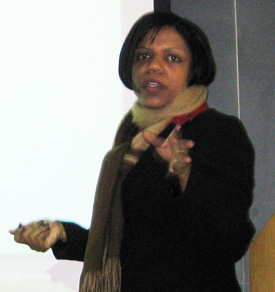
"Opportunities for incivility exist in the community, and can be [affected] by environmental manipulations," explained Furr-Holden, director of the Drug Investigations, Violence and Environmental Studies (DIVE) Laboratory at John Hopkins Bloomberg School of Public Health. She was invited to speak at the monthly BUSPH forum by the Department of Community Health Sciences.
Furr-Holden described the "block-by-block" approach that has guided her research into how features of the built and social environment are linked with a community's health. She cited several examples of how particular environmental factors can fuel rates of violence and drug use in urban settings.
In one study, Furr-Holden's team looked at the location of liquor stores in inner-city Baltimore, mapping those that were located within 300 feet of a school, in violation of state law. The researchers also collected data on crime and drug use in those school communities, vs. others without liquor stores nearby.
The results were compelling, Furr-Holden said: Youths in elementary, middle and high schools located near liquor stores were more likely to be involved with drugs and exposed to violence than those who attended schools without liquor outlets in close proximity. Also, schools within 300 feet of a liquor store were almost 10 times more likely to have had a homicide occur near the school property, have youths who reported carrying weapons, or have higher rates of community drug use.
The findings, which showed that the lack of enforcement of the existing alcohol zoning policy was impacting youth drug and violence exposure, eventually led the Baltimore City Council to step in and propose strengthening zoning enforcement. Eight of the 51 liquor stores within 300 feet of a school have been shut down so far, and "we're seeking to close all of them," Furr-Holden said. In addition, a proposal is pending to expand the state zoning regulation from 300 to 750 feet.
Furr-Holden called the liquor-store study one small example of "research to policy to practice -- live and in living color."
Furr-Holden also discussed an ongoing research project that uses biomapping -- including GPS units and galvanic skin response sensors – to gauge and impact behavior among participants in a drug-treatment program. Among other study areas, the project is looking at whether there are identifiable environmental factors that impact drug craving and relapse.
Another project, called "Safe Passages to School," has eight city agencies in Baltimore working together to clean up walking paths to six city schools, so that children do not have to walk past graffiti, trash or other negative environmental elements.
Furr-Holden was a 2006 recipient of the prestigious Presidential Early Career Award for Scientists and Engineers. The award provides her with up to $500,000 each year, over five years, to continue her research into the links between environmental factors and youth's exposure to drugs and violence.
To pursue the block-by-block approach, Furr-Holden's team has developed a measurement dubbed "NIfETy" -- short for Neighborhood Inventory for Environmental Typology -- that looks at factors ranging from the number of alleys in an area, to the types of dwellings, to the number of broken windows.
More on "NIfeTy" is available on the DIVE Laboratory website.
Submitted by Lisa Chedekel
chedekel@bu.edu
BUSPH and Partners Awarded $1 Million to Tackle Tough "C.diff" Infection
A consortium led by the Boston University School of Public Health has been awarded a $1 million federal grant to test and evaluate interventions aimed at reducing the incidence of Clostridium difficile (or "C.diff") infections, a stubborn bacterial strain that most commonly affects older adults in hospitals and long-term care facilities.
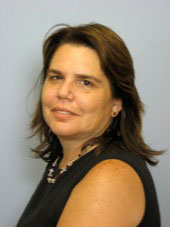
The U.S. Department of Health and Human Services recently awarded the grant to BUSPH and two partners – the Montefiore Medical Center in New York and the Greater New York Hospital Association – as part of a larger $17 million initiative to fight health care-associated infections. The Agency for Healthcare Research and Quality, in collaboration with the Centers for Disease Control and Prevention, has identified reducing C.diff as a priority.
C.diff infections, while rarely life threatening, can cause diarrhea and more serious conditions such as colitis and sepsis.
The consortium plans to assess current rates of C.diff at 10 New York–area hospitals, said Mari-Lynn Drainoni, associate professor of health policy and management at BUSPH, who is overseeing the project. Five of the hospitals will continue with the infection-control practices they already have in place, while the other five will implement new interventions.
Once the results are evaluated, the team hopes to develop a best-practices toolkit and manual to assist healthcare providers nationally in reducing C.diff rates.
"The reason I'm excited about this work is because it's really practical and can make a difference in people's lives," said Drainoni, whose other research work focuses on HIV/AIDS and hepatitis.
C.diff-associated infections occur most often when antibiotic therapy suppresses the normal bacteria in a patient's colon. Two out of three infected patients in U.S. hospitals in 2005 were elderly.
Interventions recommended to reduce C.diff in healthcare settings include adherence to strict hand-washing guidelines; use of contact precautions, such as gloves and gowns, as well as separating infected patients from the rest of the patient population; environmental equipment cleaning and decontamination; and "antimicrobial stewardship programs," which restrict the use of antibiotics associated with C.diff and curb unnecessary antibiotic use.
Because C.diff can be caused by over-prescribing of antibiotics, "we plan to look at changing prescribing patterns," Drainoni said. Other interventions could include strict environmental precautions
Montefiore Medical Center has physicians who are experts on C.diff infections, Drainoni said, while the Greater New York Hospital Association has taken steps in recent years to ramp up its fight against the infections, including prevention training for staff and early identification of the condition among patients.
Drainoni said she expects the study will take about two years to complete. BUSPH will be responsible for overseeing and evaluating the project.
Submitted by Lisa Chedekel
chedekel@bu.edu