Student Updates
BMC Names Kate Walsh as New President & CEO
Kate Walsh, executive vice president and chief operating officer of Brigham and Women’s Hospital, will become the next president and CEO of Boston Medical Center, the hospital announced today.
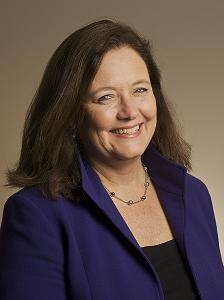
Walsh, who has been at Brigham and Women’s Hospital for the past five years, was approved by a unanimous vote of BMC’s Board of Trustees on Jan. 5, after a nationwide search that attracted numerous candidates from all four corners of the United States.
Walsh will begin on March 1, and will succeed Elaine Ullian, who announced last July that she would retire after her contract expires on Jan. 29. Ullian has served as president and CEO of BMC since its founding in 1996.
Ronald Bartlett, Boston Medical Center’s Chief Financial Officer, will be acting CEO from Jan. 30 until Walsh begins at BMC.
“It is a privilege to be given the opportunity to lead this extraordinary academic medical center,” said Walsh. “The reputation of BMC’s mission combined with its delivery of outstanding clinical care has created a foundation of excellence that our city’s residents depend upon in their daily lives. I look forward to working with the entire hospital community, Boston University School of Medicine faculty and our partners in the Boston HealthNet Centers as we strive to bring the best care to people who live in our neighborhoods and beyond.”
“Kate Walsh was the best candidate to emerge from an extremely strong field of candidates from every region of the country,” said Ted English, chairman of both BMC’s Board of Trustees and the selection committee.
“There was tremendous interest in this position and the candidates we considered were all very impressive and capable. Our selection of Kate Walsh is a testament to her and to the reputation of BMC. In this rapidly changing health care environment, we are excited to have someone with the knowledge and experience that Kate provides as our next leader,” English said.
English and Walsh praised Ullian for building an institution that has become a national model for delivering outstanding care while serving poor communities. “Any future leader of BMC will be standing on Elaine’s shoulders,” said Walsh.
“Kate Walsh is a terrific choice to lead BMC. I am impressed with her leadership and commitment to providing exceptional health care to our patients. Kate fully understands the important role BMC plays in our community,” said Ullian.
Prior to her position at Brigham and Women’s Hospital, Walsh was chief operating officer for Novartis Institutes for Biomedical Research. She began her career as a summer intern at Brookside Health Center in Jamaica Plain. After finishing graduate school, she worked as a shift supervisor in the emergency department at Montefiore Hospital and Medical Center in the Bronx. From there Walsh moved to Columbia Presbyterian Medical Center, Saint Luke’s – Roosevelt Hospital Center and the New York City Health and Hospitals Corporation. She relocated to Boston and joined Massachusetts General Hospital (MGH) as an assistant general director in medical services and was promoted to vice president of medical services and primary care and then to senior vice president of medical services and the MGH Cancer Center. Walsh received her bachelor’s of arts degree and a master’s degree in public health from Yale University.
She also is a member of the Board of Visitors for Northeastern University’s School of Business and is on the Board of Trustees at Emmanuel College.
Walsh, a native of Brookline, is married and has two children.
The search committee began its work in August. In addition to English, it included Ron Bartlett, BMC’s Chief Financial Officer; James Becker, MD, BMC Surgeon-in-Chief; Robert Brown, PhD, President of Boston University; David Coleman, MD, BMC Physician-in-Chief; Susan Donahue, BMC trustee; William Halpin, Executive Director, South Boston Community Health Center; Alyce Lee, BMC trustee; David Passafaro, BMC trustee; and Richard Slifka, BMC trustee. The committee was aided by a team from Korn/Ferry International, the largest executive search firm in the world.
About Boston Medical Center
Boston Medical Center is a private, not-for-profit, 626-licensed bed, academic medical center affiliated with Boston University School of Medicine. Committed to providing high-quality health care to all, the hospital offers a full spectrum of pediatric and adult care services including primary and family medicine and advanced specialty care with an emphasis on community-based care. Boston Medical Center offers specialized care for complex health problems and is a leading research institution. Boston Medical Center and Boston University School of Medicine are partners in the Boston HealthNet—15 community health centers focused on providing exceptional health care to residents of Boston. For more information, please visit www.bmc.org
BUSPH Researcher Part of Team Awarded $150K for Antibiotics-Regulation Study
Access to effective antibiotics is critical to public health, but antibiotic resistance threatens to undermine many of the health gains from the past 60 years. Life in a post-antibiotic era would be rife with infectious diseases and many modern surgical procedures would be impossible. With that risk in mind, The Robert Wood Johnson Foundation (RWJF) has awarded a grant to a multidisciplinary team that includes BUSPH researcher Susan Foster, professor of international health.
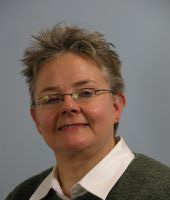
The project received an 18-month, $150,000 RWJF grant to study the public health implications of antibiotic drug regulation, and includes a major empirical study on the relationship between changes in the legal environment and the introduction and conservation of antibiotics.
The team of researchers is led by Kevin Outterson, associate professor of law at Boston University School of Law, and Rosa Rodriguez-Monguio, associate professor at the School of Public Health & Health Sciences, University of Massachusetts-Amherst. The researchers have experience in the legal, scientific and public health fields. Patent law supports the introduction of new antibiotics, but the legal environment gives many mixed signals regarding antibiotic conservation and the appropriate use of existing antibiotics.
Theoretical literature suggests that patent holders lack appropriate incentives to carefully protect antibiotics from resistance since their property right is time-limited. This study will empirically test this "patent holder waste" theory, as well as several others.
The grant is part of the RWJF's Public Health Law Research Program (PHLR), which is based at Temple University's Center for Health, Law, Policy and Practice. The grants aim to help policymakers and researchers understand how laws can affect public health.
Foster is also the director of public policy and education at the Alliance for the Prudent Use of Antibiotics.
The research team includes public health and pharmaceutical researchers from BU, Ohio State, Minnesota and Harvard, as well as infectious disease experts from BU, Harvard, the National Institutes of Health, UCLA and the Infectious Diseases Society of America. Team members include:
• Enrique Seoane, Ph.D. of the College of Pharmacy and College of Public Health at Ohio State University (project co-director);
• Brad Spellberg, associate professor of medicine at UCLA and a member of the Infectious Diseases Society of America’s Antimicrobial Availability Task Force;
• Aaron S. Kesselheim, MD, JD, MPH, a physician and researcher at the Division of Pharmacoepidemiology and Pharmacoeconomics, Brigham and Women’s Hospital, Harvard Medical School;
• Marc Lipsitch, associate professor of epidemiology at Harvard School of Public Health;
• John Powers, senior medical scientist and infectious diseases attending at National Institutes of Health;
• John C. Rotschafer, professor at College of Pharmacy at University of Minnesota.
NFL Players Association to Support Brain Trauma Research at Boston University
Collaboration Will Accelerate Groundbreaking Research on Chronic Traumatic Encephalopathy
The National Football League Players Association (NFLPA) announced today that it will collaborate with the Center for the Study of Traumatic Encephalopathy (CSTE) at Boston University School of Medicine (BUSM) to support the Center’s efforts to advance the study of the effects of repetitive brain trauma in athletes.
Brain trauma in football is now seen as a public health crisis as 10 former NFL players have been diagnosed with Chronic Traumatic Encephalopathy (CTE), a progressive degenerative brain disease caused by repetitive concussive and subconcussive head trauma. In October, NFL Hall of Fame recipient Lou Creekmur joined John Grimsley, Tom McHale and Wally Hilgenberg as former NFL players who were diagnosed post-mortem with this devastating disease that leads to dementia. Creekmur died from complications of dementia following a 30-year decline that included cognitive and behavioral issues such as memory loss, lack of attention and organization skills, and increasingly intensive angry and aggressive outbursts. To date, all 12 of the retired college or professional football players that have been studied post-mortem have exhibited this brain disease.
The NFLPA has made player health and safety a top priority under Executive Director DeMaurice Smith, who succeeded Gene Upshaw in March 2009. The NFLPA has taken an increasingly active role in the concussion and brain trauma debate, recently demanding that the NFL find new leadership for their controversial Mild Traumatic Brain Injury Committee, which quickly led to the resignation of the NFL committee co-chairs. In October, the NFLPA announced the formation of its own Concussion and Traumatic Brain Injury (TBI) Committee, chaired by Medical Director Thom Mayer and Arizona Cardinals wide receiver Sean Morey.
This new collaboration between the NFLPA and the CSTE gives the NFLPA a mechanism to support groundbreaking research that is directly benefiting current and former NFL players. The CSTE was founded in 2008 to conduct state-of-the-art research on CTE, including the neuropathology and pathogenesis, clinical presentation and course, genetics and other risk factors for CTE, as well as prevention and treatment.
Dr. Thom Mayer, NFLPA medical director said, “We will encourage our players, both retired and current, to participate in this independent academic research at Boston University School of Medicine. In addition, this collaboration will allow us to educate our players on the findings as quickly as possible so that they can make informed decisions regarding their own health. Our goal is to protect our players to the fullest extent possible given the nature of the game of professional football. This ongoing research is a critical piece of that effort.”
Current and former NFL players and their families have been supporting the CSTE since its inception, and today 61 retired and four current NFL players have pledged to donate their brain and spinal cord to the CSTE after death, including Sean Morey of the Arizona Cardinals, Matt Birk of the Baltimore Raven, and Lofa Tatupu of the Seattle Seahawks. The donors also have agreed to participate in longitudinal clinical research led by CSTE co-director Robert Stern, PhD and are joined by nearly 200 athletes in other sports like hockey, soccer, lacrosse, boxing, and rugby. In addition, the families of eight deceased NFL players already have donated their loved one’s brain and spinal cord to the CSTE Brain Bank, led by neuropathologist Ann McKee, MD. Her groundbreaking findings on CTE in retired NFL players has been featured in scientific literature and in the media over the past several months and has led to a significant increase in the awareness of the importance of this disease.
“The new association with the NFLPA will facilitate our research tremendously, allowing us to discover the risk factors for CTE and methods of diagnosing and treating the disease. This, in turn, will yield tremendous benefits for current and retired NFL players,” said Stern. Robert Cantu, MD neurosurgeon and co-director of the CSTE, added, “The long-term consequences of repetitive brain trauma in sports are a tremendous public health problem. CTE is the only fully preventable cause of dementia. This research will allow us to make informed, research-based changes to the way contact sports are played, which will decrease the risk of CTE for professional athletes and for the millions of children who participate in youth sports.”
In October, three co-directors of the CSTE Cantu and McKee, and Christopher Nowinski were among 16 experts testifying before the US House of Representatives Judiciary Committee, chaired by Representative John Conyers (D-Mich). Since the hearing, the NFL announced radical changes to its concussion management policies that will benefit the health and wellness of players.
CTE is characterized by the build-up of a toxic protein called tau in the form of neurofibrillary tangles (NFTs) and neuropil threads (NTs) throughout the brain. The abnormal protein initially impairs the normal functioning of the brain and eventually kills brain cells. Early on, CTE sufferers may display clinical symptoms such as memory impairment, emotional instability, erratic behavior, depression and problems with impulse control. However, CTE eventually progresses to full-blown dementia. Although similar to Alzheimer’s disease, CTE is an entirely distinct disease. CTE is caused by repetitive concussive or subconcussive blows to the head, but the symptoms of the disease may not be evident for years or decades after the head trauma.
The Healer’s Art: Exploring the Human Dimension of Medicine
Robert Saper, MD MPH, Assistant Professor of Family Medicine, will give a lecture open to the entire BU Medical Campus Community entitled “The Healer’s Art: Exploring the Human Dimension of Medicine” on Monday January 11, 2010 from 11:00 am to 12 noon in the Medical School Building, Room L-112.
Dr. Saper’s lecture will touch upon themes central to all health professionals including cultivating compassion, sustaining altruism, grieving loss, and preventing burnout. Lunch will be provided. Dr. Saper is the Course Co-Director for Healer’s Art, a BUSM medical student elective offered annually in the Spring semester. BUSM students interested in enrolling in the elective are encouraged to attend. Click here for more information
Alzheimer's Disease Center Receives Donation from Build-a-Bear Huggable Hero
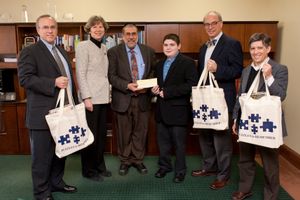
Boston University Academy sophomore Max Wallack, 13, of Natick, Mass., a recently named 2009 Build-A-Bear Huggable Hero, donated his $2,500 award to the Boston University Alzheimer's Disease Center. Established in 1996, the Alzheimer's Disease Center conducts cutting-edge research and strives to enhance clinical care for Alzheimer’s disease patients and their families. Wallack is the founder of PuzzlesToRemember (www.PuzzlesToRemember.org) which collects puzzles and donates them to facilities that care for people with Alzheimer’s disease and dementia. During the past 18 months he has collected over 2000 puzzles and distributed them, personally, to more than 85 facilities across five states plus Toronto.
BUSPH Co-sponsoring COMET Conference, Abstracts Due Jan. 31
Boston University will be hosting the eighth international conference on Communication, Medicine and Ethics (COMET) from June 28-30. This is the first time COMET will be held in the US. Dr. Barbara Bokhour, associate professor in the Health Policy and Management department at the School of Public Health and research health psychologist at the Center for Health Quality, Outcomes and Economic Research, is organizing the conference along with Dr. Ellen Cohn, Professor at Sargent College of Health and Rehabilitation Sciences.
The conference is sponsored by BU’s School of Public Health, Sargent College of Health and Rehabilitation Sciences and the Center for Health Quality, Outcomes & Economic Research, ENRM Veterans Affairs Medical Center in Bedford, Mass. Plenary speakers include Dr. Debra Roter of Johns Hopkins Bloomberg School of Public Health and Dr. Alan Radley, professor of Social Psychology at Loughborough University in the UK.
COMET brings together communication researchers from different disciplinary backgrounds, ranging from healthcare specialties to the human and social sciences. Grounded in a problem-oriented approach, COMET places special emphasis on the dissemination of high quality research in discourse/communication and practical ethics which is directly relevant to healthcare practitioners. Since the launch of COMET in Cardiff in 2003, the conference has been hosted by universities in Sweden, Australia, Switzerland, and South Africa.
COMET is now closely linked with the new quarterly journal Communication & Medicine, with a view to bringing seminal research to a wider readership. Dr. Srikant Sarangi, editor-in-chief, is also the founder of COMET and the COMET society (www.cometsociety.com ). All presenters at the COMET 2010 conference will have the opportunity to submit their work for publication to an issue of the journal dedicated to the conference.
Abstract submissions are due by January 31, 2010. For more information about the conference or to submit an abstract please visit www.bu.edu/comet.
Grand Rounds Presentation Leads to Engaging Discussion
Fourth-year DMD student Komail Abbas presented the second grand rounds of the 2009-2010 school year, based on a treatment plan he developed for a patient he treated during his externship rotation at Dorchester House from July 27 to October 2. Abbas' externship preceptor was Dr. Thomas Ricci.
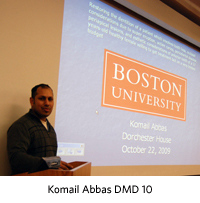
Abbas’ patient was a 37-year old Cape Verdean woman who had not been to the dentist in about five years. Her chief complaint was that her lower front teeth had been loose for more than one year. The patient had a limited budget, but was willing to invest the time to have the necessary dental procedures. A language barrier almost created an issue, since the patient’s native language was Portuguese; however, Abbas and the patient shared a common second language of Spanish. With the additional help of a translator, they were able to easily discuss her oral health history and prognosis.
Abbas diagnosed the patient with caries, periodontitis, occlusal trauma, periapical granluloma, and also recommended extraction of several teeth. His ideal treatment plan for this patient consisted of several phases and after each phase he recommended re-evaluating the treatment plan and its current success or failure in order to provide the patient with the best and most appropriate treatment possible. Abbas discussed the pros and cons of three means of treatment to correct the patient's most pressing issues including implants, removable partial dentures, or fixed partial dentures.
Dr. Carl McManama congratulated Abbas on his impressive presentation, summarizing the findings and posing some questions to engage the audience. Dean Jeffrey Hutter, students, faculty and staff shared many different ideas and questions with each other creating an intriguing discussion.
"Komail's presentation was excellent," said Dean Hutter. "He carefully considered the patient's needs when designing his ideal treatment plan and suggested thoughtful alternatives to each phase of the plan. It was also evident that everyone in attendance, including Komail, learned something from the wide variety of insight and opinions shared during the discussion portion of the presentation."
Dec. 15 Seminar on Using FlowJo Software to Interpret Flow Cytometry Data
Graduate students, postdoctoral fellows and other flow cytometry users on the BUMCare invited to attend a free introductory seminar on how to analyze flow cytometry experiments. The BUMC Flow Cytometry Core Facility is offering this seminar to help train new users in FlowJo software, which is a very valuable tool for handling multiparameter flow data.
"Complex flow data are only useful if they can be interpreted easily and clearly, and without hours spent fruitlessly trying to compensate signals manually from many fluorescence channels. We will have a guest speaker, Dr. John Quinn from TreeStar, who is an expert educator in this area," said Gerald V. Denis Ph.D., Flow Cytometry Core Co-Director.
The Flow Cytometry Core Facility operates as a fee-for-service core under the supervision of the Core Committee, at the direction of Dean Antman. The mission is to offer state-of-the-art instrumentation, analysis and consultation for BUMC scientists who use flow cytometry in their research. As PIs, members of the Flow Cytometry Core Facility understand the need to produce data in a timely and cost effective manner. They have assembled a team of talented individuals to help PIs reach their goals regardless of project complexity.
Flow Cytometry Core Facility Seminar
- "How to use FlowJo to interpret your flow cytometry data: An introduction for new users"
- John Quinn, Ph.D., special lecturer
- Tuesday, Dec. 15, 2009
- BUSM Instructional Building
- 72 East Concord Street
- Room R103
- 1 pm - 2 pm
For more information please contact Yan Deng (Flow Cytometry Core), ydeng@bu.edu, 617-414-5225.
Murnane Lab Identifies MMP Activity Indicating Colorectal Cancer
For more than 20 years, researchers from BUSM, under the direction of Mary Jo Murnane, have been working to identify and characterize markers that can either diagnose cancer at an early stage or better predict cancer outcomes. Such tumor markers may also prove useful in the design of new cancer therapies.
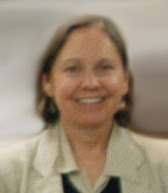
The International Journal of Cancer has published a paper by Dr. Murnane and colleagues that describes three different enzyme activities, called matrix metalloproteinases (MMPs), in patient-matched sets of normal colon and colorectal cancer tissues. They found that one particular MMP activity is particularly accurate in determining the presence of colorectal cancer. These observations may encourage the design of a cancer therapy that targets this specific MMP activity. Detection of this same marker in other types of tissues may also lead to better detection of lung, pancreatic, thyroid or breast cancers.
This work was a collaborative effort among many individuals, including surgeons, pathologists, researchers, graduate students and statisticians. In addition, the work was critically dependent on cancer patients who contributed tissue samples for study. Funding for this research was provided by the National Institutes of Health and by the Cancer Research and Prevention Foundation.
Dental Students Share Research
Boston University Henry M. Goldman School of Dental Medicine (GSDM) Student Research Group (SRG) met with student research groups from Harvard School of Dental Medicine and Tufts University School of Dental Medicine on Friday, November 13 at Harvard.
Two students from each school presented their research during the event. From GSDM Sheede Khalil DMD 12 presented her work titled "N-glycosylation Drives Duct Formation in the Developing Submandibular Gland," and Jeffrey Clark DMD 11 presented his research titled "Odontogenic Keratocyst: An Analysis of Surgical Treatment Options and Their Results."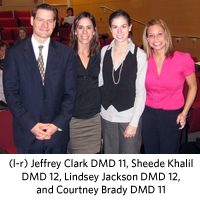
The GSDM SRG executive board including President Courtney Brady DMD 11, Vice President Clark, Secretary Nicholas Snider DMD 12, and Fundraising Co-Chairs Lindsey Jackson DMD 12 and Sarah Courtney DMD 12 helped to plan GSDM's contribution to the event.
"To my knowledge, this is the first intercampus research event of its kind between the three Boston dental schools," said Brady. "I met Todd Walker (the President of Tufts' SRG) at the IADR conference in Miami last year and we started tossing ideas around about how to get the three schools together somehow. When we returned, we contacted Rosalyn Sulyanto from Harvard's SRG and we began brainstorming."
Brady continued, "It was a very successful event and all of the presentations were extremely impressive. All three schools are very eager to make this an annual event. Our hope is to rotate between the three schools and try to build it up as the years progress."
"The initiative and planning demonstrated by the students of all three Boston dental schools is commendable," said Dean Jeffrey Hutter. "These students have taken an interest not only in research, but also in seeking out the work and opinions of their peers from other area schools. I believe that this thirst for knowledge will serve them well in their professional endeavors after dental school and I am extremely proud of their efforts."
First-year GSDM dental students wishing to join this organization should do so before the January 4 deadline. Contact Afaf Hourani, 41048 for more information or to sign-up.