Student Updates
Learn About GMS Programs, Open House, Nov. 18
The Division of Graduate Medical Sciences, the branch of the school of medicine engaged in graduate education is hosting an open house and graduate fair to showcase 12 Masters degree programs. At this event prospective students will have an opportunity to meet program directors and other prospective students; find out admissions criteria, learn about research opportunities and consider many professional career paths. Several of the programs offer part-time study options and late afternoon or evening courses to accommodate working professionals.
One of our programs is the MA in Medical Sciences, which has a 25-year history of success in preparing students for admission to professional school. Graduates of the MA in Mental Health Counseling and Behavioral Medicine and the MA in Clinical Investigation can sit for certification exams in their fields. The MA in Medical Anthropology and Cross Cultural Practice enables students to builds deep connections with Boston’s New American communities. The MS in Forensic Anthropology offers directed study at an outdoor teaching and research facility in Holliston, Mass.
Most of our 12 Masters degree programs are one-of-a-kind in that their program of study is uniquely based in the school of medicine. On November 18 from 4-7 p.m. prospective students have an opportunity to explore all our programs in one convenient location—Boston University’s George Sherman Union/Metcalf Hall.
Please visit www.bumc.bu.edu/gms for a list of participating programs. GMS looks forward to meeting you!
GSDM Research Highlighted in Nature Chemical Biology
Work from Associate Dean for Research Dr. Maria Kukuruzinska’s laboratory has unveiled a link between the canonical Wnt/beta-catenin signaling pathway and protein N-glycosylation by showing that the first N-glycosylation gene, DPAGT1, is a target of the Wnt/beta-catenin signaling pathway. Under conditions of Wnt activation, DPAGT1 transcription is upregulated though the binding of beta-catenin to Tcf at the TCF/LEF binding site in the DPAGT1promoter. The Wnt-dependent upregulation of DPAGT1 expression, in turn, leads to more extensive modification of E-cadherin, a major epithelial cell-cell adhesion receptor, with complex N-glycans, previously shown to be inhibitory to cell-cell adhesion. Thus, DPAGT1 coordinates pro-proliferative effects of Wnt/beta-catenin signaling with suppression of intercellular adhesion. Moreover, since Wnt ligands require N-glycosylation for activity and since DPAGT1 determines the N-glycosylation status of proteins, the Wnt/beta-catenin pathway is also DPAGT1-dependent, indicating that there is a positive feedback loop between Wnt signaling and the metabolic pathway of protein N-glycosylation. Although to date, at least 80 target genes of Wnt/beta-catenin signaling have been identified, this is the first demonstration that a gene involved in cellular metabolism is a downstream target of Wnt/β-catenin signaling.
"Our findings are particularly significant," said Dr. Kukuruzinska, "because both Wnt signaling and protein N-glycosylation play pivotal roles in development and differentiation, and their dysregulation has a strong association with cancer. The understanding that there is interdependence between these pathways provides a molecular explanation for many previously reported observations showing correlations between Wnt signaling and N-glycosylation."
Dr. Kukuruzinska completed this research with assistance from Research Associate Dr. Pritam Sengupta and Technical Assistant Ms. Meghan Bouchie. The paper titled “N-glycosylation Gene DPAGT1 is a Target of the Wnt/beta-catenin Signaling Pathway,” was published in the Journal of Biological Chemistry on August 6 and also highlighted in the Research Highlights section of the October 2010 edition of Nature Chemical Biology.
BU's Outreach Van Project's Mental Health Panel, Nov. 18
Are you interested in learning more about mental health issues in the homeless population? Boston University's Outreach Van Project is hosting its first event November 18, which will include a panel discussion on such topics as schizophrenia, agoraphobia, depression, bipolar disorder, and learning disabilities.
The panel will include: Dr. Karen Henley, BMC psychiatrist, Dr. James Bonnard, psychiatrist at Boston Health Care for the Homeless Program (BHCHP), Dr. Elissa Lapide, resident in psychiatry at BMC who will cover engagement strategies.
The meeting witll be held on Thursday, Nov. 18, from 5-6:30 p.m in BUSM Instructional Building, Room L-112. A non-pizza dinner will be served. For more information on this and other OVP events, please visit http://blogs.bu.edu/outreach/events/
GSDM's Dr. Elizabeth Krall Kaye Comments on Possible Dietary Treatment for Periodontal Disease
In a commentary published in the Journal of the American Dietetic Association November 2010 Issue, Professor Dr. Elizabeth Krall Kaye weighs in on the findings of researchers from Harvard Medical School and Harvard School of Public Health, which were also published in the same issue. The researchers found that n-3 fatty acid intake is inversely associated with periodontitis.
To come to this conclusion, the researchers used data from the National Health and Nutrition Examination Survey (NHANES). The survey, which involved data collected from more than 9,000 adults during dental examinations between 1999 and 2004, showed an 8.2 percent prevalence of periodontitis in the study sample. When they studied the consumption of n-3 fatty acids, the data also showed a 20 percent reduction in periodontitis in those subjects who consumed the highest amounts of n-3 fatty acids, specifically dietary docosahexaenoic acid (DHA) and eicosapentaenoic acid (EPA)—to a smaller extent. These fatty acids can be found in foods such as salmon, peanut butter, margarine, whole grain wheat, and bananas.
Dr. Kaye noted that there were three noteworthy results of the Harvard study.
"The most important conclusion is that it appears even modest amounts of omega-3 fatty acid intake may be good for gums," Dr. Kaye said. "These are amounts that people can get from dietary sources, without using supplements."
The second significant finding was that the intake of moderate levels of n-3 fatty acids provided the same benefit as high levels, indicating that the benefits remain the same after a certain threshold. Third, the results did not differ when dietary plus supplemental intakes were reviewed.
These findings suggest a promising dietary alternative to the expensive and more invasive current methods for treatment of periodontitis. Dr. Kaye noted, "more studies are needed, especially more prospective studies that follow patients over time and track changes in periodontal disease according to their omega fatty acid intake level."
BUSPH's Malcolm Bryant to Head APHA's International Health Section
In his 25-plus years as a public health physician, Malcolm Bryant has devoted much of his time to designing and implementing maternal and child health programs around the world. Now, he will be putting his expertise to use shaping global health programming and policy in a new way beginning this November.

Bryant, MBBS, MPH, an associate professor of international health at Boston University School of Public Health, will be taking on leadership of the International Health Section of APHA, an active community of more than 1700 professionals engaged in global health policy development, advocacy and the exchange of scientific knowledge and experience. The IH Section is one of 27 discipline-based sections that comprise APHA.
In his role as chair, Bryant will help guide the strategic direction of the Section, and, in turn, APHA's involvement in international health issues by helping the association develop its Annual Meeting program, draft relevant resolutions for it to support, and garner participation for various APHA boards and councils.
In recent years, the IH Section has lent its support to the reauthorization of PEPFAR 2 (the President's Emergency Plan for AIDS Relief 2), which will continue the United State's commitment to treating and preventing HIV/AIDS globally. The IH Section is currently leading APHA's efforts to develop a position for the association on global trade and public health.
As chairman, Bryant says he's looking forward to connecting the experience that the United States has gained in international health work in the last 40 years to new efforts in global health policy and advocacy. He also aims to strengthen the Section's ties with APHA's state affiliates and with students, who make up a large segment of the association's membership.
"Working closely with students is a perfect opportunity to generate enthusiasm for international health," Bryant said. "It also raises their awareness of the relevance of their work."
Bryant -- who will officially take on the chairmanship next month at APHA's Annual Meeting in Denver, Colorado -- has held leadership roles within APHA and the IH Section since 2002. He served as scientific chair of the annual program for two years, which involved coordinating more than 50 scientific sessions and five poster sessions each year. For the past four years he has served as a governing councilor on APHA's Governing Council, the organization's primary decision-making body.
Bryant has been an instructor at BUSPH since 2008, but recently took on the role of deputy project director of the Orphans and Vulnerable Children Comprehensive Action Research Project (OVC-CARE) for Boston University's Center for Global Health and Development (CGHD), which is based at BUSPH. The project is USAIDS's primary instrument to scale up services for the 145 million children around the world who have lost one or both parents to HIV/AIDS or other causes.
Prior to his work with CGHD, Bryant has worked as a consultant in international health systems and was the director of the Center for Health Outcomes at Management Sciences for Health. He has worked in communities throughout Africa, Asia and Latin America.
Submitted by Michelle Salzman
Koh Tells BU Colleagues: Health Reform Will Improve Prevention
Many Americans are focused on the insurance regulation aspects of healthcare reform -- who will be covered, for what, and when.

Not the case for Howard Koh, a Boston University School of Public Health (BUSPH) graduate and former faculty member of BUSPH and Boston University School of Medicine who is now assistant secretary for health in the U.S. Department of Health and Human Services. What Koh sees in the Patient Protection and Affordable Care Act, signed into law by President Obama in March, is an aspect of healthcare that has interested him since he was a young clinician at Boston City Hospital 30 years ago, and later a professor at BUSPH: Prevention.
"In 1985, I taught a course on cancer prevention at BUSPH, with [epidemiology professor] Marianne Prout," Koh told a packed lecture hall Nov. 1, as he visited the medical campus to deliver the first Howard K. Koh Visiting Professor Lecture, hosted by the BU School of Medicine Department of Dermatology. See the video here
"I remember some people saying, 'Cancer prevention? That's an oxymoron.' [But] I was determined to make prevention come alive."
Now, after years in which prevention was "not even mentioned," he said, "It is front and center in the Affordable Health Care Act."
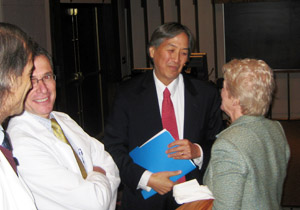
Koh described his own circuitous journey to the Health and Human Services post with humor and humility, recalling the advice of his late father, who had urged him to "Be broad, like the sky." He spent much of his early clinical career caring for patients with preventable illnesses, including those caused by smoking. He said he remembers thinking, when he could not cure a disease that could have been prevented, "There's got to be a better way." Those thoughts fueled his interest in prevention, as both a physician and as former commissioner of public health for the Commonwealth of Massachusetts, from 1997 to 2003.
Koh said his new position has "united the worlds of medicine and public health," at a time when those two areas are converging in the federal reform effort. For all the language about insurance coverage in the new legislation, he said, there is also a strong emphasis on prevention programs. Among the initiatives is the establishment of a National Prevention, Health Promotion, and Public Health Council, and a new Prevention and Public Health Fund, with an annual appropriation that begins at $500 million in fiscal year 2010 and increases to $2 billion in fiscal year 2015.
Koh, who was honored with a BU Distinguished Alumni Award, said he was hopeful that the country would make headway during his tenure in reducing obesity and tobacco consumption -- two areas of continuing concern. He recalled the frustrations of treating patients at the former Boston City Hospital (now Boston Medical Center) who were wrestling with alcohol and substance abuse problems, poverty and lack of insurance.
"I feel my journey is starting all over again," he told the crowd of medical campus students and faculty, many of whom he had worked with over the years. He said serving as the "ASH," as the assistant secretary for health is dubbed, "is just an incredible privilege."
Koh, who spoke in the Keefer Auditorium in the BU School of Medicine, said he was honored and overwhelmed to be "back in this room where I spent literally 30 years," listening to lecturers.
He dedicated his talk to Marie-France Demierre, former director of the Skin Oncology Program in Dermatology at Boston Medical Center and professor of dermatology and medicine at the BU School of Medicine, who died suddenly last April.
Submitted by Lisa Chedekel
MED’s First Student Residence, Groundbreaking on $40 million complex
Officials broke ground yesterday on the Medical Campus’ first student residence, an endeavor that will provide affordable housing for students who may face up to $170,000 in bills for their medical school education.
“This facility will make the burden of a medical education a little bit lighter to carry,” said President Robert A. Brown as a warm, blustery wind whipped the tent where city officials, trustees, donors, administrators, and School of Medicine faculty and students had gathered.

Boston Mayor Thomas Menino (Hon.’01) called the construction “good news for BU and good news for our economy,” referring to the project’s 250-plus construction jobs. “Housing is an important part of economic development.”
Scheduled to open in June 2012, the student residence, at 815 Albany St., will be a nine-story complex with 104 two-bedroom apartments and retail and common space on the first floor. The school enrolls approximately 175 first-year medical students each year.
Karen Antman, MED dean and Medical Campus provost, said the $40 million project has been in the works for the past five years, since the school’s advisory board decided to try to decrease the cost of attending BU’s medical program (among the 10 most expensive nationwide). Antman said student housing seemed an obvious solution, considering other urban schools—including those in New York City—have taken the same step.
Catherine Spina (CAS’04, MED’05,’15), former chair of the Student Committee on Medical School Activities, said newly accepted students regularly approach her during open houses to discuss a primary concern: BU’s high cost. “In order to remain competitive, BU needed to do something to mitigate the cost,” she said.
A fundraising campaign has raised $11 million of a $20 million target, to be used in part to keep the rents in the new building as low as $800 for some units. The University will also borrow money through tax-exempt, fixed-rate bonds, according to Gary Nicksa, vice president for operations.
Officials hope the low rents will be a major draw for medical students, who now face median rents of between $1,400 and $2,000 for a one-bedroom apartment and $2,000 to $2,700 for a two-bedroom in the school’s neighborhood.
“During the second and third years of medical school, it’s so crazy,” Spina said. “Living far away is tough. Then add commuting time, and when you’re not sleeping much, it’s stressful.”
The advantages of the new residence aren’t just financial. Antman anticipates that it will also foster an “esprit de corps and sense of community” among medical students, who are competitive by nature. “A common living experience would make an enormous difference in the sense of camaraderie that the classes get,” she said.
Designed by Beacon Architectural Associates, the 86,000-square-foot residential complex will have a brick and stone façade and metal and glass paneling. Nicksa said the fully furnished apartments will be similar to the Charles River Campus graduate housing at 580 Commonwealth Ave.
“It’s really a turnkey situation,” Nicksa said. “You could come in from anywhere in the world and not have to worry about where you’re going to live.”
This BU Today story was written by Leslie Friday. She can be reached at lfriday@bu.edu.
See video of the event here
See the facebook album here
TB Risk Higher Among Health Care Workers in South Africa, New Study Finds
Health care workers in South Africa are at increased risk of acquiring drug-resistant tuberculosis -- a transmission pattern that should be addressed through policies that prioritize occupational risk reduction for health care workers, according to a new study co-authored by a Boston University School of Public Health researcher.

The study by a team including BUSPH Epidemiology Chair C. Robert Horsburgh, published Oct. 19 in the Annals of Internal Medicine, found that health workers in KwaZulu-Natal province, South Africa -- which has high rates of multidrug-resistant tuberculosis (TB) -- were more than five times more likely to be hospitalized for TB than non-healthcare workers.
Recent studies indicate that hospital-based transmission of TB is a potentially important factor in the spread of multidrug-resistant TB.
"This study has implications for policymaking and the organization of health services in countries with endemic drug-resistant tuberculosis," the authors wrote. "Health care workers have a statistically significant higher risk for drug-resistant tuberculosis compared with the general population, and this should be addressed in policies for occupational risk reduction and infection control…
"Policy measures that prioritize health care worker protection and risk may be critical for tuberculosis control in resource-constrained countries with endemic drug-resistant tuberculosis."
The research team studied admissions records for more than 4,000 patients who were hospitalized in the province to receive treatment for drug-resistant TB. Patients were asked to indicate whether they were health care workers at the time of hospitalization.
Tuberculosis is a highly infectious disease that may be transmitted if droplets coughed or sneezed by an infected person are inhaled by another person. The high rate of TB infection in South Africa is complicated in many patients, who have strains of the disease that are resistant to certain antibiotics. Every year, an estimated 500,000 people develop drug-resistant tuberculosis, which can lead to death.
A recently updated guideline on TB infection control for health care workers in hospitals and congregate settings, published in 2009 by the World Health Organization, recommends prioritizing tuberculosis control on the national level. The guideline includes recommendations for implementing ongoing surveillance of tuberculosis disease among health care workers and monitoring and evaluating infection-control measures.
Horsburgh, who has researched tuberculosis for more than 25 years, is chairman of the steering committee of a large consortium called Research Excellence to Stop TB Resistance -- or RESIST-TB -- which is working to develop and promote clinical trial protocols for studies on drug efficacy and treatment for drug-resistant TB.
Other authors of the new study include researchers from the Centre for AIDS Programme of Research in South Africa; University of KwaZulu-Natal, Durban, South Africa; University of Calgary, Canada; Medical Research Council, Cape Town, South Africa; Salem State College School of Social Work, Salem, Ma.; King George V Hospital, Sydenham, South Africa; Emory University School of Medicine and Rollins School of Public Health, Atlanta, Georgia; University College, London; and McGill University, Montreal.
Read the study on The Annals of Internal Medicine website.
Submitted by Lisa Chedekel
GSDM Oral & Maxillofacial Surgery Team Returns to Ukraine
Chair of Oral & Maxillofacial Surgery and Associate Dean for Hospital Affairs at Boston University Henry M. Goldman School of Dental Medicine (GSDM) Dr. Pushkar Mehra led a carefully selected surgical team to Dnepropetrovysk, Ukraine in September 2010. During the eight-day trip, the team performed more than 50 consultations and surgeries on underserved children affected with various facial deformities and developmental anomalies including cleft lip and palate.
Other members of the team included Dr. Jim Bertz, an oral and maxillofacial surgeon from Scottsdale, Arizona; Boston Medical Center (BMC) OR Nurse Joseph App; GSDM Oral Surgery Operating Room Manager Wendy Little; Matthew Steuer OMFS 13; and BMC Family Nurse Practitioner Paula Surro.
Dr. Steuer commented on his experience, “What an irreplaceable, life-changing experience! I received so much more than I could ever give back. I look forward to continuing in such endeavors for the rest of my life.”
Similar to past trips, GSDM joined forces with the Smiles International Foundation's Smiles of Ukraine program. Over the past three years, the team from GSDM has taken a leadership role in this outreach effort, and on each trip they have trained local Ukrainian surgeons to proficiency in complex oral and maxillofacial surgical procedures. They are thrilled to be able to provide the hope of a better life for many of the children they treat.
To learn more about the team's involvement in this program, to volunteer, or to donate, please visit the newly launched website at http://www.smilesforchildren.org/.
Biochemistry-Medicine Joint Seminar Series: Molecular Mechanisms of Aging: Nov. 2, 16, and Dec. 9
The Department of Biochemistry and the Evans Center in the Department of Medicine are sponsoring their first joint, thematic seminar series. The purpose of the series is to highlight a cutting edge topic in biology with disease relevance. The theme for the fall series is “Molecular Mechanisms of Aging”.

Tuesday, November 2, 4 p.m, Bakst Auditorium
Judith Campisi, Lawrence Berkeley National Laboratory
Seminar Title: Cancer and Aging: Rival Demons?
Reception, 5 p.m., Wilkins Board Room (E-120)
Graduate Student & Post Doc Lunch, noon, Wilkins Board Room (E-120)

Tuesday, November 16, 4 p.m., Bakst Auditorium
Leonard Guarante, MIT
Seminar Title: Sirtuins Aging and Disease
Reception, 5 p.m., Biochemistry Seminar Room (K-103)
Graduate Student & Post Doc Lunch, noon, Biochemistry Seminar Room (K-103)
Thursday, December 9, 3:30 pm, Keefer Auditorium, (part of Evans Day Event)
Cynthia Kenyon, UC-San Francisco
Seminar Title: From Worms to Humans? Genes & Pathways That Extend Life Span
The theme for the Spring joint seminar series is “Stem Cells, Development, and Cancer”, and the speakers will be Robert Weinberg (Whitehead Institute, MIT), Mina Bissell (Lawrence Berkeley National Laboratory), and Matthew Scott (Stanford).