Student Updates
CSI: BU Offers Nation’s Only Master’s in Forensic Anthropology

The forensics lab is Hollywood-perfect: cramped, fluorescent-lit, skeletal remains splayed on five tables under a ceiling that’s cracked and discolored in spots. At one table, students Danielle Trull-Donahue and David Agoada pore over a heartbreaking cache—the tiny bones of a child—trying to decipher all they can about the human being that these remains once were.
Welcome to the School of Medicine’s Forensic Anthropology Program, which offers the country’s only master’s degree in this discipline. Examining the jawbone before them, the students see that the molars haven’t come through yet, indicating the child was perhaps six years old. The lab partners haven’t yet determined gender, a trickier question given the child’s tender age. Determining cause of death is not part of the assignment, but telltale patterns—some broken ribs here, other fractured bones there—"suggest there was abuse," says Trull-Donahue (MED’11). Such grim details are an occupational hazard. “Everybody kind of cringes,” she says. But “the justice of finding out who it is” and the knowledge that this profession helps family members account for loved ones were enough to convince Trull-Donahue that this was the right career for her.
Created just last year, this two-year program prepares students for academic and law enforcement jobs scouring fire, crash, and crime scenes for remains, then identifying them. Overseeing today’s lab is Debra Prince Zinni, a MED assistant professor, who grew up thinking she’d be a kindergarten teacher, but instead now instructs adult students in how to dig up and identify human remains. She recalls her parents’ reaction to her change of career plans: “You’re never going to get a job.”
But art and life conspired to turn forensic anthropology into a growth industry. The art part can be seen in the ratings for TV hits like the CSI franchise and Bones, which glamorize forensic sleuthing. (What Prince Zinni has seen of these shows hasn’t impressed her for realism. Some snazzy lab gizmos are pure fiction, she says, adding, “I don’t chase down perps.” But at six feet tall, she would cut a striking figure at precinct headquarters.) The real-life event sparking interest in this field? Terrorism.
Before 9/11, New York City’s medical examiner had one forensic anthropologist on staff, says Prince Zinni; today, there are five. “Houston didn’t have any forensic anthropologists before 9/11. Now they have four.” (Prince Zinni herself is the part-time forensic anthropologist for the Massachusetts chief medical examiner.) Before this growth spurt, medical examiners typically farmed out such work to anthropologists at local universities, who often confined their work to the lab, indentifying dead people from skeletal remains, says Prince Zinni. “Now, it’s changed a lot. Anthropologists are asked to come out to the scene, help with the recovery of remains, so that it’s done systematically and with the most scientific methodology.”
That’s necessary to combat the “junk science” seeping out of forensic labs, she says, a problem spotlighted by the National Academy of Sciences, as mentioned in a recent Boston Globe op-ed piece. Course work for the BU program includes field trips to excavate bones planted at BU’s 32-acre outdoor training facility in Holliston, Mass., replete with a ranch-house classroom, fields, woods, and cranberry bogs.
In this video, Debra Prince Zinni excavates remains with her forensic anthropology students at a mock crime scene in Holliston, Mass.
Tara Moore, a MED assistant professor, who initiated and directs the Forensic Anthropology Program, agrees that “there was a need for these programs not only for students, but also for professionals.”
The age spread between Trull-Donahue, 24, and Agoada (MED’11), 60, is evidence of the program’s broad appeal. Agoada studied for an anthropology doctorate in the 1970s with a University of Washington professor who had worked with the remains of victims of serial killer Ted Bundy. He abandoned the doctorate for podiatry, but his interest in forensic anthropology never left him. With his children now graduated from college, Agoada has returned to school and his old passion.

Prince Zinni understands career changes. Her early aspiration to teach kindergarten ebbed when she took a freshman-year intro course in anthropology at James Madison University, thinking it would be an easy A. “I loved the course. We actually got to go out and do a survey of a Civil War battlefield, which I just thought was amazing.”
Acknowledging cases like the one Trull-Donahue and Agoada worked on, the program’s website warns that forensic anthropologists often work with not just bones, but decomposing tissue, under conditions involving “unpleasant smells and sights, including decomposing flesh, insect activity, and potentially disturbing case details.” The site also stresses the field’s important duties. Prince Zinni came to BU from the federal Joint POW-MIA Accounting Command in Hawaii, which boasts the world’s largest forensic anthropology lab: 32 staffers, with plans to double that, she says.
That might help calm nervous parents who, like hers, wonder what their children are going to do with their CSI-inspired degrees. The first 11 BU students graduate next May.
This BU Today story was written by Rich Barlow. The video is by Robin Berghaus. Rich Barlow can be reached at barlowr@bu.edu. Robin Berghaus can be reached at berghaus@bu.edu.
GSDM's Dr. Erdjan Salih Uncovers Missing Link
The Journal of Biological Chemistry recently published an article titled, "The Isolation and Characterization of Glycosylated Phosphoproteins From Herring Fish Bones," written by Associate Professor Dr. Erdjan Salih and his colleagues at Harvard Medical School and Children's Hospital Boston, Drs. Hi-Yan Zhou and Melvin Glimcher.

The article is based on a research discovery made by the trio which, for the first time, isolates and characterizes two major bone extracellular matrix (ECM) phosphoproteins from herring fish bones. Until now, studies of ECM phosphoproteins have been limited to avian and mammal bones. The ECM phosphoproteins found in the herring fish bones provide the missing evolutionary link in biomineralization between contemporary vertebrates, such as modern-day humans and other mammals, and the first vertebrates, present in ancient times.
According to Dr. Salih, "The first vertebrates to evolve were fish, some 400 million years ago—pre-dating dinosaurs and contemporary mammals, including humans. By isolating and characterizing two major ECM phosphoproteins from fish bones, we've provided the first evidence that the biological calcification has common fundamental mechanistic bases for biomineralization throughout vertebrate species and evolution."
The full article can be found here.
Oct. 29 Pike Conference to Examine Care and Advocacy for America's Veterans, Sponsored by BU Schools of Law and Public Health
One in four veterans of the 1991 Gulf War suffer from an illness caused by exposure to toxic chemicals, according to a BUSPH-based research panel. Almost two decades after the war ended, however, no effective treatments have been found. This year's Pike Conference will explore the post-Gulf War experience of veterans seeking medical help, the problems encountered and concrete advocacy steps that can be taken to improve the quality of care.

On Friday, October 29, the Boston University Schools of Law and Public Health will sponsor a one-day forum, Coming Home Injured: Care and Advocacy for America's Veterans. Scientific, medical, and legal experts will contribute to framing the issues, but the primary emphasis will be on the experience and suggestions for action of the veterans themselves.
The annual Pike Conference is held to honor Neal Pike, a BU School of Law graduate, distinguished lawyer, and lifelong advocate for individuals with disabilities.
The event is free and open to the public.
Pike Conference: "Coming Home Injured: Care and Advocacy for America's Veterans"
October 29, 2010, 9:00 a.m. - 5:00 p.m.
School of Law, 765 Commonwealth Avenue, Room 1270
Boston, Massachusetts 02215
For more information, contact Andrea Rice, ajrice@bu.edu.
Conference Schedule
8:45 a.m.
Welcome
Deans of School of Law and School of Public Health 9:00 a.m.
Conference Overview
Care of Veterans in US since World War II
Veterans of the First Gulf War 9:10 a.m.
Gulf War Illness: Documenting Health Effects of Serving in the Gulf War
Roberta F. White, School of Public Health
10:00 a.m.
Commentary
Wendy Mariner, School of Public Health/Law
Audience Discussion
10:30 a.m.- 10:45 a.m.
Break
10:45 a.m.
Advocacy for Gulf War Veterans: Getting Them the Care They Need (and Deserve)
Panel:
Anthony Hardie, Research Advisory Committee on Gulf War Illness
Paul Sullivan, Veterans for Common Sense
12:00 p.m.
Presentation of the Pike Prize 12:15 p.m. - 1:30 p.m.
Lunch Veterans of Iraq and Afghanistan (Post-9/11) 1:30 p.m.
Diagnosing and Treating Post Traumatic Stress Disorder and Traumatic Brain Injury
Michael Grodin, School of Public Health
2:15 p.m.
Research (and Prevention) of Suicide in the Military (and after Discharge)
George Annas, School of Public Health/Law
2:45 p.m.
Commentary
Leonard Glantz, School of Public Health/Law
Audience Discussion
3:30 p.m. Advocacy for Post-9/11 Veterans: Where do we go from here? 4:30 p.m.
Wrap-up and plans for future actions
BUSM to Break Ground on New Student Residence, Oct. 28
Members of Boston University’s (BU) administration along with elected officials from the Boston community will celebrate the groundbreaking for the long-awaited construction of a student residence on Thursday, Oct. 28 at 2 p.m. at 815 Albany Street on the Boston University Medical Campus (BUMC).

The nine-story, $40 million structure is designed by Beacon Architectural Associates with a brick and limestone façade in the classic Boston tradition. Its 104 two-bedroom suites that include bath, kitchenette and living spaces will accommodate 208 students, each with individual bedrooms, the standard for graduate student housing.
“The addition of on-campus housing has been something that the medical school has talked about for decades,” said BU President Robert Brown, PhD. “With the generous support of our friends and alumni, the concept of student housing at Boston University School of Medicine is becoming a reality. The fundraising for this project is not yet complete, but we have reached a milestone where we are confident of attaining our goal.”
BU estimates that the project will reduce pressure on local affordable housing, and increase foot traffic and commercial activity in the area. The residence will add to the already substantial investments the University has made on campus and in the surrounding area.
“Providing safe, affordable housing for our students will provide a sense of community for our students as well as decrease students commuting time and educational debt,” said Medical Campus Provost and Boston University School of Medicine Dean Karen Antman, MD. “We have expanded and renovated campus facilities to accommodate the academic and research requirements of a modern educational and scientific center. We are now adding residential campus housing. We are pleased that these projects enrich the South End community of Boston as well as our campus,” she added.
Vegetable Consumption Associated with Decreased Risk of Estrogen Receptor-Negative Breast Cancer in African American Women
Investigators from the Slone Epidemiology Center at Boston University School of Medicine (BUSM) have reported that African American women who consume more vegetables are less likely to develop estrogen receptor-negative breast cancer than women with low vegetable intake. The study results, published in the American Journal of Epidemiology, were based on data from the Black Women’s Health Study (BWHS), a large follow-up study of 59,000 African American women from across the U.S. conducted by investigators at the Slone Epidemiology Center since 1995.
The investigators followed 51,928 participants in the BWHS for 12 years, during which time 1,268 cases of breast cancer developed. Among cases on which hormone receptor status was obtained, 35 percent were estrogen receptor-negative/progesterone receptor-negative (ER-/PR-) breast cancers. The incidence of ER-/PR- breast cancer was 43 percent lower among women consuming at least two vegetables per day compared with women who ate fewer than four vegetables per week. African American women are more likely than white women to be diagnosed with estrogen receptor-negative tumors, which have a poorer prognosis than estrogen receptor-positive tumors.
According to the BUSM researchers, specific types of vegetables may play a greater role in reducing breast cancer risk. The investigators reported that high intake of cruciferous vegetables in particular may be associated with reduced risk of breast cancer overall. Cruciferous vegetables, which include broccoli, mustard and collard greens, and cabbage, are sources of glucosinolates, which may play a role in preventing the development of breast cancer through their effects on both estrogen metabolism and detoxification enzymes. The researchers also observed evidence suggesting that increased carrot consumption may be associated with lower risk of breast cancer. Carrots are rich sources of carotenoids, which may reduce cancer risk through their antioxidant properties.
Funding for this study was provided by the National Cancer Institute.
Notch Signaling in Leukemia, Oct. 13 Seminar
Join the BUSM Pulmonary Center on Wednesday, Oct. 13, as it hosts distinguished visitor, Dr. Jon C. Aster, MD, PhD, an Associate Professor in the Department of Pathology of Harvard Medical School’s Brigham & Women's Hospital. Dr. Aster will speak on the biology of Notch, specifically “Notch Signaling in Leukemia.” This seminar will be held in the Housman Research (R) building, Conference room R-309, from 9 – 10 a.m.

Since the early 1990s, Dr. Aster has been interested in the molecular biology of cancers of the blood and blood-forming elements. Notch signaling regulates normal behavior and often go awry in cancer. Dr. Aster’s laboratory published a seminal paper in Science in 2004 that described the discovery of mutations in the Notch1 receptor in T-cell acute lymphoblastic leukemia (T-ALL). These mutations increase Notch signaling and drive the growth of the leukemia cells. To date, this finding remains the best example of an abnormality in the Notch pathway that leads to a human cancer.
Dr. Aster heads an NCI-funded Notch program project grant centered on the role of Notch signaling in lymphocyte development and leukemia. Current activities include studies aimed at the development of novel inhibitors that are selective for Notch1; and the identification and application of small molecules that act synergistically with Notch pathway inhibitors against tumor cells that depend on Notch signals.
Oct. 13 BUSPH Public Health Forum: Roadmap to Health Care Reform
Join Stacy Kern-Scheerer, JD, MPH, assistant counsel with the U.S. Senate Office of the Legislative Counsel, as she presents the talk "Roadmap to Reform: The Legislative Process Behind Federal Health Reform" at the BUSPH Public Health Forum on Wednesday, October 13 at noon.

The U.S. Senate Office of the Legislative Counsel is the nonpartisan office of the Senate that drafts legislation for all senators and committees. Kern-Scheerer will outline the legislative procedure leading up to the enactment of the Patient Protection and Affordable Care Act and the Health Care and Education Reconciliation Act of 2010, two federal statutes signed into law to provide a number of new health care rights and benefits for Americans.
Her talk will offer a general overview of the legislative process in Congress and a discussion of the jurisdictional issues of various House and Senate Committees. She will also touch on how the House and Senate procedures differ, and why, as well as the meaning and limitations of the reconciliation process.
Kern-Scheerer specializes in drafting legislation relating to public health, food, drugs, and pensions. After graduating from Beloit College in 2000, she earned her MPH and JD from Boston University Schools of Public Health and Law. While at BU School of Law, she was the executive editor of the American Journal of Law & Medicine. In 2003, she was the Health Law and Bioethics Fellow in the Department of Health Law, Bioethics, and Human Rights at BUSPH.
The BUSPH Public Health Forum is a regular series presented by the School of Public Health. It is free and open to the public.
National Depression Screening Day, Oct. 7, Free Anonymous Screenings
Mental health experts from BU Behavioral Medicine will be on the medical campus to provide depression screenings at BU School of Public Health, Talbot 106 E on Thursday, Oct. 7, 2- 6 p.m. The screening is simple and free, and can help identify if you might be experiencing symptoms of depression, other mood problems, anxiety, post-traumatic stress, or some other prevalent mental health issues. You will be assigned a participant number to ensure that screenings are 100% anonymous. The screening is a single page of multiple choice and yes or no questions, followed by an opportunity to sit one-on-one with a mental health professional to review results.
GSDM Faculty Discusses Methodological Issues in Research at International Symposium
Research Associate Professor Dr. Sok-Ja Janket was invited as a special lecturer to the Seoul National University Symposium in early September. The Symposium was a forum to determine the curriculum of epidemiologic education in dental/public health graduate schools.
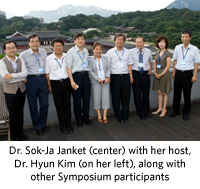
Her lecture was the keynote speech and was titled, "Methodological Issues in Oral and Systemic Health Research.” Her lecture focused on improving the quality of oral health investigations and how she has accomplished that in her study of pro-inflammatory molecules present in oral health research that are also expressed in other systemic biochemical reactions.
Dr. Janket explained her research saying, "For example, cytokines such as Interleukin-1, interleukin-6, or TNF-alpha observed in periodontitis are also expressed in systemic health, specifically in carbohydrate or lipid metabolism. This creates a triangular relationship which is called confounding in epidemiology. This phenomenon is described in my review, Oral Infection, Hyperglycemia and Endothelial Dysfunction."
Dr. Janket's review was published in a 2008 edition of Oral Surgery, Oral Medicine, Oral Pathology, Oral Radiology, & Endodontics. She collaborated on this review with Drs. Thomas Van Dyke, Judith Jones, Jukka Meurman, and Alison Baird.
Dr. Janket also emphasizes the need to study confounding to conduct unbiased research. She said, "Meticulous adjustment of all confounding factors is required to achieve unbiased results. And, this is also true in bench science, because some molecules are expressed in different part of the body by different cells with different functions."
At the close of the Symposium, Dr. Janket reported that a consensus related to her keynote speech topic was reached. She said, "The consensus was that the probing-depth based assessment of periodontitis could be subjective, time-consuming, and might bring discomfort to the study participants. Thus, in order to improve the quality of our oral health investigations, we must first, use a precise, objective, and non-invasive marker for pan-oral infection and second, adjust for all confounding factors carefully. On a personal note, it was also gratifying to know that researchers present at the Symposium plan to use salivary lysozyme, which I have been using in my research, to measure pan-oral infection in their future randomized trials."
BUSM’s Sege Finds Unemployment Linked with Child Maltreatment
The stresses of poverty have long been associated with child abuse and neglect. In a study presented Sunday, Oct. 3, at the American Academy of Pediatrics (AAP) National Conference and Exhibition in San Francisco, researchers directly linked an increased unemployment rate to child maltreatment one year later.

“When times are bad, children suffer,” said study author Robert Sege, MD, FAAP, professor of pediatrics, BUSM, and director, Division of Ambulatory Pediatrics, Boston Medical Center. “These results suggest that programs to strengthen families and prevent maltreatment should be expanded during economic downturns.”
Researchers reviewed state-level unemployment statistics from the Bureau of Labor Statistics, and compared them with child maltreatment data from the National Child Abuse and Neglect Data System (NCANDS), during the years 1990 to 2008. Each 1 percent increase in unemployment was associated with at least a 0.50 per 1,000 increase in confirmed child maltreatment reports one year later. In addition, higher levels of unemployment appeared to raise the likelihood of child maltreatment, as it was not only the lagged change in unemployment, but also the previous year’s unemployment level that influenced the number of child abuse cases.
According to the study, a prolonged rise in unemployment rates is not only detrimental to the economic health of the country but also to the physical and mental health of children. Maltreated children suffer the immediate physical consequences of abuse, including physical injury and even death, and are also at increased risk of physical and mental health effects, often lasting for decades.
Unemployment in the U.S. has risen from 4.5 percent in 2007 to a current level of 9.5 percent.