Student Updates
Toastmasters Presentation Skills Seminar Open to Medical Campus, March 1
Would you like to make your presentations more effective? BUMC Toastmasters is offering a free seminar with actress and coach Amanda Good Hennessey to address common issues when making presentations. This seminar is open to everyone on the Medical Campus, you do not need to be a member of Toastmasters to attend.
During this seminar you will learn about voice tone and variation, body language and movement, gesturing, facial expression and appearance. Audience participation encouraged. She will provide guidance on what works and what doesn’t.
Amanda received her MFA in acting from the Actors Studio Drama School in New York City. She currently teaches acting at Boston University, and has also taught at the Huntington Theatre Company, the New York Film Academy and privately. Amanda has performed on stage, in films, industrials and commercials.
This seminar will be held on Thursday, March 1, 72 East Concord St., Instructional Building, room 109A/B/C, 5-6:15 p.m.
LOX-PP Shown to Have Therapeutic Potential According to GSDM Researchers
GSDM Professor and Director of Oral Biology Research Dr. Philip Trackman’s laboratory has taken their research on the tumor suppressor activity of the lysyl oxidase propeptide, LOX-PP, one step further, showing that LOX-PP could have potential as a therapeutic.
In a paper published in early February by PLoS One, researchers show, “that the recombinant protein can inhibit growth of a pre-existing tumor in mice,” said Dr. Trackman. “This is important, because earlier work showed that if LOX-PP were made by the cancer cells themselves, growth would be slowed.”
Research Assistant Professor Dr. Manish Bais carried out the studies detailed in this paper with the support of Lab Technician Danielle Stephens and Post-Doctoral Researcher Dr. S. Selve Sume. Dr. Sume assisted Dr. Bais with histology and immunohistochemistry methods.
These studies are part of ongoing research collaboration with Tufts University School of Medicine Professor Dr. Gail Sonenshein and BUSM Professor Dr. Kathrin Kirsch, with help from BUSM Professor Dr. Matthew Nugent.
The paper is available in full on the PLoS One website.
Submitted by Laura Mackin.
BUMC Offers Electric Vehicle Charging Stations
 The Boston University Medical Campus opened new Electric Vehicle Charging Stations (EVCS) at a ‘green’ ribbon-cutting ceremony on Thursday, Feb. 16 on the first level of the 710 Albany Street parking garage. The four fueling stations offer electricity for plug-in hybrid and electric vehicles, which are more environmentally conscious alternatives to gas.

A brief speaking program including remarks from Mark Sylvia, Commissioner of the Massachusetts Department of Energy Resources; Jim Hunt, Chief of Environmental and Energy Services for the City of Boston; and president of TranSComm, Bill Gasper, was followed by a vehicle charging demonstration. Vehicles participating in the demonstration included a Volt, a Prius, a BMW Active-E , an electric scooter and a Segway.

“The installation of these Electric Vehicle Charging Stations is an important step in our shared goal of all things green,” explained Maureen Lacey, director of TranSComm.
TranSComm received funding for the charging stations through grants from the City of Boston, Massachusetts Department of Energy Resources and the federal government.
For more information about this program, call TranSComm at 638-7473.
Second Annual Shine Lecture Explores 'The Dark Side of Research' and the Influence of Money on Medicine
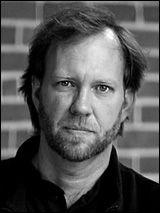
Carl Elliott, author of White Coat, Black Hat: Adventures on the Dark Side of Medicine, is the featured speaker at the Second Annual Cathy Shine Lecture and will present "The Dark Side of Research: Exploitation in Clinical Trials."
Elliott's research offers surprising examples of the influence of market forces on medicine. His studies of clinical trials reveal what physicians may not know -- from a university's refusal to investigate a student's death to the source of research subjects recruited by commercial companies. A physician and bioethicist at the University of Minnesota Medical School, Elliott is also respected as a courageous social commentator, with articles like "Guinea Pigging" in the New Yorker.
A native South Carolinian, Elliott was educated at Davidson College in North Carolina and at Glasgow University in Scotland, where he received his PhD in philosophy. He received his MD from the Medical University of South Carolina. Prior to his appointment at the University of Minnesota in 1997 he was on the faculty of McGill University in Montreal.
He has held postdoctoral or visiting appointments at the University of Chicago, East Carolina University, the University of Otago (New Zealand) and the University of Natal Medical School (now the Nelson R. Mandela School of Medicine), the first medical school in South Africa for non-white students. In 2003-04 he was Visiting Associate Professor at the Institute for Advanced Study in Princeton, New Jersey, where he led a seminar on the social implications of bioethics.
The family of the late Cathy Shine, who died in 1992 from a severe asthma attack, endowed a lectureship in her memory to be organized each year by the Department of Health Law, Bioethics & Human Rights at BUSPH. The gift recognizes the scholarly work of Department Chair Professor George Annas, who wrote about the Shine case in 1999 as an example of the importance of respecting patient rights. In making the gift, the Shine family noted that Cathy Shine admired Annas's work, especially his book The Rights of Patients.
Two years before Shine's death, she suffered a traumatic experience in which medical treatment against her will damaged her trust in physicians. In a wrongful death suit filed by her family on Shine's behalf, The Massachusetts Supreme Judicial Court later affirmed "the right of a competent individual to refuse medical treatment," even life-saving treatment.
According to her family, Cathy Shine was a strong advocate for human rights and patient rights. Before her death, she co-authored a book about race-based discrimination in criminal justice administration, Does the Punishment Fit the Crime, published after her death by the Sentencing Project.
The lecture series is sponsored by the Department of Health Law, Bioethics & Human Rights at Boston University School of Public Health.
Second Annual Cathy Shine Lecture
- Thursday, March 8
- Noon-1 PM
- Free and Open to the Public
- Room L-110 (a reception will follow in L-109)
Science as Art
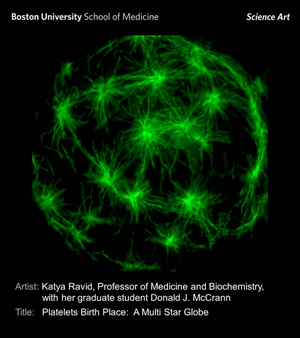 Last fall, Karen Antman, MD, Provost, BU Medical Campus, and Dean, BUSM, requested submissions from the Medical Campus community for images derived from science that would be displayed as art throughout the campus. A variety of intricate and striking images rolled out of the laboratories of the campus scientists. Faculty members, postdocs and students all participated in the call for submissions.
At the February BUSM faculty meeting Dr. Antman announced the images selected to be displayed around campus and on the flat screen panels located in the medical school lobby. “Please join me in congratulating our colleagues for their interesting and visually vibrant scientific contributions. It is impressive to note the creativity and variety of work they have produced.”
A gallery of the images is located at http://www.facebook.com/media/set/?set=a.382601751769569.107416.149595361736877&type=3
Identifying an “Achilles’ Heel” in Colon Cancer
Over 1 million cases of colon cancer are diagnosed worldwide each year resulting in approximately 600,000 deaths annually. Disease-causing mutations in the KRAS gene are found in over half of these cases.
In the United States, colon cancer patients are routinely genotyped for KRAS gene mutations and those with mutations are excluded from receiving novel “targeted” therapeutic agents due to a lack of clinical benefit. Thus, patients with KRAS gene mutations are faced with very limited therapeutic options and are subsequently given very poor clinical prognoses.
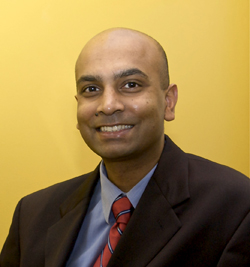
A recent study published in the Feb.17 issue of Cell has sought to tackle this problem head-on. The study’s lead author is BUSM Assistant Professor, Pharmacology and Medicine, Division of Hematology and Medical Oncology, Anurag Singh, PhD working closely with Daniel Haber MD, PhD and Jeff Settleman PhD at the Massachusetts General Hospital Cancer Center. The researchers identified a network of genes that are hyper-activated in KRAS mutant colon cancers. Within this network is a gene called MAP3K7 or TAK1, which they showed plays a very critical role in promoting colon cancer disease progression. Pharmacological inhibition of TAK1 results in strong killing of affected tumor cells, with minimal effects in “normal” non-mutated cells.
“These findings raise the possibility that anti-TAK1 agents could provide the basis for “personalized” medicine in patients with highly aggressive KRAS mutant colon cancers,” said Singh. Efforts are now underway to identify clinically efficacious TAK1 inhibitors.
American College of Dentists Honors Sheede Khalil DMD ‘12
Sheede Khalil DMD '12 was presented with the American College of Dentists (ACD) Senior Student Award at a luncheon held on Saturday, January 28, at Yankee Dental Congress 37. Khalil was selected because of her outstanding achievements in academics, leadership, and initiative.
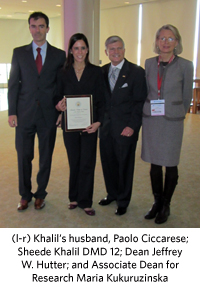 Khalil came to GSDM as a technical assistant in the lab of Associate Dean for Research Dr. Maria Kukuruzinska in 2005. From her research work at the School of Dental Medicine she was inspired to apply for the DMD program. She was accepted and began dental school in the Fall of 2008.
Dean Jeffrey W. Hutter said, “Dr. Kukuruzinska was so very impressed with the work of Sheede that I know she played a key role in convincing her to pursue a career in dental medicine, and Maria, I thank you for doing that.”
As a student, Khalil is still very much involved in research. She has been awarded a research fellowship from the Sjogren’s Syndrome Foundation, is the winner of the AADR’s Hutton competition, and has participated in various student research poster presentations. To date, she has authored or co-authored 11 abstracts pertaining to her research and also co-authored, with Dr. Kukuruzinska, a paper titled “Diverse Roles of E-cadherin in the Morphogenesis of the Submandibular Gland: Insights into the Formation of Acinar and Ductal Structures,” that appeared in a 2008 issue of the Journal of Developmental Dynamics.
During Sheede’s four years at GSDM, she has been an active member of the American Association for Dental Research, the International Association for Dental Research, and the Massachusetts Dental Society. She is also involved in community outreach and is an active volunteer with the BU chapters of ASDA, SNDA, HSDA, and the Student Research Group. In addition, during her recent externship rotation she helped put together a unique outreach program that takes place in local barbershops.
Dean Hutter added, “Since first being introduced to Sheede by Dr. Kukuruzinska six years ago, I have been continually impressed with her intelligence, dedication, motivation, can-do attitude, and wonderful personality. She is truly deserving of this award and I congratulate her on all that she has accomplished.”
Abstracts Sought for 2012 McCahan Education Day
SAVE THE DATE: Medical Campus Education Day, May 23
BUMC faculty, fellows, residents, students and staff are invited to submit proposals for workshops and abstracts of ongoing or completed education projects. Learn new teaching skills and knowledge of education scholarship by attending workshops, viewing posters and hearing presentations about educational innovation, research and scholarship.
John McCahan Medical Campus Education Day, May 23, is sponsored by the Boston University Schools of Dental Medicine, Medicine and Public Health
Attend Education Day to:
• Network with other creative educators in the BUMC community
• Showcase your innovations and ideas in classroom, clinical and lab teaching
• Cultivate your teaching skills
Abstracts must be submitted by Friday, April 20
Cash prizes awarded to top abstracts!
Past projects include:
• Promoting deep learning in a student centered classroom: A case study for Public Health
• Teaching motivational interviewing in an ambulatory medicine clerkship
• Assessment of a peer teaching model in Yemen
• The effect of faculty presence vs. absence on small-group learning and group dynamics
• Oral disease – Educational strategies to address a significant health issue in children
Past workshops include:
• How the brain learns: How neuroscience informs our teaching
• Using digital media inside and outside the classroom
• Technology-enhanced active learning
Preliminary Program (detailed schedule to follow):
Target audience: Faculty, fellows, residents, students and staff at BU interested in educational innovation and scholarship on the BU Medical Campus.
At the conclusion of this activity, participants will be able to:
1. Incorporate specific instructional techniques into their teaching
2. Identify key research questions in educational innovation and scholarship
3. Identify new approaches to educational innovation and scholarship
Click here for more information.
Is Pornography a Public Health Issue? SPH Forum Considers Both Sides
In Catharine MacKinnon’s 1993 treatise Only Words, the feminist scholar writes that “the law of equality and the law of freedom of speech are on a collision course in this country.”
This semester, students at the School of Public Health are examining that collision through an unusual lens—not through the study of law or human rights, but through a lesson in hard-core pornography.
Four SPH faculty have introduced the subject of pornography into the curriculum in hopes of stirring debate around issues of public health. Does pornography shape the way adolescents think about their sexuality? Does it fuel sexual violence? Does it intentionally degrade women?
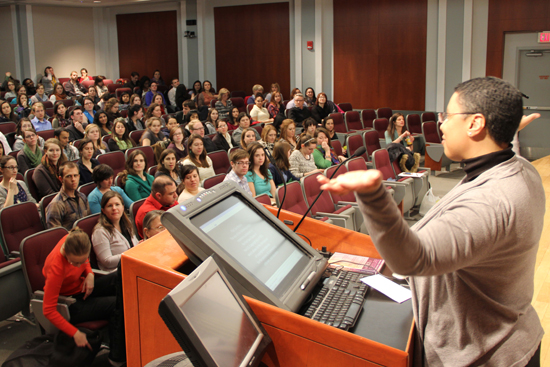
On Feb. 10 more than 150 public health students crammed into the Medical Campus Bakst Auditorium to view a documentary about the pornography industry, The Price of Pleasure: Pornography, Sexuality & Relationships, and hear from two leading experts on the topic: Gail Dines, a professor of sociology and women’s studies at Wheelock College, and Carol Queen, a sexologist and part owner of Good Vibrations, a sex merchandise company with stores in Brookline, Mass., and San Francisco.
The debate—with Dines taking the antiporn position and Queen the pro-porn—wound through issues of racism and rape, exploitation and sex education, poverty and patriarchy.
“It feels like this is what education should be like—tackling a hotly contested topic from different perspectives, including public health,” said Emily Rothman, an SPH associate professor of community health sciences, who organized the forum. “Pornography is so widely available now, in the Internet age, it’s naive to think that it isn’t having a profound impact on our culture, including the way we interact with each other.”
SPH Dean Robert Meenan (MED’72, GSM’89) acknowledged in his opening remarks that bringing students together to view and discuss a film that included scenes of hard-core pornography was not standard public health school fare. But, he noted, “Public health has to raise and deal with uncomfortable topics, and it has to push people into uncomfortable conversations.” Sex and debate, he said, are “perspectives that [fuel] the field of public health.”
Rothman, who teaches an SPH course in sexual violence, said she began thinking seriously about introducing pornography into the curriculum after seeing the The Price of Pleasure last year. The film explores the negative aspects of “gonzo” porn, in which the focus is on sexual acts—graphic and sometimes violent—not on a narrative story line.
“My first thought was, my students have to see this,” Rothman said. “I wanted us to explore the idea of whether pornography is a public health issue—and if it is, how do we come at it as practitioners?”

The forum brought Rothman’s class together with three other SPH classes that deal with sexuality, reproductive health, and adolescent health. The SPH faculty members teaching those classes–Renee Johnson, an assistant professor of community health sciences, Sophie Godley (SPH’15), a clinical assistant professor of community health sciences, and Lois McCloskey, an associate professor of community health sciences–said pornography crossed into public health in many areas, including risk behaviors, sexual exploitation, and gender roles and behavior. The four had discussed the issues as part of their course work in advance of the forum.
“The best evidence we have suggests that young people today are being exposed to pornography a lot,” said Johnson, who teaches a class on adolescent health. That exposure raises questions about whether pornography should be part of sex education, she said.
Students peppered Dines and Queen with questions about the impact and intent of pornography, including whether the porn industry had created a market for violent porn or whether violence in the culture had pushed porn to its gonzo extremes.
“I just don’t understand how you can support an industry that’s so violent towards women,” one student pressed Queen.
“Where is the line—a world with no porn?” another student asked Dines. “If we limit this type of speech, where do we draw the line?”
Dines said “body-punishing, brutal pornography” has become “the number one most profitable pornography,” and she argued that poverty, racism, and sexism drive the industry. “In an ideal world, they would have trouble finding women who would elect to do this” for employment, she said, adding that she views pornography as propaganda for a patriarchic social structure.
“Nothing delivers patriarchy to you like a bullet between the eyes like pornography,” she said.
Queen said gonzo porn is just one swath of the pornography landscape, and cautioned the students not to conflate violence with explicit sex. “The industry is more diverse” than what the film depicted, she said.
The two speakers clashed around the question of whether pornography is a trigger for sexual violence.
“What I know about sexual violence and rape, it isn’t about sex—it’s about violence,” Queen said. She doesn’t believe exposure to pornography “makes you do the things you see. It’s perfectly possible to see something and not imitate it.”
But Dines said it was wrong to assume that pornography plays no role in sexual violence. “Advertising has an effect on consumer behavior—we would all agree on that,” she said. “So does porn that involves violence and abuse. The bigger issue is, how is this imagery constructing men’s sexual identities?”
Rothman said research into the link between pornography and sexual violence is a new field, one she has started pursuing. A recent study she led found that young women who had seen pornography in the prior month were five times as likely as those who had not seen pornography to report having had a group-sex experience, coercive or consensual.
Godley, who teaches the SPH class Safer Sex in the City: From Science to Policy, which deals with research-based knowledge about sexuality and health, acknowledged that she was initially apprehensive about having her students see The Price of Pleasure.
But she was delighted, she said, to be part of an event that allowed for “a civil dialogue between people who disagree. That’s a rare thing in 2012—to actually have a productive discussion that moves us forward and gets us all thinking.”
In this video link, SPH faculty discuss whether pornography has become a growing public health issue. Video by Michael Saunders
This BU Today story was written by Lisa Chedekel. She can be reached at chedekel@bu.edu.
BUSM Professor Lewis Weintraub Recognized by BMC, Long-time Physician Honored for Excellence
Lewis Weintraub, MD, a Professor of Medicine at Boston University School of Medicine (BUSM) and a BMC Hematologist/Oncologist and, has been named the 2011 recipient of the Jerome Klein Award for Physician Excellence.
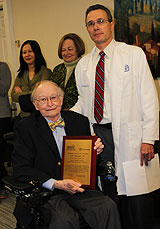
The Jerome Klein Award was established in 2010 to commemorate Dr. Klein’s 50 years of service to BMC/BUSM and is presented annually to a physician who shares Dr. Klein’s attributes. Weintraub, who has served the BMC/BUSM community for 39 years, received the recognition for his clinical and research excellence, leadership and dedicated commitment to education and mentoring.
“Lewis has a gentle approach to educating and mentoring his students, and he makes sure patients always receive the ultimate care,” Ravin Davidoff, MD, Chief Medical Officer, told the crowd gathered in the Wilkins Board Room Jan. 31 to celebrate Weintraub’s achievements.
“Thank you,” Davidoff continued, turning to Weintraub, “for what you have given us and our patients.”
During his career, Weintraub pursued a broad range of clinical and translational research topics in hematology. He is the author of 78 papers and reviews, and has served on numerous hospital and school boards. Teaching, however, has been a key interest throughout his career, and an area in which he has made a great impact.
“Dr. Weintraub is one of the best teachers and mentors I have had during my medical training,” noted a fellow in the nomination form for Weintraub. “He is a model physician who shows the utmost compassion and dedication to his patients.”
Another fellow commented: “Dr. Weintraub’s commitment to teaching is striking. Every case, from a routine follow-up he had been seeing for years to a new patient with a strange and unusual presentation, was ‘a teaching case.’ He is known in the department as ‘the final word’ when it comes to hematology. I think it is the combination of his incredible breadth of knowledge and experience, as well as his kind heart that allows him to always to be patient and available to answer a question with enthusiasm and a smile.”
Weintraub attended Dartmouth as an undergraduate and then Harvard Medical School. He trained in medicine at the Hospital of the University of Pennsylvania and the University of Michigan and then in hematology at Mount Sinai Hospital. During the Vietnam War era, he joined the “yellow berets” and served as the Assistant Chief of Hematology at Walter Reed Hospital, where he also carried out research on iron metabolism. He returned to Boston in 1965, first on the faculty at Tufts Medical School and New England Medical Center. In 1972 he was recruited to Boston University School of Medicine as an Associate Professor of Medicine. In 1977 he was promoted to Professor and Chief of Hematology at University Hospital (now known as BMC), a position he held until 2003.
“It has been a fruitful 39 years for me,” said Weintraub as he received the Klein Award plaque. “I look forward to another 39.”