Residency Training Program
Program Director:
Nicole Siegel, MD
Associate Program Directors:
Crandall Peeler, MD
Assistant Program Director:
Christine Ament, MD
Education Coordinator:
Contact: Valerie Worrell (Valerie.Worrell@bmc.org)
Boston Medical Center
On July 1, 1996, Boston University Medical Center and the Boston City Hospital merged to create the Boston Medical Center, thus enabling us to both provide high quality care and reduce the inefficiencies inherent in duplicated services at two adjacent, previously-competing academic hospitals. The merger of a private, university-based academic medical center and a public, municipal hospital into a single private institution has been eminently successful and has created a new health care presence in Boston.
Boston Medical Center carries with it a history as the major provider in Massachusetts of health services to the disadvantaged. It continues as the epicenter of public and private initiatives to improve the delivery of excellent health care for all. It draws from the fine traditions of its predecessor institutions and maintains their missions: a) providing high-quality tertiary care patient services and unparalleled primary medical care; b) providing excellent supervised training opportunities for future physicians; c) adding to medical knowledge through advances in medical research; and d) safeguarding the unique ability of this institution to provide needed medical services for underprivileged patients of the Greater Boston area.
Boston Medical Center (BMC) is one of the premier teaching hospitals in New England and it is also the keystone of the Boston HealthNet, a citywide system of Neighborhood Health Centers. The Health Centers, enthusiastically supported by the City of Boston, provide routine care for thousands of Bostonians, with rapid referral to BMC of patients requiring advanced medical or surgical care. The successful launch of a Boston Medical Center-based health plan also has contributed to a marked growth in outpatient visits.
Boston Medical Center continues the strong bond of Boston University Chobanian & Avedisian School of Medicine with the Boston Veterans Administration Healthcare System (Boston VA). The Boston VA provides comprehensive medical care to the veterans of New England and is a major site for the residency and fellowship training programs of BMC.
Ophthalmology at Boston Medical Center
The Department of Ophthalmology & Vision Sciences at Boston Medical Center provides a full range of eye care services. On site at BMC, the Department of Ophthalmology runs its Eye Center in the Ambulatory Care Center of the Yawkey Pavilion, providing general and urgent eye care services, as well as specialty services for cornea and external ocular diseases, surgical correction of refractive errors, cataract, glaucoma, oculoplastics and orbital surgery, retinal and vitreous diseases, pediatric ocular disorders, and neuro-ophthalmic diseases. The consultation service provides evaluation of hospitalized patients. Comprehensive optometric services, contact lenses and low-vision examinations are offered as well. Special diagnostic procedures of ocular photography, corneal topography, specular microscopy, visual field perimetry, fluorescein and ICG angiography, optical coherence tomography, A and B scan ultrasonography, ultrasound biomicroscopy and electrophysiological testing of the eyes are all available.
Ophthalmic surgery provided at the Boston Medical Center includes the full range of cataract, cornea, glaucoma, oculoplastic, retina, and pediatric procedures. Minor procedures and laser surgery are done at the Eye Center in the Yawkey Pavilion; major surgical cases are scheduled either in the Eye Surgical Unit of the Moakley Ambulatory Surgicenter at BMC or in the main operating rooms of the Menino inpatient hospital.
Twenty-four hour, seven-day per week emergency ophthalmology evaluation and treatment are maintained at the Level I Trauma Center of Boston Medical Center. This commitment allows our medical and surgical patients the peace of mind that comes with the certainty of dependable, available eye care any time of the day or night.
The Boston University Chobanian & Avedisian School of Medicine, the primary academic affiliate of the Boston Medical Center, also is the primary academic affiliate of the Boston Veterans Administration Healthcare System (Boston VA). The BMC Department of Ophthalmology & Vision Sciences has administrative responsibility for the ophthalmologic services at the Boston VA, the tertiary care facility for VA ophthalmology in New England, and for the training and supervision of ophthalmology residents there. The Boston VA provides general ophthalmology care, as well as care in all subspecialty areas, ancillary ophthalmic diagnostics, minor procedures, ophthalmic laser surgery, and major ocular surgery under the direct supervision of cataract, cornea, glaucoma, retina, strabismus and oculoplastic specialists. One resident from each year from the Massachusetts Eye and Ear Infirmary/Harvard Medical School residency program join the three BMC residents rotating there at any given time.
The Residency Training Program
The Residency Training Program in Ophthalmology at the Boston Medical Center has been designed with the goal of producing comprehensive clinical ophthalmologists who possess not only clinical knowledge and surgical skills, but also the judgement, confidence, and independence to succeed in a variety of career choices. Graduates have been successful in obtaining coveted clinical fellowship and research training positions. They have become expert clinicians in all areas of the country. Many have achieved recognition in academic ophthalmology, and several have become department chairmen. We strive for the breadth and depth of experience necessary to prepare our graduates for whatever future they may choose.
The Residency Training Program in Ophthalmology at Boston Medical Center is ideal for the energetic, highly motivated, self-propelled and inquisitive physician who wishes to gain wide experience and clinical expertise in ophthalmology. The resident assumes responsibility for the care of patients with a wide spectrum of ophthalmic disease, mastering the skills required for ophthalmologic diagnosis and treatment, and performing laser and surgical procedures under the tutelage of a committed faculty in a wide variety of settings.
Residency Rotations
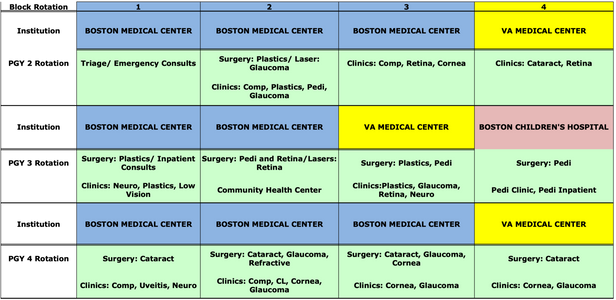
PGY-1 (3-week IM rotations and 1-week Ophthalmology rotations)
- Boston Medical Center Internal Medicine Program – 9 months
- BMC Ambulatory Care Center Eye Clinic – Twelve 1-week blocks totaling 3 months
PGY-2 (6-week rotations)
- BMC Ambulatory Care Center Eye Clinic – 9 months
- Boston Veterans Administration Healthcare System – 3 months
PGY-3 (6-week and 3-month rotations)
- BMC Ambulatory Care Center Eye Clinic – 6 months
- Boston Children’s Hospital (pediatric ophthalmology) – 3 months
- Boston Veterans Administration Healthcare System – 3 months
PGY-3 (3-month rotations)
- BMC Ambulatory Care Center Eye Clinic – 9 months
- Boston Veterans Administration Healthcare System – 3 months
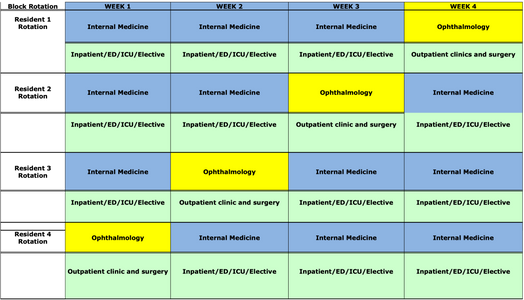
Starting with the residency class beginning residency 7/1/2021, all residents must satisfactorily complete a post-graduate clinical year of training with the Internal Medicine Program at Boston Medical Center (BMC Internal Medicine Residency) prior to entering the initial (PGY-2) year of the Boston Medical Center Residency Training Program in Ophthalmology. The joint PGY-1 year is comprised of 9 months with the Internal Medicine (IM) Department and 3 months in the Ophthalmology Department. Every month the joint preliminary year interns will complete a 3-week IM rotation followed by a 1-week Ophthalmology rotation.
The PGY-2 year of Ophthalmology training centers around the evaluation of ambulatory patients in varied settings. Each new resident is guided into the nuances of ocular diagnosis and the medical and surgical treatment of ocular diseases and ophthalmic emergencies. During the first weeks of training, residents are introduced to their clinical activities. The introductory lecture series and tutorial program in the first weeks eases the transition of new residents into their role as ophthalmic specialists. After this initial period, the balance between supervision and resident independence is gradually modified to encourage the residents’ self-sufficiency and confidence and to keep pace with their increasing ability and responsibilities throughout the course of their residency. During each first-year rotation, the resident serves on a variety of general and subspecialty services in order to gain broad exposure to the entire spectrum of eye disease. Each resident spends 9 months at the Ambulatory Care Center Eye Clinic of the Boston Medical Center. The clinics are fully supervised by the Boston Medical Center Ophthalmology faculty. The remaining three months are spent at the Boston Veterans Administration Healthcare System. All Boston VA clinics are staffed by faculty from Boston University, Massachusetts Eye and Ear Infirmary and the VA, providing general eye, cataract, cornea, retina, glaucoma, ophthalmic laser, oculoplastics, neuro-ophthalmology, and in-patient consultation services.
The PGY-3 year is devoted to further training in the ophthalmological subspecialties. Residents spend six months at the Boston Medical Center concentrating on the clinical aspects of vitreoretinal diseases, glaucoma, neuro-ophthalmology, pediatric ophthalmology and strabismus surgery, ophthalmic pathology, contact lens fitting, and vision rehabilitation. Each resident serves as the primary consulting ophthalmologist for BMC during the consult rotation. The pediatric experience is bolstered by three months at the Boston Children’s Hospital, where each resident receives intensive training in the diagnosis and medical and surgical management of childhood ocular disease under the supervision of the full-time pediatric ophthalmologists from the Harvard faculty based at that institution. As at the VA, this rotation is shared with Massachusetts Eye and Ear Infirmary PGY-3 residents. The year is rounded out by a rotation at the Boston Veterans Administration Healthcare System, providing additional training in intraocular surgery, laser surgery, vitreoretinal diseases, neuro-ophthalmology, glaucoma, corneal and external disease, and ophthalmic consultation. The primary surgical experience during the PGY-3 year focuses on strabismus, oculoplastic and orbital surgeries.
The PGY-4 year provides the bulk of the residents’ surgical experience. Nine months are spent at Boston Medical Center, where the resident receives further training in cataract surgery; cornea and external disease, and diseases of the retina and vitreous, and glaucoma. Each senior resident carries primary responsibility for all ophthalmic surgical services during the rotation at the Boston Veterans Administration Healthcare System, as shared with the senior resident rotating from Massachusetts Eye and Ear Infirmary.
Facilities and Resources
The residents are provided with excellent facilities in which to acquire and develop professional skills. All of the examination rooms at the BMC clinics are fully equipped with Haag-Streit slit lamps, Goldmann tonometers, and phoropters. It also contains a minor surgery suite and a laser facility with argon, krypton, PASCAL and Nd-YAG lasers. Our staffed ophthalmic photography unit has capabilities for digital fluorescein and indocyanine-green angiography; optical coherence tomography; fundus, slit lamp and external photography; specular microscopy; ultrasound biomicroscopy; and media facilities for presentations. An ultrasonography unit and electrodiagnostic (visual evoked potentials, electroretinography) facility complement the automated and manual perimetry unit to complete the Center’s diagnostic capabilities.
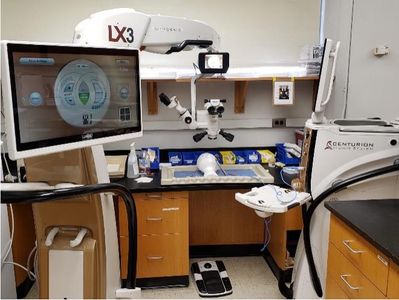
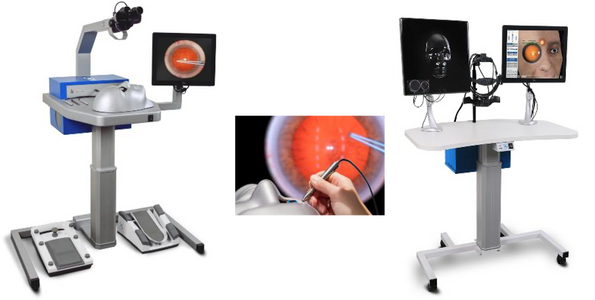
All major ophthalmic surgery (ambulatory and inpatient) for cases originating at Boston Medical Center is performed in fully updated eye operating rooms at Boston Medical Center, in the Moakley Ambulatory Surgery Center and in the Menino Building. Closed circuit television and Heads-Up displays for viewing and recording the on-going ophthalmic microsurgical procedures provides an invaluable educational tool for residents wishing to review their own techniques and document their advancements and proficiency. An Eyesi® Surgical Simulator, at the VA Hospital, is available for the residents to practice cataract surgery and pars plana vitrectomy surgery. At Boston Medical Center, our resident wet lab includes:
- Luxor microscope with two heads
- Centurion phaco machine
- Wide array of micro instruments
Emergency cases are seen in the busy and state-of-the art Emergency Rooms at Boston Medical Center, Boston Children’s Hospital and the Boston Veterans Administration Healthcare System. Call is taken from home, but there are on-call rooms at BMC for residents who find it convenient to stay in-house for call.
The Department of Ophthalmology & Vision Sciences maintains an extensive laboratory research program in the Massachusetts Lions Eye Research Laboratory, the Harold S. Larkin Eye Research Laboratory and The Larkin Family Eye Research Laboratory of the Boston University Chobanian & Avedisian School of Medicine. Scheduled teaching conferences for residents are held several days per week and follow the American Academy of Ophthalmology’s Basic and Clinical Science Course. Conference formats include case presentations, formal lectures, grand rounds, invited guess lectures, and journal article reviews. A complete in-house course in ophthalmic pathology is given by Dr. Nora Laver with microscope sessions throughout the year. Grand Rounds are held weekly. A monthly Surgical Complications Conference allows discussion of difficult cases and non-optimal outcomes as a way of introducing the new ophthalmic surgeon to surgical decision-making and the life-long task of improving surgical skills via honest self-assessment.
Residents attend the regular meetings of the New England Ophthalmological Society; the full-day seminars, which occur five times a year, bring nationally recognized educators and researchers to Boston to discuss current advances in many areas within ophthalmology.
We believe that an environment emphasizing the transfer of clinical knowledge and skills, utilizing abundant clinical cases and dedicated, proficient staff best serves the interests of our residents. We attempt to strike an appropriate balance between supervised preceptorship and individual initiative. Resident input is encouraged at all times. This feedback allows appropriate, timely updating of the didactic portion of the residency training program.
There are multiple computers, including one in each examining room with word processor, spreadsheet, and presentation media capabilities and literature searches with access to the many educational sites on the Internet. The Department of Ophthalmology also maintains dedicated computers for residents in the dedicated resident room. Copies of the latest issues of more than 30 ophthalmology journals are also available in the conference room.
Library resources are provided at the Boston University Chobanian & Avedisian School of Medicine. These include a wide selection of journals in ophthalmology and related fields, an extensive collection of ophthalmology reference books and atlases, updated yearly, and computer access with fully computerized searches of the library’s collection and of the Medline database. Computer facilities continue to expand: an interactive computer module for ocular pathology already is well established, and future uses are being explored.
Ophthalmology Research at Boston Medical Center and Boston University Chobanian & Avedisian School of Medicine
The Massachusetts Lions Eye Research Laboratory, the Harold S. Larkin Eye Research Laboratory, and The Larkin Family Eye Research Laboratory in the Boston University Chobanian & Avedisian School of Medicine is the center of basic ophthalmology research. The full-time research faculty currently numbers and post-doctoral fellows and Ph.D. candidates continues to grow. These researchers and the members of their laboratory staff actively pursue ongoing basic laboratory research projects utilizing specialized equipment including electron microscopy and confocal thick-section microscopy.
In addition, the clinical faculty pursue their particular research interests, with current clinical studies underway searching for improved methods of diagnosing, monitoring, and treating ophthalmic disease. Opportunities for resident participation in basic or clinical research are always available, and many of our residents present their work at regional and national meetings such as ARVO and the American Academy of Ophthalmology. There is a resident research requirement in place and the second year residents are expected to complete a project and have a manuscript ready for submission for publication by the completion of their second year.
The Future
The past decade has produced remarkable growth of the Department of Ophthalmology at the Boston University Medical Center. The Boston Medical Center eye clinics at the Yawkey Pavilion was recently renovated, as well as a major renovations of the eye clinics at the VA. The residency is a core mission of the department and continues to attract excellent young physicians for training.
Listing of Faculty