Student Updates
NIH Concludes that BU Biolab Poses Minimal Risk to Community, Decision Comes After Thorough and Comprehensive Analysis
On Jan. 2, the National Institutes of Health (NIH) issued a Supplemental Record of Decision on Boston University’s National Emerging Infectious Diseases Laboratories (NEIDL) affirming that the lab poses minimal risk to the surrounding community.
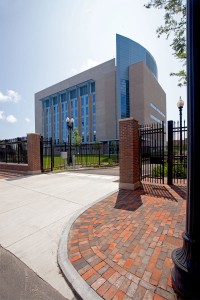 The issuance of the Supplemental Record of Decision, published in the Federal Register, follows a thorough and comprehensive analysis by distinguished scientists and researchers of the potential safety risks posed by the NEIDL and thorough consideration of the public comments on the draft and the final document. The 2,717 page Final Supplementary Risk Assessment extensively reviewed and analyzed scenarios involving the potential of human health consequences of an exposure to laboratory workers and the general public as a result of unintentional or malevolent events. It also addressed these same scenarios at potential alternative locations for the lab.
An independent panel of scientists from the National Research Council evaluated the scientific validity of the risk assessment when it was nearly complete. At that time, the independent panel’s chairman said, “The work they (the NIH) had done was sound scientific work, the scenarios they developed were credible and the analyses they presented were also sound and credible.”
“The NIH conducted an exhaustive review of the lab and its findings were affirmed by an independent panel of eminent scientists on the Blue Ribbon Panel. The NEIDL will be an important addition to life science research in our region and its work to improve public health will have local, national and global impact,” said John R. Murphy, PhD, NEIDL Director ad interim.
There are a number of necessary next steps to take in the process to open the lab for BSL-3 and BSL-4 research, including obtaining a certificate from the Massachusetts Secretary of Energy and Environmental Affairs and seeking approval from the Boston Public Health Commission. BU will soon be filing the necessary documentation, including a Supplementary Final Environmental Impact Report with the Massachusetts Office of Energy and Environmental Affairs.
BU must also seek approval from the Boston Public Health Commission, the agency that regulates BSL- 3 and 4 research in the city. Finally, before any research can begin, projects must also be approved by the Institutional Biosafety Committee and, if Select Agents are being used, approval must be granted by the US Centers for Disease Control and Prevention and/or US Department of Agriculture.
For more information on the NEIDL, go to www.bu.edu/NEIDL
Barbara Gilchrest Named 2012 Charter Fellow by National Academy of Inventors
Barbara Gilchrest, MD, professor and Chair Emeritus of the department of dermatology at Boston University School of Medicine (BUSM) and dermatologist at Boston Medical Center (BMC), has been named a 2012 Charter Fellow of the National Academy of Inventors (NAI). Gilchrest is among four faculty members at Boston University nominated to the NAI in 2012.

This year’s charter fellows, who are elected by their peers, represent 98 innovators from 54 universities and non-profit research institutes. This professional distinction is accorded to academic inventors who have demonstrated a highly prolific spirit of innovation in creating or facilitating outstanding inventions that have made a tangible impact on quality of life, economic development and the welfare of society.
Board certified in internal medicine and dermatology, Gilchrest received her medical degree from Harvard Medical School and completed residencies in internal medicine and dermatology at Harvard-affiliated hospitals. Prior to her appointment as Chair, Gilchrest held academic appointments at Harvard Medical School and Tufts University School of Medicine. She has clinical and laboratory-based research interests in skin aging and pigmentation and has published extensively based on her pioneering work in these fields. Gilchrest is a member of the Institute of Medicine of the National Academy of Sciences and was cited in the book, 100 Best Doctors in America.
NAI Charter Fellows will be inducted by the U.S. Commissioner for Patents, Margaret A. Focarino, from the United States Patent and Trademark Office, during the 2nd Annual Conference of the NAI on Feb. 22, 2013, in Tampa, Fla. Fellows will be presented with a special trophy and a rosette pin.
BU Medical Campus Early Education Center Now Enrolling
Little Sprouts a child-care and early-education center on the ground floor of the Medical Student Residence at 815 Albany St., is now open. Toddler and preschool openings are available and priority will be given to BU Medical Campus employees and students, members of the BUMC Residency Programs, BU Charles River Campus employees and Boston Medical Center employees, in this order.

Features of the Little Sprouts program include breakfast and two nutritious snacks each day, art, up-beat music and movement program, nature walks, dramatic play, literacy based programs, gross motor play, dramatic play, science and technology. In addition, Little Sprouts uses aromatherapy to create a relaxing, welcoming vibe. Program hours are 7 a.m.-7 p.m., Monday through Friday.
Kathleen Nichols is the executive director of the newly built, Little Sprouts. She holds a master’s degree in early childhood education, including children with or without disabilities. “I would be happy to meet with prospective parents, answer questions and take them on a tour of our facility. Our schools are “Preschool centers of Excellence” awarded by the U.S. Department of Education. Our goal is to create a soothing and relaxing atmosphere where your child can be safe, happy and learn every day.”
Call Little Sprouts at 1-877-977-7688 to schedule a time to view the facility or visit Little Sprouts at http://www.littlesprouts.com/
GSDM Faculty Awarded Inaugural Seed Grants
The Boston University Henry M. Goldman School of Dental Medicine (GSDM) named three faculty members as winners of the inaugural Seed Funding Competition. GSDM’s Research Endowment Fund awarded the 2012 winners $15,000 each in grant funds to enhance research at the school.
These grants are intended primarily to support new investigators but can also be used to fund new and exciting collaborations by established researchers.
 This year’s recipients are Dr. Srinivas Ayilavarapu, Assistant Professor, Department of General Dentistry; Dr. Manish Bais, Research Assistant Professor, Department of Periodontology & Oral Biology, and Dr. Ki-Young Kim, Research Assistant Professor, Department of Molecular & Cell Biology.
Dr. Ayilavarapu’s research project, “Periodontal disease and Type 2 Diabetes have excessive systemic inflammation and impaired resolution programs,” will test the hypothesis that people with periodontal disease (PD) and type 2 diabetes (T2D) will present with systemic inflammation that fails to resolve and present with priming and aggregation of platelets, neutrophils and monocytes.
Dr. Bais’s research project, “LOXL2 in anabolic response to osteoarthritis,” will build on previous observations that LOXL2 is expressed in fracture healing and is a critical regulator and effector of chondrocyte development.
Dr. Kim’s research project, “Control of ribosomal protein gene expression by transcriptional attenuation,” will study a novel regulatory mechanism known as transcriptional attenuation. The authors have described the phenomena in yeast and now they will study various attenuation relief factors (a continuation of their previous work).
“The seed funding competition will help drive research momentum at the school,” said Dr. Maria Kukuruzinska, Associate Dean for Research. “The proposals submitted were of a high standard and were reviewed for scientific merit and impact. We are very excited to fund three outstanding projects that can be developed into competitive proposals for extramural funding.”
“I would like to congratulate the winners of the Seed Funding Competition,” said Dean Jeffrey W. Hutter. “These vitally important research projects exemplify our steadfast commitment to research at the Henry M. Goldman School of Dental Medicine.”
Submitted by Jackie Simon.
BUSM, BMC Faculty Member Receives Award for Physician Excellence

Edward Bernstein, MD, vice chair of academic affairs and professor of emergency medicine at Boston University School of Medicine (BUSM) and an emergency medicine physician at Boston Medical Center (BMC) has been named the recipient of the 2012 Jerome Klein Award for Physician Excellence. Selected by a senior committee of BUSM and BMC physicians, the award was presented at the Medical Executive Committee meeting on Dec. 14.
Established to honor Jerome Klein, MD, a pediatrician at BMC for his 50 years of service to the hospital, the award is given to a physician who mirrors Klein’s commitment and service as a mentor, leader, teacher, researcher and clinician.
“Ed is certainly a most worthy recipient and I am very appreciative for all that he has done for BMC and for our patients over his 25 years here,” said Ravin Davidoff, MD, chief medical officer at BMC, who presented the award.
Bernstein has dedicated his career to incorporating public health into emergency medicine with a special focus on interventions to reduce substance abuse. This includes co-founding Project ASSERT (Alcohol and Substance Abuse Services, Education, and Referral to Treatment), which helps patients gain access to treatment for substance abuse and primary care services.
Bernstein expanded the project into the BNI-ART Institute, which provides training for health care providers to help patients overcome barriers to changing harmful behaviors, such as smoking or drug use. Bernstein serves as co-director of BNI-ART Institute/Project ASSERT at Boston University School of Public Health (BUSPH).
Prior to joining BMC and BUSM, Bernstein founded the emergency medicine residency program at the University of New Mexico. He has published dozens of articles in peer-reviewed journals and co-edited the textbook “Case Studies in Emergency Medicine and the Health of the Public.”
Bernstein received his medical degree from Stanford University School of Medicine and completed an internship in pediatrics at San Francisco General Hospital. He is board certified in both emergency medicine and family medicine.
GMS Classes Participate in Dec. 19 Emergency Management Drill, Bakst Auditorium
An emergency management exercise will be taking place in Bakst auditorium on Dec. 19, 1-6 p.m. Response activity may be visible from the areas adjacent to the Bakst including the Instructional building lobby, the hallway between the lobby and Bakst and rooms L109, L110, L111, L112. This drill is the final examination for two GMS classes: Health Care in Emergency Management Incident Command System (BC710) and Medical Death Legal Investigation (GMS FS709). Please contact Steve Morash with any questions, 414-2188.
Study Identifies Improved Method for Assessing Endoscopists’ Skills
Researchers from Boston University School of Medicine (BUSM) and Boston Medical Center (BMC) have published a study identifying a better method for grading endoscopists, physicians who perform colonoscopies. Their findings were recently published online in the journal Gastrointestinal Endoscopy.

Through screening colonoscopies, endoscopists are able to identify and remove pre-cancerous adenomas, ultimately reducing the rate of colon cancer. A high adenoma detection rate (ADR) is associated with fewer interval colorectal cancers, and the ADR is currently used to grade endoscopists on how well they perform colonoscopies. It is an imperfect measure, however, and up until now, no one has determined how many colonoscopies an endoscopist must perform before a reliable ADR can be calculated.
To address this issue, researchers reviewed data from a group of 1,110 patients who underwent screening colonoscopy at BMC. The researchers applied the use of the confidence interval, a well-known statistical tool, to develop a more precise method of calculating the ADR. They also found that an endoscopist must perform at least 500 colonoscopies before their ADR can be calculated in a reliable way.
“The ADR has been the gold standard quality measure for deciding if someone who performs a colonoscopy does a good job,” says study co-author Brian Jacobson, MD, associate professor of medicine at BUSM and gastroenterologist at BMC. “However, reporting just a point estimate ADR without confidence intervals has real limitations in terms of how to interpret the information.”
How might this new method of calculating the ADR be used? Jacobson predicts with “100 percent certainty” that this new ADR calculation will be used by groups who use the ADR to assess physicians. With quality indicators becoming more important under the Affordable Care Act, the Centers for Medicare and Medicaid Services may use the new ADR calculation to grade and pay physicians.
Submitted by Jessica Hurst, MD.
Peace Corps Director Honors BUSPH Master’s International Program
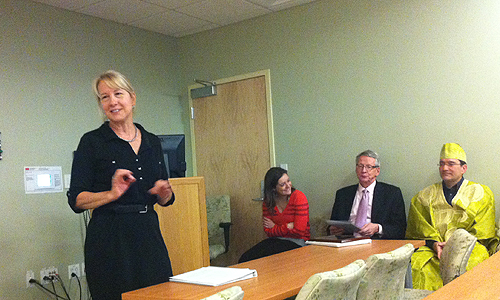
The Peace Corps has gone through myriad changes since its founding in 1961, adapting to issues of the times ranging from AIDS to education to new market economies.
But one thing hasn't changed, according to Peace Corps Acting Director Carrie Hessler-Radelet: "It is, without question, for most people, the best thing they ever did."
Hessler-Radelet came to the BU School of Public Health Nov. 16 not to recruit for the Peace Corps, but to recognize the 25th anniversary of the school's Master's International (MI) Program, which joins a Master of Public Health (MPH) degree with 27 months of field experience in the Peace Corps. BU's program was the second MI program established in the U.S., and the first in public health. Since then, dozens of MI students have been among the 1,326 BU alumni who have served in the Peace Corps.
"It has been a remarkable partnership," BUSPH Dean Robert Meenan said, crediting the late William Bicknell, founding chair of the school's Department of International Health, with establishing the MI program.
Hessler-Radelet, a BU alum, recounted her own experiences as a young woman serving in the Peace Corps in Samoa in the early 1980s, teaching English in an all-girls Catholic school. She was struck by the barriers to health care facing families, and also awed by the experience of being able to impact individual lives.
"That real, practical experience was invaluable," she told a crowd of students and returned Peace Corps volunteers. "It made a huge difference in my public health career."
She said the Peace Corps is now in the midst of the most significant reforms in its history, reorganizing its training programs, linking with international agencies, and consolidating its 211 project areas into 30 core areas, in hopes of focusing on interventions that have the highest community impact.
She praised the partnership with BU, which ranks 16th among large colleges in the number of Peace Corps volunteers, with 70 undergraduate alumni serving overseas. Hessler-Radelet presented Meenan with a plaque of appreciation commemorating the 25th anniversary of the MI program.
Among the alumni who served is Joseph Anzalone (SPH '92), senior manager of the international health department, who recounted his service in a hospital in Liberia from 1987 to 1990. Another alum, Nichole Starr, now a BU medical school student, recalled the "hard lessons" and rewards of her work in Ethiopia through the MI program.
"The Master's part of the Master's International Program gave me the technical knowledge," she said. "The most important lesson from the Peace Corps experience was, 'You need to shut up and listen'" to the community. She cited as an example helping a group of street kids to carry out their idea of opening a small shop -- which was still up and running two years later, when she returned.
Contributed by Lisa Chedekel
Dec. 11 Emergency Drill Planned for NEIDL
 On Dec. 11, BU will be conducting a discussion-based exercise at the National Emerging Infectious Diseases Laboratories (NEIDL). Researchers, facility staff, local health officials and first responders will be testing and reviewing the response to a variety of medical incident scenarios. This exercise is part of the NEIDL’s ongoing safety and training program. Participants of this exercise include NEIDL researchers and operations staff as well as representatives from Boston Emergency Medical Services, Fire and Police Departments and the Boston Public Health Commission. More information about the drill is available here. Contact Ellen Berlin, 617-520-7115, with questions.
Dec. 12 Dermatology Lecture featuring Dr. Zhi Liu
Zhi Liu, PhD, Professor of Dermatology, Microbiology and Immunology, Director of Dermatology Laboratories, University of North Carolina-Chapel Hill School of Medicine, will be speaking on BP180/type XVII Collagen in Skin Autoimmunity and Tumorigenesis. For the past sixteen years, Dr. Liu has focused his research on understanding the immunopathogenesis of bullous pemphigoid using animal models developed in his laboratory. His work in this area has lead to important new insights into the disease mechanisms at both cellular and molecular levels and has been published in several high impact journals, including Cell, Journal of Experimental Medicine, and Journal of Clinical Investigation. This event will take place on Dec. 12 at 5 p.m at 609 Albany St. (J Building) 2nd floor conference room. contact Jacy Bernal jlondon@bu.edu, 638-5517, with any questions.