Student Updates
BUSM CME Program Reviewed as Superior
BUSM’s Office of Continuing Medical Education (CME) has completed two accreditation reviews and one random audit as part of our external evaluation process with the following results:
- The Accrediting Council of Continuing Medical Education (ACCME) - “Accreditation with Commendation.”
- The American Nurses Credentialing Center (ANCC) - “Accreditation with Distinction, the highest recognition awarded by the American Nurses Credentialing Center’s Accreditation Program.”
- The American Academy of Family Physicians (AAFP) Routine Random Audit - “The procedures established for conducting CME activities at your institution are exemplary.”
"The accreditations by the ACCME and the ANCC with commendation and distinction place us in an elite group of CME providers," said Barry M. Manuel, MD, Associate Dean Continuing Medical Education, BUSM.
Nobel Laureate Jack W. Szostak Speaking on BUMC Dec. 18

Jack W. Szostak, PhD, Professor of Genetics at Harvard Medical School, Professor of Chemistry and Chemical Biology at Harvard University, Alexander Rich Distinguished Investigator at Massachusetts General Hospital, and Howard Hughes Investigator, who together with colleagues was awarded the 2009 Nobel Prize for Medicine for their discovery of how telomeres protect chromosomes, will be speaking on the Boston University Medical Campus on Tuesday, Dec. 18.
His lecture “The Origin of Life and the Emergence of Darwinian Evolution,” will begin at 1:15 p.m. in Keefer Auditorium. A reception will be held in the Wilkins Board Room at 2:30 p.m. All interested faculty, students and staff are invited to attend.
Dr. Szostak’s lab focuses on the chemical and physical processes that facilitated the transition from chemical evolution to biological evolution on the early earth. As a way of exploring these processes, his laboratory is trying to build a synthetic cellular system that undergoes Darwinian evolution.
The lab hopes that these explorations of the chemistry and physics behind the emergence of Darwinian evolution will lead to explanations for some of the universal properties of modern cells, as well as explanations of how modern cells arose from their simpler ancestors. As they explore these fundamental questions they are also on the lookout for chemical or physical phenomena that might have practical utility in biomedical research.
Dr. Szostak is being hosted by Professor James A. Hamilton, Physiology and Biophysics.
Department of Physiology and Biophysics Seminar
Nobel Laureate, Jack W. Szostak, PhD
- Tuesday, Dec. 18
- Lecture, 1:15 p.m., Keefer Auditorium
- Reception, 2:30-3:30 p.m., Wilkins Board Room
Dec. 6 Fall 2012 Thematic Seminar Series Lecture: The Cytoskeleton in Health and Disease

The Fall 2012 Thematic Seminar Series, which focuses on the Cytoskeleton in Health and Disease, concludes on Thursday, Dec. 6, at 3 p.m. with a presentation on Guarding the genome: centromeres, aneuploidy and tumorigenesis. This lecture is being given by Don W. Cleveland, PhD, Departmental Chair of Cellular & Molecular Medicine Professor of Medicine, Neurosciences and Cellular and Molecular Medicine Member, Ludwig Institute for Cancer Research, UCSD, LaJolla, Calif.
The Thematic Seminar Series is jointly sponsored by The Evans Center, the CTSI and the BUSM Department of Biochemistry. All interested staff, faculty and students are invited to the lecture. For additional information please contact Melissa Howard.
Guarding the genome: centromeres, aneuploidy and tumorigenesis
- Date: Thursday, Dec. 6
- Time: 3 p.m.
- Location: Keefer Auditorium, E111
Graduate students and postdocs are invited to a special lunch meeting at noon in K103, 72 East Concord St.
A 4 p.m. post-lecture reception will be held in the Wilkins Board Room, E120.
BU-Led Research Maps the Route to Dementia: Largest-ever study of chronic traumatic encephalopathy
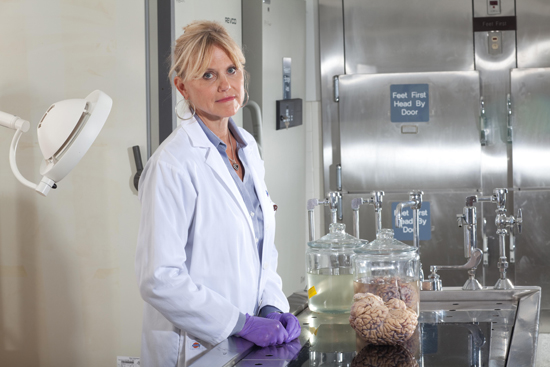
The youngest weren’t even old enough to drink legally—six high school football players who developed the degenerative brain disease chronic traumatic encephalopathy (CTE) before dying. Their brains were among 68 cases in a new, largest-of-its kind study that describes for the first time four progressive stages of CTE.
Published today in the journal Brain, the study “extends our knowledge concerning the spectrum of the clinical and pathological abnormalities associated with CTE,” says Ann McKee, a School of Medicine professor and a codirector of the Center for the Study of Traumatic Encephalopathy (CSTE). McKee led the study, which included 10 BU researchers and was done by the CSTE, the Veterans Affairs Boston Healthcare System, and the Sports Legacy Institute, a nonprofit founded in 2007 by former Harvard football player and professional wrestler Christopher Nowinski and Robert Cantu, a MED clinical professor of neurosurgery and a CSTE codirector. The institute partnered with MED in 2008 to form the CSTE.
CTE is associated with repeated brain trauma and has been found in professional athletes, military veterans, and even some people who injure themselves with repetitive head-banging, the researchers write.
The 68 brains came from men ages 17 to 98; 64 had been athletes (more than a third were also veterans), 3 were vets with no sports background, and one had repeatedly injured himself with head-banging. Almost half (33) of the men had played in the National Football League, one in the Canadian Football League, and 4 in the National Hockey League, and 7 had been professional boxers. Among the athletes whose identities the researchers were permitted to release were several NFL players who died last year: Hall of Fame tight end John Mackey, Hall of Fame running back Ollie Matson, and running back Cookie Gilchrist.
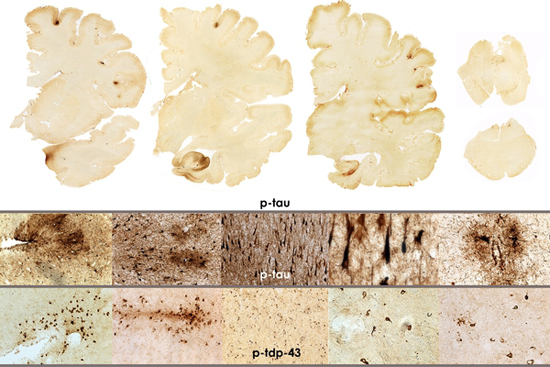
The researchers also interviewed survivors of the brain donors to learn about behaviors exhibited as the disease progressed. In stage I of the illness, CTE victims suffered headaches and had trouble concentrating and remaining attentive; stage II victims showed depression, explosive tempers, and short-term memory problems; in stage III, cognitive impairment and difficulty with planning, organization, handling multiple tasks, and judgment appeared. The researchers report that by the final stage IV, the patients suffered full dementia.
McKee says that despite the study’s advances, information vital to effective treatment of CTE remains elusive, including the disease’s prevalence, distinctions between CTE’s symptoms and those of similar conditions, the influence of genetics, “and whether other environmental exposures also play an additive role” in the illness.
In particular, the paper says, “Inclusion of more rigorous control subjects, such as individuals who experienced repetitive mild traumatic brain injury and did not develop behavioral or cognitive abnormalities, will be extremely useful in future studies.”
Cantu, a coauthor of the paper, says the researchers don’t know how much exposure to brain trauma might trigger CTE, though there’s no evidence that “occasional, isolated, or well-managed concussions” cause it.
The CSTE is a leader in researching the disease, and it maintains a bank of more than 135 donated brains, 80 percent of them showing signs of CTE. More than 600 athletes have pledged their brains to the bank for research after their deaths. The center has spurred the National Football League to make rule changes to better protect players from head trauma.
This BU Today story was written by Rich Barlow. He can be reached at barlowr@bu.edu.
Healthcare Providers Can Play Critical Role in Reducing and Preventing Intimate Partner Violence
In a perspective article appearing in the Nov. 29 issue of the New England Journal of Medicine, researchers from Boston University Schools of Medicine and Public Health (BUSM and BUSPH) report that health-care providers can play a critical role in helping to reduce and prevent intimate partner violence (IPV) by screening and referring patients to appropriate resources.
The U.S. Centers for Disease Control and Prevention recently released a comprehensive report on the prevalence of sexual violence, stalking and IPV in the U.S. The report relays the alarming findings that 35.6 percent of women in the U.S. are raped, assaulted or stalked by intimate partners at some point during their lives, and approximately six percent experience these events in a given year. Men are also at risk: 28.5 percent report lifetime victimization and five percent report past year victimization. The annual health care costs for women who are experiencing ongoing IPV are 42 percent higher than those for non-abused women, and it has been estimated that the cost of providing health care to adult survivors of IPV ranges from $2.3 billion to $7 billion in the first year after the assault.
Now that the Affordable Care Act requires insurance coverage to include domestic violence screening of women, physicians are taking a new look at how they respond to patients who are domestic violence survivors. There are several steps doctors should take when patients report potential IPV, including acknowledging the admission of abuse. “We advise thanking the patient for trusting the provider with the information, and expressing concern about the patient’s safety,” explained lead author Jane Liebschutz, MD, MPH, FACP, an associate professor of medicine and social and behavioral sciences at BUSM and BUSPH respectively.

Other steps include: asking the patient if he or she would like to be connected to IPV advocacy services; offering the patient the National Domestic Violence hotline number; considering whether child protective services are required and screening the patient for co-morbid depression, anxiety and substance abuse.
According to Liebschutz, when a patient screens negative for IPV, but providers nevertheless suspect that they are experiencing abuse, it is important that the provider not force disclosure. “It is not critical that the patient acknowledges IPV victimization in order to receive a benefit from the screening. Having asked IPV-related questions signals to the patient that the provider is caring and concerned, trustworthy and willing to discuss the topic during a future visit,” she added.

Finally, providers need not receive a positive screening response in order to provide universal education about IPV. “Even if a patient screens negative, providers are encouraged to state that many patients do experience IPV at some point, and that there are many resources to help people who feel unsafe in their relationships,” said co-author Emily Rothman, ScD., an associate professor of community health services at BUSPH.
Rape Aggression Defense (RAD) Course on BUMC, Register Today
The Boston University Police Department offers the “Rape Aggression Defense” program (RAD) specifically for women desiring to physically protect themselves against rape and other forms of violence. The course is taught by RAD-certified BUPD instructors over a 20-hour course.

The RAD system is a realistic self-defense program of defensive tactics, techniques and education. It is a comprehensive course for women that follows a progression from awareness, prevention, risk reduction and avoidance to basic self-defense participation. The course includes an easy to read and well-illustrated student manual. This manual outlines the entire physical self-defense program and can be referenced for continued personal growth.
RAD is being offered on the Medical Campus. Classes start Monday, Nov. 26, from 5-8 p.m. and will run on Mondays for five weeks. The fee is $10 per person. Classes will be held at 85 East Newton St. (Solomon Carter Fuller building in the gym). Registration is required. Sign up online or for more information visit http://www.bu.edu/police/services/RAD/ or call BUPD, 617-353-2110.
JAMA article advocates for federal leadership in combatting opioid overdoses
In the November 14 issue of the Journal of the American Medical Association (JAMA), medical clinicians and researchers advocate for new techniques to fight drug overdoses. Alexander Walley, MD, MSc, assistant professor at Boston University School of Medicine, co-authored the article with Leo Beletsky, JD, MPH, assistant professor at Northeastern University School of Law and Bouvé College of Health Sciences, who served as the paper’s lead author, and Josiah Rich, MD, MPH, professor at Brown Medical School.
The article specifically focuses on the national problem of fatal overdoses from opioid drugs, which include the street drug heroin and prescription drugs such as oxycodone. According to the article, opioid overdose kills 16,000 Americans annually and affects all sectors of society. The article calls for federal, state and local authorities to act in concordance to improve awareness about drug overdose and increase availability of the life saving drug, naloxone.
Naloxone is a critical medication that acts to quickly to reverse the effects opioid overdose. However, the authors describe several barriers impeding more effective use of naloxone. For example, although naloxone is generic, there is a critical supply shortage, making the drug expensive. Furthermore, many doctors are fearful of increased liability if they prescribe naloxone and worry about facilitating risky behavior.
In order to increase supply, the authors call for the federal government to streamline naloxone importation. They ask for the U.S. Food and Drug Administration to facilitate the clearance of easier to administer forms of the drug, such as a nasal spray or an “epi-pen” like auto injector instead of the current method, which utilizes unwieldy needles. They also call for clinicians to be educated about the benefits of naloxone for their patients. Additionally, the authors call on state and local authorities to increase awareness and offer patient education about drug overdose and naloxone therapy.
“Community-based overdose prevention programs that include overdose education and naloxone access could help avert unnecessary, preventable death,” said Walley, who also is a physician at Boston Medical Center.
-Written by David Mosbach, MD
Challenges Become Opportunities on GSDM Mexico Mission
 As you might imagine, coordinating an international externship is a feat when unexpected challenges happen. That was the case when Erik Engelbrektson, Patrick Moore, and Josephine Verde, all GSDM DMD 13, set out for San Blas, Mexico, Oct. 4-15, with LIGA International.
Mission supervisor Dr. Fred Kalinoff was forced to cancel his trip last minute for medical reasons, leaving GSDM students without a mentor and unable to practice dentistry. Thanks to quick thinking from Assistant Director of Extramural Programs Kathy Held and a lot of compassion from Ismael Montane DMD 10 AEGD 11, the group had a new preceptor—Montane—just days later. After receiving the phone call from Held, Dr. Montane jumped on a plane to Mexico.
Montane participated in a Project Stretch mission as a student in 2010 and returned as a co-supervisor with Frank Schiano CAS 01 DMD 06 AEGD 07 earlier in 2012. This time, Montane led his team in providing comprehensive care. In a letter to Montane following the trip, Held said: “The tasks you faced and your judgment calls were commendable.”
The team treated 60 patients a day totaling 240 patients. Montane estimates the team did in one week what a private practice in the U.S. would accomplish in several weeks.
“Each day on a mission trip is probably equivalent to a week in a clinic in the U.S.,” says Montane. “When you go back to school, it gives you a better frame of reference for how to approach each situation. You become a clinician.”
Engelbrektson agrees.
“You don’t have your hand held on an international externship,” he says. “Now, as we return to school, we have more knowledge and experience so we can make stronger decisions while still under faculty supervision in the patient treatment center.”
Engelbrektson reflects on how the residents affected him: “They were so gracious even if they had waited the whole day. Every time they’d leave and smile, that just gave me energy for the next patient.”
The team visited four area schools to offer screenings to about 400 children. They invited to the clinic those who needed fillings and extractions.
Verde reflects on the tough choices required of them: “It’s challenging because you know you’re fixing a problem by extracting a bad tooth, but you also know you’re potentially causing a problem down the road.”
Verde, Engelbrektson, and Moore all recall the mission as an incomparable learning experience. As for Montane, he enjoyed his new role as a team leader.
Said Dean Jeffrey W. Hutter, “On behalf of the entire Boston University Henry M. Goldman School of Dental Medicine community, I would like to express appreciation for Dr. Montane’s enthusiastic readiness to step in for mission supervisor Dr. Fred Kalinoff so that the students could treat these needy patients. Dr. Montane has demonstrated the core values of responsibility, excellence, and service that the Goldman School of Dental Medicine aims to instill in all of its students.”
Detecting Lung Cancer Sooner

For the last decade, Avrum Spira, MD, MSc, a BUSM professor of medicine, pathology, and bioinformatics and a pulmonologist at Boston Medical Center (BMC), has worked to develop molecular tests that detect lung cancer early. Now, with a $13.7 million grant from the Department of Defense, he is carrying the research forward as leader of a five-year study called Detecting Early Lung Cancer Among Military Personnel (DECAMP).
Dr. Spira is the Principal Investigator of the DECAMP project, which aims to develop and validate early detection molecular biomarkers for lung cancer. As the number one killer of all cancers in the United States and the rest of the world, lung cancer is a significant public health problem among military personnel and veterans due to high rates of smoking and exposure to carcinogens. The goal of this project is to identify the subset of people with exposure who at higher risk of developing lung cancer through less invasive means, ultimately, detecting lung cancer at an early and curable stage.
Watch the video of Dr. Spira describing his work.
Local Hero Deployed to Aid Victims, Search and Rescue Teams in Hurricane Sandy

Since the devastation of areas of New York and New Jersey caused by Hurricane Sandy, rescue teams from all over the country have been deployed to help. Ricky Kue, MD, associate professor of emergency medicine at Boston University School of Medicine (BUSM) and emergency medicine physician at Boston Medical Center (BMC) is one of those volunteers. As Medical Team Manager of Massachusetts Task Force 1 (MA-TF 1), a Federal Emergency Management Agency (FEMA) urban search and rescue team, Kue and 80 team members were mobilized for a week to assist with search and rescue operations in Queens and Staten Island.
Kue’s main responsibility was to tend to the healthcare needs of police, fire, Emergency Medical Services (EMS) and civilian volunteers. Kue and other medical personnel engaged in search operations, monitored team members for illness and injury and provided medical screening on a daily basis to help support the rescue missions.
“Our goal was for our team to be self-sufficient and not use local resources who were already dealing with disaster relief on a massive scale. Because of the risks associated with the rescues, we served as physicians and paramedics,” said Kue.
Upon arrival, the team searched collapsed buildings, trenches and aided people stranded in their homes due to the high water levels. Providing an extra hand, they ensured that residents who weren’t evacuated received the medical attention they needed.
In one particular situation Kue was stationed at his basecamp along the beach in Midland, an area in Staten Island that was hit the hardest. Medical assistance was needed for a woman with heart attack symptoms and EMS was not immediately available. Kue and another physician grabbed their medical equipment and ran to the woman’s home.
“I assessed her and fortunately she was not having a heart attack, but you could see that she was struggling. Despite the adversity this woman and the people of this community were faced with, the appreciation they showed was my most memorable experience during the mission,” said Kue.
Being deployed to this area hit home for Kue, who grew up in Queens, where his parents still live. Kue called his parents to see if they were okay as his convoy drove past their neighborhood. “I lived in NYC for 18 years and I’ve seen hurricanes growing up, but I never thought I’d see such devastation to my own borough. This was New York City’s Hurricane Katrina,” said Kue. Luckily, his family and childhood home were unharmed thanks to some emergency preparedness tips Kue has been offering his family for years.
Kue is also a Major in the U.S. Army Reserve and can be called for duty overseas at any time. “I couldn’t do this without support from my emergency medicine team at BMC and BUSM. They help cover my clinical duties so I can go out the door and deploy whenever necessary,” said Kue.
Massachusetts Task Force 1 (MA-TF 1) Urban Search and Rescue Team (US&R) is located in Beverly, Mass. Urban Search and Rescue teams are comprised of Police, Fire, EMS and Civilians and respond to major disasters under a contract with the Federal Emergency Management Agency (FEMA). Currently there are 150 people on the MA-TF 1 team.