Student Updates
New Campus Faculty Development Appointments Announced

Emelia J. Benjamin, MD, ScM, FACC, FAHA, professor of Medicine and Epidemiology at BUSM and BUSPH, and a clinical cardiologist at BMC, has been appointed BUMC Assistant Provost for Faculty Development and Robina M. Bhasin, EdM, also has been appointed BUMC Director of Faculty Development.
Benjamin is deeply engaged in the professional development of health care professionals and has a fundamental commitment to mentoring majority and underrepresented minority early-career, mid-career and established investigators in epidemiology, genetic epidemiology and academic medicine. She has co-developed and led faculty development efforts on the Medical Campus with her colleagues at GSDM, BUSPH and BUSM over the last five years, and also led an ACE/Sloan Foundation on Faculty Flexibility, which focused on mid-career faculty development.
Benjamin is co-PI of the Framingham Heart Study core contract, and PI or Multi-PI of ~10 RO1s since 1998, including a current MPI grant on the genetics of atrial fibrillation. She has published more than 400 original research articles and is listed on the Thomson Reuters List of Highly Cited Researchers (top 1%) in medicine.
She also is the recipient of multiple honors, including the American Heart Association’s (AHA) Paul Dudley White Award, AHA Women in Cardiology Mentoring Award, AHA Functional Genomics and Translational Biology Mentoring Awards, and Department of Medicine mentoring and inpatient teaching awards.

Robina M. Bhasin, EdM, our new director of Faculty Development, came to BUSM in 2013 as the director of Faculty Development and Diversity for the Department of Medicine. She has more than 12 years of experience in the creation, implementation and evaluation of domestic and international professional development programs for health practitioners and educators.
“Together they will continue to focus on improving the breadth of professional development and mentoring programs for our Medical Campus faculty,” said Karen Antman, MD, Provost, BU Medical Campus, and Dean, BUSM.
Linda Hyman to Serve One-Year Term as Director of NSF Division of Molecular & Cellular Biosciences

Beginning September 14, Linda Hyman, PhD, Associate Provost for Graduate Medical Sciences (GMS), will be ‘on loan’ to the National Science Foundation (NSF) to serve as Director of the Division of Molecular and Cellular Biosciences. The Division comprises the areas of molecular biophysics, cellular dynamics and functions, genetic mechanisms and systems, and synthetic biology. Her duties will include assessing the needs and trends in research and education related to the Division’s programs, strategic planning, and policy setting, while providing leadership to the senior Division staff.
Dr. Hyman’s position with the NSF is part of the Intergovernmental Personnel Act Mobility Program (IPA), which provides temporary assignment of personnel between the federal government and state and local agencies, colleges, universities and other organizations. It allows visiting staff to continue participating in their home organization’s activities at .20 percent time. While Dr. Hyman is at the NSF, Hee-Young Park, PhD, Assistant Dean for GMS, will assume day-to-day responsibilities for GMS.
Boston University’s PA students mark milestone

Filled with hope and motivation to help others, 33 new students entering the Physician’s Assistant (PA) Class of 2017 donned their white coats for the first time today as part of the program’s second annual “White Coat Ceremony.”
Surrounded by family and friends, the students – who hailed from all parts of the country – were welcomed into the profession by BU Medical Campus Provost and BUSM Dean Karen Antman, MD, Associate Provost for the Division of Graduate Medical Sciences Linda Hyman, PhD, and Associate Dean for Academic Affairs Doug Hughes, MD.
“The symbolism of the white coat very much embodies our responsibility to care, to learn, to teach, to discover and ultimately to create a healthcare system that fully cares for our population in a way that we would want to be cared for as individuals,” said David Coleman, MD Wade Professor and Chair of the Department of Medicine, and Physician-in-Chief at Boston Medical Center
PA Program Director Mary Warner, PA-C, introduced the keynote speaker, Captain Robin N. Hunter Buskey, DHSc, CDE, CCHP, PA-C, as her personal role model when she was a PA student.
With more than 30 years of clinical experience, Hunter Buskey is a Senior Physician Assistant with the US Public Health Service assigned to the Federal Correctional Complex in Butner, North Carolina.
“Look ahead with optimism and know that you have chosen a challenging profession of which you can be proud,” she said. “Leave your legacy of excellence, integrity, social justice and service.”
The White Coat Ceremony is part of a time-honored tradition that marks the students’ entry into the medical profession. While the PA students matriculated in April of this year, they participate in the ceremony after they have learned the history and physical exam and before they begin weekly practice in the clinical setting.
After donning their coats and reciting the Physician’s Assistant Professional Oath, the students listened to remarks from Brendan Flaherty, a patient who has received several years of care from a PA.
“Thank you for what you do,” said Flaherty. “You really help us. You really care, and you go to bat for us each day.”
10th Annual McCahan Day Draws 100+

More than 100 faculty, staff, residents and students attended John McCahan Medical Education Day at the BU Medical Campus. Hosted by the Department of Medical Sciences and Education, it was held on May 20. This was the 10th anniversary of the annual event that showcases academic innovation and teaching ideologies. The theme of the day was “Teaching Professional Competencies,” and it covered a variety of topics relating to how educators can improve and reevaluate teaching models.
The day-long event included five workshops and a poster session displaying nearly 50 abstracts. The keynote address “Changing Culture: Upending Our Notions of Professionalism,” was given by Jo Shapiro, MD, FACS, associate professor of Otolaryngology at Harvard Medical School. She shared her particular interest in professionalism and peer support programs.

Dr. McCahan attended and remarked on the history of this event and was honored for his outstanding commitment to medical education. In addition, past chairs of the planning committee, Drs. Sharon Levine (BUSM), Ann Zumwalt (BUSM) and Robert Schadt (SPH), were honored for their dedication to this event.
Please visit the McCahan Day website here to view Dr. Shapiro’s presentation.
Young Investigators Gather for Inaugural Genetic Epidemiology and Functional Genomics Workshop
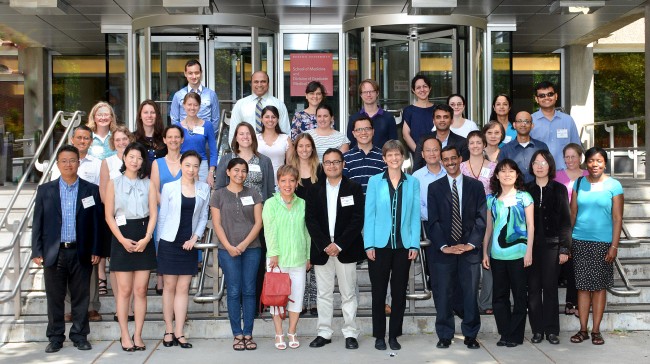
Thirty-five young investigators gathered on the BU Medical Campus for the inaugural Genetic Epidemiology and Functional Genomics Workshop held in July. The meeting was hosted by the Framingham Heart Study (FHS), the Center for Translational Epidemiology and Comparative Effectiveness Research and Section of Preventive Medicine and Epidemiology at BU School of Medicine (BUSM).
Hailing from nine states and five countries, attendees heard from faculty and staff from the Framingham Heart Study (FHS), BUSM, Harvard Medical School, University of Massachusetts Medical School and others who presented on how they have utilized FHS data to answer career-building questions as well as specific instruction on how to analyze and access the FHS data. The group also attended a series of working lunches led by BUSM’s Emelia J. Benjamin, MD, ScM, on professional development topics.
Program Director Vasan S. Ramachandran, MD, DM, FACC, FAHA, Professor of Medicine and Epidemiology, Chief of the Section of Preventive Medicine & Epidemiology, and Principal Investigator of the FHS, developed the program because of the burgeoning availability of data from cohort studies, including genomic data, and the urgency of training the next generation of translational scientists with a focus on early stage investigators. “We are excited that we were able to highlight cutting-edge talks on genomic research, career development and grant writing tips, and training to access and analyze Framingham Heart Study data,’” said Ramachandran.
“The meeting was organized as part of a broader series of initiatives to equip faculty and fellows to interrogate large human cohort studies to better understand human disease,” added David L. Coleman, MD, Wade Professor and Chairman of the Department of Medicine. “In so doing, we hope to expand the capacity of our research community to use the power of extraordinary biomic information in well-phenotyped cohort studies to answer clinically important questions.”
For any inquires or questions about the program, please contact Dr. Ramachandran.
Vietnam’s Ministry of Health Recognizes BUSM for Building Capacity in Hospital Nutrition
 Carine Lenders, MD, MS, ScD, Associate Professor of pediatrics at Boston University School of Medicine (BUSM) and Physician Nutrition Specialist at Boston Medical Center (BMC), and Elizabeth Henry, DrPH, MHS, who will graduate from BU’s School of Public Health (BUSPH) in September, have received the People’s Health Medal from the Social Republic of Vietnam’s Ministry of Health for their work on behalf of the Abbott Fund Institute of Nutrition Science (AFINS).
Lenders and Henry were recognized for advancing hospital nutrition in Vietnam using a three-prong approach based on education, clinical service and research. The commemorative medal is the highest honor awarded to nationals and foreigners who make a major contribution to health care in Vietnam.
Beginning in 2010, Lenders and Henry led AFINS, a unique effort that brings together Vietnamese and U.S. nutrition and global health experts among hospitals, academia, government and foundations.
The program is a partnership between BUSM, Bach Mai Hospital (BMH), Hanoi Medical University (HMU) and the National Institute of Nutrition (NIN) in Vietnam and the Abbott Fund to address hospital malnutrition and strengthen hospital nutrition knowledge, attitudes and practices.
These collaborative efforts would not have been possible without the vision and investment from the Abbott Fund, the foundation of the global health care company, Abbott, which awarded more than $4.4 million to implement this multifaceted project, oversee nutrition medicine fellowships for Vietnamese health professionals and provide mentoring.
Additional alliances were formed with experts in dietetics, pharmacy, nutrition medicine, education and global health from BU’s Sargent College of Health & Rehabilitation Sciences, Emory University, University of Texas and Boston Children’s Hospital in the United States and with Children’s Hospital 1 (CH1) in Ho Chi Minh City in Vietnam.
The AFINS experts provided technical support for the development of nutrition and dietetics degrees at HMU with more than 30 nurse-nutritionist and 50 bachelors in nutrition and dietetics graduates, six research projects with the NIN tracking hospital nutrition, and the training of more than 2,000 Vietnamese health care professionals to improve capacity in nutrition departments. Additionally, AFINS’ partners found that hospitalized patients surveyed in 2013 at BMH were 29 percent less likely to be malnourished compared to those surveyed in 2010.
“It is a tremendous honor to receive the People’s Health Medal from Vietnam’s Ministry of Health,” said Henry, also a former instructor in BUSM’s Department of Family Medicine. “The advances AFINS has made to improve outcomes and educate medical professionals about the importance of nutrition will have a lasting impact on the health care system in Vietnam.”
Lenders accepted the People’s Health Medal on behalf of the AFINS partners on May 27, 2015, in Hanoi. Lenders continues to lead the AFINS project in Vietnam with an extension grant from the Abbott Fund that builds on the initial approach but also focuses on pediatric nutrition training and research in the southern region of Vietnam and provides support for the development and implementation of standards and assessments of provincial hospitals nationwide.
“Higher education and more training are critical to enhance hospital nutrition in Vietnam,” said Lenders. “Moving forward we hope to learn more about the impact of medical nutrition interventions involving a younger patient population in a variety of inpatient and outpatient settings for a sustainable future.”
Dan Berlowitz Honored as VA Researcher

Dan R. Berlowitz, MD, MPH, has been selected as the recipient of the VA's 2015 Under Secretary's Award for Outstanding Achievement in Health Services Research,the highest honor for a VA health services researcher. It represents exceptional achievement in improving the health and quality of care of Veterans, inspiring and training the next generation of health services researchers, and enhancing the visibility and recognition of VA research nationally.
Berlowitz, professor of Medicine and Health Policy Management at BUSM and BUSPH, is a leading health services researcher and former Co-Director of HSR&D's Center for Healthcare Organization and Implementation Research, located in Bedford, Mass., and Boston. From 2004 to 2013, he served as Director of HSR&D's Center for Health Quality, Outcomes and Economic Research, and since 2012, he has served as Acting Chief of Staff for the Edith Nourse Rogers Memorial VA Hospital in Bedford. A former HSR&D Research Career Development Awardee (CDA), Dr. Berlowitz's research relies on strong methodological expertise in the areas of quality assessment, risk adjustment, and the use of large databases. His work focuses on assessing and improving the quality of healthcare for Veterans, with particular emphasis on ambulatory and long-term care settings.
He received his bachelor's degree from Johns Hopkins University, his medical degree from the Albert Einstein College of Medicine-Yeshiva University and his MPH from Boston University.
Could an Ebola Treatment Already Exist?
Research led by a NEIDL scientist finds hope in Zoloft, Vascor

Translational Research Highlighted During Annual GSDM Research Retreat

Translational research was the theme of the 2015 Boston University Henry M. Goldman School of Dental Medicine (GSDM) Research Retreat which took place on April 13th, 2015, in the Hiebert Lounge. Translational research applies findings from basic science to enhance human health. Along with team science, a translational science approach to research is increasingly important in the development of successful research programs which impact public health and well-being. Faculty from GSDM and the Boston University Medical Campus community presented a variety of topics relevant to translational research, and gave an overview of its successful implementation at Boston University.
The morning began with a poster viewing session followed by opening remarks given by Dean Jeffrey W. Hutter and Associate Dean for Research Dr. Maria Kukuruzinska. Dr. Kukuruzinska then introduced the first speaker Associate Provost for Translational Research and Director of the Boston University Clinical and Translational Science Institute Dr. David M. Center. Dr. Center’s talk, “Performance Enhancing Science,” was followed by four presentations given by GSDM faculty who are engaged in ongoing translational research:
- Professor, Director for the Center of Clinical Research (CCR), and Assistant Dean for Faculty Development Dr. Judith Jones gave a presentation titled “Center for Clinical Research,” which discussed the CCR and how clinical researchers can take advantage of its services.
- Professor and Chair in the Department of Orthodontics & Dentofacial Orthopedics Dr. Leslie Will gave a presentation titled “The Use of Salivary Biomarkers in Addressing Problems in Orthodontics.”
- Professor in the Department of Health Policy & Health Services Research and Director of Behavioral Science Research Dr. Belinda Borrelli presented “Translating Basic Science and Health Behavior Theory to Improve Public Health.”
- Professor and Chair in the Department of Pediatric Dentistry Athanasios Zavras presented “Pharmacogenetics of Head and Neck Adverse Effects.”
Associate Professor of Medicine, Pathology and Bioinformatics and Chief of the Division of Computational Biomedicine in the Department of Medicine at Boston University School of Medicine Dr. Avrum Spira gave the keynote address for the event. His talk titled, “Translating gene expression signatures into personalized approaches to disease management,” discussed how many clinical problems are best solved with a team science approach. Dr. Spira’s research group discovered a gene expression signature which is being used to develop less invasive clinical procedures for diagnosing lung cancer.
The retreat concluded with closing remarks followed by lunch. Assistant Professor of Epidemiology at Boston University School of Public Health Dr. Yvette Cozier won an award for Best Poster, as voted on by attendees. Her project was titled “Self-Reported Oral Health of Middle-Class Black Women in the United States.”
Dr. Maria Kukuruzinska said, “I am very pleased with the quality of the presentations at this year’s Retreat. I feel they truly highlighted the important translational work being conducted within our School and University.”
Photos are available on Facebook and Flickr.
Submitted by GSDM Communications.
Medical Campus Celebrates Promotions
MED, SPH profs move up the ranks

The Medical Campus recently promoted 11 professors whose research interests range from promoting the human papilloma virus (HPV) vaccine to preventing child abuse. Photo by Alex S. MacLean
Doctors can prescribe the treatment, but it’s up to their patients to follow their advice. A. Rani Elwy, a recently promoted School of Public Health associate professor of health policy and management, studies the reasons some patients seek medical help while others don’t. Elwy, who has won four SPH teaching awards and is an investigator with the Bedford VA Medical Center’s Center of Innovation, specializes in the study of patients’ perceptions of their health, doctor-patient communication, and how complementary and alternative therapies can be tailored to improve engagement and access to care.
“As a health psychologist, I felt that the patient role was not being investigated enough,” says Elwy. “Patients bring a whole host of cognitive, emotional, and cultural beliefs to the health care setting, and providers need to know these in order to facilitate appropriate care….Our job as researchers is to work collaboratively with patients and provider—learning from them, not imposing our views on them—which enables us to develop innovative methods to address these complex health care problems.”
Elwy’s work has been rewarded with a promotion to associate professor, making her one of 11 Medical Campus faculty members to be recently promoted (find Charles River Campus faculty members who have been recently promoted here).
“These promotions…mark an especially proud moment for the BU community, as we’ve had the pleasure of watching these talented women and men develop from promising junior faculty into scholars and teachers of national impact and recognition,” says Karen Antman, School of Medicine dean and provost of the Medical Campus. “We see great things ahead for them and are pleased they have chosen BU as the place to launch their independent careers.”
As well as A. Rani Elwy, promoted were:
Renee Boynton-Jarrett, School of Medicine associate professor of pediatrics
Boynton-Jarrett specializes in the study of social determinants, such as early life adversity, and their long-term impact on health outcomes for populations. A principal investigator on privately funded studies exploring child abuse prevention and early puberty and adolescent obesity, she codirects the Academies of Investigation and the Academic Development Block for the Boston Combined Residency Program in Pediatrics, which brings together the training programs of Boston Medical Center and Boston Children’s Hospital. She is a faculty mentor for the program’s Urban Health Advocacy Track for the Community Health Mentorships Group.
Christopher Connor, MED associate professor of anesthesiology
Connor, anesthesiology department director of research, specializes in inventing new technologies to improve patient safety and postoperative outcomes, such as critical care and pain management. Considered among the world’s top investigators in airway management and new technology studies, he holds the distinction of being the only scientist/innovator in his field to earn four out of the five national safety awards over the last five years. Connor has a joint appointment in the College of Engineering’s department of biomedical engineering, where he is an assistant professor.
Alik Farber, MED professor of surgery and radiology
A specialist in vascular disease, Farber is chief of the division of vascular and endovascular surgery at Boston Medical Center (BMC), where he directs the vascular surgery training program. He is a co–principal investigator on a $25 million National Institutes of Health award comparing outcomes of open vascular surgery and endovascular surgery in patients with critical limb ischemia (a severe blockage of the arteries in the legs or feet).
Devin Mann, MED associate professor of medicine
Mann is BMC’s associate chief medical information officer for innovation and population health and the physician lead on a project to standardize health information across 61 specialty clinics. He studies new ways to enhance health care delivery through novel technologies and the integration of multiple disciplines, including bioinformatics, behavioral medicine, and human-computer interactions. A presidential appointee to the Office of the National Coordinator for Health Information Technology’s health information technology policy committee, he has written more than 50 scholarly publications.
Paul Monach, MED associate professor of medicine
Monach researches and treats vasculitis, an inflammation of the blood vessels, with an emphasis on genetics and the development of biomarkers. He is the director of the Vasculitis Center, a regionally recognized resource for patient care and research, and of the BMC rheumatology fellowship program. He is an active member of several prominent vasculitis consortia and is co–principal investigator and site investigator on a major National Institute of Arthritis and Musculoskeletal and Skin Diseases study.
Rebecca Perkins, MED associate professor of obstetrics and gynecology
Perkins has dedicated her career to cervical cancer prevention and promoting the human papilloma virus (HPV) vaccine into clinical practice. A member of the Society of Gynecologic Investigation, she has worked to identify social and educational barriers to vaccination coming from parents and health providers and piloted interventions to increase vaccination rates and acceptance. She has published consistently in top journals and been awarded four grants as a principal investigator and two as a coinvestigator.
Frederick L. Ruberg, MED associate professor of medicine
Ruberg is the director of MED’s cardiovascular medicine fellowship training program and is an attending cardiologist and director of the advanced cardiac imaging program at BMC. He specializes in amyloid heart disease and the use of advanced imaging technology to assess cardiomyopathy (a disease of the heart muscle). He is principal investigator of an American Heart Association Scientist Development Grant and was recently site principal investigator for an NIH-funded study on the evaluation of chest pain.
Shannon Wiltsey Stirman, MED associate professor of psychiatry
Named a “rising star” by the Association for Psychological Science, Wiltsey-Stirman has been actively funded as a principal investigator since 2007, amassing more than 1,000 citations for her work, which includes a study on technology-enhanced psychotherapy for post-traumatic stress disorder (PTSD). Specializing in implementation science, she focuses on the integration of evidence-based interventions into practice settings, including VA and community health clinics.
Ann Zumwalt, MED associate professor of anatomy and neurobiology
Zumwalt is an expert on perceptual changes that occur as people grow from naïve learners to experts and in pedagogical approaches that bridge the gap between basic science and clinical education. A recognized leader within her program, she has been honored with MED’s Preclinical Educator of the Year Award. She has published extensively on science education, serves in leadership posts for numerous national organizations for anatomists, and is director of her department’s Vesalius Program, which applies principles of neurobiology to education.
Edward A. Ruiz-Narváez, SPH associate professor of epidemiology
Ruiz-Narváez studies how molecular, nutritional, and cardiovascular disease epidemiology intersects, and how it can identify genetic risk factors for a variety of diseases among African American women. A principal investigator or coinvestigator on five major grant awards, including two from the National Cancer Institute, he has earned widespread recognition for studies covering diseases that disproportionately affect black women, including breast cancer, obesity, and type 2 diabetes.
This BU Today story was written by