Student Updates
BU Awarded $23.4 Million NIH Grant
For turning discoveries into treatments, diagnostics, improved health

BU’s Clinical & Translational Science Institute (CTSI) has been awarded a $23.4 million, four-year National Institutes of Health (NIH) renewal grant to train and support scientists across both campuses in conducting cutting-edge clinical research and turning their discoveries into treatments, diagnostics, and improved public health.
CTSI is part of a national network of translational science institutes at some 60 medical research universities that have been established by the NIH’s Clinical and Translational Science Awards (CTSA). NIH created the program in 2006 to speed the translation of biomedical advances into better health care. All members of the CTSA network—among them Harvard, Tufts, and the University of Massachusetts—share research tools and innovations.
“By providing our researchers with resources, infrastructure, and funding, BU’s Clinical & Translational Science Institute supports innovation and discovery that may improve health, diagnosis, or treatment,” says Karen Antman, provost of the Medical Campus and dean of the School of Medicine. “We are delighted to be awarded this grant from the National Center for Advancing Translational Sciences at the NIH to support BU’s outstanding investigators and increase cross-fertilization between bedside and bench.”
While CTSI is based on the Medical Campus, its resources, including pilot grants funded by the award, are available to investigators across the University. “One of the great advantages we have at BU is exceptionally strong faculty in the life sciences and biomedical engineering who have the potential to collaborate with both clinical and basic science faculty in the medical school,” says Gloria Waters, BU vice president and associate provost for research. “BU CTSI, along with other initiatives we are embarking upon, provides much needed resources and infrastructure to help our faculty make connections across our two campuses. The collaborations and the infrastructure that are developed as a result of this grant will have a very real impact on our ability to facilitate translation of biomedical advances into improved care for patients.”
Under the leadership of CTSI director David Center (MED’72), associate provost for translational research, BU has received two NIH clinical translational research awards since 2008. “These were meant to be, and still are, grants that build the infrastructure of the University to help scientists do science better—and do better science,” says Center, the Gordon and Ruth Snider Professor of Pulmonary Medicine at MED and chief of pulmonary, allergy, sleep, and critical care medicine at Boston Medical Center (BMC). Center says the awards have been the foundation for a number of BU investigators—especially those in the early stages of their careers—to successfully apply for other types of federal funding.
The renewal awards also enable CTSI to provide research support for core facilities for clinical trials, biomedical informatics, pilot funding, help in navigating the regulatory system, and biostatistics, epidemiology, and research design. Center says the awards can help CTSI connect researchers with BMC patients, a large percentage of whom are underserved minorities at risk of multiple chronic diseases. The NIH considers these patients, and their health, integral to the mission of translational research.
“Translation can occur on multiple levels, not just from the bench to the bedside, but from the bedside to patients, from patients to the community—and it all flows back and forth,” says CTSI associate director David Felson (SPH’84), a MED professor of medicine and epidemiology, and section chief of the BMC clinical epidemiology research and training unit. “It also occurs from knowing something works that’s been tested in trials and actually getting it into the community where it’s given to people.”
Additionally, the award will help advance regenerative medicine at BU. Under the supervision of Darrell Kotton, a founding director of the University’s Center for Regenerative Medicine (CReM), the award will provide for six predoctoral students and four postdocs to receive advanced training in any University laboratory—it could be pediatrics, orthopedic surgery, hematology, or any number of other medical fields, Center says—that is engaged in stem cell research and regenerative medicine.
“This training program will prepare the next generation of scientists and physician-scientists to work with stem cells to advance this new technology toward clinical application,” says Kotton, a MED professor of medicine and pathology and a BMC attending physician in pulmonary and critical care medicine.
Most important, says Kotton, whose lab studies cystic fibrosis, emphysema, and other pulmonary diseases, the award “will help support open-source sharing of Boston University’s expansive bank of pluripotent stem cell lines generated from patients who have the diseases that we and other BU CTSI partners across the country study.
“We hope this stem cell bank and our capacity to make new stem cell lines for national sharing will provide the tools to better understand and treat these diseases in the years ahead,” he adds. “In this way, the award stands to benefit many universities across the country that participate in our shared mission of improving human health.”
A key part of the CTSI mission is fostering collaboration across many disciplines and across both campuses, says Center, “whether those collaborations are spurred by money in the form of pilot awards or new grants or by an individual who identifies someone in any other department doing work that might be applicable to their own.”
“We’re free to give our money as an investment to anyone across the University,” Center says. “BU CTSI’s idea is for creating unencumbered money that would be multidisciplinary and cross schools and departments. It doesn’t mean money is given without review or without strings attached. But with us, if you’ve got a good translation idea—fine. We support junior and senior investigators.”
Collaboration is one of the cornerstones of the CTSI training program, which educates young physician-scientists and other junior faculty across the University in cutting-edge, multidisciplinary translational research methods. Researchers today should be “conversant and capable in thinking about a broad range of methodologies and to be able to communicate and interact in an interdisciplinary fashion,” says Felson.
One way CTSI training encourages this sort of creativity is by holding seminars where physician-scientists and other investigators from a broad range of disciplines—cardiologists, pulmonary physicians, epidemiologists, biomedical engineers, and others—share their research findings. “They’ll be sitting in their own research world—in their own little silo—and they listen to someone doing something vastly different from them,” Felson says. “They realize, this isn’t my question that I’m pursuing, but their approach has great relevance to me.
“The future is multidisciplinary—familiarity with a lot of different research methods and an open mind about how to bring in and work with collaborators,” he says.
CTSI training also focuses on the more practical aspects of succeeding as a researcher: how to write a paper, how to write a grant, how to connect with and communicate with your mentor.
For CTSI, a major part of the NIH award will be targeted at more quickly and efficiently launching and conducting clinical trials. “We are charged to grease the wheels of a very slow and cumbersome national clinical trials network,” Center says. “We aim to shorten the Institutional Review Board [IRB] process and to assist in the efficient enrollment and retention of subjects in trials and in all the steps along the way, from identification of the need for the trial to data analysis.” As part of this, CTSI supports researchers by providing free consultation services on clinical research study design; facilities, skilled nursing, and help in enrolling subjects for clinical trials; biostatistics and bioinformatics; and hands-on assistance in navigating the obstacles that come with the often cumbersome but necessary regulatory system that oversees clinical trials.
“The overall goal is to provide resources for sharing research discoveries and tools to train researchers to translate their basic discoveries into treatments and diagnostics,” Center says. “We are in constant search of ways to expedite processes involved in clinical trials. We don’t want scientists to have to do everything themselves or reinvent the translational research wheels over and over.”
Part of complying with the necessary regulations, which are intended to protect human subjects as well as investigators, means obtaining IRB approval to run clinical trials. “BU’s process is similar to other universities, but the levels of expertise in running clinical trials and navigating the regulatory systems of our clinical researchers vary widely,” Center says. “The BU CTSI aims to help inexperienced researchers get through that process as efficiently as possible.
“We give advice to researchers so they don’t make mistakes when they write the protocol,” he says. “We help them with the consent form. We make sure it’s translated into Spanish if that’s appropriate and they’re enrolling people who don’t speak English. We give them advice on how to respond to the IRB’s concerns. But we don’t manage or influence the IRB. It is an independent body, and it should be.
“What we aim to do,” Center says, “is to simplify the complexities of translational research—that is, research involving human beings—make it more efficient, and make the science better.”
This BU Today story was written by Sara Rimer.
BUMC Influenza (Flu) Vaccine Clinics Oct. 13, 15
The Occupational Health Center will be offering influenza vaccine at no cost to BUMC employees. We encourage you to get the vaccine during one of the scheduled clinics to not only protect yourself, but also your colleagues and your family. For information regarding the 2015-2016 flu vaccine please refer to the Occupational Health Center's website at http://www.bu.edu/buohc/flu/. If you have any questions regarding the vaccine or clinic schedule, please email buohc@bu.edu.
Please walk-in during the dates and times listed below that correspond with the first initial of your last name. If you are unable to come on your designated date, you may walk-in during one of the other scheduled clinics. Please note there will be clinics held on both the Charles River and Medical campuses.
Medical Campus
Location: Medical Campus Human Resources, 801 Massachusetts Ave, Suite 400
First Initial of Last Name: A – M
Tuesday, Oct. 13
10:30 a.m.-2:30 p.m.
First Initial of Last Name: N – Z
Thursday, Oct. 15
10:30 a.m.-2:30 p.m.
Please note:
- Wear a short sleeve shirt to enable easier access to your upper arm.
- Please bring your BU ID card.
- Additional clinics will be held as needed.
- MA DPH recommends that all health-care providers receive the influenza vaccine unless contraindicated.
Contraindications:
- Severe allergy to eggs
- History of severe reaction to influenza vaccination
- Moderate-to-severe illness
- History of Guillain-Barre syndrome
GSDM Students and Faculty Volunteer at Local Book Fair
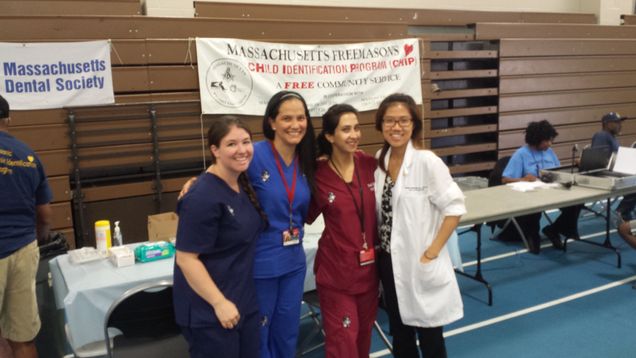
Five members of the Boston University Henry M. Goldman School of Dental Medicine (GSDM) community—three 4-year DMD students, one two-year Advanced Standing DMD student, and a faculty member—volunteered at the 29th Annual Charles C. Yancey Book Fair on July 25 at the Reggie Lewis Track and Athletic Center on Tremont Street.
The Book Fair, which offered free books and entertainment for children, took place from noon- 2 p.m. It is named after Boston City Councilor Charles C. Yancey, who is the longest serving member of the Boston City Council, having been first elected in 1983.
Councilor Yancey and his wife, Marzetta, founded the Charles C. Yancey Book Fair in 1987 and have since distributed more than 450,000 books to more than 18,000 children in the city of Boston.
While the volunteers from GSDM did not distribute books, they did serve a valuable role at the book fair. The GSDM volunteers assisted the Masonic Youth Child Identification Program (MYCHIP) in obtaining “tooth prints” from children. The MYCHIP program seeks to provide tools for law enforcement to more efficiently locate missing children.
The GSDM volunteers also set up a general dental resource table in an effort to promote positive oral health practices to the families attending the fair.
“Our students and faculty have a strong track record of lending a helping hand to the surrounding community,” said Dean Jeffrey W. Hutter. “I am very proud of the GSDM community members who volunteered to assist with the MYCHIP program at the Charles C. Yancey Book Fair.”
The GSDM volunteers were: Assal Abdossalehi DMD 16; Ana Keohane AS 16; Megan Sullivan DMD 18; Vanessa Thai DMD 16; and Clinical Instructor in the Department ofHealth Policy & Health Services Research Dr. Mohammad Mourad.
Submitted by GSDM Communications
The Power of Scholarships
Gratitude, excitement and anticipation – these three words describe the 2015 BUSM Scholarship Dinner on Thursday, Sept. 24.
In a candle-lit room at the Hotel Commonwealth in Boston, 18 medical students gathered together to meet – for the first time – their scholarship donors.

“Today is really important,” said Nick Smith, BUSM Class of 2016. “Getting to meet the face behind who’s doing this for me - it’s really special.”
To his surprise, Smith’s donor was Aram Chobanian, MD, President Emeritus, Boston University and Dean Emeritus of the School of Medicine.
“It’s terrific,” said Smith. “The weight that I’ll have in terms of debt going forward is that much less. Every little bit counts.”
Thanks to scholarships established by generous donors, every year students who otherwise could not afford a BUSM education can pursue their dream of becoming a physician.
According to Emir Morais, co-interim director of BUSM’s Student Financial Services, the cost of medical education presents a high barrier for many applicants – and a significant burden for many graduates. In fact, the Association of American Medical Colleges reports that 79 percent of medical students have debt of $100,000 or more after medical school.
“Scholarships help relieve some of the financial burden put on these students during and after their medical education,” said Morais. “These funds support their education and their intellectual, professional and personal development. It gives them the opportunity to attend a medical school that fits their passions and a chance to choose a field they care about.”
Over dinner and dessert, the students and donors were greeted by Dean Karen Antman, MD, who introduced Karanda Bowman, Class of 2016, and Adam Johnson, Class of 2017. Both students spoke about how their scholarships were a critical component in attending medical school.
“You haven’t just given me a gift,” said Johnson. “You’ve given my family a little more hope that everything really will be alright.”
As the students parted ways with their donors, handshakes and hugs were exchanged. Pleasantries and advice about medical school filled the room. But as this writer will attest, two common, contagious sentiments elevated this event – honor and gratefulness.
“We have to give kids the opportunity to be able to go to medical school without worrying about huge debts,” said Elaine Kirshenbaum, a BU donor since 1983. “It’s an honor to be able to support them.”
View the Facebook album.
New GSDM Students Gather for 2015 Professional Ceremony
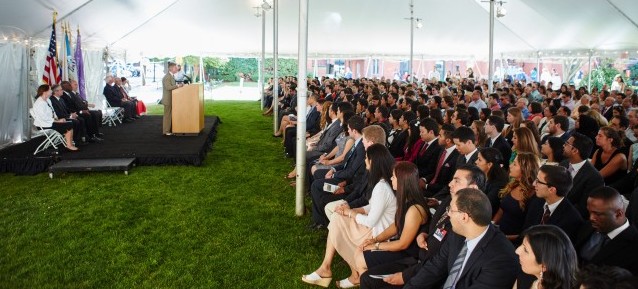
Four-year DMD 19 and two-year AS DMD 17 students from Boston University Henry M. Goldman School of Dental Medicine (GSDM) marked the end of their first week of orientation on Friday, July 31, at one of the most significant events in the educational careers of our dental students, the annual Professional Ceremony.
The students marched into the ceremony grounds, the Talbot Green, and took their seats under a large white tent. Hundreds of friends and family members looked on and cheered as the DMD 19 and AS 17 students participated in the 2015 Professional Ceremony.
Assistant Dean of Students Dr. Joseph Calabrese welcomed the crowd under the packed tent.
Dean Jeffrey W. Hutter as well as Boston University Medical Campus Provost and Boston University School of Medicine Dean Dr. Karen Antman delivered the opening remarks, while student anxiously anticipated receiving their BU pins.
The Keynote Address was delivered by Professor in General Dentistry Dr. Carl McManama. Dr. McManama began his now 39 year dental career at GSDM as a Clinical Instructor in the Department of Operative Dentistry in 1976. He was later promoted to Clinical Assistant Professor, Associate Professor, and Professor. He Chaired the Department of Operative Dentistry from 1986 to 1995.
After Dr. McManama’s speech, Assistant Dean for Admissions and Associate Professor in Health Policy & Health Services Research Catherine Sarkis took to the podium to present the DMD Class of 2019 and AS Class of 2017 to Dean Hutter.
Five faculty members then stood on the stage to present the pins to the DMD 19 and AS 17 students. The faculty members were: Dr. Calabrese; Dr. Sarkis; Associate Professor in the Department of General Dentistry Dr. Stephen Dulong; Professor in the Department of Periodontology, Associate Dean for Academic Affairs, and Professor in the Department of Molecular & Cell Biology Dr. Cataldo Leone; and Clinical Professor in the Department of General Dentistry and Faculty Liaison for the Advanced Standing Program Dr. Janet Peters.
Each DMD 19 and AS 17 student shook hands with Dean Hutter and Provost Antman before exiting the stage. When each new student had received their pin, the Professional Oath was read.
One paragraph of the Professional Oath reads: “I will conduct myself with the highest ethical and professional behavior in the classroom, the clinic, and in all areas of my life. I will promote the integrity of the profession with honest and respectful relations with other health professionals. I will strive to advance my profession by seeking new knowledge and by reexamining the ideas and practices of the past.”
After Dean Hutter delivered his closing remarks, the students and attendees stayed for a reception under the tent for a reception on the Talbot Green.
“The Professional Ceremony is one of the most important moments in these students’ dental educations here at GSDM,” said Dean Hutter. “I know that each of the students who received pins today will go on to make me, and everyone else at GSDM, very proud over the next four years.”
Photos from the Professional Ceremony can be found on Facebook and Flickr.
Submitted by GSDM Communications.
Mental Health Clinic for Students Opens on Medical Campus
Twice-a-week Behavioral Medicine services

A new Medical Campus mental health clinic, housed at the Soloman Carter Fuller Building, opened earlier this month and will be staffed on Mondays and Wednesdays by SHS Behavioral Health clinicians. Photo by Jackie Ricciardi
Some years ago, a School of Public Health survey reported that half of Medical Campus students had sought mental health care of some sort. That doesn’t surprise Kate Goodmon Nudel.
“Graduate students are under immense pressure and stress in school,” says Nudel (MED’16), “but also as adults. Many of us are married or have children or are planning to do that soon, while we are in school.” But until now, Medical Campus students needing to see Student Health Services Behavioral Medicine staff had to make their way to the Charles River Campus (CRC). Last week, Behavioral Medicine opened a satellite clinic on the Medical Campus exclusively for students, to run twice a week: Mondays, from 9 a.m. to 6 p.m., and Wednesdays, from 9 to 5. Two clinicians will staff the two offices and waiting room.
The clinic is on the eighth floor of the Solomon Carter Fuller Mental Health Center at 85 East Newton St., which is named for BU grad Fuller (MED 1897), the first black psychiatrist in the United States, who taught at BU and retired as a professor emeritus. The state-owned site was chosen with special care. While close to all the Medical Campus schools, it provides privacy from other BU student and clinical services, so “students won’t have to worry about bumping into a staff or faculty member from their program,” says Carrie Landa, director of Behavioral Medicine.
Besides SPH, the Medical Campus houses the School of Medicine and the Henry M. Goldman School of Dental Medicine. Students there who have wanted to use the CRC Behavioral Medicine services couldn’t always manage it “because of long days and nights in the hospital and the additional time getting back and forth to the CRC,” says Karen Antman, dean of MED and provost of the Medical Campus.
“This is an effort we have been pushing for many years, and we are delighted to see it come to fruition,” adds Linda Hyman, associate provost for MED’s Division of Graduate Medical Sciences.
Landa says that the clinic will provide “evaluation and brief treatment for students,” similar to what their counterparts receive on the CRC. “When longer-term treatment is indicated, we work with the student to provide a referral to a provider in the community, based on their insurance.”
“I am thrilled that all of our hard work has been recognized and our voices heard,” says Nudel. She was on the board of the Graduate and Professional Leadership Council, a student liaison group with the University’s administration, which formed a committee in spring 2014 to advocate for the clinic. The committee initially wanted a general health clinic; when that proved too ambitious, the members surveyed Medical Campus students for their priorities.
With more than 400 respondents, “we found students wanted a behavioral health clinic” most, says Nudel. Angela Jackson, MED associate dean of student affairs, says the interest at her school arises from “the stress and demands of medical school—long hours, heavy study schedule, high-stakes exams, not to mention seeing tragedy, death, and suffering on a daily basis.”
Jackson adds that “having access to care on site will make an enormous difference to the students and provide another accessible option for mental health care.…I suspect the interest will be huge, and very quickly we will need to expand the clinic’s hours.”
Indeed, Nudel says, the student group’s health survey found that 65 percent of respondents said they’d avail themselves of on-campus mental health services, leading her to predict that the new clinic “will be pretty busy.”
This BU Today story was written by Rich Barlow
Peregrine Falcons Find a Home at the Medical Campus
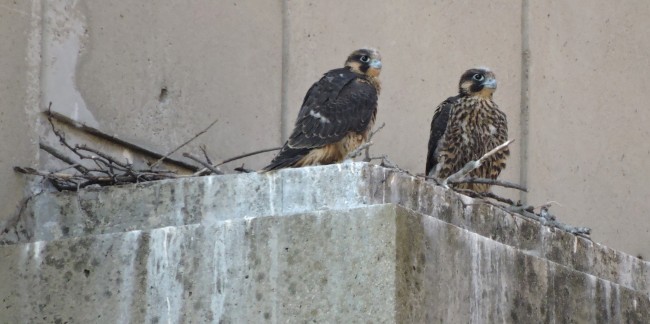
High above Talbot Green a pair of watchful eyes scopes the concrete canyon below looking for its next prey. This isn’t a scene from Mission Impossible. It’s more like a National Geographic documentary.
Perched on a window ledge atop the Solomon Carter Fuller Mental Health Building, two peregrine falcons have decided to make the BU Medical Campus their home.
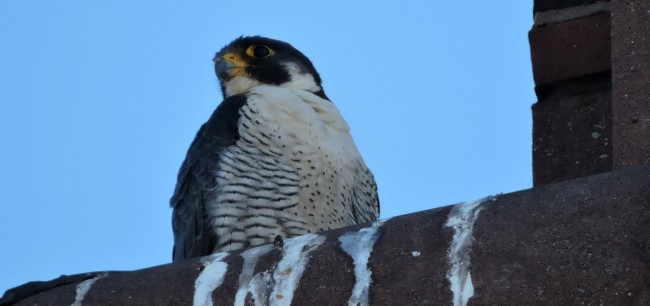
“It’s simply fascinating that such beautiful wildlife can exist in this urban area,” said Anita DeStefano, PhD, professor of Biostatistics and associate director of the BUMC Genome Science Institute.
DeStefano noticed the male and female falcons in late spring and began taking pictures of the birds from the rooftop of the medical campus parking garage. In early summer, she observed two falcon chicks in addition to the adults. After reading a recent article on BU Today about another pair of falcons on the Charles River campus, DeStefano contacted Ursula and Dave Goodine, certified volunteer observers for Massachusetts Division of Fisheries and Wildlife.
That evening, DeStefano met with the Goodines to point out the nest site and to observe the adults with one of their fledglings.
According to Ursula Goodine, peregrine falcons are the fastest flying birds in the world – reaching speeds of 200 miles per hour during a dive. They feed on pigeons and other small birds.
In 1964 nesting pairs of Peregrines were extinct in the eastern United States, but over time, conservation success was responsible for changing them from "endangered" to "protected" status. There are now more than 30 nesting pairs in Massachusetts.
Contrary to popular belief, peregrine falcons do not build a nest. They lay their eggs on cliffs.
“As the falcon population increased, some birds looked for other territories and began using tall buildings instead of the natural landscape of cliffs and quarry ledges to raise their young,” said Goodine. “This just reveals how adaptable peregrines have become in order to perpetuate their species.”
In an effort to help facilitate a safer environment for the birds, experts from the MassWildlife Natural Heritage and Endangered Species program have set up simple wooden “nest-boxes” lined with gravel in several locations throughout the city.
The Goodines now are working on a plan to have one installed on the BU Medical Campus this fall to give the birds time to acclimate to its presence. They hope the pair of falcons will use it next spring.
“Reintroduction programs have helped Peregrines make an amazing recovery,” said Goodine. “While city living poses all kinds of dangers to these birds, they are resilient and their population has rebounded quite well.”
Grant Preparation Workshops Begin Sept. 17
BU Medical Campus Investigators, graduate students and faculty members are invited to a grant preparation workshop on Thursday, Sept. 17 to learn more about the process of submitting individual research grants (R01) to the National Institutes of Health (NIH). This workshop, which will be held on the BU Medical Campus, will include presentation by Sarah Yeboah of the Office of Sponsored Programs and Renna Lilly of the Office of Proposal Development and will cover the necessary steps to submit a NIH proposal through Boston University’s Office of Sponsored Programs. Dr. Carter Cornwall will discuss the NIH study section review and a general structure to follow when writing your grant.
Grant Preparation Workshop – Administrative Presentation
- Thursday, Sept. 17
- 2-4 p.m.
- BUSM Housman Building, R-115
The second part of this series includes a small group session, where investigators will present drafts of their actual grant applications for feedback from peers and faculty who have successfully been awarded grants and served on NIH study sections. This session will be especially helpful to those who plan to submit NIH grants for the February/March submission cycle.
Grant Preparation Workshop -Grant Critiques
- Wednesday and Thursday, Dec. 9 and 10
- Location and time to be determined
Interested investigators, graduate students and faculty members are invited to attend the Sept. 17 session. For a more thorough critique of your grant in December, you must attend this first session. You are not obligated to participate in the critique if you attend the administrative portion.
If you have any questions, please contact Renna Lilly, Office of Proposal Development, at rolilly@bu.edu.
BU Clinical and Translational Science Institute Renewed
Boston University's Clinical and Translational Science Institute, directed by David Center, MD has received a four-year, $23,487,980 renewal from the National Institutes of Health.
David Felson, MD leads the section to train the next generation of translational scientists and George O'Connor, MD directs the clinical resources, which will facilitate the testing and translation of discoveries between bedside and bench for Boston University researchers.
The BU CTSI is part of the National Center for Advancing Translational Science Network of 60 University-based translational hubs.
Student Behavioral Health Services Available on Medical Campus
Beginning Wednesday, Sept. 2, behavioral medicine services for students will be available on the Medical Campus. All full-time students are eligible for care, regardless of health insurance. Part-time students who have the Aetna Student Health insurance also are eligible.
The clinic will be located in the Solomon Carter Fuller Mental Health Building, 85 E. Newton St., Suite 816. Initially, it will be staffed two days per week – Mondays from 9 a.m.-6 p.m. and Wednesdays 9 a.m.-5 p.m. – by clinicians not affiliated with the Medical Campus. Hours will increase with demand. The location was chosen specifically to be mindful of maintaining student privacy and confidentiality.
The following services will be available:
- Evaluation
- Consultation
- Short-term treatment (both medication management and psychotherapy)
- 24-hour coverage for psychiatric emergencies
When longer-term treatment is indicated, students will be referred to a provider in the community. Student Health Services is committed to maintaining the confidentiality of all patient health information in accordance with all applicable federal and state laws. To make an appointment, please call 617-353-3569 and request an appointment at the BUMC clinic.