Student Updates
CGHD’s Simon Presents Malaria Report to Congress – Research team finds PMI program “very successful”
The CGHD’s Jonathon Simon, who with a team of researchers collaborated on a top-level evaluation of the President’s Malaria Initiative, will give a presentation today on Capitol Hill on the findings, hosted by two Congressional caucuses.

In Rwanda, a network of 60,000 community health workers trained in managing malaria has been credited with helping to reduce mortality among children by 50 percent since 2005.
In Kenya, where 4.5 million insecticide-treated bed nets have been distributed, the percentage of pregnant women and children under five protected by nets climbed from 6 percent in 2003 to more than 45 percent by 2009.
These are just a few of the programs undertaken through the President’s Malaria Initiative (PMI), launched in 2005, which aims to reduce malaria-related deaths by 50 percent in 15 African countries that have a high incidence of the disease.
Today, Jonathon Simon, director of the BU Center for Global Health & Development (CGHD), will give a presentation on Capitol Hill on the findings of a top-level evaluation of the PMI done by him and a team of researchers, hosted by two Congressional caucuses, the Caucus on Malaria and Neglected Tropical Diseases and the Global Health Caucus. The findings deem the program “very successful,” while cautioning that sustaining those successes will require changes in approach to overcome increasing resistance to insecticides and to artesunate-based drugs.
Ongoing success, the team concludes in its report, will be expensive and require continued commitments from international donors and participating countries.
“The history of malaria control has been one of temporary success followed by failure,” according to the team led by Simon, a School of Public Health professor and chair of the department of international health. “PMI has helped create a success in this latest attempt at malaria control; figuring out a strategy for sustaining these advances and adapting to biologic, political, and financial challenges is essential for keeping history from repeating itself.”
The review of the first five years of the PMI was done by a team of researchers from the CGHD, former World Health Organization scientists, and other university faculty, who spent seven months conducting country site visits and extensive interviews with malaria program personnel.
The goal of the malaria initiative is to reduce malaria-related deaths through proven interventions, including insecticide-treated nets, indoor residual spraying (IRS), intermittent preventive treatment for pregnant women, and artemisinin-based combination therapies. The initiative was begun under the administration of President George W. Bush and has been extended through 2013. In 2009, President Obama launched the Global Health Initiative http://www.ghi.gov/ as the next chapter of American leadership and incorporated the PMI as one of its core components.
In each of the targeted countries, PMI collaborates with host governments and other partners, such as the Global Fund to Fight AIDS, Tuberculosis and Malaria , the Roll Back Malaria Partnership , the World Bank Malaria Booster Program, and nongovernmental and private organizations.
The evaluation found that PMI is “by and large, a very successful, well-led component of the USG [U.S. Government] Global Health Initiative…PMI has made substantial progress toward meeting its goal of reducing under-5 child mortality in most of the 15 focus countries.
“Though major biologic, political, and financial challenges exist that could seriously erode the accomplishments made to date,” the report goes on, “PMI, through its first five years of activities, has earned and deserves the task of sustaining and expanding the U.S. Government’s response to global malaria control efforts, and should be given the responsibility to steward additional USG financial and human resources to accomplish this task.”
In addition to recommending additional resources, the report says that to improve the program’s efficiency and effectiveness, there is a high-priority need to clarify interagency leadership roles. Simon’s team also recommends that PMI leaders reevaluate some of the existing malaria interventions, such as the use of indoor residual spraying.
“Amidst increasing insecticide resistance, tough financial pressure, and limited data on the additive benefits of combining IRS operations with universal coverage of (insecticide nets), PMI should reevaluate its IRS strategy,” the report says. “It is a relatively expensive approach and covers a small proportion of the at-risk population.”
The report notes that the program has developed strong partnerships with almost all of the national malaria control programs in the 15 African countries, and that its leadership is “well appreciated by most of the partners.” The initiative is led by the U.S. Agency for International Development (USAID) and implemented with the Centers for Disease Control . It is overseen by a U.S. global malaria coordinator and an interagency steering group made up of representatives from USAID, CDC, the Department of State, the Department of Defense, the National Security Council, and the Office of Management and Budget.
The report recommends that the PMI move carefully to increase individual countries’ control over the program; the evaluation team found “high levels of variability” in the willingness and capability of countries to assume leadership responsibilities.
“In some PMI-supported countries, the human capital base and management control systems are insufficient to transfer many PMI responsibilities” to people on the ground, the report says. “In other countries, where the human resources are adequate and management control systems meet foreign assistance standards, the transfer of responsibilities should be accelerated.”
The report notes that the political and economic climate around malaria control is changing rapidly, as the strong global commitment to the cause is being balanced by cost considerations, now that “the period of rapid growth in the global resource base for global health is likely over.
“There is a profound imperative…to maximize cost-effective program interventions as financial resources flatten or decline,” the report says.
Besides Simon, CGHD researchers on the report include Kojo Yeboah-Antwi, an SPH assistant professor of international health, and Mohamad Ibrahim (Bram) Brooks, CGHD senior program manager.
The full report can be found here.
This BU Today story was written by Lisa Chedekel.
GSDM Commencement Holds Special Significance for Many

On Friday, May 19, 2012, GSDM honored new graduates at the School’s 48th annual Convocation. The late afternoon ceremony boasted approximately 190 DMD and 77 post-doctoral student participants.
Dean of Marsh Chapel Reverend Dr. Robert Allan Hill began the ceremony with an invocation. Dean Jeffrey W. Hutter followed by welcoming the graduating students, family and friends, and faculty and staff adding, “The DMD Class of 2012 holds a very special meaning to me since you began your dental education at the same time that I was appointed Dean of the Henry M. Goldman School of Dental Medicine. I have watched you and your classmates grow into confident, competent dental professionals and I am delighted to share this special occasion with you as you receive your degrees.”
Attendees were also treated this year to two student speeches by co-Valedictorians Jun Hyuk Hwang and Jaeseop Lee. The duo also spent time honoring the parents and family members who had traveled internationally to share in their achievement.
Said Lee, “I am truly honored and grateful to be standing here. It has been a tough journey for all of us. After going through Dental School, I can confidently say that there isn’t anything that we cannot overcome. Maybe this may have been the School’s intention all along. I hope we remember only the good things, are strong, challenge ourselves, and make BU proud.”
Said Hwang, “Dentistry is now part of our identity. We have been through a lot and only those who went through this program truly understand what it means and what it takes to become a dentist. Being part of this very special class has been an honor, and a privilege, and it is with my deepest and most sincere feeling that I congratulate you all in this remarkable accomplishment.”
The Spencer N. Frankl Award for Excellence in Teaching was presented to two outstanding faculty members during the ceremony: Professor of Periodontology & Oral Biology and Associate Dean for Academic Affairs Dr. Cataldo Leone and BUSM Assistant Professor of Microbiology Dr. Stephanie M. Oberhaus.
Said Dr. Leone, “It is truly an honor to receive the Spencer N. Frankl Award for Teaching. Spencer Frankl was the School’s previous Dean and it was he who recruited me here to BU.” He continued, “Dr. Frankl is no longer with us, and the graduates unfortunately never got to know him. But, I share with you that he was a true role model; a good Dean, a good dentist, a good husband, a good father, a good grandfather; he was, simply stated, a good man. I humbly accept this award in his name.”
Dr. Oberhaus said to the graduates: “This award is one of the many reasons why you are graduating from a totally awesome dental school. Teaching is valued here. I didn’t know Dean Frankl well, but I am well aware of his legacy and commitment to education that continues to inspire and guide us. The best thing about being a teacher is learning from your students and colleagues, so I would like to thank you for everything you have taught me and for this wonderful award.”
2012 Commencement Speaker Dr. Dushanka Kleinman, was then introduced to the audience. Dr. Kleinman is a proud alum, having earned her Certificate in Advanced Graduate Study and Masters of Science in Dentistry in Dental Public Health at GSDM.
Said Kleinman to the graduates: “You have taken good advantage of your time here and you are adding to the legacy of this School. You have shown your commitment to population health—two-thirds of the pre-doctoral class volunteered for community outreach events (beyond the mandatory ones)—which is the highest percent for any class to date! You reflect your commitment to global health and leadership by who you are—the graduating classes represent 30 countries including the U.S. And, you are on your way to life-long learning with 30% of you continuing to advanced education.”
She continued, “It is clear that you are a class with heart and soul and a class that can and will make a difference worldwide. Soon you will be off with diplomas and certificates in hand, but before you go, I would like to leave you with three thoughts: First, health is more than health care. Second, quality of care is more than technical excellence. And finally, leadership is more than taking charge. Congratulations graduates and thank you for letting me join you on this special day!”
Following Dr. Kleinman’s speech, Class of 2012 President Alisun Kovach, Vice President Shivali Gohel, AS Class of 2012 President Sathvik Seshadri and AS Vice President Puneet Arora ascended the stage to present the 2012 Class Gift.
Added Dean Hutter, “On behalf of all the faculty, staff, and students both present and future, I want to thank the members of the 2012 Class for contributing to this very special gift to our School. Words cannot describe the significance of this gift and what it means to me and our School. You have now set a precedent for future classes to emulate and I thank you from the bottom of my heart.”
Dean Hutter also thanked Ronald Weissman PROS 77, CEO and Founder of Gentle Dental Associates and a valued member of the Dean’s Advisory Board, for the generosity he has shown in matching the contributions that came forth from the DMD and AS Classes of 2012.
The graduates of 2012 then walked across the stage to receive their diplomas. In a new and special element of the ceremony, members of the GSDM alumni were brought up on stage to present diplomas to their graduating relatives. Presenters included Cheryl Ullman ENDO 80, who presented to her son Charles Ullman DMD 12; Douglas Conn ENDO 95, who presented to his son Jason Conn DMD 10, ENDO 12; Araxi Yetenekian-Gettas DMD 86, who presented to her nephew Joseph Kabakhian DMD 12; Debra Pan DMD 01, who presented to her niece and nephew, Sarah and Michael Courtney, both DMD 12; Ping Kang Cheng PROS 80, DMD 83, who presented to his son Jared Cheng DMD 12; Mathi Theva DMD 90, who presented to her son Jay Theva DMD 12; and Jack Bednar ORTHO 75, who presented to his daughter Katy Bednar DMD 12.
Following this Dean Hutter lead the class in reciting the Oath of the Class of 2012 and brought the ceremony to a close, adding, “By receiving your degrees and certificates, you have earned the chance to uphold our, and now your School’s values and have a positive impact on the dental profession. Whether you remain in Boston, the United States, or return to your home country to continue your professional career, I know you will continue to give back to your communities. On behalf of the entire faculty, staff, alumni and student body of the Henry M. Goldman School of Dental Medicine, I congratulate you on your tremendous achievement.”
Photos from the reception following Commencement are available on facebook and flickr .
Tsuneya Ikezu to Participate in Federation of European Neuroscience Societies Symposia
Tsuneya Ikezu, PhD has been invited to participate in the satellite symposia of the Federation of European Neuroscience Societies (FENS) "Cognitive Enhancement in Health and Disease," taking place in Spain in July. He will speak on “Enhancement of Neurogenesis and Cognitive Function by Adeno-Associated Virus-Mediated Gene Therapy in Animal Models of Alzheimer's.”

This event is designed to answer two fundamental questions on contemporary neuroscience research:
- First, is it possible to enhance learning and memory capabilities in rodents?
- Second, what are the cellular, molecular and synaptic mechanisms underlying enhanced cognition?
Experts in animal behavior, synaptic plasticity and cell biology will explain the key synaptic and signaling events that can be manipulated to enhance the acquisition or retention of information. There will be discussion of the ongoing efforts to develop novel pharmacological strategies for disorders involving cognitive impairment.
Dr. Tsuneya Ikezu, serves as a professor in BUSM’s department of Pharmacology & Experimental Therapeutics and Neurology. His research focuses on neuroimmunology and how the innate immune-related molecules in the central nervous system (CNS) influence the pathology and progression of select neurodegenerative disorders e.g. Alzheimer’s Disease. Further, his lab investigates pharmacological means to suppress the innate immune response in the CNS with the goal of enhancing neuronal protection and minimizing collateral damage from an activated immune response in the CNS.
Twenty-four Graduating Students and Two Faculty Members Join Ranks of National Honor Dental Society OKU
The GSDM Lambda Mu Chapter of Omicron Kappa Upsilon National Dental Honor Society (OKU) held its 5th annual OKU Induction Ceremony on May 10, at the BU Trustee Ballroom. The induction was presided over by Dean Jeffrey Hutter and OKU chapter President Dr. Stephen Polins and Secretary Ms. Catherine Sarkis.
 Students inducted into OKU included: Shruti Apte, Jessica Leigh Bogucki, Vera Chernomordik, Mark Paul Cipolla, Evan Ross Cohen, John Joseph Costandi, Shivali Narendra Gohel, Mark William Hartzler, Jun Hyuk Hwang, Sheede Khalil Ciccarese, Fatima Khan, Ryota Kikuchi, Sara Lalani, Jaeseop Lee, Jong Jin Lee, Sarah Naghibi, Shivani Tapan Patel, Chad E. Rebhun, Lillelenny Santana Gutierrez, Robert Logan Schmidt, Kinnar Rameshchandra Shah, Aida Soroori Ebadi, Betty S. Suh, and Kimberley Marie Ung. Faculty inductees were Drs. Pushkar Mehra and Tina Valades.
“As you transition from dental school to take your place within your individual communities, you will be called upon to not only competently manage your patients’ oral health status, but to also fulfill the social contract that you will have with your communities to address unresolved concerns by becoming people of conviction,” said Dr. Polins. “Your recognition here tonight identifies that you have demonstrated the capacity to transform those qualities of courage, judgment, integrity, and dedication from aspiration to achievement, and we are confident that this achievement will continue to guide you to successful and fulfilling personal and professional lives.
Dean Jeffrey W. Hutter added, “As your Dean, I take personal pride in your accomplishment and I extend to each of the twenty-four student inductees and the two honorary faculty inductees my heartfelt congratulations.”
Inductees received OKU stoles to be worn at commencement, certificates, and a symbolic key signifying their election to the prestigious national dental honor society.
Hui Feng Named Plenary Session Presenter at International Genetics Meeting

Hui Feng, MD, PhD will be a plenary session presenter at the International Zebrafish Genetics and Development Meeting being held at the University of Wisconsin-Madison in June. Dr. Feng will be speaking on Zebrafish Genetic Screens Identify DLST as a Potential Novel Therapeutic Target of Human Acute T-Lymphoblastic Leukemia/Lymphoma. She is the director of the Laboratory of Zebrafish Genetics and Cancer Therapeutics. This is the tenth year of the meeting, which focuses on using zebrafish as a genetic model system to understand development and disease.
Dr. Feng’s research interests focus on identifying novel genes and pathways that are essential for MYC-related tumor transformation and progression, particularly for T-Lymphoblastic Lymphoma/Leukemia. Her research strategy is to combine the analysis of human cancer genomic databases with the genetic and imaging capacities of the zebrafish system. Her long-term goal is to discover novel molecular therapies to target critical components of MYC-driven oncogenic pathways, thus providing treatment alternatives that are more specific and less toxic.
Dr. Feng is assistant professor of Pharmacology and Medicine, Division of Hematology and Medical Oncology at Boston University School of Medicine.
238 Degrees Conferred at BUSM’s 165th Commencement
 As a sea of red robes envelopes the Boston University Charles River Campus during commencement weekend, the MD and PhD graduates of the School of Medicine and its Division of Graduate Medical Sciences stand out with their dark green and deep blue lapels and hoods that signify their course of study. For the 238 graduates of the Class of 2012, the academic road has led them to this day of recognition for their achievement as doctors of medicine and doctors of philosophy.
One hundred sixty-six members of the class received the MD, 10 the MD-PhD, four the MD-MBA, three MD-MPH and 55 received the PhD. Latin honors were conferred on 34 members of the class.
BUSM Dean Karen Antman, MD, welcomed the graduates, their families and friends after a rousing performance of the National Anthem by graduating medical student Mary Alice Vijjeswarapu.
“Commencement is really only the end of the beginning of your education,” Dean Antman told the Class of 2012. “We hope you have acquired the most important tool of all--the capacity for continued, disciplined inquiry, lifelong learning. You are about to embark as a resident or post doc on what will be your steepest learning curve yet. Congratulations on reaching this major milestone in your professional life-- the end of the beginning.”
 Speaking in Latin for what now has become her commencement tradition, Associate Provost for Graduate Medical Sciences Linda Hyman, PhD, told the graduates, per aspera ad astra: through hardship to the stars. “I chose this phrase because I think it is important to recognize the road you’ve traveled was likely long and difficult,” said Hyman. “And, yes, as we all know it is all about the journey – but now – stars here you come! I know it wasn’t easy and that you almost certainly experienced hardships along the way. Perhaps experiments that didn’t work, a test you knew you could have done better on, yet here you are and you most definitely have made it.”
The faculty awards conferred at commencement included Educator of the Year Awards to Adam B. Hall, MSc., instructor of anatomy and neurobiology, for Graduate Sciences; Megan T. Sandel, MD, MPH, associate professor of pediatrics and environmental health, for Preclinical Sciences; and Edward B. Feinberg, MD, professor of ophthalmology, for Clinical Sciences. The Leonard Tow Humanism in Medicine Award was presented to Heidi P. Auerbach, MD, assistant professor of medicine, and Brian Penti, MD ’04, assistant professor of family medicine. The School’s highest teaching award, the Stanley L. Robbins Award for Excellence in Teaching, was presented to Anna DePold Hohler, MD, ’98 associate professor of neurology.
Speaking on behalf of the graduate students, Johann Sebastian Bergholz Villafane said, “Whether it is in industry or academia, policy or education, we came to this particular school, to BU, because we wanted to make a difference, and we have already begun. As we teach those classes, publish our articles, discover new medicines, and treat our patients, we become part of the international scientific community, and it will be up to us to give this community direction and purpose.” Villafane received his doctorate in biochemistry and accepted a position as a research assistant professor at Sichuan University, in Chengdu, China.
 Aniruddha (Anu) Hazra, chosen by his medical school classmates to speak, pondered several major events during his BUSM education. “Recently, I found myself thinking about our induction into medicine out on Talbot Green that August afternoon,” he recalled. “When I compare that Anu in his crisp white coat, to the Anu standing today in overly priced rented regalia, the differences are staggering. On the outside, I have much less hair, gained a little weight, and perpetually look tired. But more importantly, on the inside up here, and I speak for all of us, we have consumed, digested, and applied more knowledge and skills than we could ever imagine. On Match day I made the analogy of our match to finding ‘the one.’ If that Friday in March was our engagement, this is the wedding. It is a culmination of years of dedication and diligence.” Hazra will be starting an internal medicine residency in Chicago at the Rush University Medical Center.
Commencement speaker Charles Clements, MD, MPH, executive director of the Carr Center for Human Rights Policy at the Harvard Kennedy School, shared the human rights activist three-word code: dignity, witness, and hope. “Dignity is at the core of all human rights,” he said. “Dignity should be at the core of every interaction you have with patients as a physician. Witness can come in many forms. It can mean standing up for patients who have no voice of their own. Hope is the very foundation of the Universal Declaration of Human Right. I cannot think of a single domain during my lifetime in which there hasn’t been some improvement. You began this journey with hope and I’m sure you can think back to someone who spilled a little hope on you along the way.”
The ceremony concluded with a reciting of the Hippocratic Oath by the MD graduates and, for the first time at the BUSM commencement, the Oath of the Scientist by the PhD graduates. Photos are available on Facebook and a video is available on BUniverse .
Submitted by Mary Hopkins.
Graduates Urged to Reposition Public Health as a 'Big Voice' in Health Care
They will be called many things as they head out into the world with their public health degrees -- dreamers, do-gooders, idealists. But as they received their diplomas Saturday night, the BU School of Public Health Class of 2012 was called upon to show some muscle.
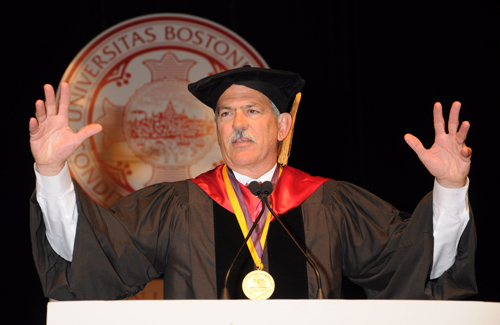
"You're the Rodney Dangerfield of all professions. You don't get no respect," commencement speaker Paul Grogan, president and CEO of the Boston Foundation, told the 215 assembled graduates.
As the nation confronts a crisis of rising health care costs, "public health must re-brand and reposition itself in the public sphere, and it must have a voice -- a big voice," he urged. "This is your moment."
Grogan took a new tack in a new venue, telling the graduates -- gathered in BU's Agganis Arena for the first time for commencement ceremonies-- that while graduation speakers traditionally were expected to dispense advice, he had come to ask for help.
His plea: That the Class of 2012 "change the paradigm" in health care by making disease prevention as important as disease care.
"The U.S. is bankrupting itself on health care costs. . . and getting terrible results in the bargain," Grogan said, noting the nation's staggering obesity rates, among other health problems. "If we continue our current path of being willing to spend infinitely on medicine, but virtually nothing on prevention, the obesity epidemic alone will crush us."
He said health care costs already were "wrecking" state and municipal budgets, forcing governments to slash spending on higher education and other services, and "crowding out other necessary investments." Most troubling, he said, was that all the billions spent on medical care were producing "comparatively poor" health outcomes.
He encouraged the graduates to boldly argue for the efficacy of public health as "a critical component" of a national solution to spiraling health care costs.
"The disease-care paradigm has had its day, and it has been found terribly wanting," Grogan said. "Yet medicine still has the power, the prestige and most of the resources.
"The visionaries of medicine and public health (must) come together to fashion a compelling hybrid strategy that would put the best of both worlds forward," he said. "That is the urgent work that lies before us, and I urge you to take it up."
Grogan's call to action was coupled with a pledge of action by student speaker Austen Musso, who urged his classmates to think about why they had chosen the public health field, and to find a sense of mission that would compel them to "create and inspire change."
Musso told a personal story about the death of a young boy he knew, at a hospital in Kenya -- which he said underlined, for him, the tragic inequities in access to basic care.
"If I had to pick just one reason why I entered public health, I would say it's because I don't believe that your health or your happiness in life should be dependent on your race, religion, gender -- or where you're born," he said.
In encouraging his fellow graduates to make a mark in their fields, Musso, who majored in international health, shared a favorite saying of William Bicknell, founding chairman and professor of international health:
"If you ever think you're too small to make a difference, try sleeping in a closed room with a mosquito."
BUSPH Dean Robert Meenan told the graduates that he had "never been prouder" of the school or its students in his nearly 20 years at its helm, despite continuing challenges such as rising tuition costs and uncertain economic times.
He said the school's strong commitments to teaching, applied research, career placement and community involvement would carry it forward, and that financial assistance to students would continue to grow next year.
The BUSPH Class of 2012 includes 357 graduates: 180 students who graduated this month, 117 who graduated in January, and 60 who graduated last September.
Two faculty members and a number of students were recognized with awards. Victoria Parker, associate professor of health policy and management, was honored with the Norman A. Scotch Award for Excellence in Teaching, while David Ozonoff, founding chair and professor of environmental health, received the Faculty Career Award in Research and Scholarship.
Student Stephen Nicholson received the Leonard H. Glantz Award for Academic Excellence.
Other student awardees included:
- Dean's Award for Student Research -- Rebecca Laws
- Award for Student Excellence in Public Health Practice -- Dominique Chambless; Priyanka Khandhar; Emily Winter-Wadsworth
- Rex Fendall Award for Excellence in Public Health Writing -- Christine Baugh; Nollascus Ganda
- Katherine M. Skinner Memorial Prize for Commitment to the Study of Women's Health Issues -- Meredith D'Amore
- Herb Kayne Prize for Excellence in Biostatistics -- Meghan Perkins
- The Dr. William B. Patterson Memorial Prize for Excellence in Environmental and Occupational Health -- Tiffany Skogstrom
- The Dr. Theodore Colton Prize for Excellence in Epidemiology -- Meredith Black
- Allan R. Meyers Memorial Prize for Excellence in Health Services -- Desiree Otenti; Lisa Schottenfeld
- The John Snow, Inc. Award in International Health -- Ivan Busulwa; Danit Kaya.
Submitted by: Lisa Chedekel, chedekel@bu.edu
March with BUMC at the Boston LGBT Pride Parade, June 9
 The Office of Diversity and Multicultural Affairs invites the BUMC community to march with "PRIDE" and show support for LGBT students, faculty and staff in the Annual Boston LGBT Pride Parade on Saturday, June 9. Showing your support for LGBT friends and colleagues reaffirms our openness and strengthens the diverse fabric of our institution.
“The parade is a fun event which fosters change and progress in our society by embracing the LGBT community's history, culture, and identity. Additionally, the parade promotes community engagement and inclusivity,” explained Associate Dean, Diversity and Multicultural Affairs Rafael Ortega, MD.
If you are interested in marching please contact the Office of Diversity and Multicultural Affairs by emailing Lance Martin, indicating that you plan to participate. The BUMC contingent will “line up” on Boylston St. at 11 a.m. on June 9. The Office will provide additional information and updates regarding the time and exact location of the the pre-march meeting.
Join us and march proudly under the BU Banner.
Study Shows First Case Series of Chronic Traumatic Encephalopathy in Blast-Exposed Military Service Personnel and Mechanism of Injury in Blast Neurotrauma
Investigators from Boston University (BU) and the Veterans Affairs Boston Healthcare System have shown evidence of chronic traumatic encephalopathy (CTE) in brain tissue from blast-exposed military service personnel. Laboratory experiments conducted by the investigators demonstrated that exposure to a single blast equivalent to a typical improvised explosive device (IED) results in CTE and long-term brain impairments that accompany the disease. They also found that the blast wind, not the shock wave, from the IED blast leads to traumatic brain injury (TBI) and long-term consequences, including CTE.
This research, which represents the first case series of postmortem brains from U.S. military personnel who were exposed to a blast and/or a concussive injury, will be published online May 16 by Science Translational Medicine.

Lee Goldstein, MD, PhD, associate professor at Boston University School of Medicine (BUSM) and Boston University College of Engineering, and Ann McKee, MD, professor at BUSM and director of the Neuropathology Service for VA New England Healthcare System, led this international collaborative study and are the senior co-authors.
CTE, which can only be diagnosed postmortem, is a progressive neurodegenerative brain disorder that has been reported in athletes with multiple concussions or subconcussive injuries. In early stages, CTE is characterized by the presence of abnormal deposits of a protein called tau in the form of neurofibrillary tangles, glial tangles and neuropil threads throughout the brain. These tau lesions eventually lead to brain cell death. CTE has clinical features in common with TBI, including psychiatric symptoms and long-term cognitive disability involving memory and learning deficits. TBI can impact military personnel exposed to an explosive blast and may affect approximately 20 percent of the 2.3 million servicemen and women deployed since 2001.
In this study, investigators performed comprehensive neuropathological analyses on brain tissue from four military service personnel with known blast exposure and/or concussive injury. They compared these results with brain tissue samples from three young amateur American football players and a professional wrestler, all of whom had a history of repetitive concussive injury, and four samples from comparably-aged normal controls with no history of blast exposure, concussive injury or neurological disease.

The investigators found that CTE neuropathology in the brains of blast-exposed military veterans was similar to that found in young athletes with repetitive concussion and consistent with what has previously been observed in brain samples from other athletes with a history of repetitive concussive injury.
“Our results showed that the neuropathology from blast exposure, concussive injury, or both were virtually indistinguishable from those with a history of repeat concussive injury,” said McKee, who is the director of the Brain Banks for BU’s Alzheimer’s Disease Center and the Center for the Study of Traumatic Encephalopathy, which are based at the Bedford VA Medical Center. McKee said that these findings indicate that TBI caused by different factors may trigger similar disease pathways in the brain.
“The neuropsychiatric symptoms of CTE that have previously been associated with athletes diagnosed with CTE could also be attributed to military personnel who were exposed to blast,” said Goldstein, who also is affiliated with the BU Photonics Center and served as the study’s lead author.
To examine the impact of a single blast exposure, the investigators collaborated with leading experts in blast physics, experimental pathology and neurophysiology at Boston University, VA Boston Healthcare System, White River Junction VA Medical Center, New York Medical College, Fraunhofer Center for Manufacturing Innovation, University of Massachusetts Lowell, Lawrence Livermore National Laboratory, Massachusetts General Hospital and the University of Oxford. The team’s experimental data showed that one blast comparable to that experienced by military service personnel in the field resulted in both neuropathological and behavioral evidence of CTE. Surprisingly, the long-term impairments in brain function, including impaired learning and memory, were observed just two weeks after exposure to a single blast.
The blast wind from an IED can reach a velocity of up to 330 miles per hour, which is greater than the largest wind gust ever recorded on earth. “The force of the blast wind causes the head to move so forcefully that it can result in damage to the brain,” said Goldstein.
Based on the results, the investigators went a step further and explored how they could prevent the brain injury. They demonstrated that immobilizing the head during a blast exposure prevented the learning and memory deficits associated with CTE that occurred when the head was not immobilized.
“Our study provides compelling evidence that blast TBI and CTE are structural brain disorders that can emerge as a result of brain injury on the battlefield or playing field,” added Goldstein. “Now that we have identified the mechanism responsible for CTE, we can work on developing ways to prevent it so that we can protect athletes and our military service personnel.”
The study results provide a pathway for the development of novel diagnostic strategies for blast-related brain trauma, as well as to treat and rehabilitate those who have been exposed to blast and/or a concussive injury.
Researcher, Surgical Oncologist Receives National Award

Maureen T. Kavanah, MD, an Associate Professor of Surgery at Boston University School of Medicine (BUSM) and a surgical oncologist at Boston Medical Center (BMC), has received the prestigious 2012 National Surgical Adjuvant Breast and Bowel Project (NSABP) Distinguished Investigator Lifetime Achievement Award for her extraordinary contributions and meritorious service to the NSABP in support of clinical research in breast and colorectal cancers.
During her nearly three decades of service at Boston University Medical Campus, Dr. Kavanah has exemplified the spirit of the award through her dedication to the promotion, publication and presentation of clinical research. “This award reflects not only Dr. Kavanah’s commitment to excellence in research and patient care, but to advancing treatment for breast cancer nationally and internationally,” said Gerard Doherty, MD, the James Utley Professor and chair of surgery at BUSM and chief of surgery at BMC.
Dr. Kavanah became a research investigator with the NSABP in 1981, and has held several leadership positions within the organization. As the Principal Investigator of the NSABP Clinical Research at BMC, she has led numerous NSABP-sponsored clinical studies in breast and bowel cancers. She has served on NSABP’s Board of Directors since 1988, and also serves as the Protocol Chair for The Breast Cancer Prevention Trial P-1. She also serves as the Chairman of the Ethics Committee.
In addition to her renowned scientific achievements, Dr. Kavanah has dedicated her time to the scientific community by serving as a faculty supervisor for many young investigators. In 1990, she established BMC as a full-member institution of the Southwest Oncology Group (SWOG) and served as its Principal Investigator until 1994. Dr. Kavanah belongs to numerous professional organizations and has been a member of the Board of Governors of the American College of Surgeons, the President of the Massachusetts chapter of the American College of Surgeons, President of the New England Cancer Society and has chaired the National Cancer Institute Central IRB (Institutional Review Board). She has lectured extensively and has been listed as a Top Doctor by Boston Magazine annually since 2008.
Dr. Kavanah received the 2012 award during a ceremony held in Scottsdale, on April 29 at the NSABP clinical trials annual meeting.
The NSABP Foundation, Inc., has a 50-year history of designing and conducting clinical trials that have changed the standard of treatment in breast and colorectal cancer. As a not-for-profit clinical trials cooperative, it’s supported primarily through grants from the National Cancer Institute and in part from the Tobacco Settlement Act and other sources. It pioneered breast cancer studies that led to the establishment of lumpectomy plus radiation over mastectomy as the standard surgical treatment for breast cancer. It also was the first to demonstrate that adjuvant therapy (treatment in addition to surgery) could alter the natural history of breast cancer, increasing survival rates, and demonstrating on a large scale the preventive effects of the drugs tamoxifen and raloxifene in reducing rates of invasive breast cancer.