Student Updates
BU Experts: U.S. Response to Ebola Raises Ethical, Legal Questions
It was the bike ride seen ‘round the world.
When Maine nurse Kaci Hickox hopped on a bike last Thursday, openly defying a quarantine order to stay home after she had treated Ebola patients in West Africa, she intensified a legal and ethical debate likely to have far-reaching consequences in the U.S., according to a panel of BU and Massachusetts health experts convened last week on the BU Medical Campus to discuss the Ebola outbreak.
“There are actually two epidemics going on,” said panel member George Annas, professor of health law, bioethics and human rights at the BU School of Public Health. “There’s an Ebola epidemic in West Africa. And there’s an epidemic of ignorance in the United States.”
Annas was referring to both overblown alarm about Ebola in the U.S. and resulting government actions, including the forced quarantine of Hickox, who was isolated in a tent at a New Jersey hospital for four days after she landed at Newark airport. She tested negative for Ebola, but was ordered to self-quarantine at home in Maine. On Friday, a Maine judge rejected state efforts to confine her in her home, but required her to submit to daily monitoring for the virus.
Annas and four other medical and legal experts – two from the state Department of Public Health and two from BU – said the handling of Ebola, both in Africa and in the U.S., has raised a host of ethical questions. The way the U.S. treats health workers returning from the three countries hardest hit by Ebola – Liberia, Sierra Leone and Guinea – could have a profound effect on the willingness of others to help, and on the course of the disease, they said.
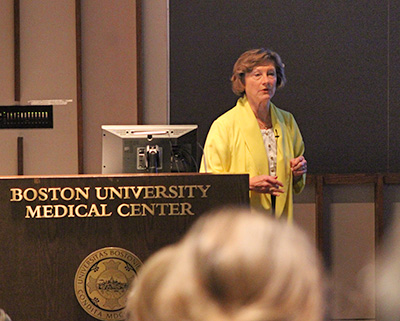
"The entire health care system is decimated” in these countries, said Dr. Nahid Bhadelia, assistant professor of medicine at the BU School of Medicine and director of infection control at National Emerging Infectious Diseases Laboratories (NEIDL) at BU. She said a lack of resources has contributed to the “exponential growth” of Ebola cases, and she stressed the need for more physicians and health care workers to assist.
“We just don’t have enough hands to help out,” she said. “It’s the amount of work to be done and how few people there are” that’s fueling the death rate. There have been close to 14,000 reported Ebola cases and 4,922 deaths to date.
Bhadelia, an infectious disease specialist at Boston Medical Center who treated patients in Sierra Leone and is now heading to Liberia, noted that the survival rate from Ebola is over 50 percent if it is caught in time.
“This is a call to action for us,” she said. “Imagine what we can do with enough hands . . . which is why the discussion of health care workers here” is so important.
Annas and colleague Wendy Mariner, a BU professor of law and public health, said a lack of clarity over which agency is in charge of Ebola has contributed to conflicting messages. The World Health Organization has come under fire for not sounding the alarm about Ebola early enough and for not coordinating a response.
The Centers for Disease Control (CDC) recently issued guidelines that call for restrictions and monitoring of health workers who are at elevated risk of infection, but stop short of the strict quarantines that some states have imposed. Meanwhile, the Department of Defense announced last week that troops who return to the U.S. after deployment to West Africa will be isolated for 21 days — the incubation period for Ebola — even if they are symptom-free.
“I don’t know who’s in charge,” Annas said with a shrug. “There’s a vacuum of leadership.”
At the state level, New Jersey, Connecticut, Florida, Illinois and three other states are imposing quarantines on health workers who’ve had contact with Ebola patients. Mariner said that while states have broad powers, there are Constitutional limits on when citizens can be confined: Namely, they must have a serious contagious disease, and there should be a probability that they will transmit the infection to others.
“That second point is being lost,” she said.
Of New Jersey and the other states that are imposing strict quarantines, Mariner said, “When you hear somebody say it’s out of ‘an abundance of caution,’ you know they have no facts behind them.”
She said Massachusetts, which is not imposing mandatory quarantines, is “doing a good job — but they’re a rare bird.” The state has had no reported Ebola cases.
“We need courageous public health and legal officials . . . who won’t be bullied” or swayed by fear, Mariner said.
Two officials from the state Department of Public Health (DPH) addressed criticism that the agency had not done enough to help to prepare for Ebola, saying the DPH is working closely with hospitals and emergency responders, while also trying to allay fears of contagion. The agency is in discussions with hospitals about whether to create regional Ebola-specialty facilities.
Dr. Alfred DeMaria, state epidemiologist and medical director of the Bureau of Infectious Disease for the DPH, said that even if some hospitals are deemed regional centers, the entire health care system needs to be prepared to deal with cases.
“Patients aren’t going to go to an ‘Ebola hospital’” when they have symptoms, said DeMaria, noting that people likely will go to the nearest hospital or health-care provider. “We still need to build a system” of community providers trained and equipped to treat Ebola.
All state hospitals have invested in training and equipment to prepare for the possibility of an Ebola patient, state officials said. Boston Medical Center is building a three-bed bio-containment unit that is expected to be ready in mid-2015.
DeMaria said that the DPH is following CDC recommendations that any identified, higher-risk individuals restrict their interactions and undergo active monitoring for symptoms and fever at least once daily.
“We’re going to be very diligent in applying the least restrictive measures . . . while ensuring the public’s health,” he said. Of returning health care workers, he said, “We should be embracing them with gratitude, not shutting them (in) and locking them up.”
DeMaria said the department has been trying to allay fears that the virus, transmitted through bodily fluids, is airborne or easily spread. He noted that the one person who has died of Ebola in the U.S., in Texas, had possible contacts with more than 100 people, but that only two nurses who treated him at the end stage of his illness had contracted the virus.
“Distance is your best protection,” he said.
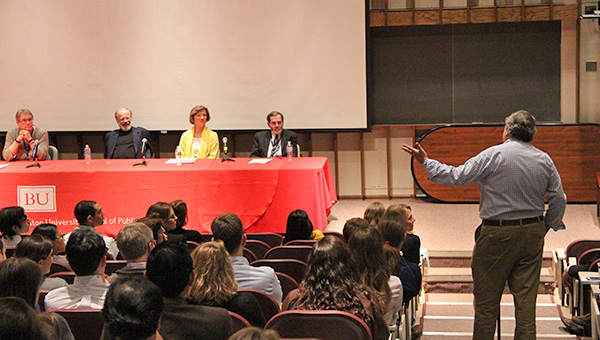
SPH Professor Leonard Glantz presents a question to the panel. Mary Clark, director of the Office of Preparedness and Emergency Management at the DPH, said the agency began working with health care and emergency providers in August to prepare for Ebola cases. The DPH has set up a special email account for residents who have questions about Ebola: AskEbola@state.ma.us.
At the forum, an audience member asked panelists why Ebola had attracted so much more public attention than illnesses such as malaria and pneumonia, which claim many more lives in Africa.
Initially, Mariner answered that those other illnesses have been around so long, people have grown tired of hearing about them. Then she added: Because Ebola has “jumped here.”
Annas agreed, adding that he hoped the Ebola outbreak ultimately might lead to better health care for West Africans with other diseases, if health systems in those countries are strengthened.
Contributed by Lisa Chedekel
BU Scientists Get a Lesson in Telling Their Stories
Alan Alda, famous for his roles in M*A*S*H* and PBS’s Scientific American Frontiers, made a guest appearance on the Medical Campus – via video recording, that is. On Oct. 21, the School of Medicine welcomed faculty from the Alan Alda Center for Communicating Science for a one-day workshop to help BU scientists communicate their work more effectively to the public, policymakers, funders, policymakers and colleagues.

Forty-one scientists from the Medical and Charles River campuses learned how to communicate their work, connect with their audience, and speak clearly and conversationally about why their work matters by attending two three-hour workshops on improvisation and message delivery.
Assistant Dean for Academic Affairs Suzanne Sarfaty, MD, previously had attended a workshop at the Alda Center at Stony Brook University in New York and was eager to bring the workshop to the Medical Campus. “I was so impressed with the thinking behind and the power of the program,” she said. “I knew it would be a valuable experience for our scientists and would enrich the BU community.”
During the “Distilling Your Message” workshop, participants had to explain their research as though they were pitching their story to a TV show producer, a non-scientist. The scientists practiced finding common ground with an audience, speaking at different levels of complexity for different audiences, and answering questions about their work. Later, the “Improvisation for Scientists” workshop used improv theater techniques to help participants speak more spontaneously and responsively with their audience.

The improvisation exercises were particularly helpful for Isabel Dominguez, PhD, assistant professor of hematology and medical oncology, who says she was excited to share the ideas and techniques with her lab colleagues and trainees. “This was a very valuable workshop that I feel will make me better at explaining my work and better able to train others in my lab to be more effective in telling their ‘stories’ as well,” she said.
The exercises challenged BU scientists, through both discussion and practice, to pay close attention to others and be aware of the two-way nature of communication.
Resilience and Mindfulness, Nov. 4

Boston University Health Promotion Series
When: Tuesday, Nov. 4, noon - 1 p.m.
Who: Karen Brouhard, BU Faculty and Staff Assistance Office
Where: BUSM Instructional (L) Building; Room L201 (72 East Concord St., Second Floor)
Description: Life is full of challenges. While we often have no choice over which challenges we encounter, we do have some control over how we respond. This presentation will focus on cultivating resilience -- the ability to cope effectively with crises and bounce back quickly from setbacks. Many factors contribute to resilience, some of which can be learned and developed. Mindfulness practices help us observe rather than react to upsetting events and negative feelings, facilitating our responding with greater wisdom and effectiveness.
What You Will Learn:
- How to explore the sources of your own resilience
- About the use of mindfulness in cultivating resilience
- How to practice several mindfulness approaches
This presentation is open to all Boston University employees. Lunch will be served.
If you have any questions, please contact Yuliya Labkovskaia at BU Occupational Health Center at 617-353-6630 or labkovsk@bu.edu.
Please register online.
Joining Forces: TBI/PTSD Conference to be Held Nov. 4

In 2011 the White House established the Joining Forces initiative to promote the education, research and clinical care for military members with TBI and PTSD. The Boston University Medical Campus (BUMC) was one of the original participants in the program. This year the Medical Campus will host the Third Annual Joining Forces Conference on Tuesday, Nov. 4, from 8 a.m.-noon in Hiebert Lounge. Faculty, students and staff are invited to attend guest lectures and participate in the poster session.
Speakers at the event include internationally renowned faculty researchers at BU School of Medicine and the VA Boston Healthcare System. BU is among the leaders in research and collaborative care for concussions and PTSD. VA Boston is a national leader in clinical care and research for veterans with post-deployment disorders, including TBI, PTSD, other anxiety disorders, affective disorders and comorbid substance abuse. VA Boston also has one of the most comprehensive mental health treatment systems in the country for veterans and is the nation’s largest recipient of VA research dollars supporting more than 150 research projects on PTSD, traumatic brain injury and other post-deployment disorders. VA Boston also is the home of the Behavioral Sciences and Women’s Health Sciences divisions of the National Center for PTSD.
Mark your calendar to learn about the cutting edge research being performed at our institutions in these fields. Hear how advances in research may be used to identify individuals at risk for prevention, intervention and treatment. After the formal lectures a poster session will highlight additional areas of research.
BUMC and VA Boston Joining Forces TBI/PTSD Conference
Tuesday, Nov. 4, 8 a.m.-Noon
BUSM Instructional Building, Hiebert Lounge, 14th Floor
- 8 - 8:30 a.m. Registration and Breakfast
- 8:30 - 8:50 Introductions and Welcome (Drs. Anna Hohler and Gary Kaplan)
- 8:50 - 9:35 "Posttraumatic Stress Disorder (PTSD) in Female OEF/OIF/OND Veterans: Overview of Recent Research Findings" by Dawne Vogt, PhD, acting deputy director, Women's Health Sciences Division, National Center for PTSD, VA Boston Healthcare System and associate professor of Psychiatry, BUSM
- 9:35 - 9:45 Break
- 9:45 - 10:30 “Current Concepts in Chronic Traumatic Encephalopathy” by Ann McKee, MD, Chief of Neuropathology, VA Boston Healthcare System, professor of Neurology and Pathology, BUSM
- 11:15 - noon Poster Viewing
BUSM #30, BUSPH #25 in Inaugural U.S. News Best Global Universities Rankings

U.S. News released its latest rankings tool, Best Global Universities, today and Boston University is listed 37.
The new rankings offer the most comprehensive assessment of research universities worldwide as well as by region and country. As an interesting comparison, U.S. News ranks BUSM 32nd, BUSPH 11th and BU 42nd in the U.S. on its list of Best U.S. Graduate Schools and National Universities, respectively. Thus both BUSM and BU are ranked higher globally (30th and 37th respectively), than they are ranked in the U.S. (32nd and 42nd).
As per the table below, the U.S. News Global rankings lists BUSM 20th in the US compared to 32nd in the U.S. in the U.S. News National rankings.
|
Global rank |
U.S. rank in Global rankings |
U.S. rank in Natl rankings |
|
| BU |
37 |
28 |
42 |
| BUSM |
30 |
20 |
32 |
| BUSPH |
25 |
16 |
11 |
The rankings also feature the top 100 global universities in 21 subject areas, including fields such as economics and business, engineering, computer science and clinical medicine. In these subject areas, BU ranks in the following 10 categories:
- #25 in social sciences/public health
- #30 in clinical medicine
- #30 in physics
- #33 in molecular biology/genetics
- #45 in psychiatry/psychology
- #46 in neuroscience and behavior
- #54 in biology and biochemistry
- #55 in economics and business
- #55 in immunology
- #76 in environment/energy
For a complete list of the rankings, visit http://www.usnews.com/education/best-global-universities
GSDM Volunteers Help Kids Prepare for Kindergarten
 On Tuesday, August 26, 2014, 34 members of the Boston University Henry M. Goldman School of Dental Medicine (GSDM) community volunteered their time at the 15th Annual Countdown to Kindergarten Celebration. Countdown to Kindergarten is an annual event at the Children’s Museum in Boston for families to learn about all things kindergarten. This was GSDM’s ninth year participating in the event.
Oral Health Promotion Director Kathy Lituri organized GSDM’s participation in the event. Volunteers provided dental screenings and led oral health activities for parents and kids in attendance, including instructing the children on brushing techniques with stuffed animals and teaching about oral health through arts and crafts. Parents also had the opportunity to talk to the volunteers and ask questions while their children were learning.
The evening was a huge success for Countdown to Kindergarten and GSDM. After three hours, GSDM volunteers had performed 97 dental screenings and interacted with hundreds of families. “I want to thank each and every one of you for volunteering at the 15th annual Countdown to Kindergarten Celebration,” Lituri said to the volunteers after the event. “Events like this are only successful because of volunteers like you. Thank you for your time and your professionalism.”
Dean Jeffrey W. Hutter said, “I am extremely proud of our students and faculty who volunteered for this important event. Countdown to Kindergarten is significant to the Henry M. Goldman School of Dental Medicine, as it helps the families in our Boston community. The time our volunteers gave to Countdown to Kindergarten helped make our participation in the event a success. Thank you to all who came out and helped.”
Student volunteers included: Heidi Borenstein DMD 17, Margi Chan DMD 16, Keerthy Chilakamarry (pre-dental), Shelby Curtis DMD 16, Michelle Dube DMD 15, Cassandra Fevelo DMD 15, Chiraag Gohel (pre-dental), Tony Hong DMD 18, Navtej Kang AS 16, Justine Karanian DMD 15, Ana Keohane AS 16, Courtney Knapnik DMD 16, Jae Kwak DMD 16, Andrea Lam DMD 16, Lana Le DMD 16, Jena Lee DMD 18, Brian Leibtog DMD 15, Matt Mara DMD 16, Mohammad Mourad (pre-dental), Mona Najafi DMD 16, Sara Najafi DMD 17, Nora Nakshabendi DMD 16, Alex Nguyen DMD 17, Divya Reddy (pre-dental), Rafaella Sampaio DMD 18, Kali Stewart DMD 15, Megan Sullivan DMD 18, Farnaz Tartibi DMD 16, and Jame Waller DMD 18. Faculty volunteers included Group Practice Leader Dr. Maria Angela Cancado, Clinical Instructor in the Department of General Dentistry Dr. Caroline Clerisme, and Clinical Instructor in the Department of Health Policy & Health Services Research Dee Devlin.
Medical Campus Hosts Updates on Ebola
 Members of BU schools of Medicine and Public Health are presenting updates on the Ebola outbreak. On Thursday, Oct. 30 from noon to 2 p.m. in Keefer Auditorium, join medical and public health experts from BUSM and SPH, the NEIDL and the Massachusetts Department of Public Health (MDPH) for “Ebola from the Front Lines” as they share facts about the virus, firsthand experience in Sierra Leone, health system preparedness in Massachusetts and the US, quarantine, travel restrictions, ethical and legal issues, and research.
SPH’s William Fairfield Warren Distinguished Professor and Chair of the Department of Health Law, Bioethics and Human Rights George Annas, JD, MPH, and Wendy Mariner, JD, MPH, the Edward R. Utley Professor, Health Law, Bioethics and Human Rights and BUSM’s Nahid Bhadelia, MD, MA, director of infection control for the NEIDL will be joined by MDPH’s director of Preparedness and Emergency Management Mary Clark, JD, MPH; and Alfred DeMaria, MD, Medical Director and State Epidemiologist.
The Department of Medicine Grand Rounds on Friday, Oct. 31 noon to 1 p.m. in Keefer Auditorium also will feature Dr. Bhadelia, BUSM Professor of Medicine, speaking on "2014 West African Ebola Epidemic: Care of Patients Here and in the Field." Dr. Bhadelia specializes in infection control issues related to emerging pathogens and highly communicable infectious diseases. Most recently, she has been part of the World Health Organization operations in Sierra Leone to combat the Ebola outbreak in West Africa in 2014. She also is an instructor for the CDC/FEMA healthcare worker preparedness course for the Ebola Response. She will return to West Africa to work with Partners in Health in Liberia.
Finding a Cure for ALS One Ice Cube at a Time

Eager onlookers cheered and shouted as pre-doctoral class representatives doused Dean Jeffrey W. Hutter with two massive buckets filled with ice water. Drs. Guarente and Calabrese were soaked right alongside him—and it was all because of Dr. McManama.
On August 22, 2014, Dean Jeffrey W. Hutter, Associate Dean for Clinical Affairs Dr. John Guarente, and Assistant Dean of Students Dr. Joseph Calabrese joined together on the patio outside Boston University Henry M. Goldman School of Dental Medicine (GSDM) to get buckets of ice water dumped on their heads to raise awareness and support for Amyotrophic Lateral Sclerosis (ALS), often referred to as Lou Gehrig’s disease. They did this in answer to a callout posted on the GSDM Facebook page from Professor in the Department of General Dentistry Dr. Carl McManama.
As a part of the Ice Bucket Challenge, those getting dumped on nominate three other people to donate, get ice water dumped on their heads, or do a combination of both. Dean Hutter stretched the rules a little bit and nominated Director of the Group Practice Experience and Team Leadership Dr. David Russell, Ad Interim Chair of General Dentistry Dr. Celeste Kong, Associate Dean of Academic Affairs Dr. Cataldo Leone, and the entire Executive Committee consisting of 18 other people. He challenged them to have ice water dumped on their heads as well as make a donation to an ALS foundation of at least $100.
In response, on September 3, 2014, Dr. Russell rallied all of the Group Practice Leaders that were around that day, and together they doused each other in a line one after another. In an email to the School, Dean Hutter said, “It means a great deal to me and our School to have you participate in this very special fundraising event in support of the ALS Foundation finding a cure for this dreadful disease.”
The next day, Dr. Leone, Dr. Kong, and—representing the entire Executive Committee—Assistant Dean of Faculty Development Dr. Judith Jones, joined together in front of the school for their icy inundation.
The awareness raised by the Ice Bucket Challenge held special significance for Group Practice Leader Dr. Karen Quigley, whose mother passed away from ALS. “The momentary hurt from the ice water ended quickly, but my mother’s affliction with ALS took two years to end,” she said. “She lost her ability to speak, to stand, to walk, to eat. Paralysis triumphed. At the end, she could still use one finger to communicate on her computer. As hard as it was for us to believe, throughout her two years, my mom remained cheerful. My mother was very fortunate; so many others don’t have it that good.”
She continued, “During her two years with ALS, my family spent a bundle of money accommodating the disease. Many people cannot afford to do that. I hope awareness of ALS is increased through the Ice Bucket Challenge and that it encourages people to financially support ALS organizations.”
The ALS Ice Bucket Challenge was started by several individuals affected either personally or through a familial connection by ALS. The Challenge was an attempt to raise awareness about Lou Gehrig’s disease and encourage people to donate to help support ALS research. As of an October 2 press release, the tour de force had pulled in around $21.7 million for the ALS Association.
Photos are available on Facebook and Flickr. Dr. McManama’s video is available on Facebook. A video of Dean Hutter, Dr. Guarente, and Dr. Calabrese being soaked is also available on Facebook.
Albany Street Safety Tips
As a result of the ongoing BMC construction project there are significant changes to vehicular and pedestrian traffic patterns on Albany Street and Massachusetts Avenue. Please follow the appropriate walking paths https://www.bumc.bu.edu/2014/10/02/bmc-construction-update/. If you have questions or concerns, please contact construction@bmc.org or call 638-4144.
Please Note:
- The sidewalk on the north side of Albany Street is closed from the Shapiro driveway to the Dowling building, and the crosswalk from Menino Pavilion to the Power Plant has been removed. This means pedestrians need to walk on the Power Plant side of Albany Street. Please do not walk in the street.
- There is no pedestrian access from Menino Pavilion/Dowling to Albany Street. Please enter and exit these buildings through the main hospital entrance on Harrison Avenue.
Tips for Getting Around Campus
- Utilize designated walking paths;
- Give yourself extra time when driving into work;
- Allow extra time when crossing the campus;
- Pay extra attention to pedestrian crossings as some have changed.
NIH Funding Information
NIH Appropriations for FY 2015 [Under the Current Continuing Resolution (CR)]:
Following previous practice under continuing resolutions (CR), the NIH on Oct. 1 announced it will issue non-competing research grants “at a level below that indicated on the most recent Notice of Award (generally up to 90 percent of the previously committed level).” The notice states that upward adjustments will be considered once a FY 2015 appropriations bill is enacted. The current CR funds the NIH at 99.9 percent of the FY 2014 enacted level through Dec. 11.
Find the guidance at: http://grants.nih.gov/grants/guide/notice-files/NOT-OD-15-001.html