Student Updates
Oct. 23 William J. Bicknell Lectureship in Public Health: Is There Such a Thing as a Safe(r) Cigarette?
In June, President Obama signed a law that gives the U.S. Food and Drug Administration the power to regulate tobacco products.
The law does not allow the FDA to ban nicotine or tobacco outright, but allows the agency to lower the amount of nicotine in tobacco products as well as to ban candy flavorings and to control certain aspects of advertising.
So what does this new FDA power mean for smokers, for the public's health and for the future of the tobacco industry? These and other questions surrounding the FDA's still developing tobacco regulation program will be discussed and debated at the 2009 William J. Bicknell Lectureship in Public Health to be held at Boston University School of Public Health.
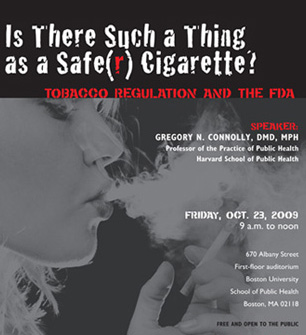
The event will be held on Friday, Oct. 23, from 9 a.m. to noon, in the first-floor auditorium of 670 Albany Street, on the Boston University Medical Campus. A continental breakfast will be available from 8:30 a.m. The event is free and open to the public.
The event will feature a lecture by 2009 Bicknell Lecturer Gregory Connolly, DMD, MPH, Professor of the Practice of Public Health at the Harvard School of Public Health.
Connolly teaches and conducts research at Harvard School of Public Health on tobacco and health issues. He has published more than 100 scientific articles on tobacco product design, marketing and tobacco control interventions. He is the former director of Massachusetts Department of Public Health's Tobacco Control Program and over the ten years he directed the program cigarette consumption fell 50 percent in Massachusetts, three times the U.S. average. He was the second American to be awarded the Surgeon General's Medallion by Dr. C. Everett Koop for his leadership in passing the federal Comprehensive Smokeless Tobacco Health Education Act. He is recognized as an international expert on smoking and health and is credited with ending the U.S. use of trade threats to compel foreign nations to import U.S. cigarettes. He has testified before Congress on more than a dozen occasions and appears regularly on U.S. national news networks. Connolly is a graduate of Holy Cross College, Tufts Dental School, and Harvard School of Public Health.
Connolly's lecture will be followed by a panel discussion and a question and answer session with the audience. The panel discussion features
Patrick Basham, Director, Democracy Institute; adjunct scholar, Cato Institute;
Cheryl Healton, DrPH, President and CEO, American Legacy Foundation, and;
Michael Siegel, MD, MPH, Professor, Community Health Sciences, BUSPH
For more information visit sph.bu.edu/bicknell2009
GSDM Molecular & Cell Biology Faculty Members Awarded NIH Supplements
Three faculty members of GSDM Department of Molecular & Cell Biology received supplements from the National Institutes of Health (NIH). As part of the American Recovery & Reinvestment Act of 2009 (ARRA) NIH awarded supplements to current grants in order to accelerate the tempo of ongoing science.
The faculty members, Professor and Director of the Predoctoral Research Program Dr. Maria Kukuruzinska, Professor Dr. David Levin, and Professor Dr. Miklos Sahin-Toth were awarded $875,000 in total.
Dr. Kukuruzinska's grant is titled, "Planar Cell Polarity Pathway Drives Duct Extension in the Developing Submandibular Gland," and through her research she aims to decipher the mechanism underlying duct formation during branching morphogenesis of the submandibular gland. The one-year supplement will further support the ongoing studies currently funded by her R01 grant titled, "Regulation of Submandibular Gland Development by Adhesion Receptors."
The administrative supplement awarded to Dr. Levin will allow him to expand on the aim of his ongoing grant titled, "Cell Wall Integrity Signaling in Yeast," through March 2011. "We use yeast as a model system with two major goals," said Dr. Levin. "The first is to identify novel mechanisms of stress signaling, to understand better the integration of different signals, and the regulation of output from stress signaling. The second is to identify potential targets for antifungal drug development."
Dr. Sahin-Toth received two separate supplements for his grant titled, "Chymotrypsin C in Pancreatitis. "One is an administrative supplement to purchase an RT-PCR machine and the other is a competitive revision supplement which will fund the development of novel chymotrypsin C inhibitors for a two-year period. The overall goal of Dr. Sahin-Toth's research is to investigate the role of chymotrypsin C in digestive physiology and the role of chymotrypsin C mutations as risk factors for chronic pancreatitis in humans.
BUSM Vitamin D Expert Receives Award from North American Menopause Society
Michael Holick, PhD, MD, director of the Bone Healthcare Clinic and the Vitamin D, Skin and Bone Research Laboratory at Boston University School of Medicine BUSM recently received the 2009 NAMS/Upsher-Smith Laboratories, Inc.Vitamin D Research Award from the North American Menopause Society (NAMS). Holick was presented with the award during NAMS' 20th annual meeting in San Diego, California on September 30-October 3, 2009.
NAMS/Upsher-Smith Laboratories, Inc. Vitamin D Research Award recognizes an individual whose body of research has advanced the understanding of the role of vitamin D-either endogenous or exogenous-for peri-and postmenopausal women.
"These NAMS awards represent the Society's commitment to enhancing women's health. In honoring outstanding researchers, health professionals, and the media, the Society strongly confirms its role in stimulating and acknowledging quality research and health care," said NAMS Executive Director Wulf H. Utian, MD, PhD, DSc (Med), NCMP. "NAMS appreciates the generous unrestricted financial support from grantors and Lippincott Wilkins & Wilkins (publishers of Menopause) that make these awards possible."
Founded in 1989, the North American Menopause Society is the world's leading nonprofit organization dedicated to promoting the health and quality of life of women through an understanding of menopause. The Society's multidisciplinary membership of over 2,000 professionals includes experts from medicine, nursing, sociology, psychology, anthropology, epidemiology, nutrition, pharmacy, education, and basic science-allowing NAMS to be the preeminent resource on all aspects of menopause to healthcare providers and the public (www.menopause.org).
Established in 1873, Boston University School of Medicine is a leading academic and research institution, with an enrollment of nearly 630 students and more than 1,100 full and part-time faculty members. It is known for its programs in arthritis, cardiovascular disease, cancer, human genetics, pulmonary disease and dermatology, among others, and is one of the major biomedical research institutions in the United States. The School is affiliated with Boston Medical Center, its principal teaching hospital, and Boston Veterans Administration Medical Center. Along with Boston Medical Center and 15 community health centers, the School of Medicine is a partner in Boston HealthNet.
BUMC Students Invited to Alumni Weekend Events
The medical campus is pleased to host events in conjunction with the all-University Alumni Weekend. Current students in the Schools of Medicine, Dental Medicine and Public Health are invited to attend the following events free of charge during alumni weekend.
Friday, October 23
WILLIAM J. BICKNELL LECTURESHIP IN PUBLIC HEALTH
"Is There Such a Thing as a Safe(r) Cigarette?: Tobacco Legislation and the FDA"
Medical Campus, 670 Albany Street 9:00 a.m. - 12:00 p.m.
Saturday, October 24
MEDICAL CAMPUS ALUMNI COLLEGE:
"Health Reform and the Promise to Address Health Outcomes Disparities"
Bakst Auditorium, BUSM
72 E. Concord Street
9:00 a.m. - 11:45 a.m.
Panel discussion from expert faculty members from the Schools of Dentistry, Medicine, and Public Health address this timely and important topic. Keynote speaker will be Dr. Louis Sullivan, a 1958 BUSM graduate, former Secretary of Health and Human Services and President of Morehouse School of Medicine.
Panelists include:
- Deb Bowen, PhD, Chair and Professor, Community Health Sciences (formerly Social & Behavioral Sciences) SPH
- Karen Freund, MD, MPH, Professor and Chief of Women's Health Unit of Section of General Internal Medicine; BUSM
- Raphael Ortega, MD, Professor and Vice-Chairman, Dept of Anesthesiology
- Michelle Henshaw, DDS, MPH, Professor, Assistant Dean for Community Partnerships and Extramural Affairs, and Director, Division of Community Health Programs
Oct. 14 Public Health Forum: A Primer on Swine Flu
This past spring, the A(H1N1) influenza virus, also known as swine flu, emerged in Mexico and quickly spread worldwide so that by June 11, WHO Director-General Margaret Chan announced that the outbreak had officially reached global pandemic levels.
On Wednesday, October 14, join BU School of Public Health faculty members David Hamer, David Ozonoff and Jean van Seventer, as they present a primer on the on the A(H1N1) virus and the pandemic.
They will cover the biological and clinical features of the virus, as well as provide an overview of the present epidemiology of the pandemic: van Seventer, associate professor of environmental health, will discuss the basic biology of influenza viruses and how it relates to the morbidity and mortality of the disease; Hamer, associate professor of international health, will cover the clinical aspects of A(H1N1) influenza, including risk factors for severe illness, treatment, and vaccine development; and Ozonoff, professor of environmental health, will give an overview of what is presently known and not known about the epidemiology of the A(H1N1) pandemic.
The BUSPH Public Health Forum is a regular series presented by the School of Public Health. It is free and open to the public.
BUSPH Public Health Forum: A Primer on Swine Flu
Speakers: David Hamer, David Ozonoff and Jean van Seventer
Date: October 14, 2009
Time: 12:00 p.m. - 1:00 p.m.
Location: BUSM Instructional Building, Room L-112
For more information, contact jvsevent@bu.edu
NewsDay (NY) Op-Ed by George Annas, JD, MPH
Op-Ed by BUSPH Health Law, Bioethics and Human Rights Professor appeared in NewsDay.com on October 3
OPINION: Don't force medical pros to get H1N1 vaccine
The New York State Health Commissioner's new mandate that all health care workers be vaccinated against both the seasonal and the swine flu this fall could qualify as the major public health blunder of the year, because it is likely to backfire.
Flu has been rightly characterized as a "slippery disease" that can mutate quickly and unpredictably, which means that planning for flu epidemics must be flexible and should be reviewed regularly as evidence of disease spread and severity accumulates.
We are already experiencing the beginning of a second wave of swine flu, the 2009 H1N1 influenza. Effective response will require cooperation of the public, and such cooperation (in actions such as getting vaccinated, social distancing and staying home when sick) will happen only if the public trusts its health officials.
Surveys have noted an erosion in public trust of government officials, but continued confidence in physicians and nurses. In this context, persuasion based on science, ethics and prudence, not on legal threats, should be the mandatory course of action for public health officials.
Physicians and nurses, educated and licensed professionals, dedicated to their patients' health and welfare, do have an ethical obligation to take all reasonable steps to protect their patients. During a threatened flu pandemic, like swine flu, this includes, I think, getting a swine flu vaccination.
So why not require vaccination if they refuse? There are at least four reasons.
Read the full text of Annas' article online.
BUVSDA Reaches Out to Local Poor and Homeless Women
The Boston University chapter of the Vietnamese Student Dental Association (BUVSDA) and dental hygiene students from The Forsyth Institute, in cooperation with Boston University Henry M. Goldman School of Dental Medicine (GSDM) Division of Community Health Programs (CHP), participated in the annual Rosie's Place Wellness Fair on September 30.
The fair was sponsored by Regis College School of Nursing and Health Professionals and information on a myriad of health topics was presented to the women of Rosie's Place. BUVSDA volunteers answered questions about oral health and passed out complimentary toothbrushes, toothpaste, and denture kits to those with full or partial dentures.
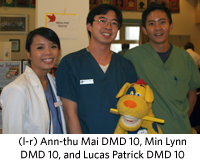
"I feel that it is always an honor and a privilege to be able to help out in the community," said BUVSDA volunteer Min Lynn DMD 10, "especially with Rosie's Place, located in our neighborhood, just down the street from our Dental School. Volunteers had the opportunity to interact with the homeless women in the South End community and supply them with toothbrushes and dentifrices. We were also able to demonstrate proper oral hygiene techniques and answer questions."
In addition to obtaining information on oral health at the Wellness Fair, women staying at Rosie's Place can work through their assigned advocate to obtain dental services at GSDM.
BUSM Researchers Identify Malaria Infection Control Methods for Hospitals in India
Researchers at Boston University School of Medicine (BUSM) have identified deficiencies in the use of methods to prevent malaria in pregnant women in antenatal clinics and hospital delivery units in the state of Jharkhand, India. The BUSM study appears online in the Malaria Journal.
Of the 2,386 pregnant women studied at the antenatal clinics over a 12-month period, the BUSM researchers found 1.8 percent had a positive diagnostic test for malaria. Of the 718 pregnant women studied at the delivery units, 1.7 percent tested positive for peripheral parasitaemia (asexual parasitic forms) and 2.4 percent tested positive for placental parasitaemia (malaria parasites on placenta) during the same period.
According to lead author, Davidson Hamer, MD, an associate professor of international health and medicine at Boston University Schools of Medicine and Public Health, and director of Boston Medical Center's Travel Clinic, malaria control measures, including indoor residual spraying of the homes of the study participants was common, whereas insecticide-treaded bed nets and malaria chemoprophylaxis were rarely used.
"Given the large-at-risk population in this region and to improve case management of symptomatic pregnant women, there should be a wider availability of insecticide-treated bed nets," said Hamer. "Improved control methods could reduce the risk of infection in this malaria-endemic region."
BUSM's Black Women's Health Study Receives $9.1M Award to Continue Research
The Black Women's Health Study (BWHS) of the Slone Epidemiology Center at Boston University School of Medicine's (BUSM) has received a five-year continuation of grant funding award from the National Cancer Institute. The $9.1M award will cover years 16-20 of the largest follow-up study of the health of African-American women.
Lynn Rosenberg, Sc.D., an associate director of the Slone Epidemiology Center and professor of epidemiology at BUSM, is the principal investigator of the BWHS, which has followed 59,000 black women from across the United States since 1995.

"African American women are more likely to be affected by aggressive breast cancers and at younger ages than other U.S. women," said Rosenberg. "We are grateful that the National Cancer Institute recognizes the importance of studying causes of breast cancer in African American women."
The BWHS has published multiple papers on breast cancer, including on topics of special interest to African American women that have not been studied previously, such as the influence of breast cancer risk on experiences of racism. The BWHS also assesses risk factors for outcomes other than cancer that disproportionately affect black women. These include diabetes, systemic lupus erythematosus, sarcoidosis, and preterm birth. Funding for these assessments has been provided by the National Institutes of Health and several foundations.
More information on the BWHS can be found at http://www.bu.edu/bwhs/.
BUSM's Framingham Heart Study Receives $1M Challenge Grant
Boston University School of Medicine's (BUSM) Framingham Heart Study (FHS) has received a two-year $1M challenge grant from the National Heart, Lung, and Blood Institute.
According to FHS investigator Emelia Benjamin, MD, ScM, a professor of medicine at BUSM and professor of epidemiology at Boston University School of Public Health, the challenge grant will be used to add two statisticians to help identify risk factors for developing atrial fibrillation beyond the aging of the heart. FHS will also work with investigative groups at the University of Minnesota, with Joint-Principal Investigator, Alvaro Alonso, MD, PhD, as well as researchers in Iceland, Germany and the Netherlands.
The novelty of the FHS challenge study is that the investigative team includes collaborators at five other major cohort studies who will work together to develop the most accurate way to predict atrial fibrillation with simple clinical factors. The researchers will then examine whether new biomarkers or genetic tests add significantly to the ability to predict new-onset atrial fibrillation.
"It is a tremendous privilege to receive this challenge grant from the National Heart, Lung and Blood Institute," said Benjamin. "We now have the opportunity to make major headway in the prevention of atrial fibrillation."
The objective of the FHS is to identify the common factors or characteristics that contribute to cardiovascular disease by following its development over a long period of time in a large group of participants who have not yet developed overt symptoms of cardiovascular disease or suffered a heart attack or stroke.
The researchers recruited 5,209 people between the ages of 30-62 from the town of Framingham, Massachusetts. Since 1948, the participants have continued to return to the study every two years for a detailed medical history, physical examination and laboratory tests. In 1971, the study enrolled a second generation, 5,124 of the original participants' adult children and their spouses to participate in similar examinations. In April 2002, the study enrolled a third generation of participants, the grandchildren of the original cohort.
Over the years, careful monitoring of the FHS population has led to identification of major cardiovascular risk factors, as well as valuable information on the effects of these factors such as blood pressure, blood triglyceride and cholesterol levels, gender and psychological issues.
More information on the FHS can be found at http://www.framinghamheartstudy.org.