Student Updates
Bicknell to Offer 'Lessons from a Life in Public Health' in Lecture
William J. Bicknell has brought his public health expertise to 62 countries and has the distinction of founding BUSPH's high-profile Department of International Health -- but ask him what drives his commitment to international health and he offers the simplest of explanations:
"Because it's not nice for people to hurt. And most people can hurt less," he says.
Despite a heady career that took him from senior physician for the Peace Corps in Ethiopia, to commissioner of public health in Massachusetts, to founder of the BU Center for International Health, Bicknell, MD, MPH, a professor of international health at BUSPH and of family medicine at the BU School of Medicine, is known for his straight talk about the angst and rewards of trying to help people in developing countries hurt less.
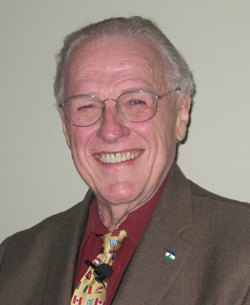
On Wednesday, May 2, Bicknell, who has been on medical leave for a recurrence of cancer, will return to BUSPH to share his thoughts on the "Lessons Learned from a Life in Public Health" in a lecture at noon in Keefer auditorium, open to the public.
Bicknell, a Newton, Mass. native who came to BU in 1978 after stints in the Peace Corps and as medical director of the Job Corps, is best known at BU for establishing a curriculum and center for international health, and for cultivating a longstanding university partnership with the small African country of Lesotho, hard-hit by HIV/AIDS and other chronic diseases.
According to 2009 estimates, the prevalence of HIV/AIDS in Lesotho was about 24 percent -- one of the highest rates in the world. Since 2004, Bicknell has led an effort, dubbed the Lesotho-Boston Health Alliance, to improve Lesotho's medical capacity by establishing a family medicine residency program that retains physicians in the country, and by bolstering the larger health-care system.
"We've been trying to reverse the brain drain -- to keep Lesotho doctors in Lesotho, where they're needed," Bicknell explained. "We had to learn how to train people there, and how to keep them there. It's a long-term, mutually beneficial arrangement.
"We never had so-called 'objectives,'" he added. "Our goal was less pain, less suffering and a longer life. We have gone down some blind alleys and found some clear paths -- but ultimately, we've built trust and strong relationships. It works."
In advance of his lecture, Bicknell talked about the struggles and successes of his journey through public health:
Q: What led you to push for international health to be a part of BU's curriculum?
A: When I graduated from medical school in the 1960s, there was a doctor draft in the military, and I thought, I want to go to Vietnam, I want to be a surgeon. But it was four years, and that was too long. The Peace Corps was just starting, and the United States Public Health Service was out looking for doctors to help keep the kids [volunteers] alive in Africa and Asia. So I signed on -- I went to Ethiopia for two years. That was really a transforming experience for me. I mean, whoa, there are incredible problems there. My primary job was caring for the volunteers, but I also worked in local hospitals, seeing all kinds of illness and suffering. It was a social and intellectual and emotional change for me. It totally hooked me on making services work for people, on improving health care systems.
After I came to BU full-time in 1980, I was made chairman of health services in the School of Public Health. I decided to start up training programs targeted specifically to people from low-income countries -- 15 to 45 students a year, with only a few select Americans. I recruited students from around 70 countries to come study international health. That eventually led to the creation of the Center for International Health -- now the Center for Global Health & Development. By 2000, it was a going concern -- 120 to 150 students. Now it's around 250. The demographics have changed -- it used to be mostly mid-career people from abroad, and now it's mostly young, idealistic students from the U.S.. That's OK. My objective was to institutionalize international health on the Medical Campus. And it's been a success.
Q: What have been the biggest lessons for you, as a health practitioner coming into a resource-poor country, from your work in Lesotho?
A: The most basic lessons: Listen. Listen some more. Ask questions. Do not open with solutions or fixed ideas. Work together to figure out what might make sense. Tell the truth and don't play "CYA" or try to look good.
On a deeper level, what lower-income countries need is far better management, less corruption (although Lesotho has very little) and to use existing resources more wisely. Figuring out how to retain skilled personnel is key. Relevant education is very important. The challenge is mostly management and thinking out-of-the-box and questioning premises -- and not being too selfish or too greedy.
My own view is that the development-assistance process in low-income countries is seriously flawed. Although transparent, it is corrupt. I don't mean people are stealing....But there's no requirement that you have to do any real good for people. They are necessary for funding, but you don't actually have to help them. Nor is it easy to figure out how to help. The system doesn't reward you on outcomes, or doing good. I think we have to have an honest dialogue about those issues.
Q: What's your view of the U.S. commitment to AIDS prevention in Africa and Asia over the last 10 to 20 years? Has enough been done?
A: I think it has been of questionable value -- some good, but lots of bad. We've definitely seen the interest waning over time. It was obvious from the start of drugs being made available -- and the Clinton Foundation did a huge amount of good on pricing and availability -- that the richer countries could not and would not pay for needed medications and all that goes with effective service delivery. So now we turn to "country ownership" of the program, which means, oops, we are not going to pay anymore, and instead, 'systems strengthening' becomes the buzzword. Easy to say -- but few know how to help countries do this. In fact, systems strengthening is a good idea and is exactly what we are doing in Lesotho. But it has to be done right.
Q: What advice would you give students who come to BU in hopes of tackling the most pressing public health issue now facing the international community?
A: Sit back -- there is no 'most pressing issue' that you can just run out and tackle. Travel, try the Peace Corps, speak to SPH alums like Arden O'Donnell [founder of Coalition for Courage], who have done it well. Read Ruth Stark's book, How to Work in Someone Else's Country.
Listen. Listen more. Think. Ask questions. But remember: Problems are tough and there are no simple, easy or fast solutions. Doubt anything that sounds quick and simple.
Bill Bicknell's 'Thoughts on Health and Development' will take place on Wednesday, May 2, from noon to 1:30 p.m. in the Keefer Auditorium of the BU School of Medicine, 72 East Concord St. The lecture is free and open to the public.
Submitted by Lisa Chedekel chedekel@bu.edu
GSDM's Oral & Maxillofacial Surgery Hosts the 4th Donald F. Booth Education Day & “Return to Residency” Program
Oral & Maxillofacial Surgery hosted the fourth Donald F. Booth Education Day & “Return to Residency” Program on April 11. The event featured two sessions, the first on Maxillofacial Surgery, and the second on Emerging Technologies and Modern Implantology.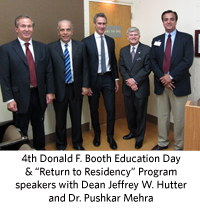
Three world-renowned speakers presented their work on a variety of topics related to the title of each session. The speakers were Drs. Nabil Samman, Alfonso Caiazzo, and Guido Riess.
Approximately 70 people attended including students, faculty, residents, alumni and private practitioners from the local community.
Chair of Oral & Maxillofacial Surgery and Associate Dean for Hospital Affairs Dr. Pushkar Mehra remarked, “Thank you to all who attended this annual event. This program would not be possible without the continued interested and presence of our attendees.” He continued, “I would like to give a special thank you to Residency Program and Credentialing Coordinator Cheryl Flynn who organized this event from start to finish.”
Perkins Award Winners Announced, Yearly Nod to Distinguished Staff Service
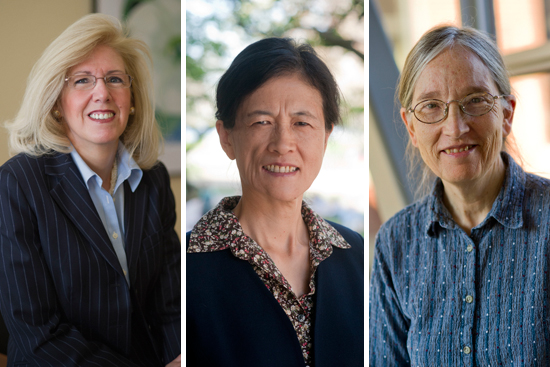
It’s a lot of work to keep and update the academic records of hundreds of medical students. Or to manage biochemistry research laboratories (especially when they’re under major renovation). Or to juggle a marketing campaign, a new software installation, and summer term administration. Three staffers have received one of the annual John S. Perkins Distinguished Service Awards for these efforts.
The winners—School of Medicine registrar Ellen DiFiore, MED biochemistry laboratory manager Celeste Rich, and Metropolitan College assistant finance director Zhuyuan Zhang—will each receive a plaque and $500 at a ceremony May 1.
The Perkins award is BU’s yearly recognition of often-unsung but essential workers at the University. Selected by the Faculty Council from nominations by professors, the awards are financed with an endowment from their namesake, the late John Perkins, a BU trustee, faculty member, and administrator, who endowed the awards.
All three of this year’s recipients were honored “for their professionalism, attention to detail, and their personal commitment to the University,” says Peter Szende, a School of Hospitality Administration associate professor and chair of the Perkins selection committee.
“It is gratifying to know that what you do is valued by the faculty, staff, and students,” says DiFiore, a 23-year BU employee and registrar since 2001. One professor called her “a rare saint and magician” who uses humor and tenacity to manage the herculean job of registering MED students and arranging leaves of absence and scheduling or enrollment changes for them throughout their education. Another prof, who has worked at two other medical schools, lauded DiFiore as the best registrar of the three institutions.
Rich, who manages two labs and also serves on MED’s laboratory safety committee, says the best part of her job “is all the wonderful people I work with in the biochemistry department and the medical school.” As a scientist, she “has the ability to identify, design, and execute key, scientifically relevant experiments,” a colleague reported. “She has the talent to make even the most technically challenging experiments and laboratory procedures look simple.” When the labs were renovated recently, Rich worked many late nights to ensure that essential equipment was up and running, one nominator said, adding, “Probably no other member of the department had the ability or skill to get this done.” Rich has also been at the University for 23 years.
Zhang (MET’04) has worked at MET since 1998. Dean Jay Halfond praised her efforts to implement BUworks, the University’s massive software upgrade, during MET’s busiest season last summer, when the college was immersed in a marketing campaign and its summer term. In addition, Zhang launched a partnership with a Chinese university that has brought 20 full-time undergraduates to MET in the last two years through the college’s international study program.
All of which leads Zhang to say that “working for MET is never boring.”
In a job requiring deft multitasking, the joy comes, she says, “when I can discover or develop new ways of improving efficiencies and the quality of the work I produce.”
The John S. Perkins Distinguished Service Awards will be bestowed at a ceremony on Tuesday, May 1, at 5 p.m. in the Trustee Ballroom, One Silber Way.
This BU Today article was written by Rich Barlow. He can be reached at barlowr@bu.edu.
Winners of GSDM’s 2012 Science Day Honored
The winners of GSDM’s 2012 Science Day were celebrated at a luncheon on April 10. Students who took first place in the pre-doctoral, post-doctoral, and post-doctoral fellow poster and oral presentation categories, and the winner of the ADA/Dentsply Award, were all presented with awards. Their posters decorated the perimeter of the Hiebert Lounge and attendees were once again able to view the winning research.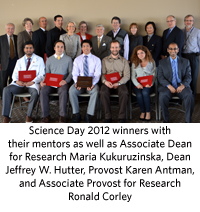
Associate Dean for Research Maria Kukuruzinska and Dean Jeffrey W. Hutter welcomed guests, including BUMC Provost and BUSM Dean Karen Antman, Associate Provost for Research Ronald Corley, and Dentsply International New England Regional Manager of Government & Schools Mr. Joel Montero, to the event.
“This year, the Awards Luncheon honored pre-doctoral and post-doctoral students whom the judges selected for their outstanding presentations at Science Day and the University’s Science and Engineering Day. However, we consider all students who elect to devote extra time to their research projects to be winners. Thus, in a broader sense, the Awards Luncheon is a celebration of scholarship and of our School’s commitment to incorporate research and the discovery of new knowledge into its educational program,” said Dr. Kukuruzinska.
Once the Science Day Awards were presented Dr. Kukuruzinska announced other prestigious research awards that had been won by students in the last year and those students—also in attendance—stood for a moment of recognition and applause.
“I am very pleased to see such a wide variety of research on important oral health topics represented among the winners of the 2012 Science Day,” said Dean Jeffrey W. Hutter. “I hope that their passion for these research topics inspire other dental students to get involved in research and also to have the opportunity to work with such wonderful faculty and staff mentors.”
Photos are available on facebook and flickr .
Submitted by Adrienne Callaghan
BUSM’s Sean Palfrey, MD, FAAP, Named First Massachusetts CDC Childhood Immunization Champion
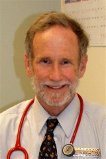
Sean Palfrey, MD, FAAP, professor of Pediatrics and Public Health at BUSM and BUSPH, and Director of the Massachusetts Chapter of the American Academy of Pediatrics (MCAAP) Immunization initiative has been named the first Massachusetts recipient of the 2012 Centers for Disease Control and Prevention (CDC) Childhood Immunization Champion Award. Established this year by the CDC, the Childhood Immunization Champion Award recognizes individuals who make a difference in the lives of infants and children through their work in immunization. Dr. Palfrey was nominated for this award by the Massachusetts Department of Public Health (MDPH).
The selection of Dr. Palfrey was praised by his colleagues. Gregory Hagan, MD, President of the Massachusetts Chapter of the American Academy of Pediatrics, said “Sean exemplifies the spirit of the award by providing community and statewide leadership on immunization issues, and collaborating with others to build support for and increase immunization rates of infants and young children. He has been an invaluable and tireless advocate for the critical role of immunizations in child health.”
Susan Lett, MD, MPH, Medical Director of the Immunization Program at the Massachusetts Department of Public Health, stated that she could not think of anyone in the state, from any discipline, more ideal to be the first recipient of the Immunization Champion award. “Dr. Palfrey is a builder of partnerships and the MCAAP’s Immunization Initiative which he founded more than 15 years ago has been a model forum for bringing together all stakeholders in childhood immunizations. He is a most effective communicator about vaccines, their importance and safety, to parents, other professionals and legislators.”
Dr. Palfrey has been a practicing pediatrician, teacher, mentor and passionate advocate for child health in Massachusetts for the past 35 years. He is a pediatrician and Professor of Clinical Pediatrics and of Public Health at Boston University. He studied received his MD from Columbia College of Physicians and Surgeons, and completed his residency at Tufts New England Medical Center. He has served in many clinical, teaching and administrative roles at the University of Massachusetts, Children's Hospital, Boston, and Boston Medical Center.
“My First Year at JAMA”, Editor-in-Chief Howard Bauchner, MD, Returns to BUMC as Alpert Lecturer
Save the date, May 17! Join Howard C. Bauchner, MD, Editor-in-Chief of JAMA and Scientific Publications and Multimedia Applications as he speaks on “My First Year at JAMA.” Dr. Bauchner was named Editor-in Chief on July 1, 2011, after serving as a faculty member of pediatrics and community health sciences on the Medical Campus for 25 years. He also served as the vice chair of the Department of Pediatrics at BMC/BUSM and assistant dean, alumni affairs and continuing medical education at BUSM.
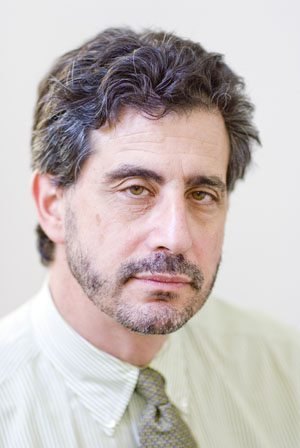
Dr. Bauchner is coming to the Medical Campus as the Joel and Barbara Alpert Lecturer in General Pediatrics. This is the 16th year of the lectureship and the associated fund supports the pilot research of pediatric residents, fellows and junior faculty largely directed at the medical and social needs of children at risk. Click here for information on the fund.
A BUSM alumnus, Dr. Bauchner is the 16th editor in the journal’s 127-year history. As Editor-in-Chief, he has editorial oversight of JAMA and the nine Archives journals, the specialty medical journals published by the AMA.
Dr. Bauchner will speak on Thursday, May 17 at 12:15 p.m. at 670 Albany St., in the Ground Floor Auditorium (lunch will be served).
Dr. Bauchner completed his undergraduate training at the University of California, Berkeley, and graduated from Boston University School of Medicine in 1979. He completed his internship and junior-year residency at Boston City Hospital, his senior-year residency at Yale-New Haven Hospital, and then returned to be Chief Resident at what was then Boston City Hospital. He received additional training in epidemiology and statistics as a Robert Wood Johnson General Pediatrics Academic Development Scholar at Yale-New Haven Hospital and has been on sabbatical twice, first as a Scholar in Residence at the David and Lucile Packard Foundation and then as a Scholar in Residence at the Agency for Healthcare Research and Quality.
Boston University 2012-13 Keyword Initiative, RESILIENCE
Beginning in September, BU students, faculty and staff are invited to participate in a year of creative discussion and action on the theme of RESILIENCE as part of the College of Fine Arts Keyword Initiative. Each year a new keyword is selected and this is the second year of the project.
Resilience is elasticity, buoyancy, and flexibility in the face of adversity. According to Friedrich Wilhelm Nietzsche a 19th-century German philosopher, poet and composer, “That which does not destroy, strengthens.” The BUMC community is encouraged to attend or host activities related to performances or exhibits that comment on different aspects of resilience.
Some activities planned by BU’s Schools of Theatre and Music during the 2012-2013 academic year will explore the theme. These are open to the entire BU community and include performances focused on the legendary, resilient character of Camille, from the Alexandre Dumas novel La Dame aux Camelias, and Violetta, from the opera it inspired, La Traviata. The School of Theater will present a festival of plays by Czech playwright Václav Havel. The School of Visual Arts will lead the second annual “Box Project,” a multidisciplinary exercise in which students create films around the keyword based on objects given them in boxes, which will focus on the intersection of CFA’s schools in relation to the concept of resilience.
For the current 2011-12 Keyword VIOLENCE events, click here. For more information or to get involved in Keyword events, contact Enrique Marquez .
BU Interdisciplinary Student Team Places in Emory Global Health Competition, also Wins Audience Choice Award
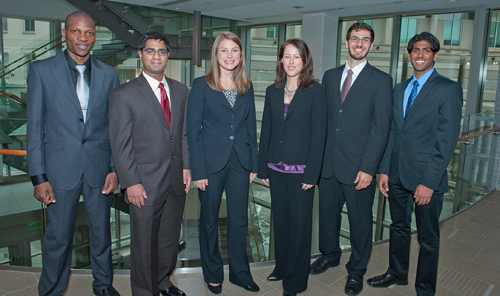
Boston University was well represented at the Emory Global Health Case Competition on March 31. The team of six included a medical student, an MD/MBA student, three MBA/MPH students and a doctoral student in biomedical engineering, placed second out of a roster of 23. This was the first year that BU has participated. The team also won the “Audience Choice Award” voted by their peers in the contest.
The team members were Ivan Busulwa (MBA/MPH’12), Darash Desai (ENG’14), Meg Meyer (MBA/MPH’12), Sunil Nair (MD/MBA’13), Catherine Shih (MBA/MPH’13), and Daniel Silva (MED’15).
The multidisciplinary competition, developed and coordinated by the Emory Global Health Institute’s Student Advisory Committee, includes graduate and undergraduate students from numerous fields including agricultural and life sciences, business, engineering, law, medicine, nursing, public health, theology, the social sciences and the humanities.
The Global Health Contest is designed to raise awareness of and develop innovative solutions for 21st century global health issues. Teams receive a global health-related case that requires an interdisciplinary approach to formulate recommendations that may involve issues such as health care policy, public health implementation and planning, business partnership/investment, medical research, logistics management, faith/cultural understanding, and international law.
The 2012 case had political overtones as well as health and development issues. The question was: “Develop a strategy for Canadian aid to Sri Lanka that deals with the health and resettlement issues of the Tamil population, keeping in mind the resistance of the Sinhalese government to accusations of war crimes and persecution, and recognizing the presence of a great many Tamil refugees in Canada.”
BU Takes On Cancer: Finding Lung Tumors Sooner, Genes and Proteins May Be Early Warning System
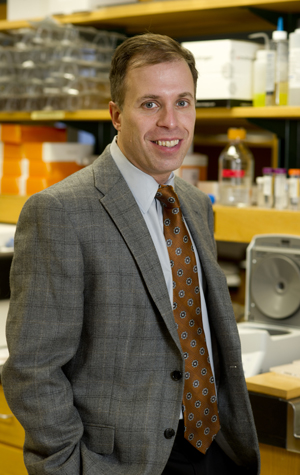
Lung cancer is the deadliest cancer in the United States. According to the National Cancer Institute, it will kill about 160,000 people in 2012, more than the next four cancers combined. Avrum Spira wants to lower these numbers by diagnosing it earlier and preventing its development.
For the last decade, Spira, a School of Medicine professor of medicine, pathology, and bioinformatics and a pulmonologist at Boston Medical Center (BMC), has worked to develop molecular tests that detect lung cancer early. And now, with a $20 million grant from the Department of Defense, he is carrying the research forward as leader of a five-year study called Detecting Early Lung Cancer Among Military Personnel (DECAMP).
“One of the reasons that lung cancer is so deadly is because we rarely find it early, when it’s still treatable,” says Spira. Only 15 percent of people in the United States with lung cancer are diagnosed at stage 1, according to the National Cancer Institute. Compare this to, say, breast cancer, where doctors catch a majority of cases at an early stage. “Lung cancer is well behind the other cancers,” Spira says. “Early diagnosis is where this field needs to be.”
Why is lung cancer so hard to catch? After all, people pay attention to their lungs: if somebody can’t breathe or they start coughing up blood, they usually call a doctor. The problem, according to Spira, is that the lungs are deep within the body, so it’s difficult to collect tissue samples without an invasive procedure. By the time someone has noticeable symptoms, the cancer has usually grown large and spread. Adding to its deadly force, lung cancers are usually very aggressive, often moving quickly to other organs.
In addition, many other lung diseases mimic lung cancer, making it difficult to diagnose. An abnormal finding on a CT scan or a chest X-ray might be lung cancer or it might be pneumonia. The National Cancer Institute’s recently completed National Lung Screening Trial, which did chest CT scans of more than 25,000 high-risk smokers over three years, found that the scans did catch many cancers early, reducing lung cancer mortality, but there was a tradeoff. While 25 percent of current and former smokers showed an abnormality on the CT scan that doctors were concerned might be lung cancer, only 4 percent turned out to be lung cancer. The other 96 percent were false positives.
“This comes at a huge cost for the patient and the health care system,” says Spira, who notes that positive CT scans are often followed by bronchoscopy, more imaging studies, or a lung biopsy, which is an invasive surgical procedure. There had to be a better way. Spira found one.
For years, he says, lung doctors and scientists studying lung cancer have worked with a theory called the “field of injury.” The idea is this: when somebody smokes, they don’t damage just their lungs, they hurt all the cells lining the respiratory tract, from nose to trachea and beyond. Spira thought these epithelial cells lining the windpipe might be able to serve as a surrogate for a tumor hidden deep within the lungs, and like a canary in a coal mine, help identify who is at risk.
Working with colleague Jerome Brody, a MED professor of medicine, Spira began to test his theory nearly a decade ago. While performing bronchoscopies on healthy active smokers and nonsmokers, he took small samples of epithelial cells from brushings of their bronchial airways or windpipes, then compared samples from smokers with those from nonsmokers. “We found a huge number of changes in gene activity in these airway cells among the smokers,” he says. “A bunch of the genes that detoxify cigarette smoke had been turned on.”
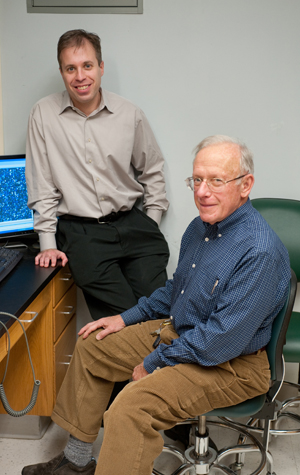
Next, Spira and Brody tested the bronchial airway epithelial cells from current or former smokers who showed an abnormal chest X-ray. Suspecting these patients might have lung cancer, doctors were giving them bronchoscopies as a diagnostic test. Bronchoscopy is a relatively noninvasive test, but is not a foolproof way to detect lung cancer, especially at an early stage. The researchers looked at airway cells that appeared normal under the microscope and found a pattern of activity in 80 genes among those smokers who were ultimately diagnosed with lung cancer. Some of the genes in the biomarker—specifically, some cancer-causing oncogenes—are turned on. Others—genes that help detoxify cigarette smoke—are turned off or dialed down. They realized that these genes could serve as a biomarker, distinguishing smokers diagnosed with lung cancer from smokers diagnosed with other chest diseases. This research, published in Nature Medicine in 2007, created a stir and attracted the attention of industry. With BU’s help, Spira and Brody formed a company called Allegro Diagnostics, Inc., to turn their biomarker, called Brochogen, into a test for early detection of lung cancer. Allegro is currently evaluating the Brochogen test in two large clinical trials in three different countries. Spira hopes the new test will be available to doctors and patients in 12 to 24 months.
Major problem among soldiers and veterans
A follow-up study gained even more attention, landing Spira on NBC Nightly News and the Today show. In this study, Spira and his colleagues looked at genes that belonged to specific signaling pathways in a cell known to be related to cancer development. They found that genes associated with the pi3-kinase (pI3K) pathway, known to play a role in the development of other cancers, were activated in the normal-looking noncancerous bronchial airway cells of smokers with lung cancer and smokers with precancerous anomalies. These results suggested that this pathway may be activated very early in the development of lung cancer and thus could be targeted to prevent its development. Moreover, this particular pathway can be blocked with a compound called myo-inositol, a carbohydrate that appears naturally in many foods, especially cantaloupes and oranges. In a small pilot study with 10 people, the researchers found that in 6 of 10 patients with abnormal, precancerous lung cells who took myo-inositol, the abnormal cells reverted to normal and the pI3K pathway gene activity in the bronchial airway cells reverted back to normal. The finding, published in Science Translational Medicine in 2010, suggests that abnormal patterns of gene activity in the airway cells may appear before cancer develops and be used to guide approaches for cancer prevention among high-risk smokers. Researchers are now testing these findings in a large clinical trial of myo-inositol sponsored by the National Institutes of Health (NIH).
Spira is starting work on the huge DECAMP study. BU is the lead institution on the multicenter study, which involves seven veterans hospitals, four military hospitals, and five additional research institutions.
Lung cancer is a major problem among soldiers and veterans, whose smoking rates are about 50 percent higher than those of civilians. Veterans are 25 to 75 percent more likely to develop lung cancer as nonveterans, according to MED, and combat soldiers are also exposed to other airborne toxins, such as radon, asbestos, and fuel exhaust.
The DECAMP research has two tracks. The first will follow 500 veterans with abnormal but ambiguous CT scans, showing small nodules that may or may not be cancerous. This group will be tested with Spira’s Brochogen test and three other biomarker tests that seem especially promising.
The larger, second section will cast a wider net. It will examine veterans over 55 who have no symptoms of lung cancer, but are at high risk for developing the disease because of past exposure to airborne toxins. Scientists will collect epithelial cells from the airways to look for a wide array of new biomarkers—not just genes, but abnormal proteins as well. “This is more of a discovery effort,” says Spira. “We’ll of course look at the known biomarkers, but we want to be open-minded and look at everything.”
Statistically, within this high-risk group of 1,000 veterans and active military personnel, he expects that about 50 will develop lung cancer by the end of the five-year study. He and his colleagues will then be able to compare the cells of those who developed cancer to those who did not and see what biomarkers pop up as different.
Eventually, Spira hopes to develop a screening test that is sensitive enough that doctors can test cells from a patient’s nose, rather than the airway. “The long-term goal,” he says, “is to develop a simple tool where a doctor can swab your nose, look at the gene activity and say, ‘You’re on your way to getting cancer,’ and then potentially offer treatment to reverse the damage and prevent lung cancer development.” An even bigger achievement would be for other researchers to expand the concept of the “area of injury” to other organs, he says, perhaps testing for liver or pancreatic cancer with a simple blood test rather than an invasive, costly biopsy.
This BU Today story was written by Barbara Moran (COM’96) is a science writer in Brookline, Mass. She can be reached through her website WrittenByBarbaraMoran.com.
BU Dentists Rock Out to Benefit BMC Food Pantry, BUMC Band Makes Guest Appearance
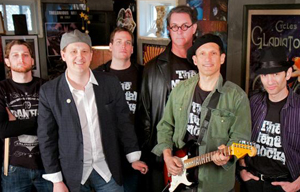
Join The Mental Blocks, a band composed of Henry M. Goldman School of Dental Medicine faculty and students on Saturday, April 28, at a concert to benefit the Boston Medicine Center (BMC) Food Pantry and Demonstration Kitchen. BMC is the only hospital in Boston with a Food Demonstration Kitchen, which promotes nutrition and healthy eating.
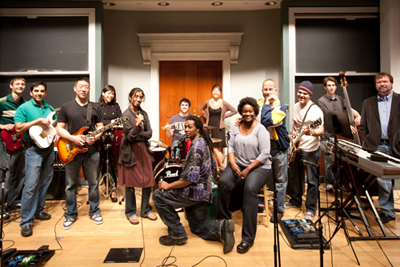
The BUMC Band will be making a special guest appearance at the event, which will be held at 8 p.m. at the BU School of Medicine, Bakst Auditorium. Tickets ($10) are available on Friday, April 13, in the Dental School cafeteria at 100 East Newton Street.
More than 7,500 BMC patients and their family members utilize the BMC Food Pantry each month, obtaining culturally appropriate foods for diets that are nutritious and therapeutic. The pantry relies totally on philanthropy, including food drives and events like the April 28 concert, to keep the shelves stocked. Patients can learn to cook nutritious meals at the Food Demonstration Kitchen, which is located across the hall from the Food Pantry. Classes, which are taught by a trained chef and registered dietitian, educate attendees about nutrition through cooking methods that are compatible with their medical and dietary needs.