Selected Publications on Religion
Books on Religion
 |
Science and the World’s Religions Patrick McNamara and Wesley Wildman (Editors) ABC-CLIO, anticipated publication date is January 2012 |
 |
The Neuroscience of Religious Experience Patrick McNamara Cambridge University Press, 2009 |
| This book is a contribution to the emerging cognitive neuroscientific study of religious experiences and practices. | |
|
|
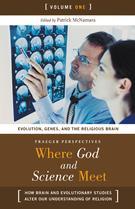
Where God and Science Meet: How Brain and Evolutionary Studies Alter Our Understanding of Religion (3 Volumes) Volume I: Evolution, Genes, and the Religious Brain Volume II: The Neurology of Religious Experience Volume III: The Psychology of Religious Experience Patrick McNamara (Editor) Praeger Publishing, 2006 |
In Press Chapters and Articles
- McNamara, P., & Butler, P. M. (in press). The neuropsychology of religious experience. In R. F. Paloutzian & C. L. Park (Eds.), The handbook of the psychology of religion, 2nd ed. New York: The Guilford Press.
- McNamara, P., & Burns, J. (in press). Religiosity as protective against addictions in adolescents. In A. Browne-Miller (Ed.), Addictions (4 vols.). Westport, CT: Greenwood Press.
Original Articles
- Butler, P. M., McNamara, P., Ghofrani, J., & Durso, R. (2011). Disease-associated differences in religious cognition in patients with Parkinson’s Disease. Journal of Clinical and Experimental Neuropsychology, iFirst, 1-12.
- McNamara, P. (2011). Response to Taves et al. Religion, 41(1), 97-101.
- Butler, P. M., McNamara, P., & Durso, R. (2011). Side of onset in Parkinson’s Disease and alterations in religiosity: Novel behavioral phenotype. Behavioural Neurology, 24(2), 133-141.
- Wildman, W. J., & McNamara, P. (2010). Evaluating reliance on narratives in the psychological study of religious experiences. The International Journal for the Psychology of Religion, 20, 223-254.
- McNamara, P. (2010). The neuroscience of religious experience – A response to the Runyan-Kreitzer review. Christian Scholar’s Review, 39(4), 479-481.
- McNamara, P., Burns, J., Johnson, P., & McCorkle, B. H. (2010). How does religiousness protect against risky health behaviors? Psychology of Religion and Spirituality, 2(1), 30-34.
- Butler, P. M., McNamara, P., & Durso, R. (2010). Deficits in the automatic activation of religious concepts in patients with Parkinson’s disease. Journal of the International Neuropsychological Society, 16(2), 252-261. PMID: 19958570
- Wildman, W., & McNamara, P. (2008). Challenges facing the neurological study of religious behavior, belief and experience. Method & Theory in the Study of Religion, 20, 212-242.
- McNamara, P., Durso, R., & Brown, A. (2006). Religiosity in patients with Parkinson’s disease. Neuropsychiatric Disease & Treatment, 2(3), 341-348.
- McNamara, P., Andresen, J., & Gellard, J. (2003). Relation of religiosity and scores on fluency tests to subjective reports of health in older individuals. The International Journal for the Psychology of Religion, 13(4), 259-271.
- McNamara, P. (2002). The frontal lobes, social intelligence, and religious worship. Ideas for Creative Research in Neurobiology. The John Templeton Foundation (pp. 50-59).
- McNamara, P. (2002). The motivational origins of religious practices. Zygon: A Journal of Science and Religion, 37(1), 143-160.
Book Chapters
- McNamara, P., & Butler, P. M. (2011). De-personalization and the psychobiology of evil. In J. Harold Ellens (Ed.), Explaining evil: Volume I: Definitions and development (pp. 50-63). Praeger, CT: Greenwood Press.
- McNamara, P. (Ed.). (2011). Religious coping strategies in healthy elderly and in those at risk for dementia. In Dementia: Volume 3: Treatments and developments (pp.119-134). Santa Barbara, CA: Praeger Publishers.
- Harris, E., & McNamara, P. (2008). Is religiousness a biocultural adaptation? In J. Bulbulia, R. Sosis, R. Genet, E. Harris, K. Wyman, & C. Genet (Eds.), The evolution of religion: Studies, theories, and critiques (pp. 69-75). Santa Margarita, CA: Collins Foundation Press.
- McNamara, P., & Szent-Imrey, R. (2007). Understanding miracles in relationship to standard religious experiences. In J. H. Ellens (Ed.), The psychology and science of miracle healing: Volume 1: Religious and spiritual events. Westport, CT: Greenwood Press.
- Emmons, R., & McNamara, P. (2006). Sacred emotions and affective neuroscience: Gratitude, costly-signaling, and the brain. In P. McNamara (Ed.), Where God and science meet: How brain and evolutionary studies alter our understanding of religion: Volume I: Evolution, genes, and the religious brain (pp. 11-30). Westport, CT and London: Praeger Perspectives.
- Park, C., & McNamara, P. (2006). Religion, meaning, and the brain. In P. McNamara (Ed.), Where God and science meet: How brain and evolutionary studies alter our understanding of religion: Volume III: The psychology of religious experience (pp. 67-89). Westport, CT and London: Praeger Perspectives.
- Paloutzian, R., Swenson, E., & McNamara, P. (2006). Religious conversion, spiritual transformation, and the neurocognition of meaning making. In P. McNamara (Ed.), Where God and science meet: How brain and evolutionary studies alter our understanding of religion: Volume II: The neurology of religious experience (pp. 151-169). Westport, CT and London: Praeger Perspectives.
- McNamara, P., Durso, R., Brown, A., & Harris, E. (2006). The chemistry of religiosity: Evidence from patients with Parkinson’s disease. In P. McNamara (Ed.), Where God and science meet: How brain and evolutionary studies alter our understanding of religion: VolumeII: The neurology of religious experience (pp. 1-14). Westport, CT and London: Praeger Perspectives.
- McNamara, P. (Ed.). (2006). The frontal lobes, and the evolution of cooperation and religion. In Where God and science meet: How brain and evolutionary studies alter our understanding of religion: Volume II: The neurology of religious experience (pp. 189-204). Westport, CT and London: Praeger Perspectives.
- McNamara, P. (2001). Religion and the frontal lobes. In J. Andresen (Ed.), Religion in mind (pp. 237-256). Cambridge: Cambridge University Press.