Student Updates
Medical Campus Experts Gather to Confer about Zika
NEIDL acquires sample of virus for further study

After weeks of BU researchers trying to procure a sample of Zika virus, the pathogen linked to microcephaly and other neurological syndromes, the vial finally arrived at BU’s National Emerging Infectious Diseases Laboratories (NEIDL) on March 22. NEIDL director Ronald B. Corley, a School of Medicine professor and chair of microbiology, announced the acquisition that day at a BUMC Provost Research Seminar. Zika, like dengue, mumps, and measles, is a Biosafety Level 2 pathogen, defined by the Centers for Disease Control and Prevention (CDC) as an agent that poses “moderate hazards to personnel and the environment.”
The sample was of the strain originally isolated in 1947, and it will allow scientists to grow and propagate the virus for study. The 1947 strain is the precursor to the virus causing the current outbreaks in South America and the Caribbean. Because samples of the modern virus are proving difficult to obtain, scientists at NEIDL will begin their work using the 1947 isolate while using published genetic data to make a clone of the modern Zika strain.
“There’s a real need for us to be doing research on this virus. It’s been seen in Boston and will be again,” said John Connor, a MED associate professor of microbiology and a NEIDL researcher, who acquired the Zika sample from the Biodefense and Emerging Infections Research Resources Repository, a supply house for scientists studying infectious diseases. “Having the virus will allow us to ask important questions, like: what is driving the pathogenesis? How is the virus getting across the placental barrier? What is its replication like in mosquitos?” Connor said. “Without understanding the virus, it’s hard to know how to block it.”
Karen H. Antman, dean of MED and provost of the Medical Campus, began planning the Zika workshop about six weeks ago, when she became aware that people from BU’s medical, dental, and public health schools were all talking about the virus, but not necessarily collaborating. “It’s a rapidly emerging field—we want everyone doing research on this in the same room,” says Antman. “Clinical people have blood specimens, lab people have techniques. We wanted them all talking to each other.”
Zika grabbed the world’s attention in fall 2015 when scientists in Brazil began to suspect a connection between the virus and microcephaly—babies born with small heads and neurological deficits—and also Zika’s possible link to other neurological syndromes like Guillain-Barré. Since January 1, 2007, 59 countries and territories have reported transmission of Zika virus, according to the World Health Organization (WHO), and on February 1, 2016, the WHO declared the cluster of microcephaly cases and other neurological disorders a health emergency. So far, 258 cases have been reported in the United States, all introduced from other countries.

The Research Seminar, which included updates from virologists, epidemiologists, and physicians, revealed what scientists have learned about the virus since the 2015 outbreak in Brazil and how many questions remain.
“Zika is difficult to diagnose; the clinical symptoms are really vague,” Robin Ingalls, a MED associate professor of medicine and microbiology, said during her clinical overview of Zika. Ingalls noted that an estimated 80 percent of people infected with Zika show no symptoms at all. Most people who get sick have a red, pimply rash that Ingalls called “very subtle,” along with other symptoms—like fever, headache, fatigue, and malaise—that overlap with dengue fever and chikungunya, making the disease even more difficult to diagnose.
Lab tests “don’t really make it much easier,” she said. “While we can detect virus in the blood, it is only there for about a week after infection.” After the first week, physicians can order blood tests that measure antibodies specific to Zika. Laboratories are reporting a backlog in these tests, however, with results taking as long as six weeks. Also, the tests can be difficult to interpret because of cross-reactions with similar viruses, like dengue, the patient may have been exposed to.
Many questions about transmission, especially from mother to fetus, remain unanswered, Ingalls said. “How can Zika evade the immune response of placenta? What is the critical time for exposure of the fetus? Is there something unique about Brazil that is increasing the risk of microcephaly?” she asked. “We’re just seeing the tip of the iceberg, and we don’t know what the long-term consequences of infection will be.”
“It appears pretty convincing that Zika is linked to microcephaly,” said Donald M. Thea, a School of Public Health professor of global health and director of the BU Center for Global Health & Development, who spoke on the public health aspects of Zika. “From an epidemiological perspective, the question is, how high is the risk?”
Much of Thea’s talk focused on what scientists know about the transmission of Zika from mosquitos to humans, and from one human to another. He noted that scientists have isolated the virus from 10 species of Aedes mosquito, and from several other mosquito families as well. While Aedes aegypti is the best known, he said, Aedes albopictus—introduced into the United States in 1985—is the most worrisome because of its hardiness and wider range. “If efficient transmission is limited to Aedes aegypti, then the virus shouldn’t get beyond Texas and the southeastern United States,” areas with warm, moist air where that mosquito can thrive, he said. But if Aedes albopictus can spread the disease just as well, larger areas of the world may be exposed.

Thea also explained what scientists currently know about human-to-human transmission. They have found that patients carry low levels of Zika virus in their blood after symptoms begin, but higher levels of the virus in urine, saliva, and semen for a longer time. (Scientists have also found Zika virus in cerebral spinal fluid and in breast milk.) Thea said that the risk of transmission through semen is especially worrisome. “The amount of virus in semen is very high,” he said, noting that the viral count in semen can be 100,000 times higher than that in blood, and that scientists have measured Zika virus in semen as late as 62 days after infection. “A patient’s semen contains virus before the onset of symptoms, but we’re not sure how long the virus remains infectious. We are at the cusp of a really interesting part of the Zika virus investigation.”
Also speaking at the seminar were Davidson Hamer, Athanasios I. Zavras, and Rachel Fearns. Hamer, an SPH professor of global health, explained how the GeoSentinel Network—a clinic-based global surveillance system that focuses on travelers, immigrants, and refugees—allows scientists to detect new infections and disease patterns, all with lab-confirmed diagnoses. He expects to publish preliminary GeoSentinel Network findings on Zika in the coming months. Zavras, a School of Dental Medicine professor and chair of pediatric dentistry, discussed the detection—and possible transmission—of Zika virus through saliva. Fearns, a MED associate professor of microbiology, described mutations in the Zika genome that may be helping the virus replicate, and spread among people, more efficiently.
“Up until about four years ago, proposing to study Zika was a dead end for funding. It wasn’t very prevalent,” Connor said during a discussion panel at the end of the seminar. “It’s only the recent rapid spread and new adverse outcomes associated with infection that have made research to understand this virus a high priority.”
This BU Today story was written by Barbara Moran. She can be reached at bmoran@bu.edu.
April 7 Symposium on Preventing Breast Cancer
 Please join us to change up the conversation about breast cancer. Let’s talk prevention and get in front of breast cancer by focusing more research dollars on identifying what is actually causing it. NPR’s Tom Ashbrook will moderate a panel discussion on shifting priorities toward comprehensive breast cancer prevention with Boston’s leaders in public health and breast cancer research. The event is presented by the Art beCAUSE Breast Cancer Foundation and showcases members of their research consortium from Boston University and Tufts University. All proceeds will directly benefit the Art beCAUSE Breast Cancer Foundation breast cancer consortium labs at BU and Tufts.
Thursday, April 7
5:30-8 p.m.
Charles River Campus, 1 Silber Way, Trustee Ballroom
More information at http://www.bu.edu/investinginprevention/
New Approach Urged in Dealing with Opioid Epidemic
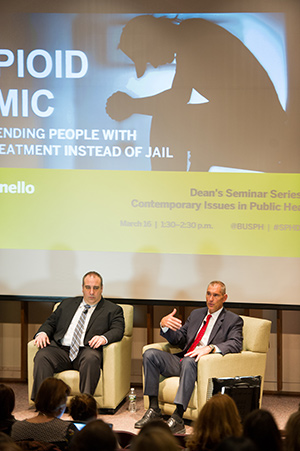
Last summer, Arlington, Mass., chief of police Frederick Ryan was briefed on a plan to arrest a major heroin supplier. “I asked some very simple questions,” he recalled. “Do we know the identities of those buying their heroin from this dealer? The answer was yes.
“The follow-up question was, what are we doing to get these people services?” he said. “The answer was: nothing.”
Ryan realized his department was about to create a public health crisis by suddenly leaving a known population of addicted people without their supply. This, he explained, was when he knew his police department needed to try a new approach.
He discussed that shift in thinking at Wednesday’s School of Public Health seminar The Opioid Epidemic: Why Cops Are Sending People with Addiction to Treatment Instead of Jail, the latest in the Dean’s Seminar Series on Contemporary Issues in Public Health.
Ryan joined another Massachusetts police chief, Leonard Campanello (MET’05), of Gloucester, whose department launched the Gloucester Angel Initiative last June. The program approaches addiction as a disease instead of a crime, and has influenced the Arlington police department and dozens of others. As well as garnering national headlines, it was the subject of a CBS 60 Minutes segment in December 2015.
Soon after, Campanello also founded the Police Assisted Addiction and Recovery Initiative to support the Gloucester program and others like it.
With 88 police departments in 22 states now taking similar approaches, Campanello and Ryan “are the leaders of a rapidly growing movement,” said David Rosenbloom, an SPH professor and interim chair of health law, policy, and management, as he introduced the two.
Since the Angel Initiative began, Rosenbloom and colleagues from SPH and the School of Medicine have been working with the Gloucester department, monitoring the program to see if—and how well—it really works.
Rosenbloom began the seminar by handing the microphone off to colleague Davida Schiff (MED’12), a MED instructor and general pediatrics fellow, to present their research findings: from June 1, 2015, to February 15, 2016, 352 people walked into the Gloucester police department asking for treatment. They came from all over the state, and 80 percent had been in treatment before.
The BU researchers have begun following up with past participants in the program, said Schiff, adding that out of the 47 contacted so far, 35 (or 74 percent) are not currently using opioids. “The numbers don’t do it justice,” Schiff cautioned. “The stories of their time through their treatment, the arc of their treatment, with relapse, with struggles to stay clean, is more telling.”
With that in mind, Rosenbloom, Campanello, and Ryan talked about the seminar’s central question: Why would, or should, police departments take on this role in the face of the growing opioid epidemic?
For Campanello, the new approach came from listening to the community he had sworn to serve. “What the community was saying was, ‘We don’t want you arresting people with this disease anymore if you don’t have to.’ Seeing death in large numbers led to this change.”
Social media proved an effective way to communicate the department’s new approach. Campanello shared the plan on Facebook: “Any addict who walks into the police station with the remainder of their drug equipment (needles, etc.) or drugs and asks for help will NOT be charged. Instead we will walk them through the system toward detox and recovery.”
That post soon had 2.5 million hits and was shared 30,000 times in every state and in 61 countries. “When you have Uzbekistan reading the Facebook post of a little North Shore city,” Campanello told the audience, “you get a very, very clear picture of how important this issue is to so many people.”
Soon after, the Arlington police department began outreach to people known to be addicted to opioids. The department had a clinician available to help create treatment plans for them and their families.
The Gloucester and Arlington models are now being adopted around the country.
What makes these approaches different from earlier efforts to get people into treatment within the court system, Campanello said, has to do with stigma. “We’re very anticoercion, anti-incentive, for this disease,” he explained. If even the threat of losing child custody doesn’t work, he said, “how is a charge of possession of an illegal substance going to incentivize someone to give up their disease?”
Stigma is the major challenge here, Ryan concurred, even when it comes to implementing these kinds of programs. He described how for decades police have offered not to charge a drug user if they identified their dealer. “That’s discretion,” he said. “We now apply that very same discretion, ‘You go into treatment and I won’t charge you with a crime,’ and prosecutors are saying, ‘I’m not so sure you have the authority.’”
The other major challenge in dealing with the opioid epidemic, both agreed, is a broader system that is full of holes. “What is so cockamamy,” Rosenbloom asked, “so opaque, about getting help for the disease of addiction that people are flocking to police stations, where they could be arrested?”
Ryan’s answer: “We’re now dispatching a clinician to an overdose in the ER.” His department has seen people brought into the emergency room after overdosing, released, and then fatally overdosing just hours later, he said.
Police, as newcomers to the treatment field, are able to bring a level of optimism and creativity to the problem, Campanello added, along with the clout to help move someone through a complex and confusing system. “We ask very three-year-old-like questions,” he said, “which always begin with, ‘Why?’”
Throughout the event, both police chiefs returned again and again to the idea at the heart of their programs: police should serve their communities. With public opinion of police far less positive in recent years, “it remains the police department’s responsibility to rebuild that trust,” Campanello said.
“There’s no achievement in this whatsoever,” he added. “This is a responsibility. This is what we’re supposed to be doing. We’re supposed to be helping people, especially people with a disease, and if that means thinking outside the box, then that too is a responsibility.”
This BU Today story was written by Michelle Samuels.
BU-CTSI Translational Research Symposium, March 28
Boston University Clinical and Translational Science Institute (BU-CTSI)
Fifth Annual Translational Research Symposium
In Memory of David C. Seldin, MD, PhD (1957-2015)
Monday, March 28
Charles River Campus , 775 Commonwealth Ave.,
George Sherman Union, Metcalf Hall
Keynote Speakers
Jeffrey W. Kelly, PhD
Lita Annenberg Hazen Professor of Chemistry
Chairman, Department of Molecular and Experimental Medicine
The Scripps Research Institute
Robert A. Stern, PhD
Professor of Neurology, Neurosurgery and Anatomy & Neurobiology
Director, Clinical Core, Alzheimer's Disease and CTE Center
Boston University School of Medicine
Ann C. McKee, MD
Professor of Neurology & Pathology
Director, Neuropathology Core, Alzheimer’s Disease Center
Boston University School of Medicine
More information including a detailed agenda and registration
Questions? Contact: ctsiadmin@bu.edu
Sponsored by: The Boston University Clinical and Translational Science Institute
The Politics of Access: The Impact of U.S. Government Policies on Pharmaceutical Markets and Public Health
Join Boston University School of Public Health students, colleagues, alumni, and affiliates for the BUSPH Pharmaceuticals Program's 5th Annual Symposium,
The Politics of Access: The Impact of U.S. Government Policies on Pharmaceutical Markets and Public Health
The event will include a panel of professionals from across the board who are making an impact in the field of pharmaceutical access. An alumni luncheon before the program and concluding reception will provide attendees with the chance to reconnect, network, and learn from one another.
RSVP for the event via Eventbrite by 5 p.m. Friday, March 18. Professional Dress requested for all attendees.
Keynote Address
BU Alumnus, Dr. Howard Koh
Former U.S. Assistant Secretary for Health, U.S. Department of Health and Human Services;
Harvey V. Fineberg Professor of the Practice of Public Health Leadership, Harvard T. H. Chan School of Public Health and Harvard Kennedy School;
Former Commissioner of Public Health for the Commonwealth of Massachusetts
Panel includes
- Robert Coughlin, President, MassBio
- Pamela Gavin, COO, National Organization of Rare Disorders
- Dr. David Jones, Assistant Professor, BU School of Public Health
- Lora Pellegrini, President and CEO, Massachusetts Association of Health Plans
- David Seltz, Executive Director, Massachusetts Health Policy Commission
Moderated by Dr. Susan Windham-Bannister, former President and CEO of Mass Life Sciences Center
For more information on each of our panelists, please visit the Pharmaceuticals Program website.
Date: Friday, March 25, 2016
Time: Program 1- 5 p.m.
Networking reception 5- 6 p.m.
Location: BUSM Instructional Building, Hiebert Lounge
March 23 Cathy Shine Lecture 2016
Barely Covered: Underinsurance and Its Impact on Access to Care
Emily Friedman
Independent Health Policy and Ethics Analyst

March 23, 2016
Noon-1 p.m.
BUSM Instructional Building
Hiebert Lounge
Live-Streaming Available During Event
Emily Friedman is an independent writer, lecturer, photographer, and health policy and ethics analyst based in Chicago. She is contributing editor of Hospitals & Health Networks and contributing writer for the Journal of the American Medical Association, Health Progress, and other periodicals. Friedman also writes a regular column for Hospitals & Health Networks Daily. She is most noted for her work in health policy, health care reform initiatives, rationing of health services, health care trends, insurance and coverage issues, the social ethics of health care, ethics issues for providers and leaders, care for the underserved, population health improvement, health care history, population demographics and their implications for health care, the lessons to be learned from international health care systems, and the relationship of society with its health care system.
Friedman has written more than 800 articles and editorials in the past 38 years. She is the editor of the books Making Choices: Ethics Issues for Health Care Professionals (American Hospital Publishing, 1986), Choices and Conflict: Explorations in Health Care Ethics (American Hospital Publishing, 1992), and An Unfinished Revolution: Women and Health Care in America (United Hospital Fund of New York, 1994). She authored The Aloha Way: Health Care Structure and Finance in Hawaii (Hawaii Medical Service Association, 1993) and The Right Thing: Ten Years of Ethics Columns from the Healthcare Forum Journal (Jossey-Bass, 1996). She has also written on health care for the World Book Encyclopedia Yearbook and the Encyclopedia of Bioethics. Among her current projects are a history of health care in the state of Minnesota; a long-term study on the rebuilding of the Cambodian health care system after its destruction in the 1970s; and an examination of attacks on hospitals, their staffs, and their patients around the world.
A prolific public speaker, she addresses audiences ranging from state legislators to allied health professionals to nursing and medical groups to community representatives to hospital and health system leaders and health care associations. She has also lectured at many universities, including Harvard, Princeton, the University of California–Berkeley, the University of California–San Diego, Ohio State, Yale, and the University of North Carolina–Chapel Hill. In 1987-1988, she was the Rockefeller Fellow in Ethics at Dartmouth College. She also serves as an adjunct assistant professor in the Department of Health Law, Policy, and Human Rights at SPH, which has repeatedly named her one of its highest-rated teachers She is a consultant on information dissemination to the Agency for Health Care Research and Quality, U.S. Department of Health and Human Services.
She has made numerous radio and television appearances, including on “ABC News Nightline” and National Public Radio shows.
She has won many awards and honors, including being named an honorary life member of the American Hospital Association, an honorary life member of the American Medical Association, a Fellow of Academy Health (formerly the Association for Health Services Research), and an honorary lifetime fellow of the American Academy of Medical Administrators. She has also received the Corning Award of the Society for Health Care Strategy and Market Development and the first Pioneer Award of the Colorado Hospital Association.
In addition, she has won many writing awards. In 2003, her column, “Making Choices,” in Health Forum Journal, won a National Award of Excellence from the American Society of Business Publication Editors (the largest competition in US business publishing), and the Gold Award from the American Society of Healthcare Publication Editors (the highest award that the Association grants).
In 2002, 2004, and again in 2006, the readers of Modern Healthcare named her as one of the 100 most powerful people in the health care field. In April 2005, the editors of Modern Healthcare chose her as one of the “Top 25 Women in Healthcare.” In January 2011, 2012, and again in 2014, she was named one of the “Top Five Speakers in Health Care” by Speaking.com.
She is an avid photographer with several record album and CD covers to her credit. Her other hobbies include writing poetry, ethnic cooking, hiking, and support and preservation of traditional folk music and culture.
Friedman is originally from Los Angeles. In l968 she received a BA degree in English, with honors, from the University of California–Berkeley.
(source http://www.emilyfriedman.com/)
March 24 Grant Preparation Workshop
Grant Preparation Workshop – Part 1: Administrative Presentation
Medical Campus Investigators, graduate students and faculty members are invited to a grant preparation workshop on Thursday, March 24 to learn more about the process of submitting individual research grants (R01) to the National Institutes of Health (NIH). Presentations will be given by staff from the Office of Sponsored Programs and the Office of Proposal Development. In this session Dr. Carter Cornwall will also discuss the NIH study section review and a general structure to follow when writing your grant.
Part 1: Administrative Presentation
- Thursday, March 24
- 2-4 p.m.
- BUSM Housman Building, R115
Grant Preparation Workshop – Part 2: Grant Critiques
The second part of this series includes a small group session, where investigators will present drafts of their actual grant applications for feedback from peers and faculty who have successfully been awarded grants and served on NIH study sections. This session will be especially helpful to those who plan to submit NIH grants for the June/July submission cycle.
Part 2: Grant Critiques
- Monday and Tuesday, May 9 and 10
- Location and time to be determined
Interested investigators, graduate students and faculty members are invited to attend the March 24 session. For a more thorough critique of your grant in May, you must attend this first session. You are not obligated to participate in the critique if you attend the administrative portion.
If you have any questions, please contact Renna Lilly, Office of Proposal Development, at rolilly@bu.edu.
Submit Works for BUMC Art Days
ART DAYS 2016
Monday-Tuesday, April 4-5
Hiebert Lounge
All students, faculty and staff from all BUMC schools are encouraged to submit artwork of any medium to the 26th annual Boston University Medical Campus gallery for the arts, sponsored by the Provost's office. "Art Days" was begun by then BUSM Dean and later BUMC Provost Chobanian to foster the support and growth of the creative arts at BUMC. It has been very successful and has shown work from students, faculty and staff and family members. The exhibition is mounted by the Creative Arts Society.
To be placed on the "submit list" or if you have any questions please contact: Keith Tornheim, PhD, 638-8296, tornheim@bu.edu
On April 1, we will accept paintings, photos, poetry, sculpture, needlework, etc. Pieces should be framed if possible. Security will be provided. Works will be returned April 6. Specific instructions will be sent at a later date to those who respond Dr. Tornheim.
3/22 BUMC Provost Research Seminar: Zika Virus
Tuesday, March 22, 3-5 p.m., Hiebert Lounge
Open to faculty, students and staff
Welcome
Karen H. Antman, MD
BUSM Dean and BUMC Provost
Ronald B. Corley, PhD
Professor and Chair, Department of Microbiology, BUSM
Director, National Emerging Infectious Diseases Laboratories
Basic Virology
Rachel Fearns, PhD
Associate Professor of Microbiology, BUSM
“Zika Virus Biology: Genetic and Phenotypic Differences Between Old World and New World Zika Virus Strains”
What We Know Clinically
Robin Ingalls, MD
Associate Professor, Medicine and Microbiology, BUSM
Topic: TBD
Athanasios I. Zavras, DDS, DMD, DScM
Professor and Chair, Department of Pediatric Dentistry, GSDM
“Zika Virus Related Concerns in Dentistry (salivary transmission of the virus)”
Public Health Aspects
Davidson Hamer, MD
Professor, Global Health, BUSPH
Professor, Medicine, BUSM
“Travel-associated Zika Virus Infection: Preliminary GeoSentinel Network Results”
Donald M. Thea, MD, MSc
Professor, Department of Global Health, BUSPH
Director, Center for Global Health and Development, BUSPH
Director, MD/MPH Program
“Zika – Epidemiology, Transmission and Population Risk”
Presentations followed by panel discussion with additional experts.
March 7 Team Science Workshop
“Ways to and Opportunities for Team Science at BU"
Junior Faculty are particularly invited to attend this luncheon meeting
- Monday, March 7
- Noon-1 p.m.
- Evans Building, Wilkins Board Room, Room 108
Presenters: Drs. Katya Ravid, Francesca Seta, and David Center
Hosts: Clinical & Translational Science Institute (BU-CTSI) and Evans Center in collaboration with the office of Faculty Development
RSVP by Tuesday, March 1 to Robin MacDonald, remac@bu.edu