Congratulations to Sarnoff Research Fellowship Recipient, Camille Shantz
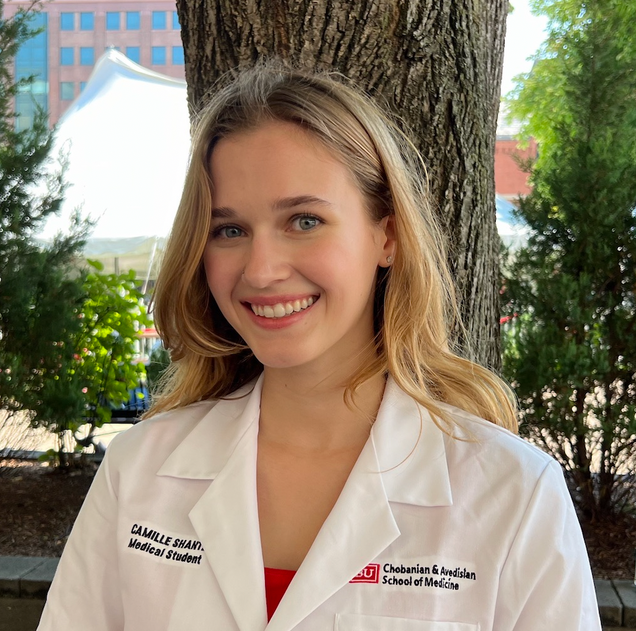
Congratulations to Camille Shantz on her placement at Stanford University as a Sarnoff Fellow, supported by the Sarnoff Cardiovascalar Research Foundation! While at Stanford, she will join the Marsden Lab, primarily working with Dr. Alexander Kaiser. Camille will work in a translational research lab that uses computational modeling to study blood flow in the cardiovascular system and address problems clinically relevant to congenital heart surgeons. Blood flow involves complex forces like pressure and turbulence that influence how the heart, blood vessels, and valves function over time. By simulating these dynamics, we can better understand disease progression and support more precise, patient-specific treatments.
In joining Dr. Kaiser’s Cardiovascular Biomechanics Computation Lab at Stanford University, Camille will also be mentored by postdoctoral scholar Dr. Karoline Marie Bornemann, and they will work closely with Dr. Michael Ma’s congenital heart surgery lab. Camille is also being supported by her Sarnoff Foundation Fellowship advisor, Dr. Karol Watson at UCLA, and her sponsor at Boston University, Dr. Ellen Cooper.
Camille’s interest in this field stems from a longstanding love of math and problem-solving. As she became involved in medical research, she found that same intellectual satisfaction in studying cardiovascular physiology, particularly in understanding the mechanisms underlying disease to optimize treatment. During her early research at the Center for Fetal Therapy at Johns Hopkins, Camille was introduced to the complexity of diagnosing heart disease before birth through prenatal echocardiography. She later worked with congenital heart surgeon Danielle Gottlieb Sen on a project using computational fluid dynamics to study how pulmonary valve replacement angle in Tetralogy of Fallot may impact long-term durability. Through this experience, she saw how mathematical modeling could directly inform clinical care, solidifying my interest in this work.
Through her research, she has developed a deeper appreciation for the complexity of congenital heart disease. She reflects on how, despite advances in pediatric cardiac surgery that have extended patient survival into adulthood, many individuals still face evolving cardiovascular challenges. Her work with computational modeling has shown her the potential of these tools to illuminate each patient’s unique physiological profile and guide more targeted interventions. She looks toward a future where such technology becomes integral to clinical decision-making and treatment planning.